
Points of interest…
- MSW-level licensure unlocks independent clinical grief diagnosis and insurance billing.
- Healthcare social workers earn a national median near $62,000 annually.
- Stackable certifications like Kessler and Good Grief formalize grief expertise post-licensure.
Grief Support Social Work: A Growing Clinical Niche
A master's degree in social work is the baseline credential for most clinical grief and loss roles; licensed clinical social workers can diagnose, treat, and bill independently. Grief-specific certifications, including the David Kessler Grief Educator Certification and Good Grief training, now differentiate practitioners across medical social work careers in hospice, palliative care, and school-based bereavement programs.
BSW-level support roles exist in group and case management settings; MSW-level practice opens individual counseling and private practice, widening the salary spread with clinical social work licensure. Demand for social workers is shifting fastest in hospice, palliative, and school settings, where structured grief intervention has moved from volunteer-led support to credentialed clinical work.
What Does a Grief and Loss Social Worker Do?
A master's degree in social work is the baseline credential for most clinical grief support roles, and licensed clinical social workers can diagnose mental health conditions, create treatment plans, and bill insurance independently.
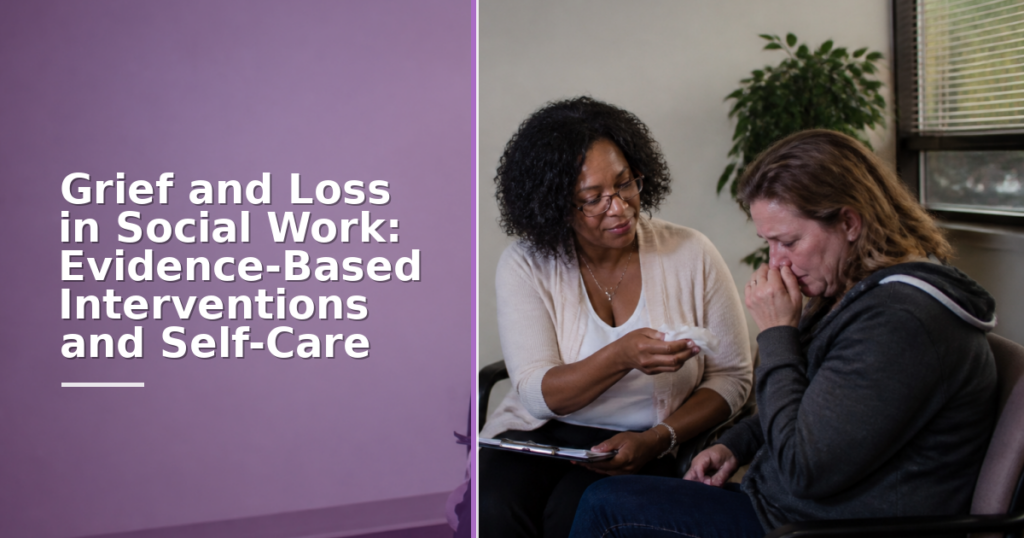
Grief and loss social workers conduct biopsychosocial assessments, screen for complicated grief and depression, provide individual and group bereavement support, coordinate with hospice teams, schools, and medical providers, and step in during crises like suicidal ideation or sudden loss. They also help families access concrete resources: funeral assistance, survivor benefits, childcare, and grief camps.
How This Role Differs from Grief Counselors and Chaplains
Grief counselors may hold certificates but often lack the licensed clinical training to assess trauma or coordinate complex systems. Chaplains provide spiritual care. Social workers bring case management training, mental health diagnosis, and a biopsychosocial perspective, addressing housing, income, safety, and family dynamics alongside emotional processing.
Where the Work Happens
Typical caseload settings include hospice, hospital palliative care units, school bereavement programs, community agencies, and employee assistance programs. In hospice, healthcare social workers support families before and after death. In schools, school social workers run lunch groups and classroom interventions. In community agencies, they facilitate adult peer groups, including faith-based grief support.
Scope of Practice by License
An LSW or LMSW often works under clinical supervision, providing support, case management, and group facilitation. An LCSW can independently diagnose and treat grief-related disorders and receive insurance reimbursement. A master's-level credential plus grief certification builds specialization, but independent clinical work still depends on the highest license held.
BSW Vs. MSW: Which Path Fits a Grief Specialization?
The real tradeoff isn't BSW versus MSW as credentials but scope of practice: how much grief work you want to do independently, and if you are prepared to spend two more years in school to do it.
What a BSW Qualifies You For
A bachelor's in social work prepares you for bereavement-adjacent roles: hospice intake, case management, discharge planning, and co-facilitating grief support groups under supervision. BSW-level interns show up regularly in hospice field placement rosters, including Avow Hospice's bereavement department1 and Heart of Georgia Hospice2, both of which accept BSW students alongside MSW candidates. What a BSW does not qualify you for is independent clinical grief counseling: diagnosing complicated grief, running individual therapy, or billing insurance for mental health services.
Why MSW Plus LCSW Is the Clinical Threshold
To do that work, you generally need a master's in social work followed by clinical social work licensure (LCSW). Licensure is what allows a grief specialist to diagnose prolonged grief disorder, provide reimbursable individual therapy, and practice with less oversight. Programs like the University of New England structure MSW field placements specifically around death and dying4, giving students supervised hours in hospice and grief settings before they ever sit for a licensing exam.
The Pathway in Practice
The sequence looks like this: BSW field placement (often case management or group co-facilitation at an agency like Gulfside Hospice3, supervised by an LCSW or MSW), then an MSW program with a hospice or palliative practicum, such as those at Northern Arizona University that route students into independent hospice agencies5. Some MSW placements, like Hospice of Southern Maine6, pair weekly clinical supervision from a licensed clinician with daily guidance from a bereavement program manager, a structure that mirrors what post-graduate social work training looks like. After the degree comes supervised hours toward LCSW licensure, requiring MSW clinical hours tracking. Certifications in grief-specific models (covered in the next section) layer on top of that license, they don't substitute for it.
Bottom Line
If you want to run support groups and manage cases, a BSW plus agency training may be enough. If you want to sit across from a grieving client one-on-one and bill for it, plan on the full BSW-to-MSW-to-LCSW arc.
The Career Ladder From BSW to Grief Specialist
Building a grief specialization in social work is a cumulative process. Each credential opens new practice settings, clinical responsibilities, and earning potential. The pathway below outlines a generic sequence that applies across states, though specific licensure titles and supervised-hour requirements vary by jurisdiction.

Questions to Ask Yourself
Do you want to provide individual grief counseling and bill insurance?
Reimbursable clinical counseling requires an MSW plus state clinical licensure (LCSW). If billing private insurance or Medicare for one-on-one bereavement therapy is your endgame, a BSW alone will not get you there.
Are you drawn to case management, hospice coordination, or group facilitation?
BSW-level roles in hospice, hospitals, and community bereavement programs open immediately after graduation and let you run support groups, coordinate resources, and work directly with grieving families under clinical supervision.
Is graduate school feasible now, or should you build experience first?
An MSW typically costs two years and tens of thousands of dollars. Working a BSW-level bereavement job first can clarify your specialization, generate tuition savings, and often unlock advanced-standing MSW tracks that finish in one year.
Settings That Hire Grief Support Social Workers
Grief support social workers practice across a wide range of clinical, community, and institutional settings. The table below outlines the most common environments where grief specialists are employed, along with the roles they fill and the credentials typically expected. Understanding these distinctions can help you target your education, licensure, and certification toward the setting that fits your career goals.
| Setting | Typical Employer | Grief Social Worker's Role | Degree/License Typically Required |
|---|---|---|---|
| Hospice and Palliative Care | Hospice agencies, hospital palliative care units, home health organizations | Provide psychosocial assessments, anticipatory grief counseling, and bereavement follow-up for patients and families; coordinate with interdisciplinary care teams | MSW with state clinical license (LCSW or equivalent); hospice experience preferred |
| Hospitals and Medical Centers | Acute care hospitals, oncology centers, trauma units | Support patients and families facing terminal diagnoses, sudden loss, or complicated grief reactions; facilitate discharge planning that includes grief resources | MSW with clinical license; medical social work experience valued |
| Child Welfare and Family Services | State agencies such as DCPP (formerly DYFS), county child protective services offices | Address grief and loss experienced by children and families involved in the child welfare system, including parental loss, foster care transitions, and family separation | BSW or MSW; state licensure at appropriate level (LSW or LCSW) |
| Faith-Based and Community Organizations | Churches, synagogues, mosques, community nonprofits, organizations like Good Grief | Facilitate grief support groups for adults and teens, train peer facilitators, and connect community members with clinical resources when needed | BSW or MSW; grief-specific certifications (e.g., David Kessler Grief Education Certification) strengthen credibility |
| Schools and Youth Programs | Public and private school districts, youth ministry centers, after-school programs | Run developmentally appropriate grief groups, provide individual support to bereaved students, and train staff on recognizing grief responses in children and adolescents | BSW or MSW with school social work credential or licensure; experience in adolescent development |
| Private Practice | Self-employed or group practice settings | Offer individual grief counseling, couples therapy after loss, and specialized programming such as podcasts or workshops on bereavement topics | MSW with independent clinical license (LCSW or equivalent); business licensure as required by state |
| Funeral Homes and Aftercare Programs | Funeral service providers, memorial societies | Deliver post-funeral bereavement check-ins, facilitate survivor support groups, and provide referrals to longer-term clinical care | BSW or MSW; grief counseling certification recommended |
| Veterans Affairs and Military Settings | VA medical centers, military family support programs, veterans' service organizations | Address combat-related grief, survivor guilt, and complicated bereavement among service members and their families | MSW with clinical license; familiarity with military culture and trauma-informed practice |
Grief Social Work Certifications and Continuing Education
Several credentials can help social workers formalize grief expertise, but they differ sharply in scope, cost, and the type of continuing education credit they yield. The table below compares the most widely referenced options as of 2026. Note that costs and CE credit structures can change, so verify details directly with each provider before enrolling. Some programs listed are primarily coaching or education credentials rather than clinical certifications, so social workers should confirm that any hours earned will be accepted by their state licensing board.
| Certification | Provider | Format | Approx. Cost | CE Credit |
|---|---|---|---|---|
| David Kessler Grief Educator Certification | David Kessler Training / Grief.com | Cohort-based online program (e.g., Fall 2026 cohort: Sept. 29 to Dec. 15) | Not publicly listed (contact provider) | Not specified; confirm with provider whether hours satisfy state social work CE requirements |
| David Kessler on Grief Healing for Mind, Body and Spirit | PESI, Inc. | Online, self-paced digital seminar | $141 | 11.5 hours |
| Certified in Thanatology (CT) | Association for Death Education and Counseling (ADEC) | Application plus proctored exam | $380 (ADEC member fee, includes exam and first three-year cycle) | 45 hours required every three years for renewal |
| Grief Counseling Certification | American Institute of Health Care Professionals / American Academy of Grief Counseling | Qualifying coursework (largely online/self-study) plus application | $220 certification fee for a four-year term (course tuition is separate) | N/A |
| Board Certified Grief Coach (BCGC) | Independent Board for Grief Coaching (INBGC) | Board certification based on documented education, practice hours, and proctored exam | $3,750 (pay-in-full certification path) | 30 hours across a rolling three-year renewal cycle |
| Good Grief Festival: When Grief is Complicated | Good Grief Festival | Live online session with six months of recorded access | Approximately £45 (GBP) | N/A |
| Grief 101: Good Grief Webinar | Behavioral Health Training and Education Network (BHTEN) | Live webinar | Not listed | 2.5 hours |
Related Articles
Assessment Tools and Evidence-Based Intervention Models
Grief work is not one-size-fits-all comfort. Effective practice starts with distinguishing normal grief from complicated or prolonged grief disorder, and social workers rely on standardized screening tools to make that call. Instruments such as the Inventory of Complicated Grief and formal prolonged grief disorder screeners help clinicians flag clients whose mourning has stalled into functional impairment, guiding whether a referral, higher level of care, or specialized treatment plan is warranted.
Frameworks Social Workers Draw On
Beyond screening, grief specialists apply established social work practice models rather than improvising support. Common frameworks include:
- Dual process model: Helps clients oscillate between confronting loss and restoring daily functioning, rather than pushing straight through grief in a linear stage model.
- Meaning reconstruction: Centers on helping clients rebuild identity and narrative after loss, particularly useful for sudden or traumatic deaths.
- Complicated and prolonged grief treatment protocols: Structured, often time-limited approaches for clients whose grief has not eased with standard support.
These are treatment frameworks, not casual talking points, and applying them correctly requires clinical training.
Why This Is an MSW-Level Function
As noted earlier when weighing a BSW versus MSW path, formal assessment and treatment planning sit squarely at the MSW and licensed clinical social worker level. A BSW-level professional can absolutely provide grief support, psychoeducation, and group facilitation, but diagnosing complicated grief, selecting an intervention model, and building a treatment plan around it typically requires the clinical training, supervised hours, and licensure that come with an MSW and post-graduate credentialing.
This section intentionally stays at the overview level. If you want protocol-level detail, session structures, and how to apply these models step by step with clients, that belongs to a deeper clinical resource elsewhere on mastersinsocialworkonline.org built specifically for practitioners ready to move from theory into direct intervention work.
Grief Social Worker Salary and Job Outlook
No federal labor category tracks grief or bereavement social workers separately, so the figures below use the closest Bureau of Labor Statistics classifications as proxies. Healthcare social workers, the category that includes hospice and palliative care roles, earn a national median of $67,880 and are projected to grow nearly 10 percent over the current decade, well above the rate for all occupations. The broader health care and social assistance sector is expected to account for roughly 45 percent of all job gains through 2032, underscoring steady demand for social workers who specialize in end-of-life and grief-related services. Industry organizations have also flagged critical staffing shortages among hospice interdisciplinary teams, including social workers, which may push compensation higher in the years ahead.
| Occupation (BLS Category) | Total National Employment | 25th Percentile Salary | Median Salary | Mean Salary | 75th Percentile Salary | Projected Job Growth (2022 to 2032) | Estimated Annual Openings |
|---|---|---|---|---|---|---|---|
| Healthcare Social Workers (SOC 21-1022) | 187,630 | $56,710 | $67,880 | $71,790 | $82,240 | 9.6% (about 18,400 new positions) | N/A |
| Mental Health and Substance Abuse Social Workers (SOC 21-1023) | 132,810 | $47,070 | $60,280 | $68,030 | $79,730 | N/A | N/A |
| All Social Workers (combined) | N/A | N/A | N/A | N/A | N/A | 7% | 63,800 |
Questions to Ask Yourself
Do you need the stability of a steady paycheck and benefits, or does the appeal of building your own client base outweigh that security?
Hospice, hospital, and agency roles offer predictable salary, health insurance, and retirement contributions, while independent practice trades that stability for control over caseload, hours, and specialization.
Are you prepared to handle the licensure, liability insurance, and business setup that independent practice demands?
Solo practitioners must secure clinical licensure, malpractice coverage, billing systems, and often an LLC, none of which an employer arranges for you.
Would a hybrid model, agency work paired with a part-time faith-based or community grief group, better match your goals?
Many grief specialists keep a salaried position for income and benefits while running a volunteer or low-fee support group on evenings or weekends to build clinical experience and community ties.
How much income variability can you realistically absorb while a private caseload grows?
New private-practice grief counselors often see thin referrals in the first year, so weigh savings, a working spouse's income, or part-time agency hours against the slower ramp-up of self-employment.
From Public-Sector Career to Grief Specialist: A Case Study
Maria Ojeda Pasterchick's career shows exactly how a public-sector MSW can convert decades of frontline experience and personal loss into a credentialed grief specialization after retirement. Her path, documented in the West Milford Messenger's Oak Ridge woman turns personal loss into grief support feature, is a working template for social workers considering a Social Work Career Change.
A Long Public-Sector Foundation
Pasterchick spent her career with New Jersey's Division of Youth and Family Services (DYFS), now the Division of Child Protection and Permanency (DCPP), rotating through multiple offices and positions before retiring in 2021 as local office manager of the Morris East office. She originally planned to work in early childhood education, but a student internship at DYFS redirected her toward therapeutic helping work, a common origin story for MSWs whose field placements reshape their trajectory.
Decades of child-welfare casework and supervisory practice gave her the clinical assessment, crisis-response, and program-management skills that later equipped her for a social worker career transition into grief work. This is the point worth underlining for readers: public-sector social work is not a detour away from private specialization, it is often the training ground for it.
Lived Experience as Clinical Focus
Her husband, Jose Louis Ojeda, died of cancer in August 2004, leaving her with sons aged 12 and 11. Two years later, she received her own cancer diagnosis. That lived experience with spousal loss, parenting bereaved children, and facing personal illness shaped the populations she now serves: adults grieving a partner, and adolescents navigating loss.
Lived experience alone is not a credential. Pasterchick built formal expertise through three stackable programs: the David Kessler Grief Education Certification, the Efficient Certification Grief Program, and online coursework through Good Grief. That combination signals competency to referral sources and protects clients, a pattern any MSW should follow before marketing themselves as a grief specialist.
Program Design: Adult Group Plus Teen Peer Model
Rather than opening a solo practice cold, Pasterchick built programs where demand already existed. In 2021, after fellow parishioners at St. Thomas the Apostle in Oak Ridge raised the need, she and a friend launched a faith-based adult grief support group with technical support from the Good Grief organization. It meets every other Wednesday evening.
She is now launching "Grief and Teens," a peer support group at the Twiggs Youth Ministry Center in Stockholm, with a deliberate succession design: she facilitates initially while training two young adults in peer support specialist training to take over as peer facilitators. Alongside the groups, she offers individual grief counseling and is developing two grief-focused podcasts. It is a portfolio model, group work, individual clients, and public education, that scales without requiring a full clinical caseload.
Grief specialization is built by stacking credentials like the David Kessler Grief Education Certification and Good Grief training on top of years of clinical practice, so that lived understanding and formal method reinforce each other in every session.
How to Start a Private Grief-Support Practice
Building a grief-focused private practice as a private practice social worker means setting up your own caseload, outside an agency structure, to offer individual counseling, adult support groups, or specialized programs like teen peer groups or widow-focused circles. Getting there requires clearing a licensure bar first, then handling the business logistics that come with working for yourself.
Clear the Clinical Licensure Bar
Independent grief counseling almost always requires a clinical license tier, not a supervised associate credential. Requirements vary sharply by state. California limits independent practice to LCSW holders1; associate clinical social workers cannot bill privately or use their registration number in a private practice under any circumstance2, and their supervised window tops out around six years.3 New York restricts LMSWs from establishing private clinical practices altogether, reserving independent psychotherapy for LCSW and LCSW-R holders.4 Maryland barred LMSW private practice outright starting in 20205, while its clinical tier can reach full independent status after roughly ten years of experience, including three years of active licensure, thousands of supervised hours, and additional supervision hours logged along the way.6 Louisiana ties private practice to the LCSW credential exclusively, with LMSWs required to log ongoing monthly supervision hours in fixed increments even while under a supervisor's oversight.7 Pennsylvania and Maine follow similar patterns, generally requiring roughly 3,000 supervised clinical hours before full independent status.89 Check your state board directly before advertising any private grief service.
Cover the Business Basics
Once licensed, treat the practice like a small business:
- Insurance: Carry professional liability coverage before seeing a single private client.
- Fees: Decide between a flat private-pay rate, a sliding scale, or both, especially if you're serving bereaved families with variable financial capacity.
- Credentialing: Choose whether to join insurance panels, which widens access but adds administrative overhead, or stay private-pay for simpler billing and faster session scheduling.
- Niche: Pick a lane, whether that's one-on-one bereavement counseling, adult grief groups, or age-specific programming for teens or widowed clients, since each demands different facilitation skills and marketing.
Build Referrals Through Community Partners
Churches, hospice agencies, and community centers are often the fastest route to steady referrals, as with the church-based grief group model outlined earlier, where a parish partnership generated an ongoing client base without paid advertising. Hospice agencies in particular already serve grieving families and frequently need outside referrals for longer-term bereavement support once their own service window closes. Reaching out to local faith leaders, hospice social workers, and funeral homes with a clear description of your services is often more effective than digital marketing alone.