Points of interest…
- A 2019 Texas law permanently bars social work licensure for certain past felony convictions, with no individualized review.
- Katherin Youniacutt and Tammy Thompson plan to petition the Texas Supreme Court after the Fifteenth Court of Appeals dismissed their challenge on June 4, 2026.
- The ban applies at both initial application and every renewal cycle, putting even longtime licensed social workers at risk.
- Texas faces a growing social worker shortage, yet remains one of very few large states enforcing automatic lifetime licensing bans.
Two Texas grandmothers with master's degrees in social work, both sober for over a decade after overcoming addiction, are permanently barred from licensure solely because of their criminal records. Enacted in 2019, Tex. Occ. Code §108.052 reclassified social workers as health care professionals and imposed an automatic lifetime ban for certain past convictions, a provision now facing a constitutional challenge headed to the Texas Supreme Court. The statute leaves no room for individualized review, treating decades-old offenses identically to recent ones. With Texas already short thousands of behavioral health practitioners, the ban cuts off a pool of educated, rehabilitated candidates who could otherwise help ease the state's substance abuse social worker shortage and similar workforce gaps.
What Is the Texas Lifetime Social Work License Ban?
In 2019, Texas lawmakers made a quiet change that drastically altered the licensure landscape for social workers. By reclassifying social workers as health care professionals under state law, the legislature subjected them to the same automatic licensing bars previously aimed at physicians, nurses, and other medical providers. The result is a lifetime ban on holding a social work license for anyone with certain criminal convictions, regardless of how long ago the offense occurred or how fully the person has rehabilitated.
A Reclassification with Sweeping Consequences
Before September 1, 2019, social work licenses fell under occupational codes with a different set of rules. With the passage of H.B. 1899, the 86th Legislature amended the Texas Occupations Code to define licensed clinical social workers, licensed master social workers, and licensed baccalaureate social workers as health care professionals.1 This seemingly technical shift brought social workers under Chapter 108 of the Occupations Code, a section designed to mandate automatic denial and revocation of health care professional licenses for specified criminal offenses.2
Automatic Denial: No Room for Rehabilitation
The core of the ban lies in Section 108.052, which orders the licensing authority to automatically deny an application if the person has a conviction for a listed offense. Those triggering offenses include any felony involving the use or threat of force, any offense requiring sex offender registration under Chapter 62 of the Code of Criminal Procedure, and certain Penal Code violations committed against a patient while licensed. Once triggered, the denial is permanent unless the conviction itself is overturned, set aside, or vacated on appeal. There is no discretionary waiver, no avenue for an applicant to present evidence of years spent drug-free, career training completed, or community service performed. The law strips the Behavioral Health Executive Council (BHEC), which oversees social work licenses in Texas, of any ability to weigh individual circumstances.
Which Social Work Licenses Are Affected?
The ban applies equally to all three tiers of social work licensure: Licensed Baccalaureate Social Worker (LBSW), Licensed Master Social Worker (LMSW), and Licensed Clinical Social Worker (LCSW). Whether someone is seeking an entry-level license to practice generalist social work or an advanced clinical license to provide mental health therapy, the same automatic disqualification rules apply. The law also mandates revocation for current licensees who receive one of the triggering convictions.5
Before the Ban: A Case-by-Case Approach
Prior to the 2019 reclassification, BHEC had the flexibility to evaluate each applicant on a case-by-case basis. The council could consider factors such as the nature and seriousness of the crime, the relationship of the crime to the practice of social work, the extent and recency of rehabilitation, and the time elapsed since the conviction. This allowed for nuanced decisions that distinguished between a decades-old, nonviolent offense and a recent, directly relevant crime. The lifetime ban eliminated that discretion entirely.
Policy Origins and Criticism
The change came as part of a broader push to tighten background checks for health care workers, motivated by concerns about patient safety. However, critics argue that social work was swept into the legislation without a deliberate discussion of how the automatic bar would clash with the profession's core values of redemption, recovery, and second chances. Those values are central to social work ethics, and many practitioners see a blanket ban as fundamentally incompatible with the field's commitment to human dignity and rehabilitation. The result is a system where a rehabilitated grandmother with a master's degree and a decade of sobriety is treated no differently than a dangerous predator, a rigidity that has now sparked a constitutional challenge.
Which Felonies Trigger an Automatic Lifetime Ban?
What specific criminal convictions permanently bar someone from obtaining a social work license in Texas?
Under Tex. Occ. Code §108.052, enacted through the 2019 law at the center of the current legal challenge, Texas imposes a lifetime bar on healthcare licensure, including social work, for individuals with certain categories of convictions.1 Unlike a discretionary review process, these bars are automatic. There is no hearing, no consideration of how long ago the offense occurred, and no mechanism for demonstrating rehabilitation. The statute identifies several distinct categories of disqualifying offenses.
Sex Offender Registration Requirements
Anyone required to register as a sex offender under Chapter 62 of the Texas Code of Criminal Procedure is permanently ineligible for a social work license. This category is broad. Under Article 62.001 and the sections that follow, reportable convictions and adjudications include offenses such as sexual assault, aggravated sexual assault, and indecency with a child, among others. If a conviction triggers registration, it triggers the lifetime licensing ban as well.1
Felonies Involving Use or Threat of Force
The statute also bars anyone convicted of a felony that involved the use or threat of force. This language is not limited to a specific list of named offenses. Instead, it captures any felony where force or the threat of force was an element of the crime. Aggravated assault under Tex. Penal Code §22.02, which covers assault causing serious bodily injury or the use or exhibition of a deadly weapon, falls squarely within this category. So does aggravated robbery and certain kidnapping offenses.
Specific Enumerated Offenses
Beyond the broader categorical bars, §108.052 cross-references specific sections of the Texas Penal Code:
- Sexual assault (Tex. Penal Code §22.011): Covers intentionally or knowingly causing penetration without consent, as well as sexual assault of a child.
- Aggravated sexual assault (Tex. Penal Code §22.021): Applies when sexual assault involves additional aggravating factors such as serious bodily injury, use of a deadly weapon, or the victim's age.
- Injury to a child, elderly individual, or disabled individual (Tex. Penal Code §22.04): This offense covers intentional, knowing, reckless, or even negligent conduct that causes bodily injury to a child aged 14 or younger, a person aged 65 or older, or a person with a disability.
Why This Scope Matters for Aspiring Social Workers
The breadth of these categories is precisely what makes the 2019 law so consequential for the social work pipeline. A conviction under §22.04 for an offense that was reckless, not intentional, and that occurred decades ago carries the same permanent consequence as a recent violent offense. The statute draws no distinction based on time elapsed, severity within the category, or evidence of change. For MSW graduates and LCSW applicants wondering whether they can become a social worker with a felony, the bar is not a hurdle to clear through documentation or a waiting period. Under current Texas law, it is a permanent wall, and that reality is exactly what the ongoing legal challenge is asking the courts to reexamine.
Youniacutt v. Texas: The Legal Challenge Headed to the Supreme Court
Two qualified social workers stand between a decades-old criminal record and a career built to help others, and the tension between punishment and rehabilitation is now headed to the highest court in Texas.
Meet the Plaintiffs
Katherin Youniacutt and Tammy Thompson are Texas grandmothers who did the hard work of rebuilding their lives after struggling with substance addiction more than a decade ago. Both earned master's degrees in social work, the same credential required for clinical licensure in Texas. Both passed the academic and professional benchmarks that licensure boards are designed to assess. And both were denied licenses under a 2019 state law that imposes a social work lifetime ban on certain healthcare occupations, including social work, based on past convictions.1
They are represented by James Knight, an attorney with the Institute for Justice, a national civil liberties organization with a track record of challenging occupational licensing laws that restrict access to work.
How the Case Unfolded
The women filed suit against the Texas State Board of Social Worker Examiners, arguing the lifetime ban violates their constitutional right to earn a living. At the district court level, they won an early procedural victory: the court refused to dismiss the case and described the law as "irrational," a meaningful signal about how the underlying policy was being viewed by an impartial judge.2
That momentum did not carry forward. On June 4, 2026, the Fifteenth Court of Appeals issued an adverse ruling and dismissed the case.3 The appellate court's decision effectively reversed the direction the litigation had been moving, leaving Youniacutt and Thompson without a license and without a clear path to one.
The Road to the Texas Supreme Court
With the appellate ruling against them, their legal team at the Institute for Justice has announced plans to petition the Texas Supreme Court for review.1 The constitutional arguments center on due process and the rational basis standard, which requires that laws restricting a fundamental right bear some reasonable relationship to a legitimate government interest. A law that bars a person from practicing social work because of a conviction from fifteen or twenty years ago, regardless of what they have done since, invites serious questions about whether that relationship exists.
If the Texas Supreme Court agrees to hear the case, the implications reach well beyond Youniacutt and Thompson. A ruling in their favor could require the state to evaluate applicants individually rather than applying a categorical lifetime exclusion. It could also prompt scrutiny of similar restrictions across other licensed healthcare occupations governed by the same 2019 statute.
What Is Not Yet Known
As of this writing, no publicly reported amicus briefs have been filed in connection with the planned Supreme Court petition, and no confirmed statements from NASW-Texas or other professional advocacy organizations have emerged in connection with this specific case. During the 2025 Texas legislative session, there was broader discussion about occupational licensing reform, but no confirmed amendments to the relevant statute were enacted. Readers tracking this case should watch for updates from the Institute for Justice and the Texas Supreme Court's docket directly.
For social work students and MSW graduates with any criminal history, this case is a live reminder that licensure eligibility is not guaranteed by a degree alone. How the Supreme Court responds, whether to hear the case or decline it, will shape what rehabilitation actually means under Texas licensing law.
Related Articles
Questions to Ask Yourself
How the Ban Affects LCSW, LMSW, and LBSW Applicants Differently
The lifetime license ban applies uniformly across all three Texas social work license tiers, yet the practical consequences vary dramatically based on how much time, money, and professional development a candidate has already invested. Understanding these differences can help prospective social workers make informed decisions about their career path before they find themselves locked out of the profession.
LCSW Applicants Face the Steepest Losses
Licensed Clinical Social Workers represent the highest credentialed tier in Texas. Reaching this level requires completing a master's degree in social work, then accumulating at least 3,000 LCSW supervision hours over a minimum of two years. If a candidate completes this entire pathway only to be denied at the licensing stage due to a qualifying conviction from decades ago, the current law offers no recourse. There is no appeal mechanism, no consideration of rehabilitation, and no weighing of how long ago the offense occurred. An aspiring LCSW who has invested five or more years in graduate education and supervised practice could lose everything at the final step.
LMSW Applicants Carry Significant Risk
Licensed Master Social Workers have completed their MSW degree but have not yet finished the clinical supervision requirements for LCSW status. These applicants still face major consequences under the ban. They have already invested in graduate education, often taking on student debt, and may have begun accumulating supervised hours. If they discover the ban applies to them mid-pathway, they lose their investment in graduate school tuition and any completed supervision hours, with no path to recover those costs professionally within Texas.
LBSW Applicants May Redirect Earlier
Licensed Baccalaureate Social Workers hold a bachelor's degree in social work. Because they encounter the licensing process earlier in their career arc, they may discover the ban before committing to graduate school. While still devastating, learning about ineligibility at the bachelor's level allows some individuals to redirect toward related fields, such as types of social work degrees that lead to roles outside the scope of the Texas ban.
Mid-Career Professionals Are Not Safe
The ban also blocks license renewals and upgrades. A working LMSW who applies to upgrade their credential to LCSW after completing supervision could be denied if a qualifying conviction exists in their past. This means even established professionals with years of good standing are vulnerable when seeking advancement.
Recommendations for MSW Students With Criminal History
Anyone with any criminal history considering social work in Texas should verify their eligibility before beginning supervised practice hours. Contact the Texas Behavioral Health Executive Council directly to request a criminal history evaluation. Do this before investing in graduate education and certainly before starting the supervision process for clinical licensure. The cost of checking early is minimal compared to the cost of discovering ineligibility after years of preparation.
Existing Licensees vs. New Applicants: Who Is at Risk?
Does the Texas lifetime ban only affect new applicants, or can a social worker who has been licensed for years suddenly lose their credential? The answer surprises many practitioners: the statute applies at both initial application and every renewal cycle, meaning no current licensee is grandfathered in.
Renewal Is the Hidden Trigger
Texas LCSWs, LMSWs, and LBSWs renew every two years through the Behavioral Health Executive Council (BHEC), which administers the Texas State Board of Social Worker Examiners. Renewal is not a rubber stamp. BHEC runs criminal history checks against state and federal databases at both initial licensure and at each renewal. A clinician who has practiced for fifteen years, built a caseload, and never had a complaint can still face denial at renewal if a background check surfaces a disqualifying offense, even one the board previously overlooked or that predates current licensure. Understanding the full levels of social work licensure helps clarify just how many credential holders are exposed.
Old Convictions Carry the Same Weight as New Ones
The 2019 statute contains no lookback period and no grandfathering clause. A felony conviction from 1995 is treated identically to one from 2025. This is precisely the situation faced by the plaintiffs in the pending Supreme Court petition: their convictions are decades old, predate the law itself, and predate their MSW degrees. The statute does not care. Convictions that occurred before the law was passed are still disqualifying at the next renewal.
No Board Discretion
Under typical occupational licensing schemes, a board weighs rehabilitation, time elapsed, and relevance to the profession. The 2019 law strips BHEC of that discretion for covered offenses. The board cannot consider mitigating evidence, letters of support, or a clean practice record. If the offense is on the disqualifying list, denial is mandatory. For a deeper look at how license denial and criminal history interact across states, practitioners should review broader denial frameworks.
The practical result: any Texas social worker with a covered conviction in their past, regardless of when it occurred or how long they have practiced, is exposed at the next renewal cycle.
A district court judge described Texas's lifetime ban as 'irrational' because it applies automatically to any covered conviction, no matter how many decades have passed or how completely an applicant has rebuilt their life. The law provides zero individualized review, zero opportunity to demonstrate rehabilitation, and zero consideration of the facts underlying the offense.
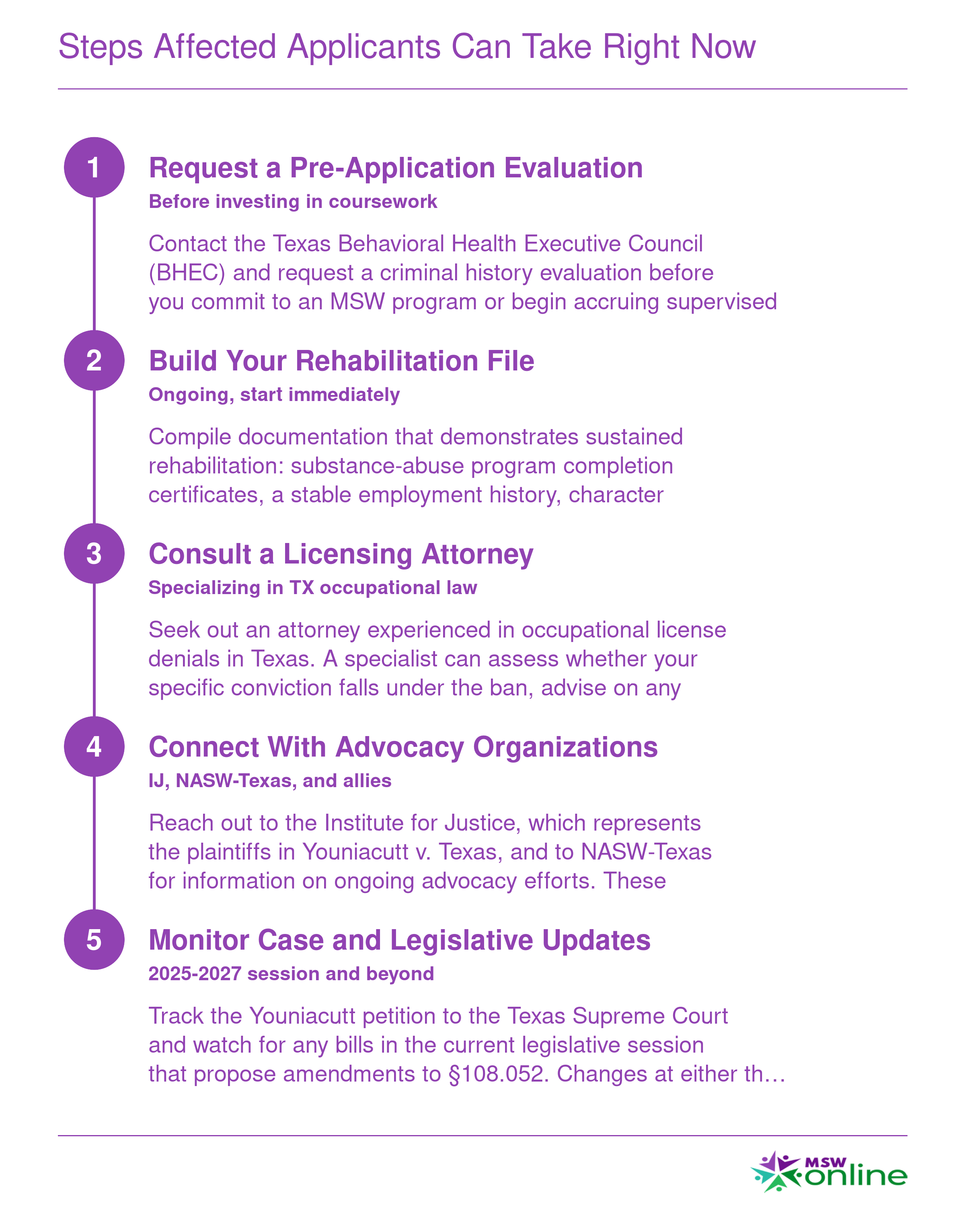
Steps Affected Applicants Can Take Right Now
If you have a criminal history and are pursuing social work licensure in Texas, waiting for the courts or the legislature to act is not your only option. These five steps can help you protect your time, money, and career goals while the legal landscape around Tex. Occ. Code §108.052 continues to evolve.
Texas Social Worker Shortage: Why This Ban Matters
Texas already faces a significant shortage of behavioral health professionals, and a lifetime licensure ban that prevents rehabilitated individuals from entering the workforce only deepens the gap. According to the Bureau of Labor Statistics, social work is a growing field nationally, with roughly 74,000 annual openings projected between 2024 and 2034. Many Texas counties are federally designated Mental Health Professional Shortage Areas, meaning communities that need licensed social workers the most are the same communities losing qualified candidates to blanket criminal history bans. For current data on shortage designations, the Health Resources and Services Administration (HRSA) maintains searchable maps of Health Professional Shortage Areas, and the Texas Department of State Health Services publishes periodic workforce reports. The Texas Chapter of the National Association of Social Workers and university programs such as those at UT Austin and Texas State University have also documented these workforce challenges.
| Metric | National Social Workers (SOC 21-1020) | California Social Workers (SOC 21-1020) | Texas Social Workers (SOC 21-1020) |
|---|---|---|---|
| Projected Job Growth Rate (through 2033/2034) | 6% (2024 to 2034) | 14% (through 2033) | Not yet published by BLS |
| Estimated Annual Job Openings (2024 to 2034) | 74,000 | N/A | Not yet published by BLS |
Social Worker Pay Across Texas Metro Areas
The table below shows 2024 wage data for three social work specializations across major Texas metro areas, based on the Occupational Employment and Wage Statistics program from the U.S. Bureau of Labor Statistics. These figures underscore the earning potential that qualified professionals stand to lose when a lifetime licensure ban removes them from the workforce. They also illustrate why blocking rehabilitated, MSW-educated practitioners from practice deepens staffing gaps in regions that already struggle to recruit.
| Metro Area | Specialization | Total Employed | Median Annual Wage | 25th Percentile | 75th Percentile |
|---|---|---|---|---|---|
| Dallas-Fort Worth-Arlington | Healthcare Social Workers | 2,580 | $74,590 | $61,010 | $85,620 |
| Houston-Pasadena-The Woodlands | Healthcare Social Workers | 3,120 | $73,030 | $51,170 | $82,960 |
| Austin-Round Rock-San Marcos | Healthcare Social Workers | 930 | $75,650 | $59,370 | $84,070 |
| San Antonio-New Braunfels | Healthcare Social Workers | 1,030 | $69,780 | $57,740 | $81,990 |
| El Paso | Healthcare Social Workers | 520 | $52,680 | $28,590 | $76,280 |
| McAllen-Edinburg-Mission | Healthcare Social Workers | 330 | $60,220 | $36,970 | $66,700 |
| Dallas-Fort Worth-Arlington | Child, Family, and School Social Workers | 5,360 | $54,850 | $46,350 | $62,500 |
| Houston-Pasadena-The Woodlands | Child, Family, and School Social Workers | 4,800 | $50,710 | $45,790 | $60,350 |
| Austin-Round Rock-San Marcos | Child, Family, and School Social Workers | 1,930 | $53,370 | $46,290 | $62,250 |
| San Antonio-New Braunfels | Child, Family, and School Social Workers | 2,880 | $53,670 | $46,670 | $62,130 |
| El Paso | Child, Family, and School Social Workers | 770 | $48,790 | $43,750 | $58,410 |
| Brownsville-Harlingen | Child, Family, and School Social Workers | 3,260 | $40,330 | $40,290 | $45,500 |
| Dallas-Fort Worth-Arlington | Mental Health and Substance Abuse Social Workers | 1,590 | $43,920 | $37,740 | $53,490 |
| Houston-Pasadena-The Woodlands | Mental Health and Substance Abuse Social Workers | 820 | $52,430 | $42,740 | $74,840 |
| Austin-Round Rock-San Marcos | Mental Health and Substance Abuse Social Workers | 530 | $47,470 | $44,380 | $65,570 |
| San Antonio-New Braunfels | Mental Health and Substance Abuse Social Workers | 460 | $42,070 | $37,660 | $63,990 |
| El Paso | Mental Health and Substance Abuse Social Workers | 230 | $44,790 | $44,790 | $50,390 |
| Brownsville-Harlingen | Mental Health and Substance Abuse Social Workers | 200 | $39,700 | $39,700 | $45,530 |
How Texas Compares to Other States on Criminal History Licensing
Texas stands almost alone among large states in maintaining automatic lifetime bans for social work licensure based on decades-old convictions, while most peer states have adopted individualized review processes that weigh rehabilitation, time elapsed, and offense relevance.1 Examining how California, New York, Florida, Illinois, Ohio, and Georgia handle criminal history reveals a national trend toward second-chance licensing that leaves Texas increasingly isolated.
States That Rely Exclusively on Individualized Review
California, New York, and Illinois have eliminated automatic bans entirely, requiring licensing boards to evaluate each applicant's criminal history case by case. California's 2024 framework limits the use of older non-serious convictions and mandates administrative hearings where applicants can present rehabilitation evidence.3 New York's Article 23-A approach gives applicants written reasons for denials and allows administrative review, with no fixed lookback period. Illinois imposes a five-year threshold for non-violent, non-sexual offenses if no new crimes have occurred, and requires that disqualifying convictions be directly related to the duties of a social worker.4 All three states permit waiver or appeal mechanisms, including court challenges in Illinois, ensuring that boards cannot reject rehabilitated applicants without documented justification.
Hybrid Models That Balance Public Safety With Rehabilitation
Florida and Ohio use hybrid approaches that list certain disqualifying offenses while preserving individualized review for most convictions. Florida imposes automatic bars for violent and sexual crimes, with statutory disqualification periods that may be permanent, but offers an exemption-from-disqualification process for other felonies.5 Administrative hearings allow applicants to demonstrate rehabilitation. Ohio maintains a similar structure, with presumptive disqualifications that applicants can overcome by presenting rehabilitation evidence and meeting fitness standards in a case-by-case administrative hearing.6 Georgia falls into a discretionary model, granting its board broad authority to review applicants' criminal histories without fixed lookback periods, though serious felonies may effectively bar licensure unless strong rehabilitation is shown.
Texas Remains the Outlier: No Room for Rehabilitation
Texas's 2019 lifetime ban statute offers no individualized review, no administrative appeal, and no mechanism for demonstrating rehabilitation, regardless of how much time has passed or how thoroughly an applicant has rebuilt their life. Unlike Florida's exemption process or Ohio's fitness analysis, the Texas ban operates as a categorical exclusion. The state has not yet enacted the Social Work Licensure Compact, which would harmonize certain multistate practice rules but would not change Texas's underlying criminal-history disqualifications.7 The compact's provisions apply only to license portability among member states, leaving each state free to impose its own disqualification criteria. For aspirants pursuing the path to become a licensed clinical social worker who carry past convictions, Texas thus stands as one of the most restrictive jurisdictions in the nation, with no legal path forward short of legislative repeal or successful constitutional challenge.
Frequently Asked Questions About the Texas Social Work License Ban
The Texas lifetime license ban has raised urgent questions for MSW graduates, current licensees, and career changers across the state. Below are answers to the most common questions, drawing on the legal developments, statutory details, and workforce data discussed throughout this article.