Points of interest…
- CSU campuses dominate the 2026 rankings, with in-state MSW tuition typically under $10,000 per year.
- Advanced standing and accelerated tracks are distinct pathways, and both can shorten the MSW timeline significantly.
- California's LCSW licensure requires roughly three additional years of supervised practice after earning the MSW.
- Online MSW students in California can usually complete required field placement hours near their home community.
Finding the Right Online MSW Program in California
California offers more CSWE-accredited online MSW options than almost any other state, but finding the right fit means weighing cost, format, and licensure readiness against your personal circumstances. In this guide, we rank the top online MSW programs in California for 2026, break down tuition across public CSU campuses and private universities, and clarify the difference between accelerated and advanced standing tracks. You will also find a detailed look at how field placements work for remote learners, a step-by-step roadmap from MSW to licensed clinical social worker, and salary data to help you evaluate return on investment. Whether you hold a BSW and want a 12-month fast track or you are a career changer exploring accelerated online MSW programs, this page gives you the information you need to make a confident decision.
Top-Ranked Online MSW Programs in California for 2026
Every program below earned its spot by balancing CSWE accreditation with genuine affordability. Because financial accessibility weighs heavily in these rankings, California's public CSU campuses dominate the list, with in-state tuition typically under $10,000 per year. Two private institutions round out the roster for students who prioritize specific concentrations or faith-integrated curricula. All programs offer online or hybrid delivery, and each holds (or is pursuing) CSWE accreditation, the credential California's Board of Behavioral Sciences requires for LCSW licensure eligibility.
- Net price and tuition affordability
- CSWE accreditation status
- Graduation and retention rates
- Program flexibility and format
- Graduate debt and earnings outcomes
- College Scorecard graduate earnings — collegescorecard.ed.gov
- NCES-IPEDS federal institutional data — nces.ed.gov
- Independent program research
- Internal program database
California State University-Los Angeles
#1Los Angeles, CA · ~$4,000/yr (est.)
Best for: Budget-focused students in metro LA
Cal State LA pairs one of the lowest net prices in the state (under $4,000 after aid) with a CSWE-accredited MSW that has been running since 1999. Students choose among an 11-month Advanced Standing track, a two-year full-time plan, or a three-year part-time plan, all delivered in a hybrid format with coursework available at the main campus or the downtown LA location. The school's overall graduation rate is 53%, and median graduate debt sits at just $13,000.
- Hybrid delivery with main campus and DTLA options
- Advanced Standing track completable in 11 months
- Full-time 2-year and part-time 3-year plans available
- CSWE accredited since 1999
- Field education integrated into every track
- In-state tuition approximately $8,688 per year
- Summer and fall start dates offered
California State University-Fullerton
#2Fullerton, CA · $7,000 – $20,000/yr
Best for: Working professionals needing evening cohorts
Cal State Fullerton's MSW Flex Program is built around evening cohorts, making it a strong match for working professionals in Orange County and the Inland Empire. The 60-credit hybrid curriculum requires 576 clinical hours across two nine-month field placements at community agencies. A Community Mental Health concentration zeroes in on advanced practice in psychiatric and residential treatment settings. The school's overall graduation rate is 70%, one of the highest among CSU MSW programs.
- 60-credit hybrid program designed for working adults
- Evening classes across fall, spring, and summer terms
- Community Mental Health concentration available
- 576 clinical hours at community agency placements
- Cohort-based structure for peer support
- Multicultural social work practice emphasis
- Capstone project required for completion
California State University-San Bernardino
#3San Bernardino, CA · $5,000/yr (net price)
Best for: Out-of-state students seeking CSU affordability
Cal State San Bernardino stands out for offering a fully online, part-time MSW pathway alongside traditional campus options, and the program explicitly enrolls students from any U.S. state. BSW holders can enter the 35-unit Advanced Standing track and finish in as few as 12 months. The standard 60-unit program runs two or three years depending on pace, and a concurrent MSW/MPA dual degree is available for those eyeing policy careers. Net price after aid averages roughly $4,564, and the school's overall graduation rate is 55%.
- 60-unit standard program with 2- or 3-year timelines
- Online and on-campus delivery at two locations
- Concurrent MSW/MPA dual degree option
- Advanced generalist practice curriculum
- Practicum education embedded in coursework
- Open to students in all 50 states
- In-state tuition approximately $9,612 per year
- 35-unit accelerated track for BSW graduates
- 12-month or 5-semester completion options
- Available fully online
- CSWE accredited
- Practicum education included
- Flexible scheduling for working professionals
California State University-Northridge
#4Northridge, CA · ~$7,000/yr (est.)
CSUN delivers its MSW entirely online in two- and three-year formats, with authorization in most U.S. states (though not Iowa, Mississippi, North Carolina, New Mexico, or Rhode Island). The curriculum emphasizes advanced clinical skills, interpersonal processing, and ethical practice. Spring 2026 entrants are placed into the three-year track. Net price averages about $7,021 after aid, and the school's overall graduation rate is 57%.
- Fully online delivery with no required campus visits
- Two-year and three-year completion formats
- Advanced clinical practice and ethics focus
- Advanced Standing option for BSW graduates
- Authorized in most U.S. states
- In-state tuition approximately $8,982 per year
- Social justice commitment woven into admissions
California State University-Stanislaus
#5Turlock, CA · ~$6,000/yr (est.)
Stanislaus State offers a hybrid MSW with a strong social justice and transformative practice orientation in California's Central Valley. The program runs in two- or three-year formats, and its 18-to-1 student-faculty ratio is the lowest among the CSU entries on this list. Net price hovers near $6,067, and median earnings ten years after enrollment reach roughly $63,188. The school's overall graduation rate is 53%.
- Hybrid format combining campus and online coursework
- 2-year and 3-year program plans
- Social justice and transformative practice focus
- Practicum component with community agencies
- 18-to-1 student-faculty ratio
- In-state tuition approximately $9,766 per year
- Three professional references required for admission
San Jose State University
#6San Jose, CA · $14,000/yr
San Jose State's Advanced Standing MSW is a one-year, 37-unit hybrid program built exclusively for BSW holders living in California. Admission is competitive: applicants need a 3.5 GPA, an A- average in social work courses, and at least 400 hours of relevant experience. Small cohorts and in-person internships anchor the clinical training. The school's overall graduation rate is 69%, and its median alumni earnings ($78,988 ten years out) are the highest on this list, reflecting the Bay Area labor market.
- 37-unit program completable in one year
- Hybrid format with in-person internships
- Requires 3.5 GPA and A- in social work courses
- 400 hours of prior related experience needed
- Small cohort model with fall-only admission
- California residency required for enrollment
- CSWE accredited with advocacy-centered curriculum
California State University-East Bay
#7Hayward, CA · $8,000 – $20,000/yr
Cal State East Bay's Advanced Standing MSW blends online coursework with campus experiences in Hayward, targeting BSW graduates who want to fast-track into advanced practice. The hybrid program emphasizes leadership, advocacy, and financial accessibility, with a net price near $9,320. The school's overall graduation rate is 48%, though its median earnings ten years out ($71,401) reflect strong placement outcomes in the East Bay job market.
- Hybrid learning for BSW holders
- Leadership and advocacy emphasis
- Financial aid options available
- Campus located in the East Bay region
- In-state tuition approximately $9,107 per year
- Prepares graduates for advanced practice roles
California State University-Chico
#8Chico, CA · ~$14,000/yr (est.)
Chico State's Distributed Learning MSW uses a distinctive hybrid schedule: roughly two-thirds of coursework is online, with face-to-face sessions on two weekends per semester. The program requires 1,200 practicum hours completed in the student's home community. BSW graduates can enter a one-year accelerated plan, while others follow a three-year part-time track. The school's overall graduation rate is 63%, and it holds dual accreditation from CSWE and WASC.
- Hybrid model, approximately 67% online
- In-person sessions on two weekends per semester
- 1,200 practicum hours in student's local area
- One-year accelerated option for BSW graduates
- Three-year part-time plan also available
- CSWE and WASC accredited
- Social justice and community support focus
California State Polytechnic University-Humboldt
#9Arcata, CA · ~$13,000/yr (est.)
Cal Poly Humboldt's MSW is purpose-built for students committed to rural and Indigenous communities in Northern California. The online program requires California residency and includes a mandatory orientation plus a three-day January campus intensive each year. Advanced Standing and traditional tracks are both available. At a 16-to-1 student-faculty ratio and with partnerships with tribal service providers, it offers a level of mentorship uncommon in distance programs. The school's overall graduation rate is 49%.
- Online delivery with required January campus intensive
- Rural and Indigenous communities concentration
- California residency required throughout enrollment
- Advanced Standing and traditional tracks offered
- 16-to-1 student-faculty ratio
- Partnerships with tribal service providers
- Cultural humility and decolonizing practice emphasis
- Advanced generalist curriculum
University of Massachusetts Global
#10Aliso Viejo, CA · $33,000/yr
University of Massachusetts Global (formerly Brandman) is a public institution based in Aliso Viejo that charges a flat tuition rate regardless of residency. Its 69-credit Standard track requires 1,000 field placement hours, while the 39-credit Advanced Standing track requires 600. An optional Pupil Personnel Services Credential prepares graduates for school social work roles in California. Available in most states, the program is delivered fully online. The school's overall graduation rate is 43%, and median graduate debt ($24,276) is notably higher than CSU alternatives.
- Fully online with 69-credit standard track
- 39-credit Advanced Standing track for BSW holders
- 1,000 practicum hours (standard) or 600 (advanced)
- Flat tuition rate regardless of residency
- Up to 15 transfer credits accepted
- CSWE accredited, WASC regionally accredited
- Prepares for California school social work licensure
- Same 69- or 39-credit structure as standard MSW
- California licensing compliance built into curriculum
- Field placements arranged in student's local area
- Online delivery for working professionals
- Credential earned alongside the MSW degree
Pacific Oaks College
#11Pasadena, CA · $33,000/yr
Pacific Oaks College is a small private institution in Pasadena offering a fully online, 60-credit MSW with a culturally competent clinical practice focus. Full-time students finish in two years; part-time in three. An Advanced Standing track (35 credits, roughly one year) is also available. The 11-to-1 student-faculty ratio supports close mentoring. Tuition is significantly higher than CSU options at roughly $22,260 per year, and the program holds CSWE Candidacy status. The school has not reported a graduation rate.
- Fully online, asynchronous class format
- 60 credits with 2-year full-time or 3-year part-time pacing
- Culturally competent clinical practice emphasis
- Prepares for California clinical social worker licensure
- 11-to-1 student-faculty ratio
- Fall and spring start dates
- 35-credit accelerated track for BSW graduates
- Completable in approximately one year
- 720 hours of field education required
- Asynchronous online delivery
- Small cohort sizes
- Focus on underserved communities and social justice
California Baptist University
#12Riverside, CA · $25,000 – $30,000/yr
California Baptist University is a private, faith-based institution in Riverside offering a 60-unit MSW online or in person. The program integrates Christian values with evidence-based practice and includes 900 hours of field work (500 for Advanced Standing). A built-in Pupil Personnel Services Credential option requires no extra coursework. Tuition runs about $822 per unit, and the school's overall graduation rate is 62%. Net price after aid averages approximately $26,285, placing it well above CSU tuition levels.
- 60-unit program with online and in-person options
- Advanced Standing (30 units) for BSW graduates
- 900 field work hours (500 for Advanced Standing)
- Pupil Personnel Services Credential included
- Faith integration component in curriculum
- $822 per unit tuition
- CSWE accredited with fall-only admission
- 30-unit accelerated track completable in one year
- Online delivery available
- 500 field work hours required
- Faculty mentorship throughout the program
- Evidence-based training with faith-based perspective
- Statistics prerequisite with C or better required
What Drives These Rankings: Our Scoring Criteria
Transparency matters when you are comparing online MSW programs in California. Our rankings rely on a data-driven framework that evaluates each program across several weighted dimensions. You can review the full details in our rankings methodology, but here is a brief overview of the key factors.
We assess each program on five core criteria:
- CSWE accreditation status, which is non-negotiable for licensure eligibility
- Academic quality, including faculty credentials, student-to-faculty ratios, and field placement support
- Affordability, measured by net tuition cost and availability of financial aid
- Student outcomes, such as graduation rates, licensure exam pass rates, and post-degree employment data
- Online flexibility, covering asynchronous options, part-time scheduling, and technology platforms
These criteria ensure that the programs featured here meet rigorous standards for both academic excellence and real-world applicability. Whether you are exploring accredited online MSW programs at the national level or narrowing your search to California-specific options, understanding the methodology behind these rankings will help you make a more informed decision. Programs that perform well across all five dimensions earn higher placement, giving you a reliable shortlist of schools worth your time and investment.
Tuition Face-Off: What California Online MSW Programs Actually Cost
Tuition for California's online and hybrid MSW programs varies dramatically depending on whether you attend a public CSU campus or a private university. The table below compares annual graduate tuition rates (in-state and out-of-state) alongside the institution-wide average net price after financial aid. Keep in mind that the net price figure reflects an institution-wide average across all students and degree levels; individual MSW students may pay more or less depending on their specific aid packages, enrollment status, and fee structures. The spread between the least and most expensive options is striking: in-state tuition at Cal State LA runs roughly $8,688 per year, while University of the Pacific's flat rate tops $55,452, a difference of nearly $47,000 annually.
| School | In-State Tuition | Out-of-State Tuition | Avg. Net Price (Institution-Wide) | Program Format |
|---|---|---|---|---|
| Cal State LA | $8,688 | $18,768 | $3,967 | Hybrid |
| Cal State San Bernardino | $9,612 | $19,692 | $4,564 | Hybrid |
| Stanislaus State | $9,766 | $19,846 | $6,067 | Hybrid |
| Cal State Fullerton | $8,994 | $19,074 | $6,555 | Hybrid |
| CSUN | $8,982 | $19,062 | $7,021 | Online |
| Cal State East Bay | $9,107 | $19,187 | $9,320 | Hybrid |
| Cal Poly Humboldt | $9,921 | $20,001 | $13,171 | Online |
| San Jose State University | $9,934 | $20,014 | $13,760 | Hybrid |
| Cal State Chico | $9,996 | $20,076 | $14,480 | Hybrid |
| California Baptist University | $15,562 | $15,562 | $26,285 | Online |
| National University | $16,416 | $16,416 | $22,878 | Online |
| University of the Pacific | $55,452 | $55,452 | $25,447 | Hybrid |
Questions to Ask Yourself
Accelerated Tracks and Advanced Standing: Earning Your MSW Faster in California
Interest in faster social work education pathways has surged, yet many prospective students conflate advanced standing with accelerated programs, two distinct routes that shorten the timeline in different ways. Advanced standing is a streamlined pathway available exclusively to applicants who hold a bachelor of social work from a CSWE-accredited program, allowing them to bypass foundational coursework and complete the MSW more quickly. Accelerated programs, by contrast, compress the entire curriculum for all students, regardless of undergraduate background, often through a fast-paced cohort model with fewer breaks. The distinction matters because eligibility and program design differ dramatically.
Defining the Two Fast Routes
Advanced standing credit typically reduces the MSW from 60 credit hours to around 24 to 32 credits, shaving off a full year of study. Accelerated formats still require the full 60 credits but deliver them on a condensed schedule, such as year-round terms or intensive semesters. For career changers without a BSW, accelerated online MSW programs are the primary path to a faster degree, though they rarely shrink the timeline below 1.5 to 2 years. Readers should avoid the common mistake of assuming that a "one-year MSW" is universally available; it is almost always tied to advanced standing.
Which California Online Programs Offer Advanced Standing?
Several CSWE-accredited online MSW programs in California provide an advanced standing option, with the fastest culminating in a 12-month timeline. The University of Southern California's online MSW with advanced standing requires 24 credits and targets completion in 12 months, contingent on a 3.0 GPA and a BSW from an accredited program. University of the Pacific's online advanced standing MSW also runs 12 months but demands 32 credits, making it a slightly heavier courseload. Loma Linda University offers an advanced standing pathway online, though its specific duration varies; prospective students should inquire about the exact reduction in credit hours and any cohort start-date restrictions. Most advanced standing tracks have limited enrollment windows, often fall or spring only, so verifying start dates early is crucial.
Licensure Eligibility and Program Quality
A frequent concern is whether expedited programs compromise clinical preparedness or LCSW eligibility. Because all tracks discussed here are CSWE-accredited, advanced standing and accelerated graduates meet the same educational standards as traditional students. The coursework, while compressed, covers identical competencies and leads to the same degree. California's Board of Behavioral Sciences recognizes any CSWE-accredited MSW for LCSW licensure, so accelerated graduates are not at a disadvantage when pursuing licensure. That said, the intensity of a 12-month program demands careful time management and may limit opportunities for part-time work or outside commitments, a factor worth weighing before enrolling.
Fully Online or Hybrid? Decoding California MSW Program Formats
If you are searching for a fully online MSW in California, set your expectations early: nearly every program in the state uses a hybrid format that pairs online coursework with some form of in-person requirement. Understanding what "hybrid" actually means at each school is critical, because the on-campus commitment varies widely.
Some programs keep in-person time minimal. San Jose State University, for example, delivers classes entirely online but requires students to complete an internship at a California-based site. Cal Poly Humboldt asks students to attend a mandatory orientation and an annual January campus intensive, with the rest of the coursework delivered remotely. Other programs demand more regular face-to-face contact. CSU Chico requires two campus weekends each semester, while CSU Long Beach schedules Saturday in-person class meetings at designated program sites along with local practicums.
Private institutions follow a similar pattern. Loma Linda University's hybrid MSW includes in-person practicum one weekday per week, making it best suited to students who live within commuting distance. CSU San Bernardino runs its seminars online but mandates an in-person practicum component as well.3
Before you apply, ask each program three questions: How often must I be on campus? Can I complete my social work field placement at an agency near my home? And does the schedule accommodate full-time employment? The answers will help you distinguish between programs that are online in name and programs that genuinely fit a remote learner's life. If you are also weighing schools outside California, reviewing how to compare online MSW programs nationally can provide useful benchmarks for evaluating flexibility, cost, and accreditation.
Related Articles
How Field Placements Work for Online MSW Students in California
Can I stay in my hometown and still complete the required field placement hours for an online MSW in California?
That question looms large for anyone considering a distance-based degree, especially in a field like social work where hands-on experience is non-negotiable. The short answer is that most California online MSW programs are built to let you train in or near your own community, with no relocation required. However, the logistics depend heavily on the program's model and your location.
The CSWE baseline and California's expectations
Every CSWE-accredited program, including all online options in California, requires a minimum of 900 hours of supervised field practicum. That breaks down to roughly 16 to 24 hours per week at your agency site, spread across two distinct placements (a generalist foundation and a specialized concentration). Your field instructor must hold an MSW from a CSWE-accredited program and have at least two years of post-MSW experience. Those standards are universal.
California programs often exceed the floor. Cal Poly Humboldt's online MSW, for example, mandates 960 hours2, while USC's online MSW sets the bar at 1,100 hours, including 100 additional field hours and a 250-hour virtual practicum component woven into the curriculum.3
Who finds your placement
Most programs follow a hybrid approach: the university supplies placement coordination, but you are expected to identify prospective agencies in your area. For a broader look at navigating this process, consult our social work internships guide. Here is how it typically works:
- Program-driven matching: The field education office maintains a list of approved sites and works to match you with an agency, scheduling interviews and confirming that the experience aligns with your concentration.
- Student-led proposals: You can suggest a local agency, such as a community mental health center, a school district, or a VA clinic, and the program vets it for suitability, ensuring the supervisory structure meets CSWE criteria. If approved, the school assigns a field liaison to oversee your progress.
In both cases, the goal is a placement within a 30- to 60-mile travel radius, though that is not a hard rule. Some programs are more proactive than others. USC's online MSW, for instance, places students nationally and takes the lead in securing sites, soliciting student input but ultimately placing you.3 Cal Poly Humboldt, by contrast, operates in the Superior Region of Northern California and expects students to be California residents; the program matches you with a local agency after student interviews.2
Rural areas and geographic constraints
Living in a small town or a rural county does not automatically disqualify you. Many online students in California's far northern counties or high desert communities have successfully completed placements without moving. Programs work to identify telehealth-eligible opportunities or partner with regional service networks that already supervise MSW interns. That said, if you are in an extremely remote area with few MSW-level supervisors, you may need to drive farther or propose a creative site (a tribal health clinic, a county behavioral health outpost) that the program can approve. The California State University system often leverages its regional anchors, as CSU campuses have deep ties to county agencies, while private universities like USC use a national placement network that can tap agencies in unexpected locations.
Public versus private placement logistics
Public CSU programs tend to have tighter geographic footprints. Humboldt's online MSW, for example, limits placements to its designated Superior Region, so you must live in or near that part of the state.2 Other CSU online programs (like Bakersfield's or San Bernardino's) center on specific counties but may accept students statewide, with placements arranged in your locale. Private programs, notably USC, offer more flexibility: because they recruit a national cohort, their placement infrastructure is built to identify sites anywhere in the country, including rural pockets of California that a CSU might not serve.3
Before enrolling, ask the field education office three questions: Does the program have established partnerships in my county? What is the furthest distance a student has commuted for a placement? And if I strike out locally, will the program help me find a virtual or alternative site? Answers will reveal whether the online MSW truly works where you live.
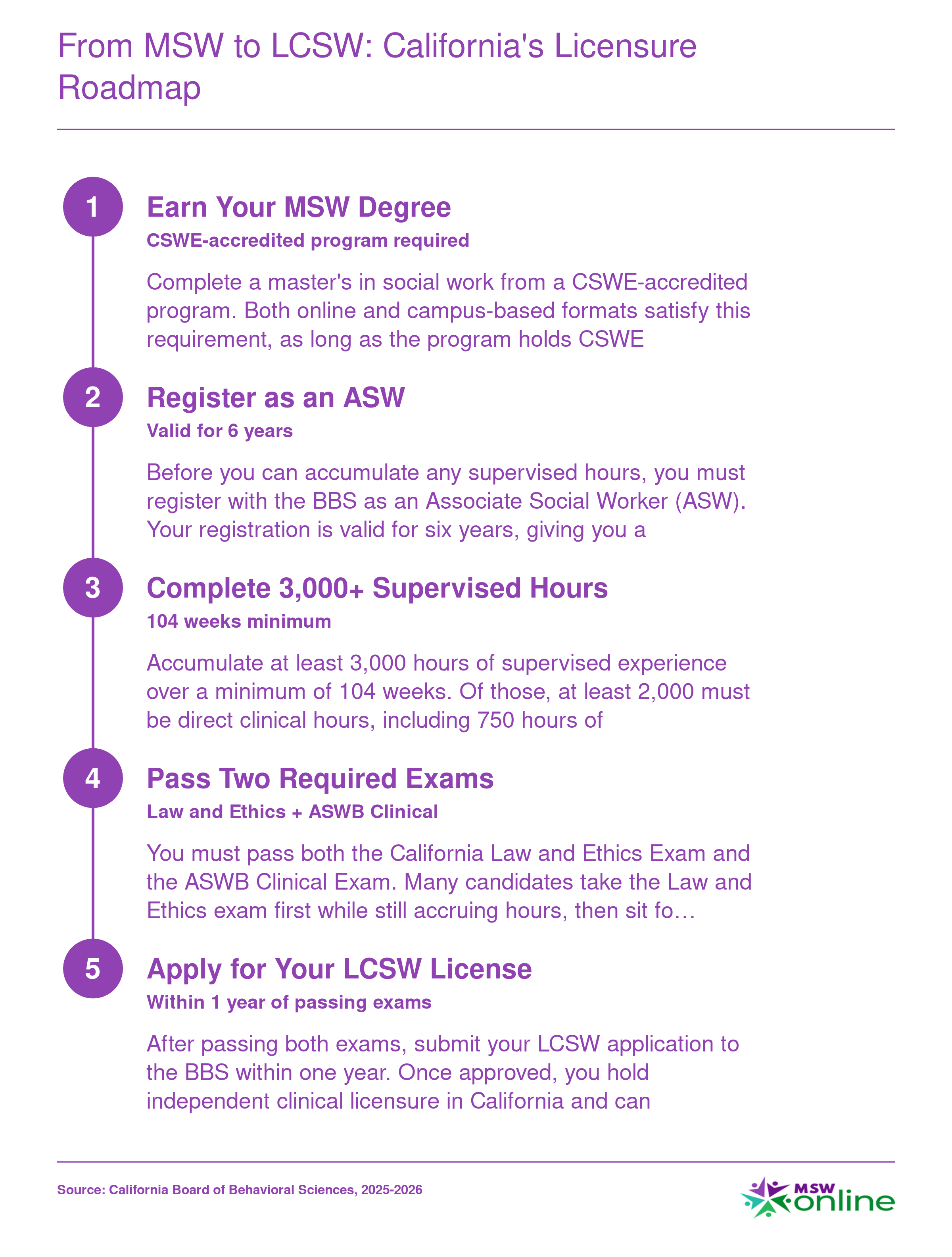
From MSW to LCSW: California's Licensure Roadmap
An MSW is a graduate degree; an LCSW is a clinical license issued by California's Board of Behavioral Sciences (BBS). You need the degree before you can pursue the license, and the full journey from graduation to LCSW typically takes two to three years of post-degree supervised practice. Here is the step-by-step sequence.
What California MSW Graduates Earn: Program Outcomes and Salary Data
Earnings for California MSW graduates depend on three variables: which program you attended, which msw specialization you enter, and whether you hold an Associate Clinical Social Worker (ASW) registration or a full Licensed Clinical Social Worker (LCSW) credential. Salaries for the profession itself are well documented; program-specific outcomes are less complete, and we flag that honestly below.
Statewide Wages by Specialization
California's median wage for social workers overall sits at $72,810 as of 2026.1 Broken out by specialty (2024 figures), the variation is significant:
- Healthcare social workers: $92,970
- Mental health and substance abuse social workers: $75,320
- Social workers, all other: $70,440
- Child, family, and school social workers: $69,250
Macro and policy roles often sit alongside the "all other" category, while LCSWs in private practice or hospital settings tend to cluster at the upper end. Nationally, projections call for 6% job growth and about 74,000 annual openings through 2034, giving California graduates a steady labor market to enter.
Program-Level Earnings and Debt
Long-term institutional earnings (measured roughly a decade after enrollment, across all majors at each school) range widely among ranked California MSW providers: Loma Linda University reports about $89,800, San Jose State around $79,000, University of the Pacific near $78,400, and Cal State East Bay near $71,400. Median debt at graduation varies similarly, from roughly $13,540 at CSU Stanislaus and $13,750 at CSU Fullerton to about $25,000 at National University. Note that these figures are institution-wide averages, not MSW-only, and program-specific earnings data is not yet published for these programs. Graduates pursuing clinical MSW programs leading to LCSW licensure tend to reach the higher end of these salary ranges.
A Quick ROI Look
Dividing long-term earnings by median debt gives a rough return ratio. San Jose State graduates earn roughly 5.3 times their median debt, CSU Stanislaus about 4.7 times, and Cal State Fullerton about 4.6 times. By comparison, higher-priced private programs land closer to 2.7 to 4.0. ROI is a blunt instrument, but for cost-sensitive applicants the public CSU pathway consistently produces the strongest ratio.
Among the California online MSW programs with published data, median first-year earnings hover around $42,000 to $48,000, while total program costs range from roughly $24,000 to over $90,000. That means the most affordable options can pay for themselves in under a year of post-graduation earnings, while the priciest programs may require two or more years of salary just to break even on tuition alone.
Common Questions About California's Online MSW Programs
Prospective students often share the same set of concerns before committing to an online MSW. Below are direct answers to the questions that come up most frequently, grounded in current program data and CSWE standards.
More Accredited Online MSW Programs Available to California Students
If you're still exploring your options and want to consider more institutions, the following schools also offer accredited MSW programs accessible to California students. Each program brings its own unique format and specialization opportunities.
San Diego Area
- Master of Social Work (Clinical Practice)
- Master of Social Work (Medical Social Work)
- Master of Social Work (Child Welfare)
- Master of Social Work
- Master of Social Work (Advanced Social Work with Children and Families)
- Master of Social Work (Advanced Social Work Practice with Marginalized Populations)
- Master of Social Work (Advanced Standing)
Central Valley
- Master of Social Work (Health Care, Behavioral Health)
- Master of Social Work (Behavioral Health)
- Master of Social Work (Health Care)
Inland Empire
- MSW Advanced Standing Program