
Points of interest…
- CACREP accreditation is required or strongly preferred for licensure in nearly every U.S. state.
- BLS projects 19% to 22% job growth for major counseling occupations through 2032, well above average.
- Net price after grants can cut published tuition by thousands, so always compare both figures before enrolling.
- Full licensure typically takes 7 to 10 years from the start of a bachelor's degree to clinical independence.
Finding the Right Master's in Counseling Program
A master's in counseling opens the door to licensure as a professional counselor, but the program you choose shapes how quickly and smoothly you get there. Accreditation status, clinical hour requirements, specialization options, and cost all vary widely, and a mismatch with your career goals can add semesters of extra coursework or block your licensure path entirely. This guide breaks down the top fully online programs for 2026, compares CACREP and MPCAC accreditation, walks through state licensure requirements, and details scholarships and loan forgiveness options designed specifically for counseling students. Whether you are considering clinical mental health counseling, school counseling, or an MFT master's degree, the sections below give you the data and framework to make a confident decision.
Top Fully Online Master's in Counseling Programs for 2026
Every program below is 100% online, with no hybrid or in-person classroom requirement. They are ordered by a quality composite that weighs graduation rates, graduate earnings, debt levels, and completion volume, not by tuition alone. Institution-wide graduation rates are included for context, but they reflect the university as a whole, not the counseling program specifically. Program-level earnings data are not yet available for most of these degrees, so the 10-year median earnings figure shown is the institution-wide number reported by the College Scorecard.
- Graduation and retention rates
- Graduate earnings outcomes
- Median student debt levels
- Program completion volume
- Accreditation and licensure alignment
- Internal program database
- College Scorecard graduate earnings — collegescorecard.ed.gov
- Independent program research
- NCES-IPEDS federal institutional data — nces.ed.gov
Florida State University
#1Tallahassee, FL · $11,000/yr
Best for: Florida educators seeking specialist credentials
Florida State University's online counseling program awards both an M.S. and Ed.S. in School Counseling through a single CACREP-accredited track, giving graduates a specialist credential alongside the master's degree. With a low median graduate debt of $18,000 and a net price of $11,297, it is one of the more affordable R1 options on this list. The university posts an 85.6% institution-wide graduation rate, and its College of Education counseling programs have earned top-tier national recognition. Practicum and internship placements draw on strong partnerships with Florida's diverse K-12 public school districts.
- CACREP-accredited with dual M.S. and Ed.S. outcome
- No GRE required for admission through Fall 2026
- Minimum 3.0 undergraduate GPA to apply
- Data-driven strategies to close achievement gaps
- Practicum and internship in Florida K-12 schools
- Close faculty mentorship throughout the program
- Prepares for Florida school counselor certification
William & Mary
#2Williamsburg, VA · $15,000 – $20,000/yr
Best for: Military-connected students in counseling
William & Mary pairs a respected CACREP-accredited M.Ed. in Counseling with a distinctive Military and Veterans Clinical Mental Health Counseling concentration, making it one of the few ranked programs with a dedicated military-focused track. The institution's 89.4% graduation rate is among the highest on this list, and a 12:1 student-to-faculty ratio supports close interaction with faculty. Median graduate debt sits at $18,500, and the 10-year institution-wide median earnings reach $73,490.
- CACREP-accredited school counseling concentration
- Social justice and diversity integrated into curriculum
- Small class sizes with dynamic online platform
- Includes practicum and internship field experiences
- Can be completed in as few as three years
- Prepares for K-12 school counselor licensure
- 60-credit CACREP-accredited clinical program
- Concentration on military and veteran populations
- Includes practicum and supervised internship hours
- Prepares for Virginia LPC licensure pathway
- Online format with dedicated faculty support
- Fieldwork opportunities in military-connected settings
Northwestern University
#3Evanston, IL · $29,000/yr (net price)
Best for: Aspiring marriage and family therapists
Northwestern University offers both a CACREP-accredited M.A. in Counseling (with a child and adolescent specialization option) and a COAMFTE-accredited M.S. in Marriage and Family Therapy online. A 6:1 student-to-faculty ratio and synchronous live class sessions create an intimate learning environment despite the online format. Median graduate debt is just $15,000, the lowest among the private universities here, and institution-wide 10-year median earnings top $89,000. Full-time students can finish the MFT track in 21 months.
- CACREP-accredited with optional child/adolescent focus
- 18- to 36-month completion timeline
- 200-hour practicum plus 600-hour internship
- Live online and asynchronous class sessions
- Faculty-approved clinical training sites
- Standard and Bridge program pathways available
- COAMFTE-accredited MFT program
- 25 graduate-level courses required
- 400 clinical hours including 100 relational hours
- 21-month full-time or 36-month part-time schedule
- No GRE required for admission
- Cohort-based structure with placement assistance
North Carolina State University at Raleigh
#4Raleigh, NC · $9,000 – $33,000/yr
NC State delivers CACREP-accredited online master's tracks in both School Counseling and Clinical Mental Health Counseling, each structured around a 60-credit curriculum with no entrance exam requirement. The clinical mental health track uses a cohort model and a three-year part-time format designed for working professionals. Coursework emphasizes multicultural competence and serving North Carolina's diverse and rural communities, with formal K-12 school partnerships supporting practicum and internship placement across the state. Net price is $17,303 and median graduate debt is $20,121.
- CACREP-accredited 60-credit program
- No GRE required; 3.0 GPA minimum
- Prepares for NC school counselor licensure
- Eligible to sit for National Counselor Examination
- Covers crisis intervention and counseling theories
- Practicum and internship in NC K-12 schools
- Online three-year part-time cohort model
- No entrance exam required for admission
- Multicultural curriculum with rural counseling emphasis
- Prepares for North Carolina LPC licensure
- Field experience in community mental health settings
- CACREP-accredited degree program
University of Kentucky
#5Lexington, KY · $19,000/yr (net price)
The University of Kentucky's M.A. in Counseling with a Clinical Mental Health Counseling concentration is CACREP-accredited and built around evidence-based, culturally competent practice. The program is designed to meet Kentucky's LPCA and LPCC licensure requirements and places a strong emphasis on addressing behavioral health shortages in Appalachian and rural parts of the Commonwealth. No GRE is required, and admission asks for a 2.75 undergraduate GPA. Institution-wide median graduate debt is $22,500 with a net price of $18,851.
- CACREP-accredited clinical mental health focus
- No GRE required; 2.75 GPA minimum
- Three recommendation letters and interview required
- Pathway to Kentucky LPCA and LPCC licensure
- Emphasis on Appalachian and rural community needs
- Evidence-based and socially just counseling training
- Must maintain 3.0 GPA while enrolled
University of Missouri
#6Columbia, MO · $20,000/yr
The University of Missouri's M.Ed. with certification in School Counseling blends the scientist-practitioner model with comprehensive K-12 guidance training, preparing graduates for Missouri school counselor certification at both elementary and secondary levels. The program is frequently promoted as an advancement path for Missouri-certified teachers already working in state districts. A 3.0 undergraduate GPA, three recommendation letters, and a statement of purpose are required. Net price runs $20,268, and institution-wide median graduate debt is $20,500.
- Online and on-campus delivery options available
- Scientist-practitioner model curriculum
- Leads to Missouri school counselor certification
- Multiculturally sensitive training emphasis
- 3.0 undergraduate GPA required for admission
- CV and statement of purpose required
- Targets elementary, middle, and secondary levels
Touro University
#7New York, NY · $30,000/yr (net price)
Touro University's online School Counseling master's is a 60-credit program aimed squarely at New York State school counselor certification, with a 600-hour internship embedded in the curriculum. A separate Counseling degree with an Addiction Specialization is also available online, aligned with New York standards for addiction-focused practice. The 10:1 student-to-faculty ratio supports individualized attention. Median graduate debt is $15,547, and net price for the institution is $29,627.
- 60-credit online program for NY certification
- 600-hour internship in diverse K-12 settings
- Covers child development and high-risk behavior
- Flexible format for working professionals
- Pathway to professional certification after two years
- Focus on urban and high-need school populations
- 60-credit online counseling degree
- $500 per credit hour tuition
- Minimum 2.5 GPA for admission
- Addiction-focused clinical coursework
- Scholarships available for qualified students
- Aligned with New York State practice standards
Western Kentucky University
#8Bowling Green, KY · $12,000 – $27,000/yr
Western Kentucky University's M.A.E. in Clinical Mental Health Counseling is a 60-credit fully online program that combines live synchronous Zoom sessions with asynchronous coursework. The JUMP accelerated option lets qualified WKU undergraduates begin graduate counseling credits early, creating a cost-efficient pipeline for Kentucky residents. The program is structured as a pathway to LPCC licensure in Kentucky, with an emphasis on serving mental health provider shortages in south-central Kentucky and surrounding rural areas. Net price is $10,990, one of the lowest figures in this ranking.
- Fully online with live synchronous Zoom classes
- 60-credit hour curriculum required
- JUMP program for accelerated WKU undergraduates
- Pathway to Kentucky LPCC licensure
- Fall semester start date only
- Designed for south-central KY workforce needs
- Addresses rural mental health provider shortages
Citadel Military College of South Carolina
#9Charleston, SC · $13,000 – $39,000/yr
The Citadel's online M.Ed. in Counselor Education offers both Elementary and Secondary School Counseling concentrations, each requiring 60 credit hours and a 600-hour internship. The program is tailored to South Carolina school counselor certification and includes pathways to LPC and NCC credentials for graduates who want to practice in community or private settings. Located in Charleston, The Citadel brings a unique strength in working with military-connected children and families across the state's installation-dense communities. Institution-wide median graduate debt is $21,096.
- 60 credit hours with 600-hour internship
- Prepares for SC school counselor certification
- Pathway to LPC and NCC credentials
- 3.0 undergraduate GPA required
- Multicultural education emphasis
- Focus on K-8 developmental counseling
- Fully online 60-credit program
- 600-hour school internship requirement
- State licensure preparation for SC
- Secondary-level specialization focus
- Supports military-connected student populations
Texas A & M International University
#10Laredo, TX · $4,000/yr (net price)
Texas A&M International University offers a 48-credit online M.S. in School Counseling that can be completed in just 16 months using a flexible 7-week course format with six annual start dates. The program is tightly aligned with Texas school counselor certification and requires a valid Texas teaching certificate for admission. With a net price of $3,637, it is by far the most affordable option in this ranking. TAMIU's location in Laredo gives the curriculum a strong emphasis on culturally responsive counseling for bilingual and border-region student populations.
- 48-credit program completable in 16 months
- Flexible 7-week course format, six start dates
- In-state tuition approximately $17,616 total
- Requires valid Texas teaching certificate
- Culturally responsive, border-region focus
- Practicum and internship experiences included
- No thesis requirement
- Texas state certification preparation
University of Southern California
#11Los Angeles, CA · $33,000/yr
USC's Rossier School of Education runs an online M.S. in Marriage and Family Therapy as well as an M.Ed. in School Counseling. The MFT program prepares students for California LMFT licensure and includes fieldwork in the student's home state, while the school counseling track covers 49 units with equity-focused coursework and multiple annual start dates. A 91.8% institution-wide graduation rate and 9:1 student-to-faculty ratio underscore the university's resource depth. Net price is $32,740, and median graduate debt is $18,000.
- Online MFT with California licensure pathway
- Full-time two-year completion timeline
- Field work conducted in student's state of residence
- 3,000 clinical hours for CA licensure
- Cultural humility and telehealth focus
- Prepares for community, private practice, and teaching
- 49 units with equity-centered curriculum
- 20-21 months full-time or 33 months part-time
- $2,354 per unit tuition rate
- 100-hour practicum plus fieldwork
- January, May, and August start options
- Focus on whole-child support and college readiness
University of the Cumberlands
#12Williamsburg, KY · $14,000/yr
University of the Cumberlands offers two counseling pathways online: a 30-credit M.A. in Education with a School Counseling concentration and a 60-credit CACREP-accredited M.A. in Clinical Mental Health Counseling. The school counseling track, designed for already-licensed educators, can be completed in about one year. The clinical mental health track runs at $449 per credit hour. Net price is $14,107, and median graduate debt is $14,911, keeping total cost of attendance relatively low across both programs.
- 30-credit program for licensed educators
- Online with flexible scheduling
- Completable in approximately one year
- Focus on student well-being and academic success
- Develops school counseling leadership skills
- Accredited institution
- 60-credit CACREP-accredited program
- $449 per credit hour
- 3.0 GPA required for admission
- Practicum and internship included
- Multicultural counseling focus
- Online flexible learning format
Eastern New Mexico University
#13Portales, NM · $5,000/yr
Eastern New Mexico University's M.A. in Counseling with a Clinical Mental Health concentration is one of the most affordable fully online options available, with a net price of $4,904 and median graduate debt of $16,500. The program is structured to meet licensure requirements for Licensed Professional Clinical Counselors in New Mexico and other states. Small class sizes, graduate assistantship opportunities, and HLC accreditation round out the value proposition, though the institution-wide graduation rate of 45.1% is lower than most programs on this list.
- 100% online and flexible for working professionals
- Meets New Mexico LPCC licensure requirements
- Low in-state tuition rates
- Small class sizes with qualified faculty
- Graduate assistantships available
- HLC-accredited institution
Texas Tech University Health Sciences Center
#14Lubbock, TX
Texas Tech University Health Sciences Center delivers a CACREP-accredited M.S. in Clinical Mental Health Counseling with integrated telehealth training and a separate M.S. in Addiction Counseling, both online. The clinical mental health track's 60-credit curriculum includes eligibility for the Board Certified TeleHealth Mental Health credential. Median graduate debt is just $12,268, the lowest in this ranking. Institution-wide 10-year median earnings reach $92,348, reflecting the health sciences center's strong post-graduation outcomes. A 7:1 student-to-faculty ratio supports close mentorship.
- CACREP-accredited 60-credit program
- Telehealth training with BC-THM eligibility
- 12 credits of practicum and internship
- Licensed counselor preparation pathway
- Flexible distance learning format
- Addresses Texas counselor workforce shortages
- CACREP-accredited 60-credit online degree
- Includes telehealth certificate component
- Focus on substance use disorders and neurobiology
- Multicultural counseling coursework included
- Prepares for LPC licensure and NCE exam
- Evidence-based addiction counseling practices
Truman State University
#15Kirksville, MO · ~$13,000/yr (est.)
Truman State University offers CACREP-accredited online M.A. tracks in both School Counseling and Mental Health Counseling, each built on a 60-credit working-professional cohort model priced at $562 per credit hour. The school counseling track requires 400 hours of field experience, while both programs emphasize reflective practice and cultural awareness. Net price is $12,780, and no in-state versus out-of-state tuition distinction applies to the graduate rate. The 12:1 student-to-faculty ratio supports individualized advising from experienced, licensed faculty.
- CACREP-accredited school counseling track
- 100% online cohort model for working professionals
- 60 credit hours at $562 per credit
- 400 hours of practical field experience
- Reflective practice and cultural awareness emphasis
- Experienced licensed faculty
- CACREP-accredited mental health track
- 60-credit online cohort curriculum
- $562 per credit hour
- Practical field experiences included
- Designed for working professionals
- Licensed faculty with clinical expertise
Cedarville University
#16Cedarville, OH · ~$24,000/yr (est.)
Cedarville University's online Master of Theological Studies in Biblical Counseling is a 36-credit program oriented toward church, ministry, and parachurch settings rather than state licensure. It blends core theology with specialized counseling coursework, and multiple start dates each year add flexibility. Net price is $24,468, with median graduate debt of $20,937. This program is a fit for students whose vocational goals center on faith-based counseling rather than clinical licensure pathways.
- 36-credit hour online program
- Multiple start dates throughout the year
- Focus on biblical counseling application
- Does not prepare for state licensure
- Full-time and part-time study options
- Core theology integrated with counseling training
- Financial aid available
- Designed for ministry and church settings
Arizona State University
#17Scottsdale, AZ
Arizona State University's online Master of Counseling in Clinical Mental Health Counseling is a 60-credit program that includes three semesters of in-person supervised clinical practice alongside its otherwise online delivery. ASU also offers an online M.S. in Addiction Psychology through a NAADAC Approved Education Provider pathway. The clinical mental health track emphasizes multicultural, client-centered services and requires a minimum 3.00 GPA for competitive admission. Median graduate debt is $19,500, and institution-wide 10-year median earnings sit at $62,668.
- 60-credit program with online coursework
- Three supervised field experience semesters
- Prepares for professional counselor licensure
- Multicultural counseling and trauma focus
- Weekly virtual group supervision sessions
- Competitive admission: 3.00 GPA minimum
- Online program via NAADAC Approved Provider
- Combines research and clinical expertise
- Prepares for state addiction counselor licensure
- Focus on addiction counseling practice
- Flexible online format for working students
Wake Forest University
#18Winston-Salem, NC · $25,000 – $30,000/yr
Wake Forest University's CACREP-accredited M.A. in Counseling is available in three online concentrations: School Counseling, Clinical Mental Health Counseling, and Addiction Counseling. All tracks require 60 semester hours, including practicum and internship, and no GRE is needed. The program prepares graduates for licensure in North Carolina and beyond. With a 10:1 student-to-faculty ratio, an 89.2% institution-wide graduation rate, and a net price of $28,719, Wake Forest combines selective institutional quality with flexible online delivery.
- CACREP-accredited 60-semester-hour program
- No GRE required for admission
- Prepares for K-12 school counselor licensure in NC
- Practicum and internship field experiences
- Online format for working professionals
- Combines counseling theory and ethical practice
- CACREP-accredited online clinical track
- 60 semester hours with practicum and internship
- Part-time format designed for professionals
- Prepares for professional counselor licensure
- Comprehensive clinical counseling curriculum
- CACREP-accredited addiction counseling focus
- 60 semester hours required
- Three-year completion timeline
- No GRE required
- Includes clinical experiences
- Online with flexible scheduling
Valdosta State University
#19Valdosta, GA · $10,000 – $15,000/yr
Valdosta State University's M.Ed. in Counselor Education offers a 60-credit Clinical Mental Health Counseling track online. The program emphasizes clinical competence and ethical practice across diverse mental health settings, and it is structured to meet Georgia licensure requirements. With a net price of $10,945 and in-state tuition of $4,488, it is one of the more affordable options for Georgia residents. Median graduate debt is $24,779, higher than some peers, so prospective students should weigh financial aid carefully.
- 60-credit online clinical mental health track
- Designed to meet Georgia licensure standards
- Two specialized tracks available
- Emphasis on ethical and professional practice
- State licensure preparation built into curriculum
- Advanced clinical counseling skill development
New York University
#20New York, NY · $37,000/yr
New York University's Steinhardt School offers an MPCAC-accredited M.A. in School Counseling with options in general K-12 counseling and a Bilingual School Counseling concentration. The curriculum includes internship placements in New York City schools, with strong cross-cultural and social justice threads. Full-time and part-time schedules are available, and the program ranges from 48 to 51 credits. Net price is $37,050, and median graduate debt is $20,500. Graduates are eligible for New York State guidance counselor certification.
- MPCAC-accredited program, 48-51 credits
- Eligible for New York State certification
- Internship placements in NYC schools
- Full-time and part-time options available
- Cross-cultural and social justice focus
- Flexible elective options
- Bilingual counseling concentration
- 48-51 total credit hours
- MPCAC accredited
- NYC school internship placement
- New York State certification eligible
- Hands-on applied learning emphasis
Pittsburg State University
#21Pittsburg, KS · $16,000/yr (net price)
Pittsburg State University's 48-credit online master's in School Counseling prepares graduates for Pre K-12 professional certification with options for thesis, research problem, or coursework-only completion. No GRE is needed for applicants with a 3.0 GPA or higher, and candidates from fields outside education can enroll with additional coursework. Net price is $15,784, and median graduate debt is $18,969. The program is known for its strong regional reputation in psychology and counseling education across the central U.S.
- 48-credit online program for Pre K-12 certification
- No GRE required with 3.0 GPA or higher
- Thesis, research problem, or coursework options
- Open to non-education majors with extra coursework
- Affordable tuition with flexible online format
- Prepares for PRAXIS II certification exam
The University of Tennessee-Martin
#22Martin, TN · $11,000/yr (net price)
The University of Tennessee at Martin's online M.S. in Education with a School Counseling concentration is both CAEP and CACREP accredited, a dual credential that can simplify interstate licensure conversations. The full degree requires 60 credit hours, while a 30-credit licensure-only option exists for students who already hold a related master's. Net price is $10,701, and institution-wide median graduate debt is $21,024. The program is 100% online and focused on Tennessee school counselor licensure.
- 100% online coursework
- Full degree: 60 credit hours
- Licensure-only option: 30 credits
- CAEP and CACREP dual accreditation
- Tennessee school counselor licensure eligible
- 12:1 student-to-faculty ratio in the program
- Prepares socially ethical counseling professionals
Ohio University
#23Athens, OH · $22,000/yr
Ohio University's online M.Ed. in School Counseling is CACREP accredited and designed for bachelor's degree holders from any discipline, requiring no prior education background. The curriculum includes a 100-hour practicum and a 600-hour internship, totaling 60 credit hours. Flexible scheduling and expert faculty mentorship support working professionals. Net price is $21,637, and median graduate debt is $21,056. The summer start date is fixed, so applicants should plan accordingly.
- CACREP-accredited 60-credit program
- Open to any bachelor's degree holder
- 100-hour practicum plus 600-hour internship
- Fully online with flexible scheduling
- Summer-only program start date
- Expert faculty guidance and mentorship
- Licensure preparation curriculum
How These Counseling Programs Were Evaluated
Choosing a master's in counseling program is a significant investment of time, money, and effort, so a clear evaluation framework matters. The programs featured in this guide were assessed using a consistent set of criteria designed to highlight quality, accessibility, and career outcomes.
First, accreditation served as a baseline filter. Programs needed to hold institutional accreditation from a recognized regional or national body, and preference was given to those with specialized accreditation from CACREP (the Council for Accreditation of Counseling and Related Educational Programs). CACREP accreditation signals that a program meets rigorous academic and clinical training standards, which also simplifies the path to licensure in most states.
Second, curriculum depth and specialization options were weighed heavily. Strong programs offer concentrations in areas such as clinical mental health counseling, school counseling, rehabilitation counseling, and marriage and family therapy. Graduates who pursue the latter, for example, can explore a marriage and family therapist career path that often requires specialized coursework at the master's level.
Third, clinical practicum and internship requirements were evaluated. Programs that integrate substantial supervised fieldwork hours prepare students more effectively for post-graduation licensure exams and real-world practice.
Additional factors included:
- Faculty credentials and student-to-faculty ratios
- Graduation and licensure exam pass rates
- Availability of online or hybrid delivery formats
- Tuition affordability and financial aid options
- Alumni career placement data
For a more detailed breakdown of the data points and weighting used across all program rankings on this site, you can review our rankings methodology. This structured approach ensures the recommendations reflect programs that genuinely equip counseling students for competent, ethical practice.
What a Master's in Counseling Costs: Tuition and Net Price Comparison
Sticker price and what you actually pay are two different numbers. The tuition figures below reflect published annual rates for in-state and out-of-state students, while the net price column shows the institution-wide average cost after grants and scholarships are applied. The spread is significant: net prices range from roughly $3,600 at Texas A&M International University to about $14,100 at University of the Cumberlands. Public universities with favorable residency policies for online learners tend to cluster at the low end, while private institutions and schools that charge out-of-state rates regardless of where you live push costs higher. Keep in mind that net price figures are calculated across all students at each institution, not just graduate counseling students, so your actual out-of-pocket cost may differ depending on program-specific fees, credit requirements (most counseling master's programs run 48 to 60 credits), and graduate-level financial aid availability.
| School | State | In-State Tuition | Out-of-State Tuition | Net Price (Institution-Wide) | Median Graduate Debt |
|---|---|---|---|---|---|
| Texas A&M International University | TX | $6,650 | $15,490 | $3,637 | $15,000 |
| Eastern New Mexico University | NM | $5,706 | $7,480 | $4,904 | $16,500 |
| The University of Tennessee at Martin | TN | $11,916 | $12,978 | $10,701 | $21,024 |
| Valdosta State University | GA | $6,316 | $18,934 | $10,945 | $24,779 |
| Western Kentucky University | KY | $12,140 | $18,340 | $10,990 | $22,095 |
| Florida State University | FL | $10,553 | $26,707 | $11,297 | $18,000 |
| Texas Woman's University | TX | $8,520 | $15,900 | $11,963 | $19,218 |
| Truman State University | MO | $12,168 | $12,168 | $12,780 | $21,000 |
| University of Louisiana at Monroe | LA | $9,399 | $21,499 | $13,466 | $21,500 |
| University of the Cumberlands | KY | $3,195 | $3,195 | $14,107 | $14,911 |
Questions to Ask Yourself
CACREP vs. MPCAC Accreditation: What Licensure Actually Requires
Not all programmatic accreditation carries the same weight when it comes to state licensure. The two bodies you will encounter most often are CACREP (Council for Accreditation of Counseling and Related Educational Programs), founded in 1981, and MPCAC (Masters in Psychology and Counseling Accreditation Council), established in 2011. Understanding the practical differences between them is essential before you commit to a program.
CACREP is explicitly licensure-driven: its standards align with state LPC and LMHC requirements.2 Under the 2024 standards, CACREP-accredited programs must include a minimum of 60 semester credits, a 100-hour practicum, and a 600-hour internship.2 A growing number of states now mandate graduation from a CACREP-accredited program as a prerequisite for licensure. Kentucky began requiring CACREP accreditation in 2020, Ohio in 2018, Iowa in 2012, and New Hampshire in 2022.2 North Carolina followed in July 2022, and Florida's requirement takes effect on July 1, 2025. Utah also requires CACREP accreditation.2 If you plan to practice in any of these states, choosing a non-CACREP program could block your path to licensure entirely.
MPCAC takes a different approach, grounded in a psychology-based, scientist-practitioner model that emphasizes empirically supported interventions and multicultural competence. Credit requirements are lighter, typically 42 to 48 semester credits, though internship hours still total 600.2 The key limitation is that MPCAC is not explicitly named in most state statutes as of 2025, which can complicate the licensure process.2 Graduates of MPCAC-accredited programs may need to demonstrate course-by-course equivalency or complete additional credits to satisfy state boards.
For prospective students weighing related helping professions, fields such as private practice social work share overlapping clinical training demands, and understanding accreditation standards in counseling can clarify how credential requirements compare across disciplines.
The bottom line: if straightforward licensure is your priority, CACREP accreditation remains the safer, more universally recognized choice. Research your target state's regulations before enrolling, because accreditation status can determine whether your degree qualifies you to sit for licensure exams.
State Licensure Pathways for Counseling Graduates
Earning a master's degree in counseling is a critical step, but it is not the final one. Every state requires professional licensure before you can practice independently, and the specific requirements vary significantly from one jurisdiction to the next. Understanding your state's licensure pathway early in your graduate program helps you choose the right coursework, field placements, and supervision arrangements to avoid costly delays after graduation.
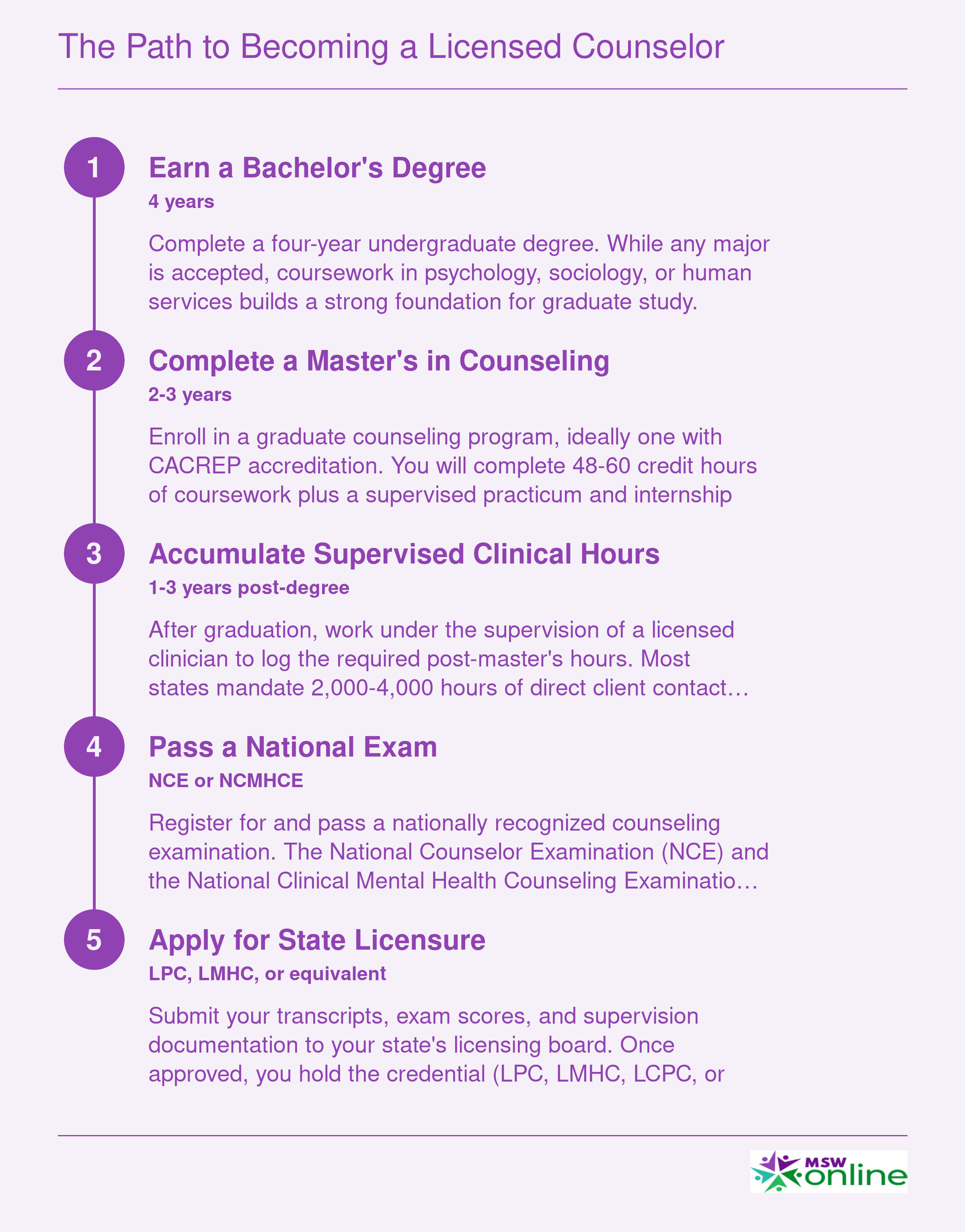
Most states issue a Licensed Professional Counselor (LPC) credential, though some use alternate titles such as Licensed Mental Health Counselor (LMHC), Licensed Clinical Professional Counselor (LCPC), or Licensed Professional Clinical Counselor (LPCC). Regardless of the title, the core requirements typically follow a similar structure:
- A master's degree of at least 60 semester hours from a CACREP-accredited or equivalent program
- Completion of a supervised clinical practicum and internship during the degree
- A post-graduate supervised experience period, usually ranging from 2,000 to 4,000 hours over two to three years
- A passing score on a national exam, most commonly the National Counselor Examination (NCE) or the National Clinical Mental Health Counseling Examination (NCMHCE)
- A state-specific jurisprudence or ethics exam in some jurisdictions
The supervised experience phase is where timelines diverge most. States like Virginia require 3,400 hours of post-degree supervised practice, while others accept as few as 2,000 hours. Some states allow supervision by licensed counselors only; others accept supervision from licensed psychologists or clinical social workers. If you plan to pursue a career as a chemical dependency counselor, additional specialized hours or certifications may be required on top of your general counseling license.
Portability is another important consideration. Counselors who anticipate relocating should look for programs aligned with the most widely accepted standards. CACREP accreditation and the 60-credit-hour curriculum are increasingly recognized as the baseline across states, making license transfer smoother. Several states have also joined interstate compacts designed to simplify the process for licensed counselors who move.
Before enrolling, contact your state's licensing board directly to confirm current requirements. Board websites list approved exam formats, acceptable supervision structures, and any continuing education mandates you will need to maintain after licensure. Taking these steps early puts you on the fastest path from graduation to independent practice. Pursuing additional social work certifications can also strengthen your credentials if you plan to work in specialized settings.
Related Articles
What You Can Do With a Counseling Master's: Specializations and Salary
Four distinct specialization tracks account for the vast majority of master's-level counseling graduates, and each one leads to a different credential, a different client population, and a meaningfully different labor market.
Clinical Mental Health Counseling
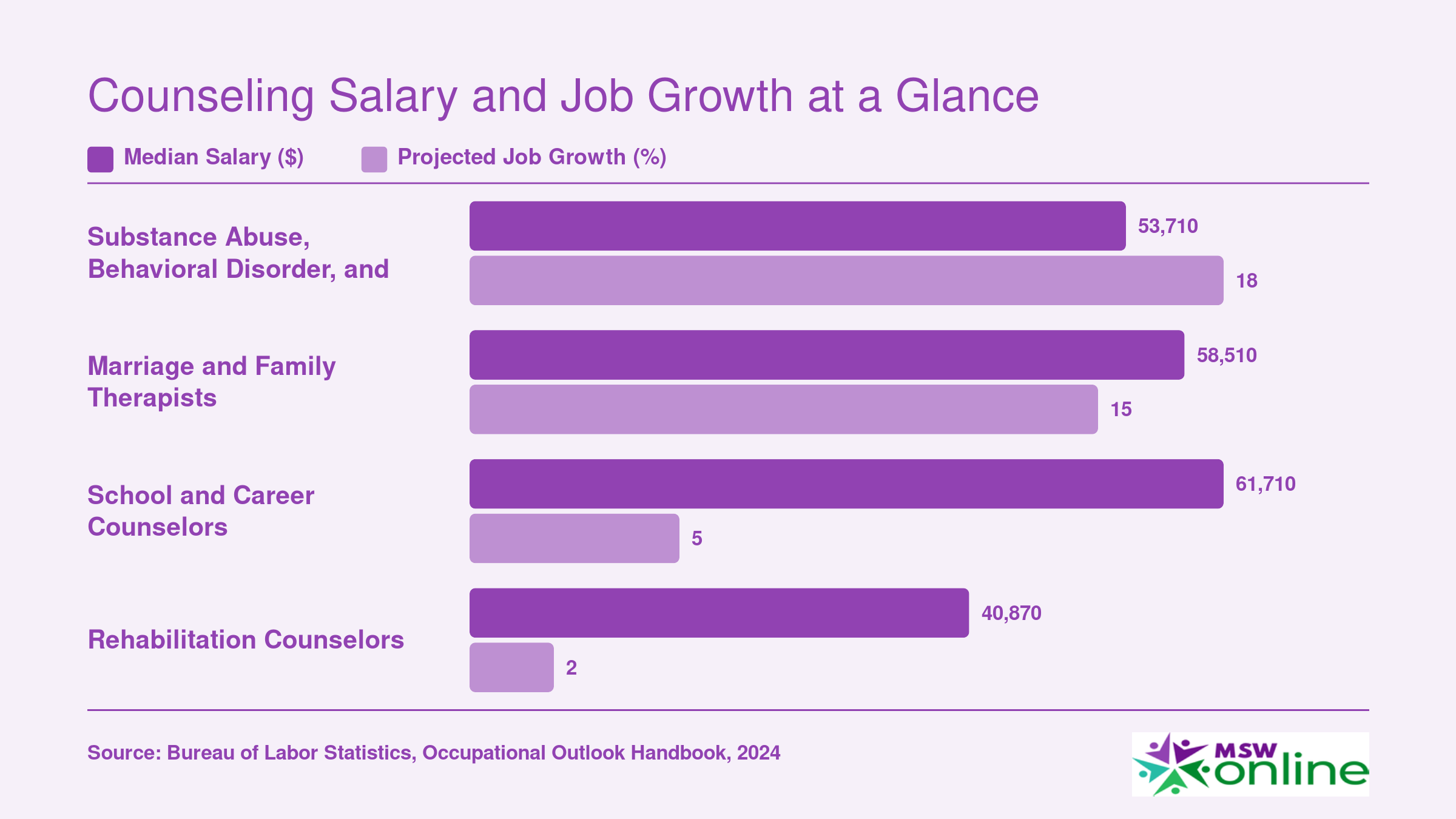
This is the most common track and the one that leads to licensure as a Licensed Professional Counselor (LPC) or Licensed Mental Health Counselor (LMHC), depending on the state. Graduates diagnose and treat mental health disorders in private practice, community agencies, hospitals, and integrated care settings. The BLS groups mental health counselors with substance abuse and behavioral disorder counselors under a single occupational category (SOC 21-1014 and 21-1011 combined). Nationally, the median annual wage for that combined group was $59,190 as of May 2024, with projected job growth of 17 percent from 2024 to 2034 and roughly 42,000 annual openings. Clinical mental health counselors typically command the higher end of that wage range, particularly once fully licensed and in private practice.
School Counseling
School counselors work in K-12 settings and, increasingly, in postsecondary institutions. They focus on academic planning, social-emotional development, and crisis intervention rather than clinical diagnosis. Licensure is issued through state departments of education rather than counseling boards, and the credential is usually titled School Counselor or Certified School Counselor. The BLS reports a national median annual wage of $65,140 for school and career counselors and advisors (SOC 21-1012), with a projected growth rate of 4 percent from 2024 to 2034 and about 31,000 annual openings. Demand tracks enrollment trends and public funding, so certain rural and urban districts face persistent shortages while suburban markets can be more competitive.
Marriage and Family Therapy
An MFT specialization prepares you to treat relational and systemic issues: couples, families, and individuals whose presenting concerns are rooted in relationship dynamics. Graduates pursue licensure as a Licensed Marriage and Family Therapist (LMFT). The BLS reports 15 percent projected job growth from 2022 to 2032 for marriage and family therapists (SOC 21-1013), with roughly 71,200 employed nationally and about 5,900 openings per year.
Substance Abuse and Addiction Counseling
Substance abuse and behavioral therapist degree holders work in detox facilities, outpatient programs, correctional settings, and community health centers. They help clients manage addiction, develop relapse-prevention strategies, and coordinate care. This track shares the BLS occupational category with mental health counselors, contributing to the combined $59,190 median wage and 17 percent growth rate noted above. Demand is especially strong in states with high opioid-related treatment needs, though wages tend to be lower than in clinical mental health roles because a larger share of positions are funded through public behavioral health systems.
How Earnings Data on This Site Differs From BLS Figures
The program-level earnings figures presented in the scorecard data on this site reflect what all counseling graduates earned at one and two years after completing their degrees, regardless of which specialization they pursued or whether they had obtained full licensure. BLS occupational data, by contrast, reflects the wages of workers already employed in a specific counseling occupation. The two data sources answer different questions: one tells you what recent graduates are earning during the supervised-practice phase, while the other captures the full employed workforce, including seasoned clinicians.
Counseling vs. Social Work: Scope and Licensure
Prospective students often weigh a counseling degree against a Master of Social Work. The core difference is scope of practice. Licensed Professional Counselors are trained primarily in psychotherapy, assessment, and diagnosis. Licensed Clinical Social Workers (LCSWs) can also provide therapy but are additionally prepared for case management, policy advocacy, and systems-level intervention. Settings overlap considerably, yet social work in mental health is more prevalent in child welfare, hospital discharge planning, and government agencies, while LPCs cluster in outpatient mental health and private practice. Licensure paths differ as well: LPC candidates complete 2,000 to 4,000 supervised clinical hours (varying by state), while LCSW candidates typically complete 3,000 or more hours of supervised practice after earning the MSW. If direct clinical work with individuals and couples is your primary goal, a counseling degree is the more targeted route. If you want flexibility to move between clinical, macro, and administrative roles, social work offers a broader credential, and you can explore the full range of careers in social work to compare.
Counseling Salary and Job Growth at a Glance
The four major counseling occupations each carry distinct earning profiles and growth trajectories. The figures below are national medians from the Bureau of Labor Statistics; actual salaries vary significantly by state, metro area, practice setting, and years of experience.
Choosing Between Fully Online and On-Campus Counseling Programs
Format does not change what you earn at the end: a CACREP-accredited master's in counseling carries the same weight with licensing boards whether you completed it online or on campus. Licensure requirements, including supervised clinical hours, are identical. The real differences come down to logistics, cost structure, and how much support you need arranging field placements.
Pros
- Online programs let you apply to schools in states with stronger CACREP options, bypassing limited local availability.
- Completing coursework around a work schedule means you can keep earning income and building relevant experience simultaneously.
- On-campus programs typically coordinate practicum and internship sites for you, reducing placement uncertainty.
- In-person cohorts foster direct relationships with local clinicians and agencies, which often translate into job referrals after graduation.
- Campus-based students benefit from real-time faculty mentoring during skills labs and live counseling simulations.
- Net price for online programs is frequently lower once you factor in the elimination of housing, commuting, and campus activity fees.
Cons
- Most online programs require students to locate and secure their own practicum and internship sites, a process that can take months.
- A few state licensing boards apply additional scrutiny to clinical hour documentation submitted by online graduates, sometimes requesting supplemental verification.
- On-campus enrollment locks you into one geographic area, which can be a problem if your local region has limited or expensive program choices.
- Working professionals pursuing on-campus degrees face rigid class schedules that may conflict with employment obligations.
- Online learners miss informal hallway conversations and study groups that naturally build a professional support network.
- Total cost of attendance for residential programs rises substantially when rent, relocation, and transportation are included in the calculation.
Skipping the GRE removes a real barrier, but it does not make one program better or worse than another. No published data shows meaningful differences in completion rates or post-graduation earnings between GRE and no-GRE counseling programs. Focus your evaluation on what actually shapes your career: CACREP accreditation, clinical placement support, faculty credentials, and documented graduate outcomes.
Scholarships, Loan Forgiveness, and Financial Aid for Counseling Students
A master's in counseling can cost anywhere from $20,000 to over $100,000, but several federal and state programs can dramatically reduce that burden. Understanding your options early helps you graduate with manageable debt and move into the career you want.
The National Health Service Corps Loan Repayment Program (NHSC LRP) is one of the most generous options available. Licensed Professional Counselors and Marriage and Family Therapists who commit to a two-year, full-time (40 hours per week) service term at an NHSC-approved site in a mental health Health Professional Shortage Area can receive up to $50,000 in loan repayment.1 Half-time clinicians qualify for up to $25,000, and bilingual providers who deliver services in Spanish may receive an additional $5,000 enhancement.1 After the initial award, continuation funding of up to $20,000 per year is available. In fiscal year 2026, HRSA expects to fund approximately 2,561 LRP awards.1
Counselors working in substance use disorder treatment should also consider the NHSC SUD Workforce Loan Repayment Program, which offers up to $75,000 for a three-year service commitment, plus the same $5,000 Spanish-language enhancement.2 This track is especially relevant for those pursuing careers as substance abuse social workers.
At the state level, more than 30 states operate their own State Loan Repayment Programs (SLRPs), with awards typically ranging from $25,000 to $50,000.3 West Virginia, for example, runs a dedicated Mental Health Loan Repayment Program that provides $10,000 per year with up to three renewals for counselors carrying at least $10,000 in qualifying student debt.3
Finally, Public Service Loan Forgiveness (PSLF) remains a powerful long-term strategy. After making 120 qualifying payments while employed full time by a government or nonprofit employer, your remaining federal student loan balance is forgiven entirely, and the forgiven amount is tax-free.3 Many counseling roles in community mental health centers, schools, and hospitals qualify.
Beyond federal programs, check with your graduate program's financial aid office about institutional scholarships, graduate assistantships, and field placement stipends. Professional associations such as the American Counseling Association and the National Board for Certified Counselors also offer merit-based awards targeted specifically at counseling students.
The Path to Becoming a Licensed Counselor
Earning independent licensure as a professional counselor is a multi-stage process that typically spans 7-10 years from the start of your bachelor's degree to full clinical independence. Here is the standard credentialing sequence most states follow.
More Online Counseling Master's Programs Worth Exploring
Beyond our top-ranked programs, many other fully online counseling master's programs merit consideration. The following schools offer additional options that may align with different priorities, such as specialization, cost, or geographic location.
- Master of Science in Counseling (School Counseling)
- Master of Science in Counseling (Addictions Counseling)
- Master of Science in Counseling (School Counseling)
- Master of Science in Counseling (Addictions Counseling)
- Master of Education in School Counseling