
Points of interest…
- An MSW from a CSWE-accredited program and LCSW licensure are non-negotiable requirements for all military social work paths.
- Roughly 20 schools nationwide offer dedicated military social work concentrations or field placements on military installations.
- The Social Work Licensure Interstate Compact, active since 2024, lets LCSWs in member states practice across state lines without re-licensing.
- From BSW enrollment through full LCSW licensure, the typical timeline spans six to eight years.
Military social workers hold a credential most clinicians never pursue: an MSW plus an active clinical license (LCSW or equivalent) used inside one of the most structurally demanding employment systems in the country. Whether the role is an Army commissioned officer position, a GS-12 slot at a VA medical center, or a DoD behavioral health contract on a military installation, the entry bar is consistent: graduate degree, supervised hours, full licensure.
Three distinct career paths in social work exist for military practice, and they differ on pay structure, deployment exposure, relocation expectations, and advancement timelines. Active-duty officers earn military compensation with housing allowances and retirement benefits. VA civilians work under the federal General Schedule pay scale with civil-service protections. Contractors often earn higher base salaries but carry fewer long-term benefits and less job stability.
The practical tension for most candidates is time: earning an MSW takes two years, post-degree supervised hours for licensure add another two, and some branches impose age cutoffs for commissioned officer accessions. Starting the process without a clear track in mind can cost years.
Defining the Military Social Worker Role
Civilian clinical social workers typically see clients in community mental health centers, hospitals, or private practices. Military social workers encounter the same clinical conditions (PTSD, depression, substance use) but inside a culture shaped by deployment cycles, combat exposure, and the chain of command. That shift in context defines the specialty: military social work is the macro social work and clinical practice focused on service members, veterans, and military families, distinct from general clinical social work not in its clinical tools but in its systems-level understanding of military life.
Three Career Tracks for Military Social Workers
The job title "military social worker" actually covers three separate employment pathways, each with a different employer, benefits structure, and client population.
- Active-duty uniformed officer: Social workers in the Army, Navy, or Air Force hold officer commissions and wear the uniform. They are bound by the Uniform Code of Military Justice, deploy with units, and serve active-duty personnel and their families on bases worldwide.
- VA civilian social worker: These are federal civil servants employed by the Department of Veterans Affairs, typically working in VA medical centers or community-based outpatient clinics. They serve veterans and occasionally their families but are not members of the armed forces.
- Civilian contractor with DoD: Contractors work for private firms that hold Department of Defense contracts, such as the Military OneSource program. They provide short-term, non-medical counseling to service members and families without enlisting or commissioning. This path has the fewest military obligations but also offers none of the military benefits.
What Sets Uniformed Service Apart
Active-duty social workers are military officers first. They earn a commission (usually as an O-2 or O-3 depending on branch and degree), complete officer training, and are subject to military regulations, fitness standards, and deployment. Their patients are active-duty service members, retirees, and families, often on base in behavioral health clinics, embedded within operational units, or during field exercises. The work combines clinical practice with military culture, and assignments may include combat stress control teams, family advocacy programs, or substance abuse treatment. Because active-duty social workers are uniformed personnel, they receive military pay and benefits (housing allowance, health care, retirement), but they also accept the demands of military life: frequent moves, overseas tours, and the possibility of deployment to conflict zones.
The VA Civilian Track and DoD Contractor Roles
VA social workers are federal civilian employees on the General Schedule (GS) pay scale, most hired at the GS-11 or GS-12 level. They work inside the nation's largest integrated health care system, the Veterans Health Administration, and their clients are veterans, not active-duty troops. The role is clinic-based, with a focus on evidence-based psychotherapy, case management, and coordination with primary care teams. Benefits include federal retirement, health insurance, and loan repayment programs, but the job does not involve military service obligations. Civilian contractors, by contrast, typically work for firms like Magellan Health or Zeiders Enterprises that operate DoD programs. These roles provide short-term counseling, often via phone or telehealth, and do not require any military commitment. The barrier to entry is lower: many contractor positions require only an independent social work license and a few years of experience. However, the benefits (no military pension, no Tricare health coverage) are leaner than either the uniformed or VA path. Military social work is just one of many career opportunities in social work, each with its own licensure requirements and client populations.
Daily Duties and Practice Areas in Military Social Work
Military social workers perform a wide range of clinical and administrative tasks depending on whether they serve on active duty, in the reserves, or within the VA system. Understanding these daily responsibilities helps you decide which path fits your professional goals and personal lifestyle.
Active-duty behavioral health officers typically rotate through permanent change-of-station (PCS) assignments every 2 to 4 years. Stateside tours generally last about 3 years, while overseas accompanied tours run 2 to 3 years and unaccompanied tours last roughly 1 year.1 Day-to-day duties include conducting individual and group therapy, crisis intervention, suicide risk assessments, and command consultations. Officers also develop unit-level resilience programs, brief commanders on behavioral health trends, and coordinate referrals across the military healthcare system.
Deployment is a defining feature of uniformed service. Army behavioral health officers can expect 0 to 2 deployments per tour, each lasting 6 to 9 months. Navy and Marine Corps officers face similar 6-to-9-month rotations, while Air Force mental health officers typically deploy for 4 to 6 months with a 1:2 dwell ratio, meaning they spend at least twice as long at home station between deployments.2 During deployment, social workers embed with units to deliver forward-positioned behavioral health care, run combat stress programs, and facilitate reintegration support.
Practice areas within the field are broad. Many military social workers focus on trauma and PTSD treatment, substance use intervention, or family readiness programming. Others specialize in working with children and families at on-base clinics, a role that shares core competencies with child social worker requirements. Some concentrate on chemical dependency, pursuing additional credentials similar to those outlined for a chemical dependency counselor.
VA social workers follow a different rhythm entirely. They have no combat deployment requirement and no PCS obligation, offering geographic stability that appeals to clinicians at later career stages.3 Their daily work centers on case management, benefits navigation, housing assistance, and outpatient mental health treatment for veterans across the lifespan. Despite these differences, both uniformed and VA social workers share a mission: delivering evidence-based care to service members, veterans, and their families.
Frequently Asked Questions About Military Social Work
Prospective military social workers often have overlapping questions about pay, deployment, education funding, and how the role differs across settings. The answers below cover the most common concerns and clarify what it takes to launch a career in military social work.
Step-by-Step: How to Become a Military Social Worker
The path from undergraduate student to fully licensed military social worker spans roughly six to eight years. Each step builds on the last, and skipping any stage is not an option: the LCSW requirement is non-negotiable for both active-duty commissions and VA clinical positions.
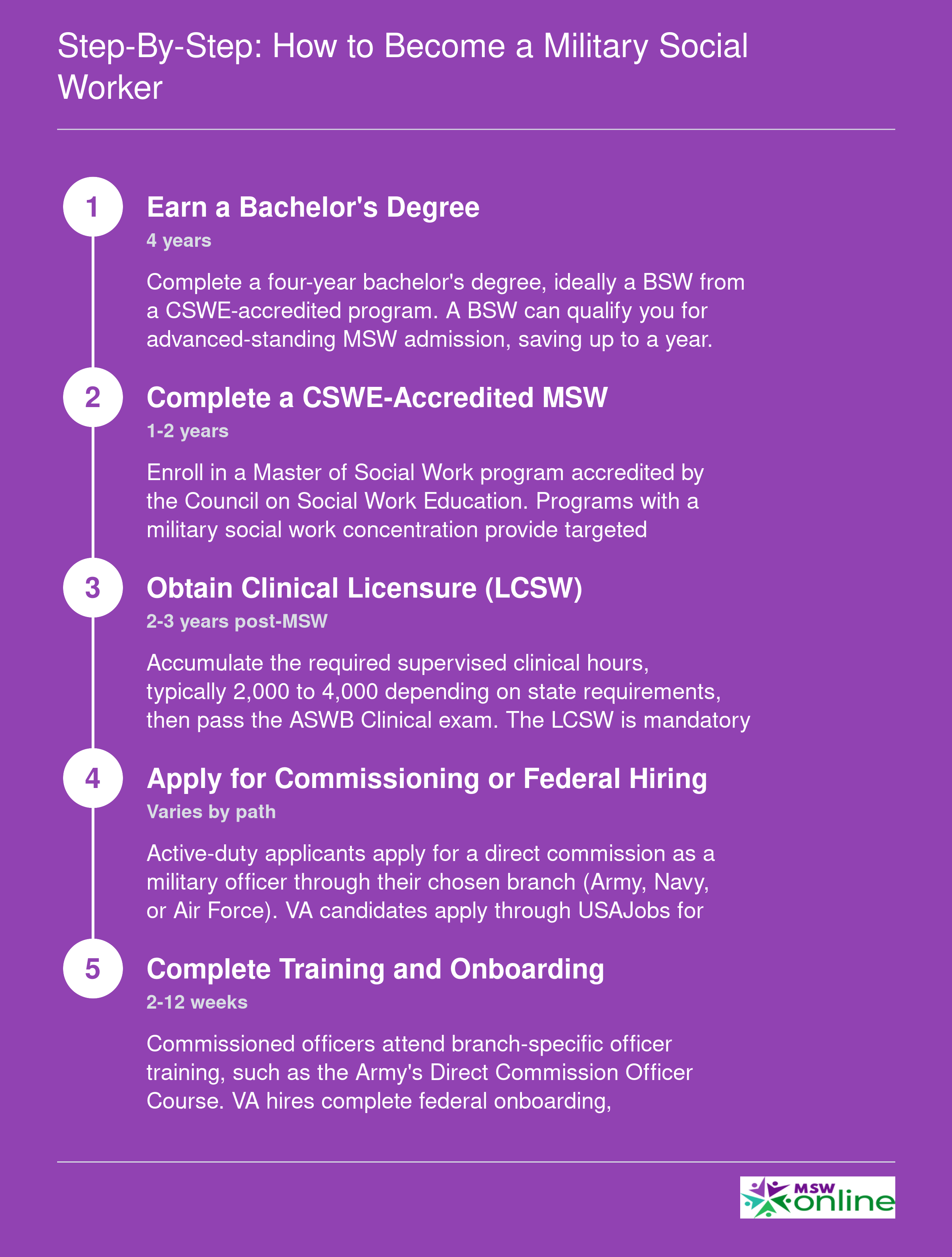
The Full Pathway: BSW Through Commissioning or VA Hiring
Becoming a uniformed or civilian military social worker involves a sequence of academic, licensure, and entry steps that vary by branch and employer. The roadmap below outlines the major decision points, but specifics shift year to year, so verify current rules with the sources listed at the end of this section before committing to a path.
Build the Academic Foundation
Most candidates start with a BSW from a CSWE-accredited program, though any bachelor's degree is acceptable so long as you go on to earn a CSWE-accredited MSW. The MSW is the credential that opens both commissioned officer slots and competitive VA positions. Aim for a clinical concentration if you want to work in behavioral health, family advocacy, or substance use treatment, all of which are core military practice areas. Candidates interested in the therapeutic side of this work may also benefit from exploring behavioral therapist education to broaden their clinical skill set.
During the MSW, pursue a field placement at a VA medical center, Vet Center, military installation, or community agency serving veterans. This experience is heavily weighted in hiring and accession decisions.
Choose Active Duty, VA, or Civilian Contractor
After the MSW, three doors open:
- Active duty commissioned officer: Army (Medical Service Corps, 73A), Navy (Medical Service Corps, designator 1850), or Air Force (Biomedical Sciences Corps, 42SX). Each branch sets its own age cutoffs, rank entry points, and waiver policies, and each runs its own officer training: the Army's Basic Officer Leader Course, Navy Officer Development School, or Air Force Officer Training School.
- VA social worker (federal civilian): Apply through USAJOBS for positions at VA medical centers, Vet Centers, or community-based outpatient clinics. The VA hires at multiple grade levels and often supports licensure progression.
- Civilian contractor: Work for firms providing behavioral health services on military bases under contracts with TRICARE, Military OneSource, or the Family Advocacy Program.
Secure Licensure
Active duty officers must obtain independent clinical licensure (LCSW or equivalent) in any U.S. state or territory, typically within a defined window after commissioning. VA positions can be entered pre-licensure at lower grades, with the agency supporting supervised hours toward the LCSW. Because licensure requirements differ by state, candidates working in VA medical centers or military hospitals should also review medical social worker requirements for context on clinical credentialing expectations.
Verify Current Requirements
Before applying, confirm details with authoritative sources:
- Official branch sites: GoArmy.com, Navy.com, and AirForce.com publish current age limits, rank entry points, and accession bonuses.
- The Bureau of Labor Statistics Occupational Outlook Handbook entry for social workers covers wage and job outlook context, including federal employment.
- A local officer accessions specialist (not a general enlisted recruiter) can give branch-specific, personalized guidance.
- The National Association of Social Workers maintains military and veterans practice resources and a specialty section that connects practitioners across settings.
Questions to Ask Yourself
Military Social Worker Requirements by Branch and Setting
Requirements for military social workers vary depending on whether you serve in uniform, work as a DoD civilian, or practice through a private contract with the VA. Each pathway carries its own eligibility criteria, and the branch of service you choose adds further distinctions.
The U.S. Army's Social Work Officer role (MOS 73A) offers a clear example. Candidates must hold at least a bachelor's degree, preferably in social sciences, and must obtain LCSW licensure.12 Applicants must be U.S. citizens or permanent residents and cannot exceed 31 years of age at the time of commissioning.3 Once accepted, officers commit to an initial service obligation of two to four years.2
The Navy and Air Force maintain similar clinical standards but set their own age limits, physical fitness benchmarks, and commissioning timelines. Across all branches, uniformed social workers must pass a background investigation, meet medical and fitness standards, and complete officer training before beginning clinical duties.
DoD civilian social workers bypass the military fitness and age requirements but still need an MSW from a CSWE-accredited program and, in most positions, an active LCSW. These roles are posted through federal hiring channels and follow the General Schedule (GS) pay scale.
VA and contract settings bring yet another layer of variation. VA medical centers typically require an MSW and state licensure, though some accept provisionally licensed clinicians under supervision. Private contractors working with military populations, such as those offering services similar to a hospice social worker or community social worker, must meet the credentialing standards outlined in each contract, which often mirror or exceed VA requirements.
Before applying to any pathway, verify the most current requirements directly with the recruiting command or hiring office, as eligibility criteria can change between fiscal years.
MSW Programs With Military Social Work Concentrations
Any CSWE-accredited MSW will satisfy the educational requirement for military and VA social work roles, including the commissioning route. That said, a small group of schools (roughly 20 nationwide) offer dedicated military social work concentrations, certificates, or field placements designed around uniformed populations. Choosing one of these tracks is not required, but it can sharpen your clinical preparation and connect you to internships at installations and VA facilities before graduation.
What a Military Concentration Actually Covers
Coursework inside a military track typically goes beyond the standard clinical curriculum to address the specific stressors service members and families face. Expect classes in:
- Combat-related trauma and PTSD treatment, including evidence-based protocols like Cognitive Processing Therapy and Prolonged Exposure
- Military culture, rank structure, and the norms that shape help-seeking behavior
- Deployment-cycle behavioral health, covering pre-deployment readiness, sustainment, reintegration, and family adjustment
- Veteran policy, benefits navigation, and the VA system
- Traumatic brain injury (TBI) screening and co-occurring conditions
- Moral injury, military sexual trauma (MST), and suicide prevention
Programs Worth Investigating
A few well-known options to research as you build your list:
- USC Suzanne Dworak-Peck School of Social Work: Offers a Military Social Work track available online and on-campus, one of the longest-running concentrations of its kind.2
- Fayetteville State University: Located near Fort Liberty, with a Military Behavioral Health focus and strong installation-based field placement pipelines.
- Loyola University Chicago: Offers a Certificate in Military Social Work that can be paired with the MSW.
- University of Louisville Kent School: Online MSSW with military social work field practicum options.
Verify current offerings directly with each school, since concentrations and certificates change from year to year. Field placements through these programs commonly occur at VA medical centers, military treatment facilities, Vet Centers, and partner nonprofits such as the Wounded Warrior Project. If you are comparing programs more broadly, our guide to online master's in social work programs can help you evaluate admission requirements, tuition, and time to degree.
Paying for the Degree
Financial incentives are a real differentiator for military-aligned students. Note that the Health Professions Scholarship Program (HPSP) and the Health Services Collegiate Program (HSCP) do not currently fund MSW students; both are limited to disciplines like medicine, dentistry, and doctoral psychology. The realistic options for social workers are:
- VA Education Debt Reduction Program (EDRP): Awards up to tens of thousands of dollars for clinical social workers hired into qualifying mental health roles at the VA.
- Public Service Loan Forgiveness (PSLF): Forgives remaining federal student loan balances after 120 qualifying payments while employed full-time by the VA, DoD, active-duty military, state or local government, or a 501(c)(3) nonprofit.
Factor these programs into your total cost calculation before you commit to a school.
Active-duty military social workers relocate every few years, and state-specific licensure can create career hurdles. Since 2024, the Social Work Licensure Interstate Compact allows LCSWs in member states to practice across state lines without obtaining a new license, a major relief for military spouses and uniformed social workers. VA social workers avoid this entirely: they hold a single federal credential valid at any VA facility nationwide.
Military Social Worker Salary: National Pay Data by Setting
The BLS does not break out military social workers as a separate occupation, so the closest national benchmarks come from broader social work categories. The figures below reflect approximate 2024 national data for all workers in each category, not military-exclusive roles. For active-duty officers, total compensation runs well above base pay once you factor in Basic Allowance for Housing (BAH), Basic Allowance for Subsistence (BAS), and tax-free status on those allowances. A newly commissioned O-1 starts at roughly $3,826 per month in base pay (about $45,914 annually), while an O-3 with six or more years of service earns roughly $7,133 per month (about $85,594 annually) before allowances. BAH alone can add $1,200 to $3,000 or more per month depending on duty station and dependents, and because allowances are untaxed, the effective total compensation at O-3 can rival six-figure civilian salaries. VA clinical social workers typically enter at the GS-11 level (base range of roughly $59,966 to $77,955 in 2024) and advance to GS-12 (roughly $71,880 to $93,444), with locality pay adjustments of 15% to 40%+ in high-cost areas pushing actual take-home considerably higher.
| Setting or Occupation | Pay Metric | Annual Amount |
|---|---|---|
| Social Workers, All Other (BLS National) | Median Salary | $69,480 |
| Social Workers, All Other (BLS National) | 25th Percentile | $52,010 |
| Social Workers, All Other (BLS National) | 75th Percentile | $95,390 |
| Mental Health and Substance Abuse Social Workers (BLS National) | Median Salary | $60,060 |
| Mental Health and Substance Abuse Social Workers (BLS National) | 25th Percentile | $46,550 |
| Mental Health and Substance Abuse Social Workers (BLS National) | 75th Percentile | $78,980 |
| Active Duty, O-1 (under 2 years) | Base Pay Only | $45,914 |
| Active Duty, O-2 (over 4 years) | Base Pay Only | $66,600 |
| Active Duty, O-3 (over 6 years) | Base Pay Only | $85,594 |
| VA Social Worker, GS-11 (base, no locality) | Salary Range | $59,966 to $77,955 |
| VA Social Worker, GS-12 (base, no locality) | Salary Range | $71,880 to $93,444 |
Highest-Paying States for Social Workers
The table below draws from BLS state-level wage data across three social work occupation categories most relevant to military social work practice. States with large military installations, VA medical centers, or high costs of living tend to rank near the top, largely because of locality pay adjustments for federal civilian positions. Keep in mind that active-duty military social worker pay is set by federal pay grade (O-1 through O-6) and does not vary by state. These figures primarily reflect compensation for VA, civilian contractor, and state-employed social workers.
| State | Occupation Category | Total Employment | Median Annual Wage | 75th Percentile Wage |
|---|---|---|---|---|
| Washington | Social Workers, All Other | 870 | $96,550 | $112,320 |
| Massachusetts | Social Workers, All Other | 590 | $94,000 | $112,650 |
| Georgia | Social Workers, All Other | 1,180 | $92,750 | $110,930 |
| South Carolina | Social Workers, All Other | 500 | $91,940 | $106,870 |
| Texas | Social Workers, All Other | 2,700 | $89,520 | $113,840 |
| Virginia | Social Workers, All Other | 1,000 | $86,690 | $105,810 |
| New York | Mental Health and Substance Abuse Social Workers | 14,180 | $80,230 | $98,100 |
| Connecticut | Mental Health and Substance Abuse Social Workers | 1,350 | $78,820 | $92,270 |
| California | Mental Health and Substance Abuse Social Workers | 18,020 | $75,320 | $105,020 |
| District of Columbia | Mental Health and Substance Abuse Social Workers | 640 | $72,720 | $106,720 |
| Connecticut | Child, Family, and School Social Workers | 5,360 | $78,940 | $98,060 |
| District of Columbia | Child, Family, and School Social Workers | 2,800 | $78,920 | $95,820 |
| New Jersey | Child, Family, and School Social Workers | 6,410 | $78,150 | $98,920 |
| Washington | Child, Family, and School Social Workers | 10,570 | $72,290 | $84,180 |
| Maryland | Child, Family, and School Social Workers | 5,030 | $70,840 | $93,810 |
| California | Child, Family, and School Social Workers | 55,220 | $69,250 | $88,190 |
Career Outlook and Demand for Military Social Workers
Steady, broad-based growth across the social work profession versus acute, targeted shortages inside federal and military behavioral health: the national outlook and the military-specific outlook tell two different stories, and both favor candidates entering the field now.
What the National Numbers Show
The Bureau of Labor Statistics projects 6% employment growth for social workers (SOC 21-1020) from 2024 to 2034, with roughly 74,000 annual openings nationwide. Two subspecialties most relevant to military practice grow faster than the overall average: mental health and substance abuse social workers at 10.6% and healthcare social workers at 9.6% (2022 to 2032 projections). Both subfields map directly onto the clinical work that fills active-duty, VA, and contractor caseloads.
BLS does not publish a separate projection for military social workers specifically, so these national figures are the closest reliable benchmark. Treat them as a floor rather than a ceiling for the federal sector.
Demand Drivers Specific to Military Practice
Several forces concentrate demand in military and veteran settings beyond what the headline numbers suggest:
- Aging Vietnam-era veterans: Geriatric care coordination, hospice, and dementia-related casework are expanding inside VA medical centers.
- Post-9/11 cohort in peak treatment years: Veterans who served between 2001 and 2014 are now in the life stage where PTSD, substance use, and family stressors most often surface clinically.
- Military sexual trauma (MST) response: Both DoD and VA have expanded MST coordinator roles and survivor advocacy programs over the past decade.
- Embedded behavioral health teams: Each branch has pushed clinicians out of central hospitals and into operational units, multiplying the number of billets.
The geriatric care expansion alone has created a growing need for professionals trained in aging populations. You can learn more about that pathway in our guide on how to become a geriatric social worker.
VA and Active-Duty Hiring Posture
The Department of Veterans Affairs is one of the largest single employers of social workers in the country and has repeatedly designated social work a shortage occupation, which unlocks recruitment incentives, direct-hire authority, and student loan repayment. On the active-duty side, the Army, Navy, and Air Force routinely report unfilled behavioral health officer billets, meaning qualified LCSWs who meet age, fitness, and security clearance standards face favorable commissioning odds compared with most other officer specialties.
Related Articles
Which entry point actually fits your life right now? That single question matters more than any other. Commission as an officer if you want full immersion in military culture, rank progression, and potential deployment. Apply to the VA through USAJobs (search GS-0185, Social Worker) if you prefer federal benefits with a stateside clinical focus. Pursue a DoD civilian contract if you value flexibility and competitive pay without a uniform commitment.
Your concrete first step: contact a branch health professions recruiter or open a USAJobs account and set alerts for GS-0185 postings in your region. Demand for licensed clinical social workers in military and VA settings is strong and projected to stay that way. Few careers in social work let you combine advanced clinical practice with direct service to those who have served. Start now.