
Points of interest…
- Most states require an MSW plus a separate school certification or license to work as a school social worker.
- The typical timeline from bachelor's degree through MSW and licensure spans five to seven years.
- BLS data shows roughly 382,960 child, family, and school social workers employed nationally, signaling strong demand.
- A few states permit entry with a BSW, but career advancement and salary growth generally depend on earning an MSW.
Student mental health referrals in U.S. public schools rose sharply between 2020 and 2024, and districts continue adding positions to meet demand. School social workers fill a role that neither school counselors nor school psychologists cover: they connect students and families to community resources, conduct clinical assessments, and address systemic barriers to learning.
The credential path typically stacks three layers: a degree (usually an MSW), a state social work license, and a school-specific certification or endorsement. Whether a bachelor's degree alone qualifies you depends entirely on your state, though the short answer is that most states and most districts require a master's. That single requirement adds roughly two years and significant tuition cost to the timeline, making it the central planning decision for anyone entering the field.
What Does a School Social Worker Actually Do?
School social workers occupy a unique niche among pupil-services professionals. Their core mandate is to mitigate the environmental, familial, and systemic barriers that keep students from learning. While school counselors focus on academic planning and college or career advising, and school psychologists concentrate on psychoeducational testing and IEP eligibility, school social workers cast the widest net across systems outside the building.
On a typical day, a school social worker might:
- Conduct psychosocial and ecological assessments that examine family dynamics, community risk factors, and socioeconomic stressors
- Make home visits to understand a student's living situation firsthand
- Coordinate case management across child welfare, juvenile justice, housing, and healthcare agencies
- Facilitate crisis response when a student faces abuse, neglect, or acute mental health episodes
- Link families to community resources such as food assistance, counseling services, or legal aid
- Provide individual or group psychotherapy when they hold the appropriate clinical license
These responsibilities are guided by the NASW Standards for School Social Work Services and the SSWAA National School Social Work Practice Model, which together define best practices for the profession. The emphasis on ecological assessment sets school social workers apart: rather than focusing solely on what happens inside the classroom, they evaluate the full context of a child's life.
It is worth noting how this role differs from related positions. A school counselor designs and implements a comprehensive counseling program for all students, relying on the ASCA National Model, while a school psychologist administers cognitive and academic testing and develops behavior intervention plans under the NASP Practice Model.2 The school social worker, by contrast, serves as the bridge between school and community, coordinating services that no single institution can provide alone. Professionals drawn to this intersection of child social worker duties and educational advocacy often find the school setting deeply rewarding.
If you are considering a career that blends social work in mental health with direct student support, understanding this day-to-day scope is your first step.
School Social Worker vs. School Counselor vs. School Psychologist
Three professionals, one building, overlapping goals. Understanding where school social workers, school counselors, and school psychologists diverge is not just an academic exercise. It shapes which credential you pursue, which problems you are trained to address, and which job titles will actually appear on your hiring paperwork.
What Each Role Is Designed to Do
School social workers are the bridge between the school and the family. Their training roots them in systems thinking, meaning they examine how poverty, housing instability, trauma, and community factors affect a student's ability to learn. They coordinate with outside agencies, facilitate crisis intervention, and lead groups focused on attendance, behavior, and mental health.
School counselors focus on academic planning, college and career readiness, and short-term emotional support. They manage course scheduling, facilitate guidance programs, and often run the logistics around graduation requirements and postsecondary transitions.
School psychologists concentrate on cognitive and psychological assessment. They administer and interpret standardized testing to evaluate learning disabilities, diagnose developmental conditions, and inform special education placements. Their work is typically more evaluative and less relationship-based day to day.
Education and Entry Requirements
School social workers and school counselors both require a master's degree in their respective fields.1 School psychologists, however, typically need a specialist degree (EdS) or a doctorate, reflecting the scope and technical depth of their assessment responsibilities.2 That additional training translates directly into salary: nationally, school psychologists earn a mean annual wage of roughly $93,610, compared to $62,920 for school social workers and $48,190 for school counselors.1 These are national figures, and individual states vary. In North Carolina, for example, the comparable figures are approximately $70,090, $59,010, and $45,790, respectively. Most states credential each role separately, and earning the right school social worker certification is a distinct process from qualifying as a counselor or psychologist.
Staffing Realities and Growth
All three roles are in demand, with projected job growth over the 2020 to 2030 period running close together: 12 percent for school social workers, 11 percent for school counselors, and 10 percent for school psychologists. Professional associations recommend a 1:250 ratio for both school social workers and counselors, and 1:500 for school psychologists.1
Actual staffing in many states falls far short of those benchmarks. North Carolina illustrates the gap clearly: the state's school social worker ratio sits at roughly 1:920, school counselors at 1:333, and school psychologists at a striking 1:1,863.1 Numbers like these signal genuine unmet need, but they also mean practitioners in understaffed schools carry heavier caseloads than recommended.
Choosing Your Path
If your instinct is to work with families and community systems, school social work is the more direct fit. If assessment and psychoeducational testing draw you, school psychology offers a more specialized lane, with higher compensation but a longer training runway. School counseling occupies the middle ground, with a strong academic advising component. None of the three roles is interchangeable in practice, and most states credential them separately, so clarifying your focus before you apply to graduate programs will save significant time and tuition.
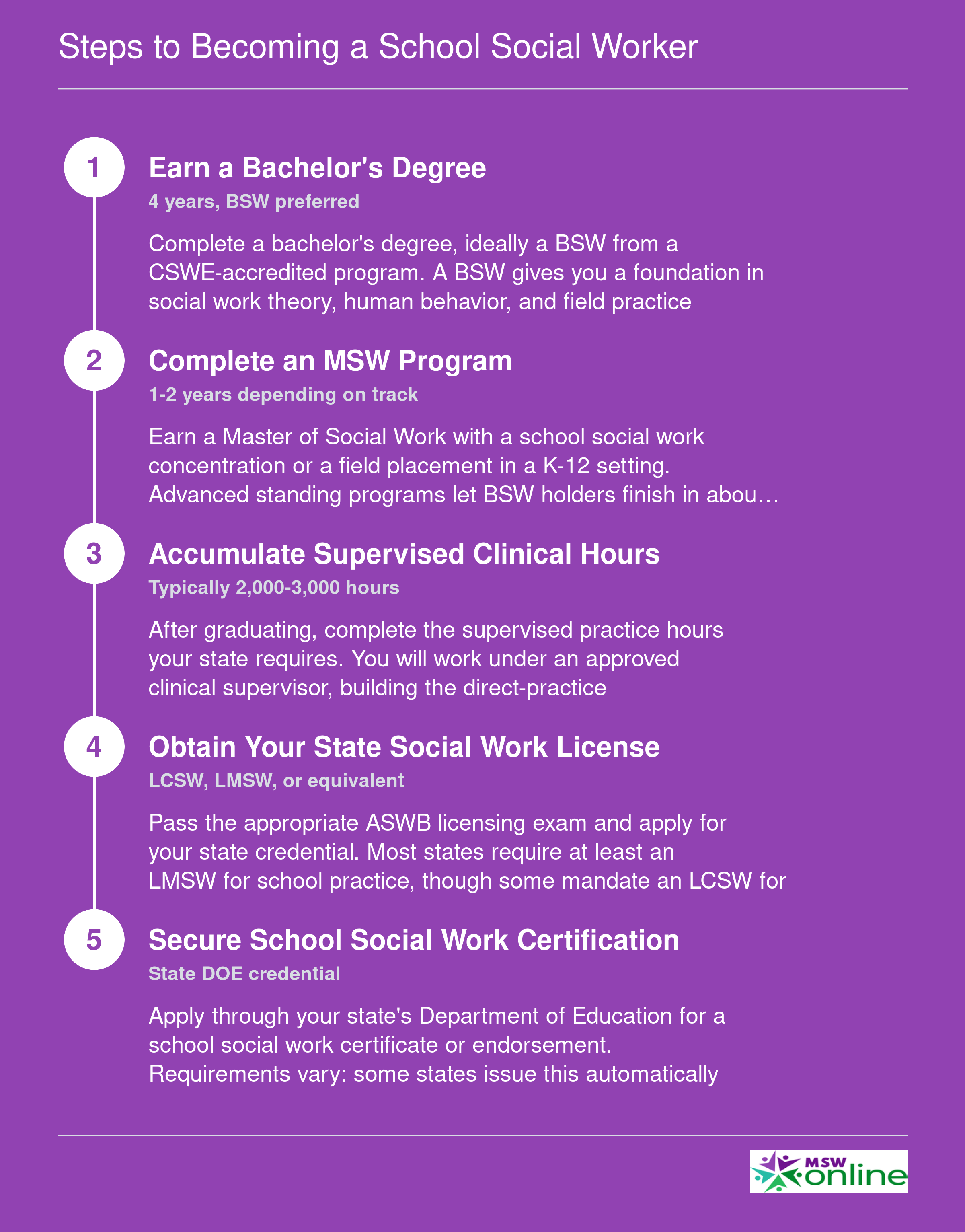
Steps to Becoming a School Social Worker
The path to school social work follows a credentialing ladder that builds from foundational education to specialized certification. Some states combine licensure and school certification into a single credential, while others require you to hold both a state social work license and a separate Department of Education certificate.
Education Requirements: Do You Need a Master's Degree?
Two pathways start with a bachelor's degree, but only one, the Master of Social Work, meets the educational threshold most states and school districts demand for the official school social worker role.
The Core Requirement: An MSW is Non-Negotiable in Most States
The direct answer to the most common question is clear: you almost always need a master's degree to become a credentialed school social worker. While a Bachelor of Social Work (BSW) provides foundational knowledge, the Council on Social Work Education (CSWE) and school employers across the country have set the MSW as the standard. In 2026, the national school social worker credential requires an MSW, and state licensure boards mirror this expectation. Approximately 39 states offer some form of bachelor-level social work licensure, but that license does not authorize independent school social work practice or confer the title "school social worker." Instead, it may permit supervised roles like social work assistant or family liaison. For those who want the full scope of practice, from assessment and crisis intervention to IEP collaboration, the MSW is the entry ticket.
The BSW Pathway: Limited but Not Closed
BSW holders can find meaningful work inside schools, but the position titles and responsibilities differ. Common roles include social work assistant, behavioral specialist, attendance officer, or family engagement coordinator. These positions often support certified school social workers and may involve case management, home visits, or resource coordination. However, without an MSW, you will not be able to hold the official "school social worker" credential in any state that specifically regulates school social work. If your long-term goal is to step into that role independently, plan on returning for an MSW.
The Non-BSW Bachelor's Route: Starting from Scratch
Career changers with a bachelor's in psychology, sociology, education, or any other field also have a straightforward path. Most CSWE-accredited MSW programs accept applicants from all undergraduate backgrounds. Without a BSW, you will enter a two-year generalist track that covers core social work competencies in the first year before concentrating on school-based practice. This path takes longer but is open to anyone. It is the default route for the many school social workers who discover the field after their first degree. Those drawn to youth-focused work may also want to explore careers in social work to compare related specializations before committing to a concentration.
Online MSW Programs: A Flexible Path to School Social Work
For working professionals or those who need geographic flexibility, online MSW programs with a school social work emphasis are widely available and equally credible, provided they hold CSWE accreditation. That accreditation is the single non-negotiable factor, as it ensures the curriculum meets licensure and certification standards. Several established universities now offer fully online MSW concentrations designed for school settings:
- University of Illinois: an online MSW with a School Social Work concentration, CSWE-accredited.
- University of Michigan: an online MSW with a School Social Work concentration, CSWE-accredited.
- University of Denver: an online MSW with a Children, Youth, and Families concentration, CSWE-accredited.
- Simmons University: an online MSW with a Children and Families concentration, CSWE-accredited.
- University of Southern California: an online MSW with a Children, Youth, and Families concentration, CSWE-accredited.
Each program prepares graduates to pursue state school social work credentials, though field placements should be chosen with school-based roles in mind. These online pathways mirror their on-campus counterparts in rigor and often in tuition, but they add the flexibility to continue working while earning the degree.
The Advanced Standing Shortcut for BSW Holders
If you already hold a BSW from a CSWE-accredited program, you may qualify for advanced standing, which can reduce the MSW timeline from two years to roughly one. Advanced standing programs recognize your foundational coursework and field experience, allowing you to start immediately in the specialization year. This option makes the transition to a full school social work role significantly faster and more economical, but it requires that your BSW was earned recently (typically within the last five to seven years) and that you meet minimum GPA thresholds set by the admitting university.
Related Articles
Licensure and School Certification Requirements by State
Every state sets its own rules for who can practice social work in schools, so the credentials you need depend on where you plan to work. Some states require a standalone school social work credential issued by the state education agency. Others accept a clinical social work license (such as the LCSW) and may add a supplementary certification. A few states require both. Understanding the distinction between a state education credential and a clinical license is critical to mapping out your timeline.
California offers a clear example. To work in public schools, you must earn the Pupil Personnel Services (PPS) Credential in School Social Work, issued by the California Commission on Teacher Credentialing.1 This credential requires 45 semester units of approved coursework, a practicum, and at least 150 supervised hours.1 Notably, California does not require a separate clinical license to practice in schools, so the PPS credential alone authorizes you to serve students in a K-12 setting.1 If you later choose to pursue clinical licensure as an LCSW, you will need an additional 3,000 hours of supervised experience completed over a minimum of 104 weeks.
Other states follow different models. New York, for instance, issues a school social worker certificate through its Department of Education, while Texas requires applicants to hold a Licensed Master Social Worker (LMSW) credential and obtain a separate school-based certificate. States like Illinois combine a Professional Educator License with a school social work endorsement.
Because requirements shift frequently, always verify current rules with your state's education department and licensing board before enrolling in a program. Many MSW programs align their curricula with the credentialing standards of the states they serve, but confirming this alignment yourself prevents costly surprises. Professionals interested in related school-based roles, such as how to become a behavioral therapist, should note that each specialty carries its own credentialing pathway.
State Credential Requirements at a Glance
Requirements to practice as a school social worker vary significantly from state to state. Some states allow entry with a BSW, while most require an MSW and a state-issued license or certification. The table below summarizes credential requirements for selected states. Always verify current rules with your state's department of education and social work licensing board, as policies can change.
| State | Required Degree | Social Work License Needed | DOE Credential Name | School-Based Practicum Hours |
|---|---|---|---|---|
| California | MSW | No (but recommended) | Pupil Personnel Services (PPS) Credential | 600 |
| Connecticut | MSW | Yes (LCSW or provisional) | Educator Certificate, School Social Worker | N/A |
| Florida | MSW | Yes (LCSW) | Certification in School Social Work | N/A |
| Illinois | MSW | Yes (LSW or LCSW) | Professional Educator License with School Social Worker Endorsement | 600 |
| Massachusetts | MSW | No (license not required for school-based role) | Educator License, School Social Worker/School Adjustment Counselor | 300 |
| Michigan | MSW | Yes (LMSW or LCSW) | School Social Worker Approval | N/A |
| New York | MSW | Yes (LMSW or LCSW) | Certificate in School Social Work | 600 |
| Ohio | MSW | Yes (LSW or LISW) | Pupil Services License, School Social Worker | 600 |
| Pennsylvania | MSW | No (license not required for school-based role) | Educational Specialist Certificate, School Social Worker | 600 |
| Texas | MSW | Yes (LMSW or LCSW) | School Social Worker Certificate | N/A |
| Virginia | MSW | Yes (LCSW recommended) | Pupil Personnel Services License, School Social Worker | 600 |
| Wisconsin | BSW or MSW | No (license not required for school-based role) | DPI License, School Social Worker | N/A |
Questions to Ask Yourself
How Long Does It Take to Become a School Social Worker?
The total timeline to become a school social worker typically ranges from six to eight years after high school, depending on the path you choose and your state's specific requirements.
The foundation is a four-year bachelor's degree. While a Bachelor of Social Work (BSW) is ideal because it can qualify you for advanced standing in a graduate program, degrees in psychology, education, or sociology are also common entry points. After completing your bachelor's, you will need a Master of Social Work (MSW), which generally takes two years of full-time study. If you hold a BSW from a CSWE-accredited program, advanced standing can shorten the MSW to roughly one year, saving significant time and tuition.
During your MSW program, expect to complete a substantial field education requirement. CSWE-accredited programs mandate a minimum of 900 hours of supervised field education, a standard that ensures graduates are practice-ready before entering schools or other settings. This fieldwork is typically built into the program's curriculum, so it does not add extra semesters, but it does demand a heavy time commitment during your final year.
After earning your MSW, you will need to obtain licensure and, in most states, a credential issued by State Education Agencies. The licensure process usually involves passing an examination and accumulating supervised clinical hours, which can take one to two additional years. Some states, like North Carolina, offer a provisional credential that allows you to work while completing licensure requirements, which can help you gain experience without a gap in employment.
Compared to other social work specializations, such as becoming a pediatric social worker or pursuing a marriage and family therapist career path, the school social work timeline is similar. The key variable is whether your state requires post-graduate supervised experience before granting full credentials. Planning ahead and choosing an advanced-standing MSW program when eligible is the most effective way to shorten your path into the school setting.
School Social Worker Salary and Employment Outlook
The Bureau of Labor Statistics groups school social workers under the Child, Family, and School Social Workers category (SOC 21-1021). As of the most recent BLS data, roughly 382,960 professionals work in this occupation nationally, reflecting strong and sustained demand across school districts. BLS projects 5.3% job growth for 2024 to 2034, adding an estimated 18,900 new positions. Can a school social worker earn $100,000? The 75th percentile sits at $74,060 nationally, but professionals in high cost of living states (such as California, New York, and New Jersey) or those who move into administrative and supervisory roles regularly cross the six figure mark.
| Metric | National Figure |
|---|---|
| National Median Salary | $58,570 |
| National Mean Salary | $62,920 |
| 25th Percentile Salary | $47,480 |
| 75th Percentile Salary | $74,060 |
| Total National Employment | 382,960 |
| Projected Job Growth (2024 to 2034) | 5.3% |
| Projected New Positions (2024 to 2034) | 18,900 |
Highest-Paying States for School Social Workers
The BLS groups school social workers under the "Child, Family, and School Social Workers" category (SOC 21-1021). The table below ranks the top-paying states by median annual wage and includes total employment so you can compare compensation with job availability. States with strong public-sector unions, teacher pay scale placement for school social workers, and higher costs of living tend to cluster near the top. Michigan does not appear among the highest-paying states in the most recent BLS data for this occupation; school social workers there earn closer to the national median, reflecting moderate cost of living and varied district pay structures across the state.
| State | Median Annual Wage | Mean Annual Wage | 25th Percentile | 75th Percentile | Total Employment |
|---|---|---|---|---|---|
| Connecticut | $78,940 | $80,180 | $63,730 | $98,060 | 5,360 |
| District of Columbia | $78,920 | $80,040 | $59,280 | $95,820 | 2,800 |
| New Jersey | $78,150 | $79,610 | $59,590 | $98,920 | 6,410 |
| Washington | $72,290 | $73,080 | $58,250 | $84,180 | 10,570 |
| Maryland | $70,840 | $73,490 | $52,350 | $93,810 | 5,030 |
| California | $69,250 | $73,150 | $54,890 | $88,190 | 55,220 |
| Massachusetts | $67,880 | $70,620 | $55,510 | $87,150 | 9,830 |
| Rhode Island | $67,150 | $69,960 | $50,770 | $83,910 | 2,320 |
| North Dakota | $66,900 | $67,350 | $58,840 | $77,480 | 780 |
| Hawaii | $66,450 | $68,790 | $58,550 | $77,100 | 1,080 |
| New York | $65,430 | $75,270 | $57,950 | $82,980 | 27,220 |
| Vermont | $65,370 | $65,460 | $58,760 | $71,720 | 540 |
| Minnesota | $65,010 | $68,580 | $54,230 | $79,450 | 6,430 |
| New Hampshire | $64,630 | $65,880 | $45,790 | $76,880 | 1,130 |
| Colorado | $63,560 | $69,470 | $53,930 | $80,440 | 7,840 |
School social work blends stable demand and competitive pay with a school-year schedule, offering a rare work-life balance in the profession. The catch: most states require both an MSW and a separate school certification, so map out your credential path early. The investment pays off in summers off and the deep satisfaction of supporting students every day.
Essential Skills and Competencies for School Social Workers
Classroom-level counseling skills and systems-level advocacy skills may sound related, but they draw on very different competencies, and school social workers need both. MSW programs with a school social work concentration, along with standards set by the School Social Work Association of America, emphasize a core skill set that goes well beyond traditional talk therapy.1
Core Competency Areas
Graduate training and credentialing standards converge around several domains:
- Crisis intervention: Responding to suicidal ideation, abuse disclosures, or violent incidents in real time, often before outside responders arrive.
- Trauma-informed care: Applying healing-centered and prevention-focused frameworks so that discipline policies, classroom routines, and referral pathways account for adverse childhood experiences.
- Special education law: Understanding IDEA, Section 504, and the school social worker's role in IEP teams, including conducting social-developmental assessments.
- Cultural competency: Working effectively across racial, linguistic, and socioeconomic lines in districts that are often more diverse than their teaching staffs.
- Family systems work: Engaging caregivers as partners rather than adversaries, including conducting home visits when school-based contact is not enough.
These areas overlap with what school counselors and school psychologists study, but several competencies sit more squarely in the social worker's lane: navigating community resources such as housing assistance or food banks, conducting home visits, and advocating within school board and district policy structures for systemic change. This work spans micro, mezzo, and macro levels of practice. School social workers also drive multi-tiered systems of support (MTSS), equity initiatives, and trauma-informed practice adoption across entire buildings or districts.
Is It Hard Being a School Social Worker?
Honestly, yes, parts of it are very hard. The recommended student-to-school-social-worker ratio is 1:250, yet many practitioners carry caseloads far above that threshold.3 Role confusion with counselors and psychologists can create bureaucratic friction. The emotional toll is real: secondary traumatic stress and burnout are well-documented challenges in the field, and increasing student mental health needs show no signs of easing.4
That said, practitioners consistently report deep rewards that counterbalance the strain. Witnessing student growth over months or years, building long-term relationships that are rare in clinical settings, and influencing an entire school's climate are experiences unique to this role. The school calendar also provides a structural advantage: summers, winter breaks, and holidays offer recovery time that most healthcare social workers do not receive in clinical positions.
Deepening Skills Over a Career
Licensure renewal in every state requires continuing education, and those hours are an opportunity rather than a chore. Practitioners can pursue advanced training in areas like restorative justice, play therapy, motivational interviewing, or school-based substance use intervention. Many school social workers also attend SSWAA conferences or complete specialized certificates that align with district priorities around equity or behavioral health integration.
The combination of compassion, professional expertise, and resilience that the role demands is not built in a single degree program.4 It develops through years of practice, supervision, and intentional skill-building, which is exactly what the continuing education cycle is designed to support.
Your Next Steps
Becoming a school social worker requires deliberate planning, but the path is well-defined. Start by confirming your state's credential requirements, then choose a CSWE-accredited MSW program with a school social work concentration or a related youth-and-family track. If you already hold a BSW, explore advanced standing options that can cut your graduate timeline in half. During your MSW, secure a school-based field placement to build the competencies districts want to see on day one. After graduation, prioritize licensure exams and any state education credential applications so you can enter the workforce without delays. If you are still weighing whether school-based practice is the right fit, compare it with other career opportunities in social work to clarify your direction. The students who need you are already in the building. Your job is to get credentialed and walk through the door.