
Points of interest…
- Advanced standing online MSW programs typically require about 30 fewer credits than traditional tracks, cutting time to roughly one year.
- Net prices across ranked programs range from roughly $6,400 to $23,000 per year after grants and scholarships.
- Every program on this list holds CSWE accreditation, which is required to pursue LMSW or LCSW licensure in all states.
- Field placements average 500 to 600 hours and can usually be completed at agencies near your home.
An advanced standing MSW slashes the standard two-year program by up to 45 credits, translating into $15,000 to $40,000 less in tuition and a full year of earlier earning potential. That math is only available to graduates of CSWE-accredited BSW programs, and the most accelerated online tracks can wrap the degree in under 18 months.
Every program listed holds CSWE accreditation, the non-negotiable credential for licensure. But the real friction point for online advanced standing students is not coursework: it is field placement. Finding a local agency willing to supervise the required 900 to 1,200 hours while you complete classes remotely can delay graduation if left to the last month.
Where you plan to practice after graduation shapes which program's field placement network matters most.
Top Advanced Standing Online MSW Programs for 2026
We evaluated these programs using a composite that prioritizes what BSW graduates care about most: total cost after aid, debt load at graduation, and early-career earnings. Every school listed holds CSWE accreditation and offers an advanced standing track that lets you finish your MSW in roughly one year. Net price, median graduate debt, and institution-wide earnings data drove the order below, so the most affordable, lowest-debt options rise to the top.
- Net price after financial aid
- Median graduate debt at completion
- Post-graduation earnings outcomes
- Institution-wide graduation rate
- Program format and flexibility
- NCES-IPEDS federal institutional data — nces.ed.gov
- College Scorecard graduate earnings — collegescorecard.ed.gov
- Independent program research
- Internal program database
The University of Texas Rio Grande Valley
#1Edinburg, TX · $0 – $5,000/yr
Best for: BSW grads seeking border-region practice
Located along the Texas-Mexico border, UT Rio Grande Valley pairs one of the lowest net prices on this list with a 33-credit-hour advanced standing MSSW built for BSW graduates. The program is available fully online and features concentrations tailored to border-region communities, including Direct Practice with Latino Individuals, Families, and Groups, and Administration and Community Practice. With a median graduate debt of $12,950, UTRGV delivers strong value for students planning careers in underserved areas of South Texas and beyond.
- 33 credit hours for BSW graduates
- Fully online format with flexible admission cycles
- Direct Practice with Latino communities concentration
- Administration and Community Practice concentration
- CSWE accredited with research-focused curriculum
- Requires 3.0 GPA, personal statement, and three recommendations
- Basic statistics course is a prerequisite
California State University-San Bernardino
#2San Bernardino, CA · $5,000/yr (net price)
Best for: Working professionals wanting a 12-month finish
Cal State San Bernardino's 35-unit advanced standing MSW can be wrapped up in as few as 12 months or stretched across five semesters for working professionals. Available online or at the San Bernardino and Palm Desert campuses, the program pairs practicum education with CSWE-aligned coursework. At a net price of $4,564, it is the most affordable option on this list when measured by out-of-pocket cost after aid, and the institution reports median graduate debt of $14,715.
- 35-unit curriculum completable in 12 months full-time
- Five-semester part-time option available
- Online, San Bernardino, or Palm Desert campus delivery
- Practicum integrates classroom learning with field experience
- Requires BSW from a CSWE-accredited program
- CSWE accredited with focus on practical skills
- Flexible scheduling designed for employed students
University of Central Florida
#3Orlando, FL · $10,000/yr
Best for: Clinically focused students preferring accelerated terms
UCF's online MSW program offers a 32-credit-hour advanced standing track that can be completed in about 16 months, with accelerated seven-week terms and no required campus visits. Priced at roughly $487 per credit hour, the program emphasizes clinical social work and requires 600 field hours. The university's 78% institution-level graduation rate is the highest among all schools on this list, and median earnings ten years after enrollment reach $58,308.
- 32 credit hours for advanced standing students
- Approximately 16-month completion timeline
- 600 field hours required, arranged locally
- Accelerated seven-week course terms
- No campus visits required for online track
- Approximately $487 per credit hour
- Prepares graduates for state clinical licensure exams
University of South Florida
#4Tampa, FL · $10,000/yr
USF's fully online advanced standing MSW totals 35 credit hours and can be finished in three semesters at full-time pace or five semesters part-time. Coursework is asynchronous with live sessions two evenings per week, and no GRE is required unless a student's GPA falls below 3.0. The institution reports a net price of $9,812 and median graduate debt of $17,988, with ten-year median earnings of $57,743 for graduates across all programs.
- 35 credit hours, completable in three full-time semesters
- Five-semester part-time path available
- Fully online with two live evening sessions weekly
- No GRE required for applicants with 3.0+ GPA
- CSWE accredited, meeting Florida licensure standards
- In-person field placement arranged in student's community
- Emphasis on social and economic justice frameworks
Florida Atlantic University
#5Boca Raton, FL · $5,000 – $17,000/yr
Florida Atlantic University's advanced standing MSW blends online coursework with on-campus components in a hybrid format designed for BSW holders. The program highlights a 93% job placement rate within one year of graduation and stresses evidence-based clinical practice. In-state tuition sits at $6,693 and net price lands at $8,752, while the institution's median graduate debt is $17,236.
- Hybrid format combining online and on-campus learning
- Clinical practice emphasis with evidence-based approach
- Practicum experiences arranged in local communities
- Requires 3.5 GPA in last 60 credits of BSW studies
- Reports 93% job placement within one year
- Meets Florida licensure requirements
- Fully online option also available
New Mexico State University
#6Las Cruces, NM · $8,000 – $25,000/yr
New Mexico State University's hybrid advanced standing MSW is designed for one-year completion, blending online coursework with campus sessions in Las Cruces. The program centers on advanced generalist practice and requires a BSW from a CSWE-accredited institution along with a completed statistics course. At a net price of $8,889 and in-state tuition of $6,605, NMSU is a budget-friendly pick, though it carries the lowest ten-year median earnings ($39,067) among ranked schools, reflecting regional wage patterns in New Mexico.
- One-year completion timeline for BSW graduates
- Hybrid format with online and campus components
- Advanced generalist practice focus
- Requires 3.5 GPA in BSW coursework and 3.0 overall
- Statistics course prerequisite
- CSWE-accredited BSW degree required for admission
- Practicum component integrated into the curriculum
San Jose State University
#7San Jose, CA · $14,000/yr
San Jose State's hybrid advanced standing MSW requires 37 units and can be finished in one year, with online coursework paired with in-person internship placements in the Bay Area. Applicants need a 3.5 GPA, an A-minus or higher in core social work courses, and 400 hours of related experience. The institution's ten-year median earnings of $78,988, the highest on this list, reflect the high-cost, high-wage Silicon Valley labor market rather than social-work-specific salaries.
- 37 units, completable in one year
- Hybrid delivery with in-person Bay Area internships
- Fall admission only, small cohort model
- Requires 3.5 GPA and A-minus in social work courses
- 400 hours of related experience required
- CSWE accredited with advocacy and community focus
- California residency may be required
University of West Florida
#8Pensacola, FL · $5,000 – $10,000/yr
The University of West Florida offers its MSW with a Clinical concentration online or face-to-face, with the advanced standing track totaling 30 credit hours. Based in Pensacola, UWF maintains strong relationships with regional agencies for field placement and charges in-state tuition of $9,062. The program meets Florida licensure requirements and prepares graduates for clinical social work roles across healthcare, mental health, and community settings.
- 30 credit hours for advanced standing students
- Fully online or face-to-face delivery options
- Clinical concentration prepares for LCSW pathway
- In-state tuition at approximately $378 per credit hour
- Strong regional agency partnerships for fieldwork
- Meets Florida clinical licensure requirements
- Experienced faculty with clinical practice backgrounds
California State University-East Bay
#9Hayward, CA · $8,000 – $20,000/yr
Cal State East Bay's hybrid advanced standing MSW blends online learning with campus sessions in Hayward, emphasizing leadership and advocacy in social work. The program is open to BSW holders from accredited programs and provides financial aid options to keep costs manageable. Institution-level median earnings reach $71,401 ten years after enrollment, partly reflecting the Bay Area labor market. The school's net price of $9,320 and median graduate debt of $16,544 position it as a mid-range investment with solid long-term earning potential.
- Hybrid format with online and Hayward campus components
- Designed for BSW holders from accredited programs
- Leadership and advocacy curriculum emphasis
- Financial aid options available to offset costs
- Prepares graduates for advanced practice roles
- CSWE accredited program
Understanding the Advanced Standing MSW Track
Advanced standing MSW programs are designed specifically for students who already hold a Bachelor of Social Work (BSW) from a CSWE-accredited institution. Because these students have completed foundational social work coursework at the undergraduate level, advanced standing tracks waive the generalist-year requirements found in traditional two-year MSW programs. The result is a significantly shorter path to a graduate degree, typically 30 to 39 credit hours completed in roughly 12 months of full-time study.
To qualify, applicants generally need a BSW earned within the past five to seven years, a minimum GPA (often 3.0 or higher), and documented field practicum hours from their undergraduate program. Some schools also require professional references and a personal statement outlining clinical or macro-practice goals. If you are still weighing undergraduate options, exploring bachelor of social work programs can help you identify CSWE-accredited pathways that set you up for advanced standing eligibility later.
The curriculum in an advanced standing track focuses on specialized, upper-level content. Expect courses in clinical assessment, evidence-based intervention, policy analysis, and an intensive field placement of 500 or more supervised hours. Students often concentrate in areas such as clinical practice, child and family services, or community leadership. Those interested in therapeutic roles should also consider how clinical MSW programs structure their specialization sequences, since many advanced standing options overlap with clinical concentrations.
It is worth noting that advanced standing is not the same as a general accelerated online MSW format. Accelerated programs compress the full MSW curriculum for students from any undergraduate background, while advanced standing specifically rewards prior BSW preparation by eliminating redundant coursework. Understanding this distinction ensures you select the track that matches your academic history and career timeline.
Advanced Standing vs. Traditional Online MSW: A Side-by-Side Look
The difference in total credits between the two paths can reach 30 credits or more, which translates directly into time and tuition. Understanding where those credits come from, and what each track demands in the field, makes the comparison concrete rather than abstract.
Credit Load and Program Length
Traditional online MSW programs typically require around 60 credits and take two to three years to complete on a full-time schedule. Advanced standing programs, by contrast, generally fall in the 30-to-42-credit range, with many students finishing in as little as 12 to 16 months full-time. The credit reduction reflects an institutional recognition of the foundation-year coursework BSW graduates already completed at the undergraduate level.
Part-time options exist in both formats, so a working student on the traditional track might spend four years completing the degree, while the same student on the advanced standing track might need two to three years. Every program sets its own pace, so check the specific school's website for its credit breakdown before assuming a timeline.
Field Placement Hours
Field hours follow a similar pattern. CSWE accreditation standards require a minimum of 900 supervised field hours across a full MSW program. Advanced standing students, who enter the concentration year directly, are typically expected to complete around 500 field hours rather than the full 900, since their undergraduate BSW program already included a foundational field experience. Students who earned their bachelor's degree through accelerated BSW programs should verify that their field placement hours satisfy the receiving school's prerequisites.
Those 500 hours are a commonly cited benchmark, but individual programs set their own requirements, and some exceed it. Confirm the exact hour requirement with each program's admissions office before enrolling.
Cost Implications
Fewer credits mean lower total tuition in most cases, though per-credit rates vary widely. A 30-credit advanced standing program at a school charging $1,000 per credit costs $30,000 in tuition before fees. The same per-credit rate on a 60-credit traditional program doubles that figure. Scholarship availability, in-state versus out-of-state pricing, and financial aid eligibility can all shift the real cost considerably. NASW and state chapter resources sometimes list funding opportunities worth exploring alongside program-specific aid.
Same Degree, Different Entry Point
Both tracks award an identical MSW credential. Licensure boards do not distinguish between the two when evaluating eligibility for the LMSW or LCSW exam, and graduates of either track can pursue LCSW preparation programs or additional social work certifications to deepen their specialization. The advanced standing path simply assumes you built your foundation as an undergraduate and skips repeating it at the graduate level. If your BSW came from a CSWE-accredited program and your GPA meets the threshold the school requires, advanced standing is almost always the more efficient route.
Related Articles
What Does an Advanced Standing Online MSW Actually Cost?
Tuition at these programs is more affordable than most prospective students expect, and after aid, the out-of-pocket cost drops further than the sticker price suggests.
Net Price After Aid
Across the ten ranked programs, institution-wide average net prices (meaning what a typical student actually pays after grants and scholarships are factored in) range from roughly $4,564 at Cal State San Bernardino to $9,812 at the University of South Florida. These figures are institution-wide averages reported to the federal government, so your individual net price will vary based on your own financial profile, but they give a realistic floor for what to expect. Comparing that range to published tuition rates makes the gap clear: Cal State San Bernardino lists in-state tuition around $8,093 and out-of-state around $20,693, yet the average student pays closer to $4,564 after aid.
In-State vs. Out-of-State Tuition
The in-state and out-of-state tuition gap varies considerably across these programs. At New Mexico State University, in-state tuition sits near $8,183 while out-of-state climbs to $25,307. Portland State University shows a smaller spread, with in-state around $11,679 and out-of-state around $31,074. Some programs effectively narrow this gap for online students through flat-rate distance tuition structures, worth confirming directly with each school before applying. Western New Mexico University, for example, lists in-state tuition near $6,165 and out-of-state near $10,937, a comparatively modest difference that makes it accessible regardless of where you live.
What Graduates Actually Borrow
Program-level debt figures specific to the advanced standing MSW are not yet published for these programs. At the institution-wide level, however, graduate debt at completion varies across these schools: Cal State San Bernardino graduates report a median of around $14,715, UT Rio Grande Valley graduates around $12,950, and Marshall University graduates around $23,250. These figures cover all graduate completers at each institution, not MSW students exclusively, but they still serve as a useful reference point when estimating realistic borrowing. If you are still comparing broader online MSW programs accredited by CSWE, the same net-price logic applies.
Strategies to Reduce Your Cost
A few practical levers can bring costs down further:
- Employer tuition reimbursement: Many social services agencies, hospitals, and nonprofits offer tuition benefits. If you are already working in the field, ask your HR department before borrowing anything.
- Title IV federal aid: Online advanced standing programs at accredited institutions are eligible for federal loans and, in some cases, grants. Complete the FAFSA every year you are enrolled.
- SARA reciprocity: Most states participate in the State Authorization Reciprocity Agreement, which allows students to enroll in out-of-state online programs without those programs needing separate state approval. SARA participation does not automatically guarantee in-state tuition rates, but it removes a regulatory barrier and expands your options considerably.
Running the numbers before you commit, comparing net price against your expected borrowing and any employer benefits, takes less than an hour and can meaningfully shape which program makes the most financial sense for your situation.
Most Affordable Advanced Standing Online MSW Programs
Cost is often the deciding factor for BSW graduates weighing advanced standing options. The table below ranks five of the most affordable advanced standing online MSW programs by net price (the average annual cost after grants and scholarships). Tuition figures reflect annual rates reported to IPEDS, while the institution-wide graduation rate offers additional context about each school's overall student outcomes.
| School | State | In-State Tuition | Out-of-State Tuition | Net Price | Graduation Rate |
|---|---|---|---|---|---|
| California State University, San Bernardino | CA | $9,612 | $19,692 | $4,564 | 54.9% |
| University of Texas Rio Grande Valley | TX | $8,589 | $15,971 | $4,831 | 50.9% |
| Marshall University | WV | $9,510 | $22,192 | $7,502 | 51.2% |
| Western New Mexico University | NM | $6,165 | $10,937 | $8,522 | 32.2% |
| Florida Atlantic University | FL | $6,693 | $18,482 | $8,752 | 62.6% |
Questions to Ask Yourself
Who Gets In: Eligibility and Admissions Criteria
Advanced standing MSW programs share a core set of eligibility requirements, though details vary by school. Understanding these criteria early will help you target the right programs and avoid application surprises.
BSW Requirement and Accreditation
The non-negotiable starting point is a Bachelor of Social Work from a CSWE-accredited program. Both your undergraduate institution and the MSW program you are applying to must hold CSWE accreditation for the advanced standing waiver to apply. Programs verify this through the CSWE Directory of Accredited Programs, so confirm your BSW program's status before you begin.
Degree Recency
Most programs require your BSW to have been earned within a specific window, typically 5 to 10 years. Selective clinical social work programs tend to enforce a stricter 5-year window, while other schools allow up to 7 or even 10 years with supplemental documentation. If your degree falls outside the recency window, admission may still be possible on a case-by-case basis. Schools often require recent practice experience, 2 to 3 letters of recommendation from supervisors, and sometimes additional coursework.
GPA Thresholds
Advanced standing applicants are generally held to a higher GPA standard than regular MSW applicants. A 3.0 is the most common minimum, calculated on your overall record, your last 60 credits, or your social work major coursework, depending on the program. Some schools offer flexibility with GPA floors as low as 2.75 to 2.9 and may grant conditional admission for borderline applicants. Field placement evaluations from your BSW program are also weighed heavily alongside your GPA.
Typical Application Components
- Official transcripts verifying your CSWE-accredited BSW
- Personal statement or essay
- Resume or CV highlighting social work experience
- 2 to 3 professional letters of recommendation
- Supplemental materials if your degree is older than the standard recency window
By knowing these benchmarks, you can gauge your competitiveness early and address any gaps, whether that means completing a refresher course or securing strong supervisor recommendations, before submitting your application.
Completing Field Placement as an Online Student
How many field hours will you actually need to finish, and who helps you find a placement site when your campus is hundreds of miles away?
Field placement is the one piece of an online MSW that cannot happen on a screen. Advanced standing students benefit from a significantly reduced requirement, but the logistics still demand early planning, especially if you live outside a major metro area.
Hour Requirements for Advanced Standing Students
CSWE sets a minimum of 900 field hours for a traditional (two-year) MSW.1 Advanced standing programs cut that substantially because your BSW fieldwork already covered foundational competencies. Programs such as Keuka College, Cleveland State University, and the University of Denver each require 500 hours for their advanced standing tracks.4 Across the landscape, expect somewhere in the range of 500 to 600 hours, typically completed in a single placement rather than two. Most programs structure this as 10 to 20 hours per week at your site, spread across two or three semesters.
How Online Programs Handle Placement Logistics
The standard model works like this: you identify a potential agency or organization in your local community, and the university's field coordinator reviews and approves the site. Some schools actively assist with the search, while the University of Denver offers a school-assisted process alongside a self-placement option, with sites generally expected to fall within about 60 miles of the student.4 Many programs also allow employment-based placements, meaning you may be able to log hours at your current job if the setting and learning objectives meet CSWE standards.4
Since the pandemic, some hybrid arrangements have emerged, but fully virtual practicums remain limited. Expect the bulk of your hours to be completed in person at a local agency, hospital, school, or community organization. Students pursuing clinical concentrations should confirm that their chosen site offers direct-practice supervision aligned with clinical social work MSW requirements.
Supervision Requirements
Your field site must have a qualified supervisor on the ground. The standard expectation is a licensed social worker holding an MSW with at least two years of post-degree practice experience.4 You will typically receive a minimum of one hour of individual supervision per week. Some programs allow a "task supervisor" model: a non-MSW professional oversees your day-to-day work while a separate MSW field liaison from the university provides the required clinical or macro supervision remotely.
A Critical Step for Rural Students
If you live in a rural area or a state where the program has few existing agency partnerships, placement logistics can become the biggest obstacle in your degree timeline. Before you submit an application, contact the admissions or field education office directly and ask:
- Does the program have any existing placement partners in your region?
- Will a field coordinator actively help you secure a site, or is placement entirely self-directed?
- Are employment-based placements permitted, and what criteria must your current role meet?
- What happens if a placement falls through mid-semester?
Getting clear answers upfront saves you from enrolling in a program that leaves you scrambling for a site halfway through your degree. For a broader look at how different schools structure their field requirements and online curricula, see our guide to Online Master's in Social Work Programs.
Earnings and Career Paths After an Advanced Standing MSW
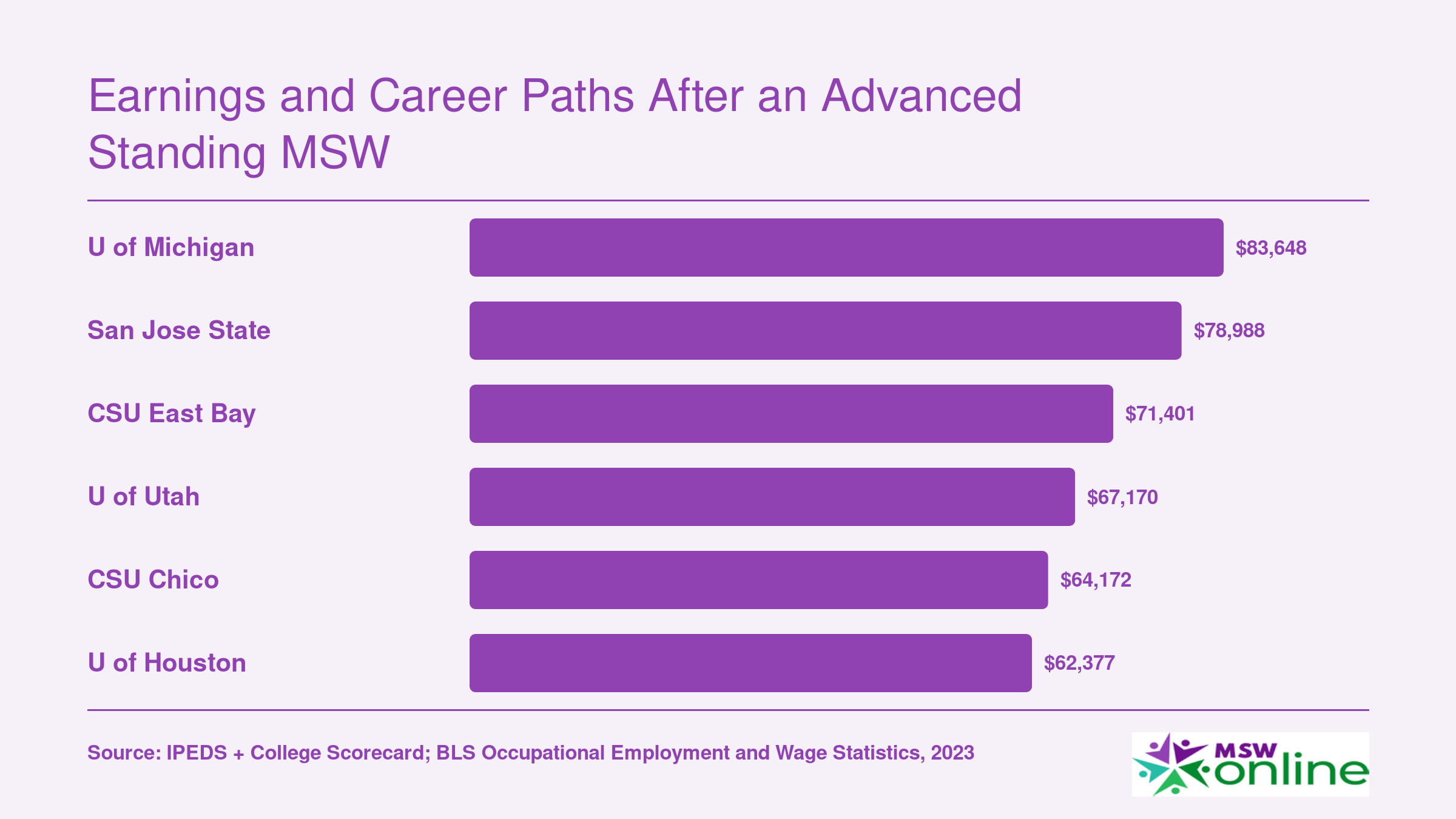
Program-level earnings data for these advanced standing MSW programs are not yet published at the granular post-completion level. However, institution-wide median earnings ten years after enrollment offer a useful proxy for long-term earning potential. The national median annual wage for clinical social workers (SOC 21-1022) was $61,330 as of 2022, per BLS. All six schools shown here produce graduates whose institution-wide median earnings exceed that benchmark, reflecting the upward trajectory an MSW can unlock over time.
Licensure After Your Online Advanced Standing MSW
Social work licensure is the state-issued credential that legally authorizes you to practice and use protected titles like Licensed Master Social Worker (LMSW) or Licensed Clinical Social Worker (LCSW). After finishing an online advanced standing MSW, licensure is the gate to employment, clinical practice, and independent work. The process has two main tiers, and while the broad requirements are consistent nationwide, details vary by state.
The Two-Tier Licensure Path
The initial license, commonly called LMSW (or LSW, LGSW in some states), is available immediately after graduation once you pass the ASWB Masters exam.1 This credential allows you to work in non-clinical roles and, in many states, begin supervised clinical practice toward the higher license.
The clinical license, the LCSW (or LICSW, LISW), requires an additional 2 to 3 years of post-MSW supervised clinical experience and passing the ASWB Clinical exam.2 The supervised hours range from 2,000 to 4,000 depending on the state, and your supervisor must hold a clinical license, typically with at least 2 to 5 years of post-licensure experience. If you are planning to pursue the LCSW, exploring clinical social work MSW options during your program search can help you select the right clinical concentration.
Does Online or Advanced Standing Affect Eligibility?
In nearly every state, graduating from an online program or an advanced standing track does not restrict licensure eligibility, as long as the program holds CSWE accreditation.1 State boards evaluate the program's accreditation status, not its delivery format. Advanced standing is built into CSWE standards, so a BSW-to-MSW fast track is treated the same as a traditional program for licensure purposes.
One practical note: field placements must generally occur in the state where you plan to be licensed, with supervision from an in-state licensed professional.1 Reputable online programs coordinate this for you.
State-by-State Variations to Watch For
While the core exam and supervision requirements are similar, some states layer on extra steps. These can include: - Jurisprudence exams that test your knowledge of state-specific laws and rules. - Coursework mandates requiring a specific class in ethics, substance abuse, or spousal abuse that may not be built into every advanced standing curriculum. - Background checks and additional forms that vary by board.
If you ever plan to practice in a different state, be aware that your initial license may not transfer directly. Portability often requires verifying that your education and supervision meet the new state's standards, and you may need to complete additional coursework or exams.
Verify Before You Enroll
Before committing to an online advanced standing MSW, confirm the licensure requirements for the state where you intend to practice, not just where the school is based. Contact the state social work board directly or review their published regulations. Also note that the ASWB exams undergo a significant format change in August 2026.3 While content remains aligned with CSWE competencies, timing your exam around this transition may affect your study approach.
Picking the Right Program: A Decision Framework
The online MSW market has expanded faster than most applicants can vet, with dozens of advanced standing options now competing on price, format, and concentration mix. A structured comparison beats a gut decision. Use these five factors, in order, to narrow your shortlist.
The Five Factors That Should Drive Your Choice
- Total cost after aid: Sticker tuition tells you little. Request a net price estimate that accounts for institutional scholarships, graduate assistantships, and any employer tuition benefits. Per-credit rates between $500 and $1,200 are common, and a 30-credit advanced standing track can land anywhere from roughly $15,000 to $45,000 once fees are factored in.
- Specialization match: Concentrations among the ranked programs span clinical mental health, school social work, substance abuse and addictions, healthcare, child and family, and macro practice. If you want to sit for clinical licensure and open a private therapy practice, a clinical track is not optional. If you see yourself in policy or community organizing, a macro concentration serves you better. Those drawn to addictions work should also explore the substance abuse social worker career path to understand field expectations.
- Field placement support in your area: Ask whether the school sources your internship or whether you are expected to find it yourself. Programs with dedicated regional field coordinators tend to place students faster, especially in rural zip codes.
- Licensure portability: Verify the program meets educational requirements in the state where you intend to practice, not just where the school is located. Curriculum gaps can delay your LCSW by months.
- Schedule format: Fully asynchronous programs let working professionals log in at midnight. Synchronous or hybrid formats add live class sessions that build cohort connection but constrain your week.
The Non-Negotiable
CSWE accreditation is the gatekeeper for licensure in every state. If a program is not accredited by the Council on Social Work Education, walk away regardless of price or convenience. You can review every level of credential on our social work degree programs page to confirm how accreditation applies at each stage.
Your Next Step
Contact admissions offices at two or three programs this week. Ask each one specifically about field placement support in your zip code, request a personalized net price estimate after aid, and compare the offers side by side before committing.
More Online Advanced Standing MSW Programs to Explore
Beyond the top-ranked programs, these additional CSWE-accredited online advanced standing MSW options are worth researching. Each offers unique strengths, from specialized concentrations to flexible formats. Explore the list below and compare program features to find the right fit for your career goals.
- MSW Program
- Master of Social Work (Clinical Specialization)
- Master of Social Work – Advanced Standing
- Master of Social Work – Advanced Standing (Clinical and/or Crisis Intervention)
- Master of Social Work – Advanced Standing (Cognitive Behavioral Therapy)
- MSW Advanced Standing
- Social Work, Advanced Standing. M.S.W.
- Master of Social Work (MSW) (Behavioral Health)
- Master of Social Work (MSW)
- Social Work - Advanced Standing, M.S.W.
- Master of Social Work
- Master of Social Work
- Online Master of Social Work
- Advanced Standing MSW Pathway
- Advanced Standing MSW
- Master of Social Work (MSW) (Rural Practice)
- Master of Social Work, Advanced Standing
- MSW Advanced Standing Program (advanced generalist social work)