

Points of interest…
- Reaching LCSW licensure typically takes 7 to 10 years from your first college class through supervised hours.
- A solo virtual practice can launch for as little as $8,000 in first-year startup costs.
- Solo LCSWs seeing 20 to 25 clients weekly can take home roughly $85,000 to $108,000 after overhead.
- The MSW generally offers broader insurance panel access and more career flexibility than the MFT path.
Private practice social workers operate outside agency hierarchies, setting their own hours, selecting their caseload, and building a clinical identity around a specialty they choose. That autonomy is real, but it carries a concrete licensing requirement: every U.S. state requires a Licensed Clinical Social Worker credential, or its state-specific equivalent, before an MSW can see clients independently for pay. No state permits a BSW or an unlicensed MSW to open a private practice.
The pipeline from undergraduate enrollment to an LCSW typically spans seven to ten years, combining a master's degree with post-graduation supervised clinical hours that most states set between 2,000 and 4,000. Startup costs for a solo practice run $8,000 to $20,000 in year one. Insurance credentialing adds months of administrative lead time before the first reimbursed session.
For clinicians who clear those hurdles, a solo practice carrying 20 to 25 sessions per week can generate take-home income in the $85,000 to $108,000 range after overhead. The ceiling is real, but so is the gap between clinical competence and business readiness. Understanding how private practice fits within the broader landscape of career opportunities in social work can help you decide whether independent practice is the right goal.
From BSW to LCSW: The Full Education and Licensure Pipeline
Private practice sits at the end of a credentialing pipeline, and the distance between where you start and where you can hang a shingle is longer than many prospective students expect. Understanding exactly what lies ahead lets you plan finances, timelines, and career decisions with clear eyes.
The Four-Stage Path
Most clinical social workers reach independent licensure through four sequential stages:
- BSW (optional): A bachelor's in social work from a CSWE-accredited program is not required, but earning one shortens the MSW. Many programs offer advanced standing admission for BSW holders, compressing a two-year MSW into roughly one year.
- MSW from a CSWE-accredited program: This is the non-negotiable academic requirement. A standard full-time MSW takes two years; advanced standing takes one. Part-time routes run three to four years.
- Entry-level licensure: After graduating, most states require you to pass the ASWB Master's exam and obtain an LSW, LMSW, or equivalent title before accumulating supervised hours.
- LCSW (or state equivalent): After completing supervised clinical hours under a licensed supervisor, you sit for the LCSW-level exam and receive your independent license.
Realistic Timelines
If you begin with a non-social-work bachelor's degree, count on roughly six to eight years total: four years of undergrad, two years for an MSW, and two or more years of post-master's supervised experience. Starting with a BSW and using an advanced standing MSW program trims that to four to five years before you are eligible for the LCSW exam. Timelines stretch further if you attend part-time, which many working adults do. For a broader look at degree requirements for social worker roles, review the general pathway before mapping your private practice plan.
The Licensing Exam
The ASWB Clinical exam is the standard pathway in most states. It tests clinical theory, diagnosis, treatment planning, ethics, and professional relationships. A handful of states diverge from this model. California, for instance, administers its own clinical exam rather than accepting the ASWB Clinical, so if you plan to practice in California, verify the specific exam requirements with the California Board of Behavioral Sciences before you register.
Why the LCSW Is Non-Negotiable for Private Practice
No state permits a social worker to operate an independent private practice under a bachelor's-level license or a pre-clinical master's license. The LSW and LMSW designations exist for supervised or agency-based roles, such as community social work positions in public agencies. The LCSW (called LICSW in several states) is the credential that removes the supervision requirement and grants autonomous practice authority. Until you hold that license, private practice is legally off the table, regardless of your skills or experience.
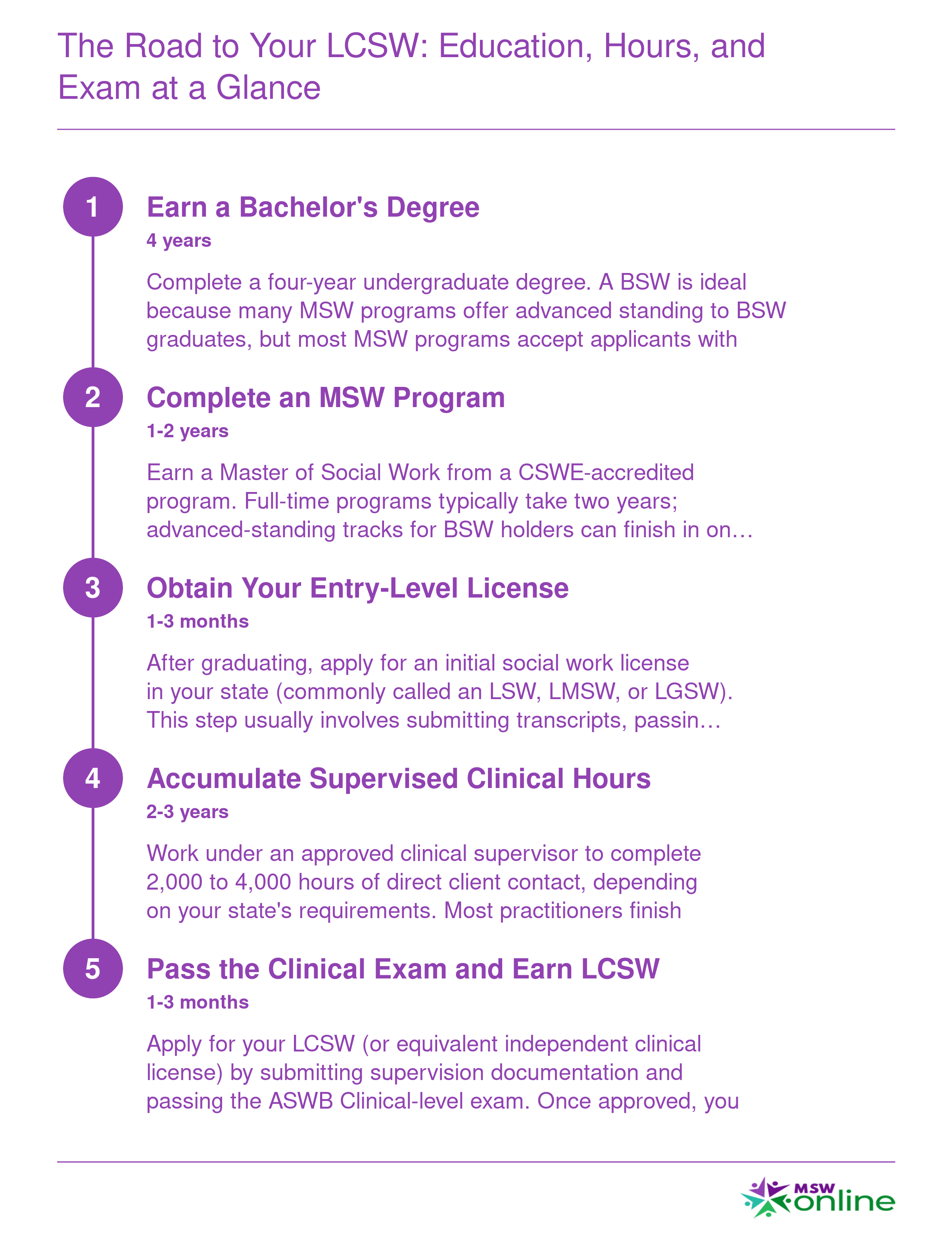
The Road to Your LCSW: Education, Hours, and Exam at a Glance
Earning your LCSW is a multi-stage process that typically takes 7 to 10 years from your first day of college to full independent licensure. The timeline below breaks down each milestone so you can plan ahead.
Supervised Clinical Hours Required for LCSW Licensure by State
The supervised clinical experience phase is the longest single milestone on the road to licensed clinical social worker licensure, and every state sets its own combination of total hours, direct client contact thresholds, and supervision ratios. These mandates exist to ensure that aspiring clinical social workers develop competent diagnostic and therapeutic skills under the guidance of an experienced professional before they practice independently.
How States Define Supervised Experience
All states require a period of post-MSW supervised practice, but the specifics vary considerably. The hours typically encompass face-to-face psychotherapy, assessment, and case management, though each licensing board defines exactly which activities qualify. Most states also distinguish between total supervised hours and direct client contact hours, the latter often making up half to two-thirds of the required total. In addition, regulations specify how many hours of supervision you must receive, the frequency of supervisory meetings, and the qualifications of the supervisor.
State-by-State Hour Requirements
While no two states are identical, the following examples illustrate the range of requirements for three of the largest jurisdictions:
- California: 3,000 total supervised hours, with at least 1,700 hours of direct client contact. Additionally, 104 hours of supervision are required, spread over a minimum of 104 weeks of experience.1
- Texas: 3,000 total hours, including 1,500 direct client hours, and 100 hours of supervision. The supervision must involve face-to-face interaction at least one hour per week.2
- New York: 3,600 total hours, with no separate direct client hour minimum stated, but requiring 150 hours of supervision, which must include at least 50 hours of individual supervision.2
Other populous states fall on a spectrum. For instance, Florida and Illinois generally require around 3,000 hours with similar direct practice proportions, while some states like Michigan or Virginia demand 4,000 hours or more. The license title also differs: most states use "LCSW," but a few, like Massachusetts, use "LICSW." Always verify with the specific board, as ASWB maintains an updated directory of state regulations.
Supervision Ratios and What Counts as Clinical Work
Rules about supervision are as critical as the raw hour tallies. In many states, one hour of supervision must be provided for every 20 to 40 hours of clinical work. Some states allow group supervision for a portion of the total, while others require a minimum of individual, face-to-face sessions. Direct client contact often means psychotherapy or clinical assessment, but some boards count phone consultation, record review, or clinical team meetings as indirect hours, though typically capped at a small fraction of the total. California, for example, allows up to 750 hours of indirect work within the 3,000-hour total.1
Verifying Your State's Current Rules
Requirements change periodically. Before beginning your supervised practice, always consult the official regulatory board for your state. A slightly outdated plan built on old requirements can delay your licensure by months, so verify early and document everything from day one.
Startup Costs and Business Setup for a Solo Social Work Practice
A solo LCSW can open a private practice for $8,000 to $20,000 in the first year, with the spread driven almost entirely by how much physical office space you commit to.1 A fully virtual clinician on the low end of every line item can launch for closer to $5,000; a clinician signing a dedicated downtown lease will land near the top of that range or above.
Itemized First-Year Cost Breakdown
- Office space: A part-time sublet runs $100 to $800 per month, while a full-time dedicated lease runs $500 to $3,000 per month depending on the metro.2 Hourly sublet rates often start around $2.50 per hour.
- Malpractice insurance: $450 to $800 annually for most LCSWs, with low-risk generalist coverage starting near $300 and higher-risk specialties (forensic, high-acuity) reaching $900.3
- EHR and practice management: $50 to $100 per month. SimplePractice runs $39 to $79, TherapyNotes is $49, and Jane App is $79 to $99 for solo clinicians.3
- HIPAA-compliant telehealth: Either bundled inside your EHR or added through a standalone platform with a signed Business Associate Agreement (BAA).
- Business registration and LLC filing: A one-time $40 to $60 in low-cost states (Kentucky, Arkansas), $90 to $200 in typical states, and $300 to $500 in high-cost states like Massachusetts or Tennessee.4 Some states also charge recurring annual reports.
- Marketing and website: $500 to $2,000 for a lean launch, $2,000 to $5,000 for a moderate spend. A Psychology Today directory listing alone is $30 to $40 per month.1
LLC vs. Sole Proprietorship
Default to an LLC. A sole proprietorship is free and automatic, but it offers zero separation between your personal assets and a practice liability claim. An LLC creates that legal wall, lets you elect S-corp taxation once revenue justifies it (typically above $60K to $80K in net profit), and signals professionalism to insurance panels. Filing requirements vary by state, so check your secretary of state's website before choosing a registered agent.
HIPAA Compliance Essentials
If you plan to deliver sessions remotely, review the broader landscape of telehealth social work before selecting a platform. Four non-negotiables apply: a signed BAA with every vendor touching client data (EHR, telehealth, email), encrypted communication channels, secure intake and consent forms inside the EHR rather than over plain email, and a documented plan for backing up and eventually destroying records per your state's retention rules.
How to Get Credentialed with Insurance Panels and Set Your Fees
Accepting insurance broadens your client base and provides a steady revenue stream, but the credentialing process requires patience and careful documentation. Before you apply to any panel, form your business entity, obtain your tax IDs, and gather the required paperwork: your clinical social work license, malpractice insurance certificate, CV, educational transcripts, driver's license, and W-9.1
Your first stop is CAQH ProView, a universal provider database used by most major insurers. Setting up your CAQH profile takes roughly 2 to 4 hours, and you must re-attest every 120 days to keep it active.2 Be sure to enter your LCSW taxonomy code (1041C0700X) accurately, as errors here can delay every application downstream.3
Once your CAQH profile is complete, submit credentialing applications to individual payers. Timelines vary considerably:
- BCBS: 60 to 120 days4
- Aetna: 60 to 120 days3
- Cigna: 90 to 150 days3
- UnitedHealthcare: 90 to 180 days3
- Medicare (via PECOS): 60 to 90 days2
Plan to have at least two to three months of operating capital on hand before your first reimbursement arrives, since the overall credentialing window spans 60 to 180 days.2
When setting your fees, start with the reimbursement rates panels actually pay. For a standard 45-minute individual therapy session (CPT 90834), commercial plans typically reimburse LCSWs between $70 and $110, while Medicare pays roughly $80 to $105.3 Extended 60-minute sessions (CPT 90837) bring $85 to $130 from commercial carriers, and diagnostic evaluations (CPT 90791) reimburse between $100 and $160.3 Set your private-pay rate above the highest contracted rate so you never inadvertently bill an insurer more than you charge self-pay clients. Many practitioners also offer a sliding scale for uninsured clients to maintain both accessibility and financial viability.
Private Practice Social Worker Salary: National and State Benchmarks
The BLS tracks wages for Mental Health and Substance Abuse Social Workers (SOC 21-1023), the closest occupational proxy for private practice social workers. These figures reflect all employment settings, including agency and nonprofit roles, so clinicians in private practice often earn more, especially those with full caseloads. Keep in mind that private practice income is revenue minus overhead: a clinician seeing 25 clients per week at $150 per session grosses roughly $195,000 per year, but nets significantly less after rent, insurance, billing software, and other expenses. The five highest-paying states by median salary are New York, Connecticut, Minnesota, California, and the District of Columbia. California and New York also lead in total employment, each with more than 14,000 workers in this category.
| State | Total Employment | Median Annual Salary | 25th Percentile | 75th Percentile | Mean Annual Salary |
|---|---|---|---|---|---|
| New York | 14,180 | $80,230 | $63,720 | $98,100 | $96,240 |
| Connecticut | 1,350 | $78,820 | $51,250 | $92,270 | $75,190 |
| Minnesota | 3,430 | $77,100 | $61,300 | $89,470 | $77,190 |
| California | 18,020 | $75,320 | $55,440 | $105,020 | $83,110 |
| District of Columbia | 640 | $72,720 | $55,360 | $106,720 | $81,300 |
| Oregon | 2,160 | $71,830 | $57,990 | $86,080 | $74,310 |
| New Jersey | 3,140 | $70,420 | $48,170 | $88,000 | $72,450 |
| Hawaii | 410 | $70,340 | $53,720 | $83,430 | $70,960 |
| Vermont | 370 | $69,540 | $61,260 | $80,850 | $74,120 |
| Washington | 3,490 | $69,060 | $56,220 | $84,180 | $71,660 |
| Maine | 1,120 | $67,820 | $52,820 | $86,100 | $71,820 |
| New Mexico | 620 | $65,600 | $55,060 | $81,220 | $70,620 |
| Colorado | 1,980 | $65,080 | $51,820 | $76,840 | $65,530 |
| Massachusetts | 6,790 | $64,960 | $56,660 | $78,980 | $69,990 |
| New Hampshire | 460 | $63,810 | $59,980 | $79,120 | $71,030 |
| Virginia | 3,130 | $63,530 | $53,540 | $84,780 | $70,870 |
| North Dakota | 230 | $61,660 | $58,180 | $66,240 | $65,800 |
| Maryland | 1,950 | $61,100 | $46,390 | $82,200 | $68,020 |
| Rhode Island | 620 | $60,490 | $47,680 | $108,750 | $75,200 |
| Michigan | 5,130 | $60,000 | $49,510 | $73,510 | $62,220 |
| Illinois | 1,730 | $58,090 | $47,590 | $70,770 | $61,600 |
| Alaska | 340 | $57,650 | $50,270 | $73,080 | $65,420 |
| Delaware | 410 | $57,620 | $48,880 | $63,980 | $58,850 |
| Wisconsin | 1,950 | $57,590 | $46,290 | $70,750 | $60,150 |
| North Carolina | 2,700 | $56,730 | $46,890 | $64,180 | $58,300 |
| Kansas | 1,360 | $56,110 | $51,310 | $65,410 | $58,640 |
| Indiana | 2,060 | $54,410 | $45,910 | $67,400 | $58,170 |
| Idaho | 390 | $50,900 | $42,340 | $75,570 | $61,280 |
| Florida | 6,260 | $50,860 | $44,350 | $67,630 | $56,120 |
| Georgia | 1,450 | $50,810 | $41,630 | $61,920 | $54,000 |
| Iowa | 1,260 | $50,340 | $39,360 | $65,520 | $56,910 |
| Nevada | 1,140 | $49,850 | $38,600 | $70,990 | $55,490 |
| Arkansas | 930 | $49,820 | $45,100 | $64,250 | $58,980 |
| Pennsylvania | 4,150 | $49,590 | $43,910 | $63,230 | $55,260 |
| South Dakota | 240 | $49,560 | $43,420 | $56,830 | $51,560 |
| Mississippi | 890 | $48,830 | $32,250 | $59,850 | $48,330 |
| Tennessee | 2,130 | $48,760 | $44,990 | $59,070 | $53,240 |
| West Virginia | 390 | $47,840 | $35,940 | $57,700 | $49,250 |
| Arizona | 3,610 | $46,650 | $43,680 | $51,440 | $49,530 |
| Ohio | 6,870 | $46,330 | $39,240 | $59,180 | $51,470 |
| Missouri | 2,530 | $46,250 | $39,180 | $54,520 | $48,520 |
| Kentucky | 1,040 | $45,450 | $37,330 | $58,290 | $50,560 |
| Nebraska | 800 | $45,120 | $41,480 | $57,450 | $48,390 |
| Texas | 5,810 | $44,790 | $39,890 | $59,040 | $51,660 |
| Louisiana | 980 | $44,050 | $34,120 | $62,480 | $50,380 |
| Montana | 630 | $43,880 | $41,290 | $59,310 | $50,890 |
| Oklahoma | 1,470 | $43,190 | $35,790 | $45,940 | $42,620 |
| Wyoming | 140 | $42,220 | $37,840 | $57,810 | $48,360 |
| Alabama | 670 | $42,100 | $31,910 | $55,000 | $44,670 |
| South Carolina | 650 | $41,750 | $33,300 | $53,900 | $44,380 |
Solo vs. Group Practice: Comparing Models, Overhead, and Take-Home Pay
A solo practitioner carrying 20 to 25 sessions per week can realistically take home between $85,000 and $108,000 annually after overhead, based on a gross revenue example of around $144,000 and overhead running 25 to 35 percent.1 That range tells most of the story about why many LCSWs start solo: you keep what you bill.
Solo Practice: Higher Ceiling, Higher Administrative Load
Solo practitioners retain 60 to 75 percent of gross revenue, but that figure comes with a cost.2 Plan to spend 20 to 30 percent of your working hours on tasks that generate no billable income: scheduling, billing, documentation, credentialing renewals, and practice marketing.3 The ceiling for solo take-home pay is higher than what most employed clinicians earn in group settings, but the floor drops quickly if your caseload thins out or an insurance panel delays reimbursement.
Typical solo salary range in 2026: $60,000 to $120,000 depending on caseload, fee structure, payer mix, and geography.1
Group Practice: Lower Individual Take-Home, Shared Infrastructure
Clinicians employed by or contracted to a group practice typically work under a revenue split, most commonly somewhere between 40 and 80 percent to the clinician. A 50/50 split is a widely reported benchmark.2 That structure reduces your administrative burden considerably since the group handles billing, credentialing, and often scheduling, but it also compresses your take-home pay. Group-employed clinicians typically earn $40,000 to $70,000 annually while seeing slightly higher weekly caseloads of 22 to 28 sessions.2
Owning the group is a different calculation. Group practice owners in 2026 report median practice revenue of approximately $169,000 with a median profit around $80,000 and a median profit margin near 47 percent, according to the Heard 2026 Financial State of Private Practice Report.2 That position, however, involves hiring, supervising clinicians, managing compliance, and accepting business risk. Only about 13.5 percent of therapists in private practice operate at the group ownership level.3
Hybrid and Subletting Arrangements
A practical middle path is subletting space within a group practice as an independent solo clinician. You pay a flat fee or percentage for office space and occasionally administrative support, but you bill independently and keep your own panel relationships. Overhead tends to run slightly above pure solo practice (closer to 30 to 40 percent), but you avoid isolation and gain built-in referral networks without surrendering the revenue retention that makes solo practice financially attractive.2
The right model depends on where you are in your career, your risk tolerance, and whether you want to build a business or simply sustain a caseload. For a broader look at what different social work roles pay, explore careers in social work.
MFT or MSW for Private Practice? Scope, Panels, and Career Flexibility
If you plan to open a private therapy practice, the license you choose will determine who you can treat, which insurers will reimburse you, and how easily you can shift careers later. For most practitioners, the decision narrows to two paths: the Licensed Clinical Social Worker (LCSW) or the Licensed Marriage and Family Therapist (LMFT). Both allow independent clinical practice, but their foundational training, regulatory constraints, and market acceptance diverge in ways that matter deeply for a sole proprietor. If you are still exploring the marriage and family therapist career path, it helps to compare the two credentials side by side before committing.
Scope of Practice: Diagnosing and Treating Across the Population
LCSWs are trained to diagnose and treat mental and emotional disorders within a broad psychosocial framework that spans individuals, families, and groups. In 47 states, clinical social workers possess explicit diagnostic authority, and their scope routinely covers the entire lifespan.1 By contrast, an LMFT's clinical lens is rooted in systems theory with a primary focus on couples, families, and relationship dynamics.2 While many states authorize LMFTs to diagnose and treat mental disorders, several impose additional scope restrictions, for instance, limiting the populations an LMFT can serve or requiring extra coursework before working with certain conditions.1 If your dream client is the couple struggling with communication or a family navigating separation, the MFT's relational training is a precise tool. However, if you see yourself treating a wider range of presenting concerns, including serious mental illness outside a family context, the LCSW offers a more expansive legal scope in more jurisdictions.
Insurance Panel Acceptance: The Medicare Tipping Point
For a private practice, reimbursement hinges on paneling. Historically, LCSWs have been credentialed on virtually all major commercial and public insurance panels, including long-standing recognition by Medicare.1 LMFTs, while gaining ground, have often encountered narrower panel networks and, in some regions, outright exclusion. A pivotal shift occurred in 2024 when the Consolidated Appropriations Act extended Medicare eligibility to LMFTs, removing a major federal barrier.1 Despite this win, many private insurers and regional panels still credential LMFTs more slowly, and some maintain shorter rosters. That means an LCSW is likely to start a practice with a broader and more stable payer mix, reducing the time and hassle spent pursuing contracts.
Career Flexibility: Private Practice Isn't the Only Destination
An MSW leading to an LCSW is a clinical license built on a generalist degree. If private practice does not prove sustainable, or your interests evolve, the MSW allows fluid movement into hospital systems, community agencies, school-based work, or policy and administrative roles without requiring a new master's credential.3 Pursuing an Online Master's in Social Work gives you that generalist foundation from the start. An MFT is more narrowly clinical; while rewarding, its portability to non-therapy settings is limited.3 This distinction can be a safety net for practitioners who want the option to step away from fee-for-service instability into a salaried position with benefits.
How to Decide: Align Your License with Your Long-Term Vision
- Choose an MFT if: couples, families, and relational systems are your clear clinical passion, and you are comfortable navigating a more targeted panel application process.
- Choose an MSW/LCSW if: you want maximum insurance access, a practice that can treat individuals and families across the lifespan with minimal state-imposed scope limits, and the career flexibility to pivot into non-clinical roles later.
Your decision ultimately rests on whether your vision of private practice is tightly focused on relational therapy or broad enough to require the most versatile credential in mental health.
Highest-Paying Metro Areas for Mental Health Social Workers
The table below ranks major metro areas by median annual salary for mental health and substance abuse social workers, based on the latest BLS data. Keep in mind that the highest-paying metros (San Jose, New York, Riverside) also carry some of the steepest costs of living, so private practice session rates in those areas tend to be proportionally higher. If you are looking for a strategic location to launch a practice, pay attention to metros that combine strong employment numbers with competitive pay but lower living costs. Minneapolis, Portland, and Denver stand out as metros where median salaries are well above the national average while offering more affordable overhead than coastal California or New York.
| Metro Area | Total Employment | Median Salary | 25th Percentile | 75th Percentile |
|---|---|---|---|---|
| San Jose, Sunnyvale, Santa Clara, CA | 900 | $102,760 | $70,880 | $124,540 |
| Riverside, San Bernardino, Ontario, CA | 1,490 | $83,710 | $61,560 | $119,060 |
| New York, Newark, Jersey City, NY/NJ | 12,050 | $83,490 | $64,800 | $101,840 |
| San Francisco, Oakland, Fremont, CA | 1,630 | $78,660 | $63,360 | $126,460 |
| Washington, Arlington, Alexandria, DC/VA/MD/WV | 2,310 | $77,600 | $60,320 | $98,210 |
| Minneapolis, St. Paul, Bloomington, MN/WI | 2,420 | $77,540 | $61,300 | $93,640 |
| Seattle, Tacoma, Bellevue, WA | 2,020 | $77,360 | $56,300 | $91,170 |
| Portland, Vancouver, Hillsboro, OR/WA | 1,150 | $77,260 | $59,690 | $87,110 |
| Los Angeles, Long Beach, Anaheim, CA | 8,430 | $74,890 | $49,610 | $105,020 |
| Sacramento, Roseville, Folsom, CA | 1,210 | $73,950 | $57,820 | $109,230 |
| San Diego, Chula Vista, Carlsbad, CA | 850 | $69,850 | $54,620 | $98,840 |
| Denver, Aurora, Centennial, CO | 1,040 | $68,120 | $51,820 | $77,160 |
| Boston, Cambridge, Newton, MA/NH | 4,220 | $67,060 | $58,520 | $80,270 |
| Worcester, MA | 970 | $61,780 | $52,070 | $74,740 |
| Providence, Warwick, RI/MA | 1,150 | $60,500 | $49,280 | $81,480 |
| Chicago, Naperville, Elgin, IL/IN | 1,390 | $59,500 | $48,740 | $70,770 |
| Detroit, Warren, Dearborn, MI | 2,100 | $59,180 | $49,440 | $69,560 |
| Baltimore, Columbia, Towson, MD | 890 | $57,980 | $41,060 | $75,290 |
| Kansas City, MO/KS | 1,120 | $56,110 | $46,940 | $65,410 |
| Philadelphia, Camden, Wilmington, PA/NJ/DE/MD | 2,420 | $55,830 | $46,430 | $74,540 |
| Atlanta, Sandy Springs, Roswell, GA | 920 | $54,470 | $45,620 | $63,550 |
| Houston, Pasadena, The Woodlands, TX | 820 | $52,430 | $42,740 | $74,840 |
| Las Vegas, Henderson, North Las Vegas, NV | 900 | $48,300 | $37,840 | $71,840 |
| Columbus, OH | 1,390 | $47,840 | $43,080 | $65,750 |
| Phoenix, Mesa, Chandler, AZ | 2,600 | $46,860 | $44,760 | $52,770 |
| St. Louis, MO/IL | 940 | $46,380 | $40,050 | $58,810 |
| Cincinnati, OH/KY/IN | 1,090 | $46,200 | $41,900 | $60,320 |
| Cleveland, OH | 1,410 | $45,240 | $36,550 | $50,330 |
| Dallas, Fort Worth, Arlington, TX | 1,590 | $43,920 | $37,740 | $53,490 |
Career Growth and Job Outlook for Clinical Social Workers
The job market for clinical social workers is strong and expected to remain so for years to come. According to the Bureau of Labor Statistics, employment for social workers overall is projected to grow by 6% between 2024 and 2034, with roughly 74,000 annual job openings anticipated during that period. The outlook is even more promising for those specializing in mental health and substance abuse: that subset is projected to grow by 11% from 2022 to 2032, nearly double the rate for social workers as a whole.
Several factors drive this demand. An aging population, expanding insurance coverage for mental health services, and growing public awareness of behavioral health needs all contribute to a steady pipeline of clients seeking therapy. For private practice social workers, these trends translate into a reliable and expanding client base.
Clinical social workers who want to diversify can also explore adjacent specializations. Some practitioners branch into areas like geriatric social work or behavioral therapist qualifications, adding new client populations without leaving private practice entirely. Whether you choose to specialize further or build a generalist therapy practice, the long-term career trajectory for licensed clinical social workers remains highly favorable.
Private practice is achievable, but the path is deliberate: earn your MSW, log your supervised hours, pass the ASWB Clinical exam, then choose a practice model that matches your risk tolerance and lifestyle. A solo virtual setup keeps startup costs at the lower end of that $8,000 to $20,000 range, while credentialing with two or three insurance panels early builds a caseload before you rely on private-pay referrals alone.
If you are still in the education pipeline, explore accredited online master's in social work programs that emphasize clinical placement hours. If you already hold your LCSW, the most useful next move is straightforward: pull three panel credentialing applications this month and start the clock. The sooner those are in, the sooner you have a sustainable practice.