Points of interest…
- Full-time MSW students should expect to commit roughly 40 to 50 hours per week across classes, field placement, and study.
- Field placements typically require 900 to 1,200 total hours, so confirm your site logistics and supervision plan well before day one.
- The path from MSW graduation to full LCSW licensure generally takes three to four years of supervised clinical practice.
- About 20 percent of MSW students report significant secondary traumatic stress symptoms, making a structured self-care plan essential from the start.
Most incoming MSW students expect rigorous coursework. Fewer expect the emotional weight that arrives alongside it. A thread in the r/SocialWorkStudents community on Reddit captures this gap plainly: students asking for real-world advice before their first semester, concerned not just about grades but about field placement hours, finances, burnout, and what licensure actually requires after graduation.1
The tension is practical. MSW programs typically run two years, require 900 to 1,200 hours of supervised field placement, and can cost between $20,000 and $60,000 depending on the institution and residency status. Students who enter without a concrete plan for time, money, and self-care often discover these pressures simultaneously, mid-semester, when course corrections are hardest to make.
The tips ahead draw on peer experiences, faculty perspectives, and the kind of candid advice that circulates in communities like r/SocialWorkStudents. They cover time management, field placement, finances, networking, self-care, and licensure planning. For students who want a broader orientation before diving in, first-year MSW tips can help frame what to expect from orientation onward. A few hours of preparation now can meaningfully reduce the trial-and-error that derails otherwise capable students in their first year.
Map Out Your Weekly Time Commitment Before Classes Start
A full-time MSW program will consume more of your week than most incoming students expect, and the students who struggle least are the ones who mapped out every hour before the first day of class.
How the Hours Actually Break Down
Start with field placement, because it is the single largest time block in your schedule. The Council on Social Work Education (CSWE) requires a minimum of 900 hours of supervised field education for MSW students, and many programs exceed that floor. Schools commonly require between 1,000 and 1,200 total field hours. East Carolina University, for example, requires 1,032 hours spread across placements on Wednesdays through Fridays2, while UCLA logs 1,100 hours and USC ranges from 1,000 to 1,150. In practice, that minimum translates to roughly 16 to 24 hours per week in the field across your placement semesters, typically spanning two to three days each week.
Layered on top of field hours, expect:
- Classroom time: 6 to 12 hours per week depending on credit load and format.
- Readings and assignments: 8 to 15 hours per week, with heavier surges around midterms and finals.
- Supervision and reflection: 1 to 2 hours per week of required field supervision, plus journaling or process recordings many programs assign.
Add those together and a realistic total weekly commitment lands in the range of 30 to 50 or more hours during placement semesters. That is why experienced MSW students describe the program as a full-time job with mandatory overtime.
Can You Work at the Same Time?
Part-time employment is common and manageable with intentional scheduling. Many students hold jobs of 10 to 20 hours per week, especially in the first year before field hours peak. Full-time employment alongside a full-time MSW program, however, is rarely sustainable. If your finances require significant work hours, look into time management tips for social work students balancing part-time or extended MSW tracks, and ask your program about employment-based field placements, which CSWE does allow under certain conditions.3 These arrangements let you complete field hours at your current social-services employer, reducing the scheduling strain.
A Concrete Planning Tip
Before orientation, build a sample weekly calendar using real data from your program. Most schools publish syllabus templates, course meeting times, and field placement schedules well in advance. Block out your confirmed field days first, then layer in class sessions, a conservative estimate for study hours, and any work shifts. Seeing the full picture on a single page reveals conflicts early, when you still have time to adjust your work schedule, arrange childcare, or negotiate field placement days. Students who skip this step often discover in week three that they are 10 hours short of what the week actually demands, and by then the semester is already moving.
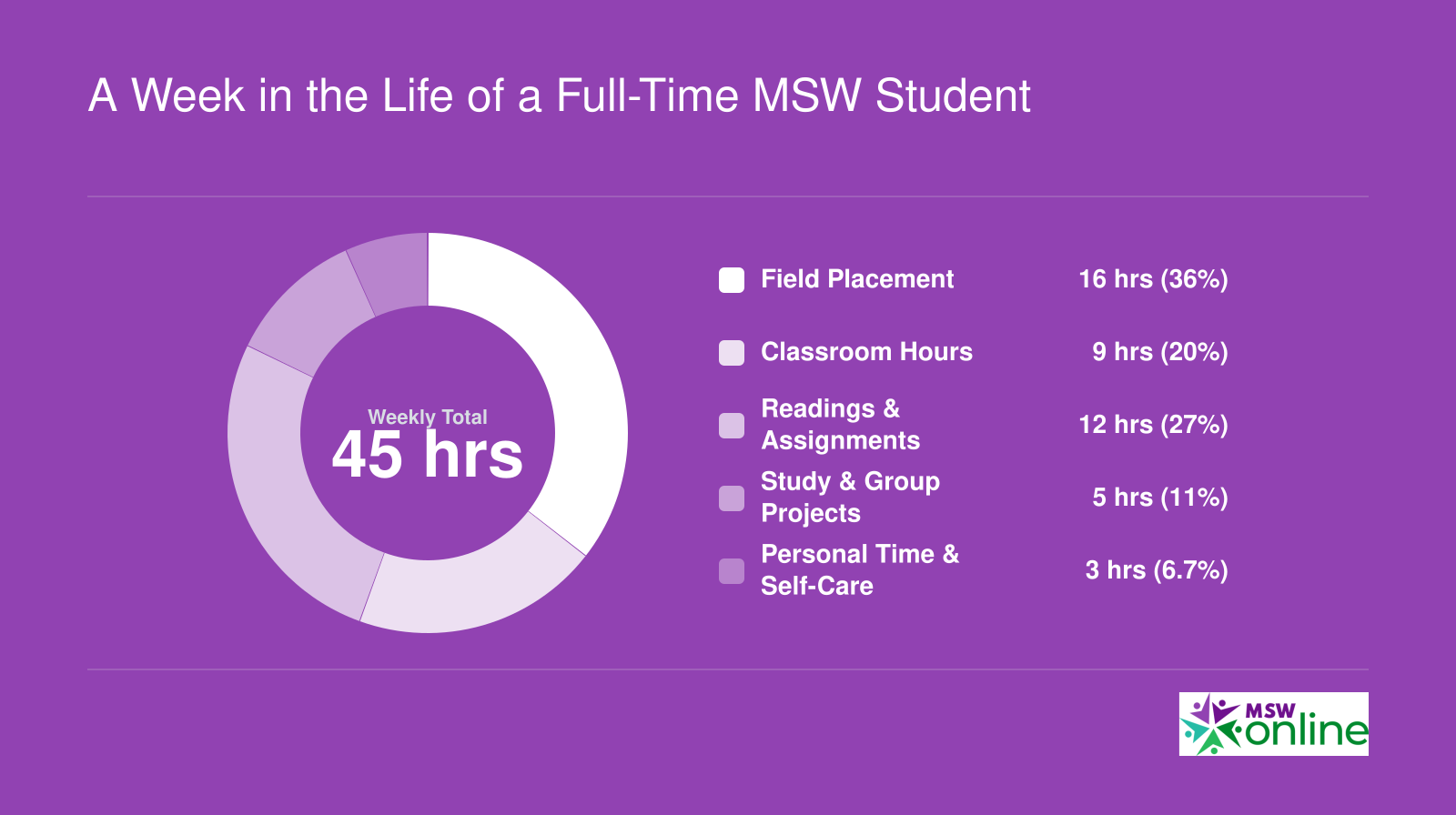
A Week in the Life of a Full-Time MSW Student
Time management ranks as the number-one concern among incoming MSW students, and it is easy to see why. Between coursework, field placement, and independent study, a full-time MSW schedule can rival a demanding full-time job. The breakdown below shows how roughly 45 hours per week typically split across core commitments, making it clear why planning ahead is essential.
Create a Financial Plan: Scholarships, Aid, and Working During Your MSW
A financial plan for your MSW means mapping every expected cost against all money you can bring in , grants, scholarships, loans, and work income , so you can focus on learning instead of scrambling for rent.
Targeted Scholarships and Fellowships for Social Work Students
Many funding sources are designed specifically for social work students. The NASW Foundation offers multiple graduate social work scholarships with application windows from January to March each year; membership in NASW is required.2 The CSWE Minority Fellowship Program (MFSW) supports students from underrepresented groups and also accepts applications early in the calendar year.3 Other notable awards include:
- Consuelo W. Gosnell Memorial Scholarship: Up to $4,000 for American Indian/Alaska Native and Hispanic/Latino students in accredited MSW programs.2
- Davis-Putter Scholarship Fund: Awards up to $15,000 for students active in social justice movements; the 2026-2027 deadline is April 1, 2026.4
- Roothbert Fund Fellowships: Renewable awards of $5,000-$7,000 based on character, financial need, and a commitment to service.
- Ima Hogg Scholarships: $5,000 for Texas residents enrolled in a CSWE-accredited MSW program.
- Carl A. Scott Memorial Fund: Two $500 awards for students committed to equity and social justice.3
Additional programs like the Verne LaMarr Lyons Memorial Scholarship (African American students), the Lawanna Renee Barron Scholarship (social justice and leadership), and HRSA behavioral health workforce grants further expand options.2 University-specific aid, such as departmental assistantships and tuition remission, often has separate deadlines, so check with your program's financial aid office early.
Public Service Loan Forgiveness: A Lifeline for Social Workers
If you take out federal student loans, Public Service Loan Forgiveness (PSLF) can erase the remaining balance after 120 qualifying monthly payments while working full-time for a qualifying employer, typically a nonprofit, government agency, or school. Most MSW career paths qualify. Set yourself up from day one:
- Consolidate loans (if needed) into a Direct Loan program.
- Enroll in an income-driven repayment plan so your payments count toward PSLF.
- Submit the PSLF Employment Certification Form annually and whenever you change jobs to track progress.
Missing this paperwork is the top reason payments are later disqualified. Treat it like a routine professional task, not an afterthought.
Graduate Assistantships: Earning While Learning
Many MSW programs offer graduate teaching, research, or administrative assistantships. These positions typically pay a stipend (often $8,000-$15,000 per academic year) and may include partial or full tuition remission. Positions are limited, so apply as soon as you confirm your enrollment. Contact your department's MSW program coordinator or career services to ask about availability, and cast a wide net across campus offices, since counseling centers, student affairs, and field education offices sometimes hire MSW students.
Hidden Costs to Budget For Beyond Tuition
Students are often surprised by expenses that fall outside of tuition and fees. Plan for these with realistic estimates:
- Field placement transportation: Commutes to agency sites can run $100-$300 per month.
- Professional liability insurance: Often required by field placements; annual premiums range from $50 to $150.
- Background checks and drug screenings: One-time costs of $50-$200, sometimes repeated for each placement.
- Professional memberships: NASW membership for students costs about $60 per year; conference attendance adds registration and travel.
- Licensing exam prep and fees: Budget $200-$500 for study materials and exam registration later in the program.
Tracking these early prevents mid-semester panic and keeps your financial plan grounded in all the costs of becoming a social worker.
Questions to Ask Yourself
Understand Your Field Placement Before You Get There
How many hours per week does MSW field placement actually require, and what should you know before your first day at a new site?
Field placement is the backbone of your MSW education, often accounting for 900 to 1,200 total hours across your program. Knowing what to expect before you walk through the door can make the difference between a transformative learning experience and one that leaves you scrambling. A solid MSW field placement guide can help you understand requirements and set realistic expectations from the start.
What Field Placement Actually Looks Like
Most full-time MSW students spend 16 to 24 hours per week at their placement site, though part-time students may log fewer weekly hours over a longer period. Supervision typically includes one hour of individual supervision with your field instructor each week, plus a group supervision session with other interns. You will be expected to maintain documentation, often in the same electronic health record system the agency uses, and your caseload will ramp up gradually. In the first few weeks you may shadow your field instructor or co-facilitate groups; by mid-semester you could be carrying a small caseload independently under supervision.
Go in with clear expectations. During your first week, sit down with your field instructor and discuss:
- Caseload timeline: When will you begin seeing clients on your own, and how quickly will cases be added?
- Documentation standards: What charting format does the agency use, and what is the turnaround expectation for progress notes?
- Evaluation criteria: How and when will your performance be assessed?
Ask About Safety Protocols Up Front
If your placement is in a crisis center, hospital emergency department, child welfare office, or community mental health setting, safety is not a topic to learn about reactively. Before your first client interaction, ask about de-escalation training, buddy systems for home visits, panic buttons or alarm procedures, and protocols for threats or violent incidents. Resources on social worker safety in mental health settings can help you understand what reasonable protections look like. A placement site that cannot clearly articulate its safety plan is a red flag worth raising with your field liaison immediately.
Do Your Homework on the Agency
Read the agency's mission statement and any recent news coverage. Look for annual reports or publicly available outcome data. Ask your field liaison whether previous students have been placed at this site and what their experiences were like. A quick conversation with a former intern, if your program can connect you, often reveals more about the day-to-day culture than any orientation packet.
You Have More Agency Than You Think
Students sometimes feel locked into a placement even when the environment is unsafe, supervision is absent, or the work has little connection to their learning goals. That is not the case. Your program's field liaison exists specifically to mediate issues between students and placement sites. If you have documented concerns, such as consistently canceled supervision sessions, exposure to situations without proper training, or tasks that amount to free labor rather than educational experiences, bring them to your liaison in writing. Programs can and do reassign students to new sites. Advocating for yourself in field placement is not a disruption; it is a professional skill you will use throughout your social work career.
Choose Your Specialization Strategically: Clinical Vs. Macro Vs. Other Tracks
Choosing a specialization within your MSW program means committing to a focused area of practice, typically direct clinical work with individuals and families, macro-level community and policy change, or a niche track like school social work or healthcare. This decision shapes your courses, field placements, and long-term career path, so approaching it strategically is essential.
Clinical vs. Macro: Understanding the Core Divide
A clinical specialization leans into assessment, diagnosis, and therapeutic intervention. Graduates often pursue licensure (LCSW) and roles in mental health clinics, hospitals, or private practice. Macro social work, by contrast, emphasizes program development, advocacy, policy analysis, and community organizing. Job titles might include program director, legislative aide, or nonprofit manager. Many programs also offer blended tracks or concentrations like child welfare, gerontology, or substance abuse social work.
How to Research Specialization Outcomes
Start with reliable labor market data. The Bureau of Labor Statistics (BLS) provides occupational outlook profiles. Search for "Social Workers" (SOC 21-1029) to compare general salary ranges and projected growth. While the BLS may not always break out clinical versus macro roles cleanly, the baseline information helps you gauge demand across settings such as healthcare, government, and individual services. Supplement this by reviewing accredited social work programs' websites. Look for annual reports or program overviews that publish enrollment trends, completion rates, and the distribution of students by concentration. These can signal which MSW specializations are growing and where resources are concentrated.
Consulting Professional Associations and Networks
Organizations like the National Association of Social Workers (NASW) periodically release member surveys and practice briefs on job satisfaction, employer demand, and salary by specialty. Although specific studies vary by year, you can often find broad insights: clinical roles tend to dominate in direct-practice settings, while macro practitioners emphasize organizational leadership and advocacy skills. Employer-perception data may highlight a strong preference for clinical credentials in certain states, or a rising need for policy-trained social workers in public agencies.
Informational Interviews: Real-World Insights
Reach out through LinkedIn or your school's alumni network to schedule brief conversations with professionals in each track of interest. Ask about day-to-day responsibilities, typical employers, and how their specialization influenced career progression. Many find that clinical and macro paths overlap more than expected. A clinical social worker might later move into program management, while a macro practitioner may need clinical literacy to design effective services. These conversations often reveal regional variations and unadvertised career routes, helping you decide where to invest your limited time and energy during the MSW.
Approach this decision as an active investigation, not a onetime choice. The specialization you declare now can evolve, but front-loading research ensures your first jobs and licensure steps align with your ultimate professional goals.
Build Your Support Network Early, Cohort, Faculty, and Beyond
Solo vs. connected: students who treat an MSW as a solo academic exercise often find themselves overwhelmed by the second semester, while those who invest in relationships early have a visible buffer against burnout and a stronger professional foundation at graduation. The difference is not personality; it is intentionality.
Lean Into Your Cohort
MSW programs are emotionally demanding in ways that most graduate programs simply are not. You will process vicarious trauma in class discussions, navigate ethically murky field situations, and question your own assumptions about identity and power on a near-weekly basis. Your cohort is the one group of people who understands exactly what that feels like in real time. Treat those relationships as more than study partnerships. They are a coping mechanism now and a referral network for the next thirty years of your career.
If your program is online or you want peer support that extends beyond a single cohort, communities like the r/SocialWorkStudents subreddit show how much students benefit from connecting with peers across programs and regions.1 Reading how others have navigated field placements, licensing anxiety, or difficult supervisors can normalize your own experience and surface practical advice you would not find in a syllabus.
Build Faculty Relationships Before You Need Them
Do not wait until you need a letter of recommendation to introduce yourself to a professor. Attend office hours in your first semester, even if you do not have a pressing question. Ask faculty about their research interests; most are genuinely glad when a student is curious. Identify early who might serve as a thesis advisor or professional reference, because those conversations take time to develop into something meaningful. Faculty connections also open doors to social work research and practice opportunities that rarely appear on a program bulletin board.
Join NASW and Show Up Somewhere
Student membership in the National Association of Social Workers (NASW) is relatively affordable and gives you access to professional development events, chapter meetings, and a community that stretches well beyond your campus. Attend at least one conference or local chapter event before you graduate. You do not need to work the room; observing how professionals talk about their work is informative on its own.
Networking for Introverts
If large professional events feel like too much, start smaller. Study groups, online forums, and one-on-one informational interviews with practitioners in your area of interest are all legitimate entry points. An informational interview is especially useful: a thirty-minute conversation with a licensed clinical social worker working in a setting you are curious about costs very little and often opens doors that formal applications cannot.
Related Articles
Prioritize Self-Care and Mental Health to Prevent Burnout
Approximately 20 percent of MSW students report experiencing seven or more symptoms associated with post-traumatic stress, according to research published by SAGE Publications on secondary traumatic stress in field education.1 This figure underscores a reality that generic wellness advice fails to address: social work students face occupational hazards to their mental health that require specific, evidence-based responses rather than vague reminders to "take breaks."
Understanding Vicarious Trauma and Secondary Traumatic Stress
Vicarious trauma and secondary traumatic stress are not abstract risks but documented phenomena affecting students during their training. Research from Smith College found that 47 percent of MSW students reported high adverse childhood experience scores, which can increase vulnerability to retraumatization when working with clients who have experienced similar difficulties.2 Among mental health providers broadly, studies indicate that 15 to 39 percent experience high levels of vicarious trauma at any given time.
The encouraging news is that 93 percent of novice social workers report awareness of vicarious trauma, and 87 percent can define it accurately.4 Awareness, however, does not automatically translate into effective prevention. You need concrete strategies.
Evidence-Based Strategies That Work
A scoping review published by Taylor & Francis examined 27 studies on vicarious trauma interventions. The findings showed that 76 percent of these interventions produced positive effects.5 The most common approaches included:
- Psychoeducation programs: Comprising 62 percent of studied interventions, these teach students to recognize warning signs and understand the neurobiological effects of trauma exposure.
- Mindfulness-based practices: Accounting for 18 percent of interventions, mindfulness meditation and similar techniques have research support for reducing secondary traumatic stress symptoms.
- Recreational self-care: Research from California State University, San Bernardino found that recreational activities were the most effective self-care type for social work students, outperforming other categories in stress reduction.6
Beyond these structured approaches, regular clinical supervision matters even while you are still a student. Use supervision sessions at your field placement not just for case consultation but explicitly for processing your emotional responses to client work. Peer debriefing with cohort members who understand the context can also provide essential support between formal supervision meetings. For students juggling outside obligations, balancing work and MSW program demands requires the same intentional planning you would apply to self-care.
Navigating Practical Barriers
Campus counseling centers typically limit students to six to twelve sessions per academic year, and waitlists during midterms or finals can stretch for weeks. If you anticipate needing ongoing support, ask during orientation about extended care options, sliding-scale community referrals, or whether your student health insurance covers off-campus providers. Student mental health resources through campus social work offices can also point you toward options you may not find on your own.
Students with caregiving responsibilities, disabilities, or financial constraints face tighter margins for self-care. Building micro-practices into your existing routine often works better than adding new time commitments. A five-minute grounding exercise before leaving your field placement, a brief journaling practice during your commute, or a standing weekly call with a supportive friend can provide meaningful buffers without demanding hours you do not have.
Reframing Help-Seeking as Professional Development
Self-awareness is a core competency in social work education, explicitly named in the Council on Social Work Education standards. Recognizing when you need support and acting on that recognition demonstrates professional judgment, not weakness. The same skills you will use to help clients navigate systems and overcome stigma apply to your own wellbeing.
If you notice intrusive thoughts about client cases, emotional numbing, or irritability that persists beyond a bad day, treat these as clinical data points about your own stress load. Responding to them proactively is part of becoming a competent practitioner, not a distraction from your studies.
The classmates sitting next to you in policy class are future agency directors, clinical supervisors, and hiring managers. Many MSW graduates land their first job through a cohort referral or a field placement contact, so treat every group project, study session, and internship introduction as both genuine relationship building and long-term career infrastructure.
Start Thinking About Licensure Now
Your MSW degree opens doors, but licensure is the key that lets you walk through them. Clinical positions, private practice, insurance reimbursement, and many agency roles require state licensure, and the path to full clinical credentials often takes two to four years after graduation. Starting your licensure planning during your MSW program, not after, puts you months ahead.
Understanding the ASWB Exam Structure
The Association of Social Work Boards (ASWB) administers standardized licensing exams across four categories: Bachelors, Masters, Advanced Generalist, and Clinical. Most MSW graduates sit for either the Masters exam or, after completing supervised clinical hours, the Clinical exam. Both exams contain 122 questions (110 scored, 12 unscored pretest items) and allow four hours total across two sections.1
The Masters exam weighs content across three areas: values and ethics (35 percent), assessment and planning (33 percent), and intervention and practice (33 percent).2 The Clinical exam shifts slightly, with values and ethics at 36 percent and the other two areas at 32 percent each.1 Questions use three or four response options, and you have two hours per section.1 Understanding this structure early helps you target your study time effectively.
Supervised Hours: The Long Road to Full Licensure
Most states require between 2,000 and 4,000 hours of post-MSW supervised clinical experience before you can sit for the Clinical exam and earn full LCSW supervision hours toward licensure. Some states allow hours accumulated during your field placement to count toward this total, so check your state board's rules before graduation. Selecting a supervisor who meets your state board's requirements matters: most boards specify that supervisors hold a clinical license themselves and have practiced for a minimum number of years.
State-by-State Variation
Licensure titles vary widely. You will encounter LMSW, LCSW, LISW, LICICW, and other designations depending on the state. For a full breakdown of what each credential means, levels of social work licensure differ in fees, continuing education requirements, and reciprocity agreements. If you plan to relocate after graduation, research both your current state's requirements and your destination state's policies. Some states have reciprocity agreements that simplify transfers; others require additional exams or supervised hours.
Building Your Timeline
Start studying for the ASWB exam three to six months before your intended test date. Many students register during their final semester so they can sit for the exam shortly after graduation while coursework remains fresh. Begin identifying potential clinical supervisors in your last year of the program, particularly if you plan to pursue LCSW licensure. Your field placement supervisor or faculty advisor can often recommend qualified professionals in your area.
Planning for licensure now, while you are still in your program, transforms a daunting post-graduation checklist into a manageable sequence of steps you can start checking off today.
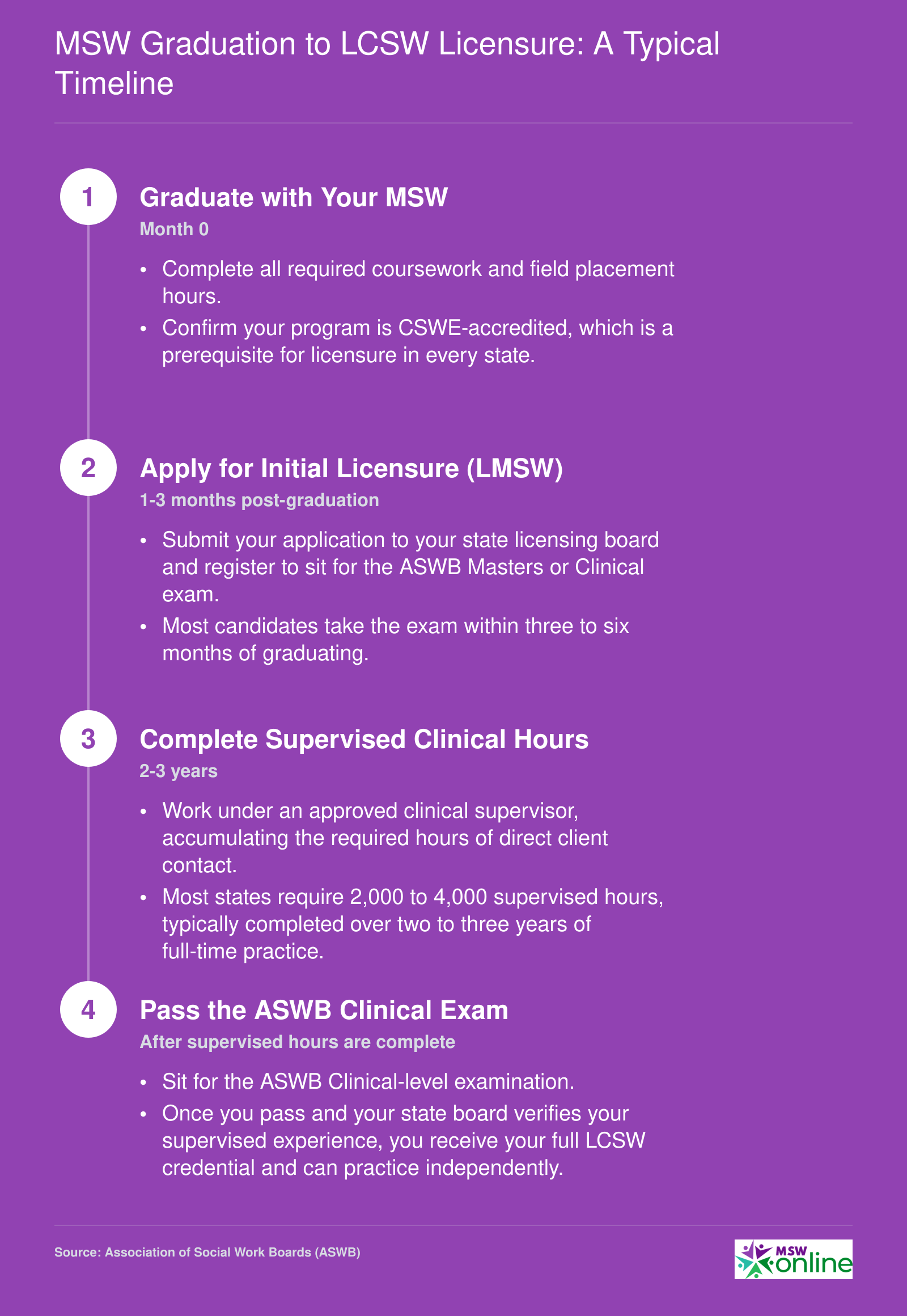
MSW Graduation to LCSW Licensure: A Typical Timeline
Earning your MSW is a major milestone, but independent clinical practice requires additional steps. The path from graduation to full LCSW licensure typically spans three to four years, depending on your state's requirements and how quickly you accumulate supervised hours. Here is what that journey looks like.
Online Vs. On-Campus MSW Programs: Adapting These Tips to Your Format
Online and on-campus MSW programs are two sides of the same coin: both are accredited by the Council on Social Work Education (CSWE) and meet the same educational standards, yet the delivery method can shape how you learn, connect, and complete field requirements. Recognizing these differences helps you adapt the advice in this article to your chosen path.
Same Credential, Different Learning Environment
Employers and licensing boards generally do not distinguish between a CSWE-accredited online MSW programs and an on-campus degree. Hiring decisions rest on accreditation status, your licensure, and relevant experience.2 A small number of hiring managers may express mild skepticism about fully asynchronous programs, but this is rarely a barrier when your degree is from an accredited institution.3 All or nearly all U.S. jurisdictions accept online MSW degrees for licensure, so your career options remain intact.2
Networking and Peer Support
Campus-based students often build connections organically during class, study sessions, and campus events. In an online program, cohort bonds require more deliberate effort. Participate actively in virtual discussion boards, form or join online study groups, and attend any optional live sessions. Consider using video check-ins with a small group of peers to maintain accountability and mutual support. Treat your online cohort as your first professional network and stay engaged.
Time Management and Field Placement Logistics
Online programs typically offer asynchronous coursework, giving you flexibility to study around work and family obligations. This freedom demands strong self-directed time management for MSW students; without the structure of a physical classroom, it is easy to fall behind. Create a weekly schedule that blocks out readings, assignments, and live sessions, and stick to it.
Field placements present a different challenge. On-campus programs often have long-standing partnerships with local agencies, simplifying the process. Online students frequently must arrange their own placements in their local area, which can involve more legwork and fewer paid internship opportunities.3 Begin researching and contacting agencies early, and lean on your program's field education office for guidance. Remember that the required 900 to 1,000-plus hours are the same regardless of format, so plan your life accordingly.
Frequently Asked Questions About Starting an MSW Program
Starting an MSW program raises practical questions that admissions brochures rarely answer in enough detail. The questions below draw on common concerns voiced by incoming students, including those shared in forums like the r/SocialWorkStudents community on Reddit, combined with guidance from faculty and field educators.
What separates MSW students who thrive from those who merely survive? The answer runs through every section of this guide: preparation. Mapping your weekly hours before orientation, building a realistic financial plan, researching your field placement site, and understanding the licensure timeline all compound into a smoother two or three years.
Bookmark this page and revisit it at each milestone. The advice on time management hits differently once you are juggling 20 hours of field placement per week; the licensure section becomes urgent as graduation approaches. If you want a deeper look at what the first year demands, first-year MSW survival tips can help you anticipate challenges before they arrive. Your next step is simple: pick one tip from this list and act on it this week. Draft a weekly schedule, submit a scholarship application, or email a faculty member to introduce yourself. Small moves now create momentum that carries you to graduation and beyond.