
Points of interest…
- The ASWB exam changes on August 3, 2026 shift focus from memorization to applied reasoning and clinical judgment.
- Prep course costs range from under $200 for free resource bundles to over $1,000 for live coaching programs.
- AI assisted platforms like Springer Publishing's ExamPrepConnect now offer personalized study planning across BSW, MSW, and Clinical levels.
- A realistic 4, 8, or 12 week study plan matters more than which brand of prep course you purchase.
On August 3, 2026, the Association of Social Work Boards restructured every level of its licensure examination, shifting the exam's core emphasis from memorization of terms and theory to applied reasoning, professional judgment, and real-world clinical decision-making. It is the most significant overhaul to ASWB testing in over a decade.
The practical problem: most exam prep courses on the market were built for the old format. A course designed around definition recall and category memorization will not adequately prepare you for an exam that now rewards contextual thinking and ethical reasoning under realistic practice scenarios. Evaluating prep options carefully is not optional.
Springer Publishing's ExamPrepConnect platform, developed with licensure expert Dr. Dawn Apgar, is among the first course offerings explicitly aligned to the 2026 changes.1 That gap between legacy prep materials and a restructured exam is exactly why candidates preparing for BSW, MSW, or Clinical-level licensure in 2026 face a more consequential product decision than any cohort before them.
What Changed: The 2026 ASWB Exam Shift Toward Applied Reasoning
The Association of Social Work Boards has restructured its licensure examinations effective August 3, 2026, marking the most significant change to social work licensing exams in over a decade. If you are preparing for any level of the ASWB exam, whether Bachelor's, Master's, or Clinical, you need to understand exactly what shifted and why your study approach must change accordingly.
The Structural Changes at a Glance
The new exam format differs substantially from its predecessor. According to ASWB's official communications on ASWB exam development and candidate experience, the August 2026 exam contains 122 total questions, with 110 scored items and 12 pretest items that do not count toward your score.1 You have 240 minutes to complete the exam. The previous version contained 170 questions, so the new format is notably shorter but demands more depth per question.
Perhaps the most consequential structural change is the consolidation from four content areas to three, with a pronounced emphasis on values and ethics as the highest-weighted domain.1 The question format now includes a higher proportion of three-option multiple-choice items rather than the traditional four-option format. Scoring remains compensatory, meaning strong performance in one area can offset weaker performance in another.
What "Applied Reasoning" Actually Means for You
The shift from memorization to applied knowledge and reasoning changes what you will see on test day. Rather than asking you to recall a definition of informed consent or list the stages of a particular theory, questions now present clinical vignettes, ethical dilemmas, and multi-step case scenarios that require you to synthesize knowledge and make professional judgments.
Expect questions that describe a client situation and ask you to determine the most appropriate next step, weighing competing ethical principles, agency policies, and client preferences simultaneously. A solid grounding in ethical considerations in social work will be especially important, given that values and ethics carry the highest domain weight on the restructured exam. You may encounter scenarios where multiple answers seem reasonable, and you must identify the response that best reflects professional social work values and sound clinical reasoning.
Springer Publishing launched next-generation preparation courses on its ExamPrepConnect platform specifically to address these changes, developed in collaboration with licensure expert Dr. Dawn Apgar.2 These courses explicitly target the new emphasis on real-world decision-making.
Why Your Old Study Strategy Will Not Work
If your exam preparation plan consists primarily of flashcards, terminology drills, and memorizing DSM criteria, you are underprepared for the August 2026 exam. Those tools remain useful for building foundational knowledge, but they cannot teach you to navigate the ambiguity of applied reasoning questions.
Effective preparation now requires practicing clinical judgment frameworks: learning systematic approaches to ethical decision-making, understanding how to prioritize competing client needs, and developing comfort with scenarios where the "right" answer depends on context. Courses that teach you how to think through problems, not just what to remember, will better position you for success.
Every licensure candidate is affected by these changes. Whether you are a recent BSW graduate, an MSW student, or an experienced practitioner pursuing levels of social work licensure, the same applied reasoning emphasis applies across all exam levels. Begin adjusting your study approach now.
Types of Licensure Prep Courses: Live, Self-Paced, Hybrid, and AI-Assisted
What format of ASWB prep course will actually fit how you study and how you live? The answer matters more than which brand name you choose, because the wrong format wastes both money and study time. Five main course types dominate the market in 2026, and each rewards a different kind of learner.
The Five Main Formats
- Live instructor-led workshops: Held over one day or a few sessions, usually on weekends. An instructor walks through content domains in real time and fields questions. Best for candidates who need external structure, retain information better through discussion, and want immediate clarification on tricky DSM or ethics scenarios.
- Self-paced asynchronous courses: Recorded lectures, reading modules, and untimed practice banks you work through on your own schedule. Best for working clinicians, parents, and anyone whose weeks are unpredictable. Requires real self-discipline.
- Hybrid live plus on-demand programs: Combine recorded content with scheduled live review sessions, office hours, or cohort check-ins. A reasonable middle ground if you want flexibility but know you will drift without some accountability.
- Boot camps: Intensive multi-day formats (often two to four days) that compress core content review before a test date. Useful as a final push, less useful as your only preparation.
- AI-assisted and app-based platforms: Adaptive question banks, mobile flashcards, and AI tutors that respond to your specific weak areas. Springer's ExamPrepConnect now includes Course Coach, an AI assistant built to mimic tutor-style guidance at any hour. This is part of a broader move toward AI learning companions across professional licensure prep.
Matching Format to Learner
For candidates balancing work and an MSW program, the self-paced format often wins on paper, but it demands a level of self-accountability that live and hybrid options build in automatically.
AI-assisted tools are notable because they reduce the need for expensive one-on-one tutoring, which has historically priced out many candidates. A well-designed AI tutor can explain why a vignette answer is correct at 11 p.m. the night before your exam, something a human coach charging hourly cannot reliably do.
The trade-offs are predictable. Live courses give accountability but lock you into a schedule. Self-paced offers freedom but punishes procrastinators. Hybrid splits the difference and costs accordingly. Boot camps deliver intensity but burn out candidates who use them as a substitute for months of steady review.
Match the format to your actual calendar and learning style. Defaulting to whatever your classmates picked is how candidates end up retaking the exam.
Questions to Ask Yourself
Side-By-Side Course Comparison: Features, Costs, and Formats
A licensure prep course comparison is a feature-by-feature breakdown of what each provider offers, what it costs, and how the instruction is delivered. With multiple vendors competing for your attention, understanding exactly what you get for your money helps you avoid overpaying for features you will not use or underpaying for a course that leaves gaps in your preparation.
What to Compare Across Providers
Not all prep courses are built the same way. Some bundle practice exams with digital textbooks; others charge separately for each component. When evaluating options, focus on these core variables:
- Exam levels covered: Does the course prepare you for the BSW, MSW, or Clinical exam, or all three? Buying a course that does not match your licensure track wastes money.
- Delivery format: Self-paced online courses let you study on your schedule, while live workshops or hybrid models add structured deadlines and instructor interaction.
- Practice exams: Full-length, timed practice tests simulate real testing conditions. Some providers include unlimited attempts; others cap you at two or three.
- Personalized study planning: Adaptive tools that adjust to your weak areas can save weeks of inefficient review.
- Access duration: A 90-day window may feel rushed if you are working full time. Continuous or perpetual access removes that pressure.
- Price: Courses range from under $100 to several hundred dollars. Institutional pricing through your university may reduce or eliminate out-of-pocket costs.
Springer ExamPrepConnect at a Glance
Springer's ExamPrepConnect platform covers all three exam levels (BSW, MSW, and Clinical) through a self-paced online format.1 A standard course is priced around $129.99, with the broader catalog ranging from roughly $90 to $200 depending on bundled materials.2 Key features include full-length timed practice exams, a personalized study plan, and integrated digital book content.3 Access is continuous, meaning you retain your materials until you pass.
For students enrolled in partnering programs, the ExamPrepConnect University Solution integrates directly into the curriculum.4 Pricing is handled at the institutional level, and licenses typically span the semester or full program length, with perpetual user access per license.
Other Providers to Investigate
Several other companies serve this market, including Therapist Development Center, NASW chapter workshops, and independent platforms like SIRIPro. Features, costs, and formats vary widely. Some emphasize audio lectures; others focus on question banks. Before committing, request a free trial or sample questions to gauge whether the teaching style matches how you learn.
Making the Comparison Actionable
Create a simple spreadsheet listing each provider across the top and the comparison categories down the side. Fill in what you can verify from official sources, then highlight the gaps. If a vendor does not publish pass rates or does not specify access duration, that opacity itself is data worth noting. The goal is not to find the cheapest option but to find the best match for your online MSW program selection criteria, timeline, and budget.
Related Articles
How Prep Courses Map to ASWB Exam Content Domains
Not every prep course covers the exam the same way, and the difference between a course built around the actual ASWB content blueprint and one that simply reviews broad social work theory can determine whether you pass on the first attempt.
Know the Domains Before You Shop
The ASWB exams are organized around defined content domains. For the Master's exam, those domains include Human Development, Diversity and Culture, Assessment, Psychotherapy and Clinical Interventions, Casework Management, and Professional Ethics and Values, among others. The Clinical exam shifts the weighting toward direct practice competencies, while the Bachelor's exam emphasizes foundational knowledge and generalist practice. The specific percentage each domain carries differs across exam levels, and that matters more than most candidates realize.
Before committing to any course, pull up the official ASWB content outline from the ASWB website. It is freely available, organized by exam level, and lists every domain along with the approximate proportion of questions it represents. This document is your audit tool.
How to Audit a Course Syllabus
When you review a course's table of contents or syllabus, look for explicit domain-by-domain organization. A well-built course labels each module or lesson with the domain it addresses. If the curriculum groups everything under vague headings like "clinical concepts" or "practice skills" without mapping back to specific ASWB categories, you have no reliable way to know whether your study time is distributed proportionally.
Cross-reference the course topic list against the ASWB outline line by line. Flag any domain that receives less coverage than its exam weight warrants. That gap is a risk.
Why the 2026 Blueprint Update Changes the Calculation
The August 2026 ASWB exam changes reweight certain domains to emphasize applied reasoning and professional judgment over recall-based knowledge. Legacy prep materials built before this revision may still reflect the old weightings, leaving candidates underprepared in areas the updated exam now stresses more heavily.
Courses developed specifically for the new blueprint, such as the Springer Publishing materials created in collaboration with licensure expert Dr. Dawn Apgar, are structured around what the exam actually tests in 2026, not what it tested two or three years ago.1
The Problem With "All Levels" Marketing
Be cautious of any course marketed as suitable for BSW, MSW, and clinical social worker candidates without offering distinct content tracks for each level. Because domain weightings differ meaningfully across those three exams, a single undifferentiated curriculum cannot serve all three candidates equally well. A legitimate multi-level course shows you exactly where the tracks diverge and what content is unique to each level. If it does not, treat it as a generalist resource at best, not a primary prep tool.
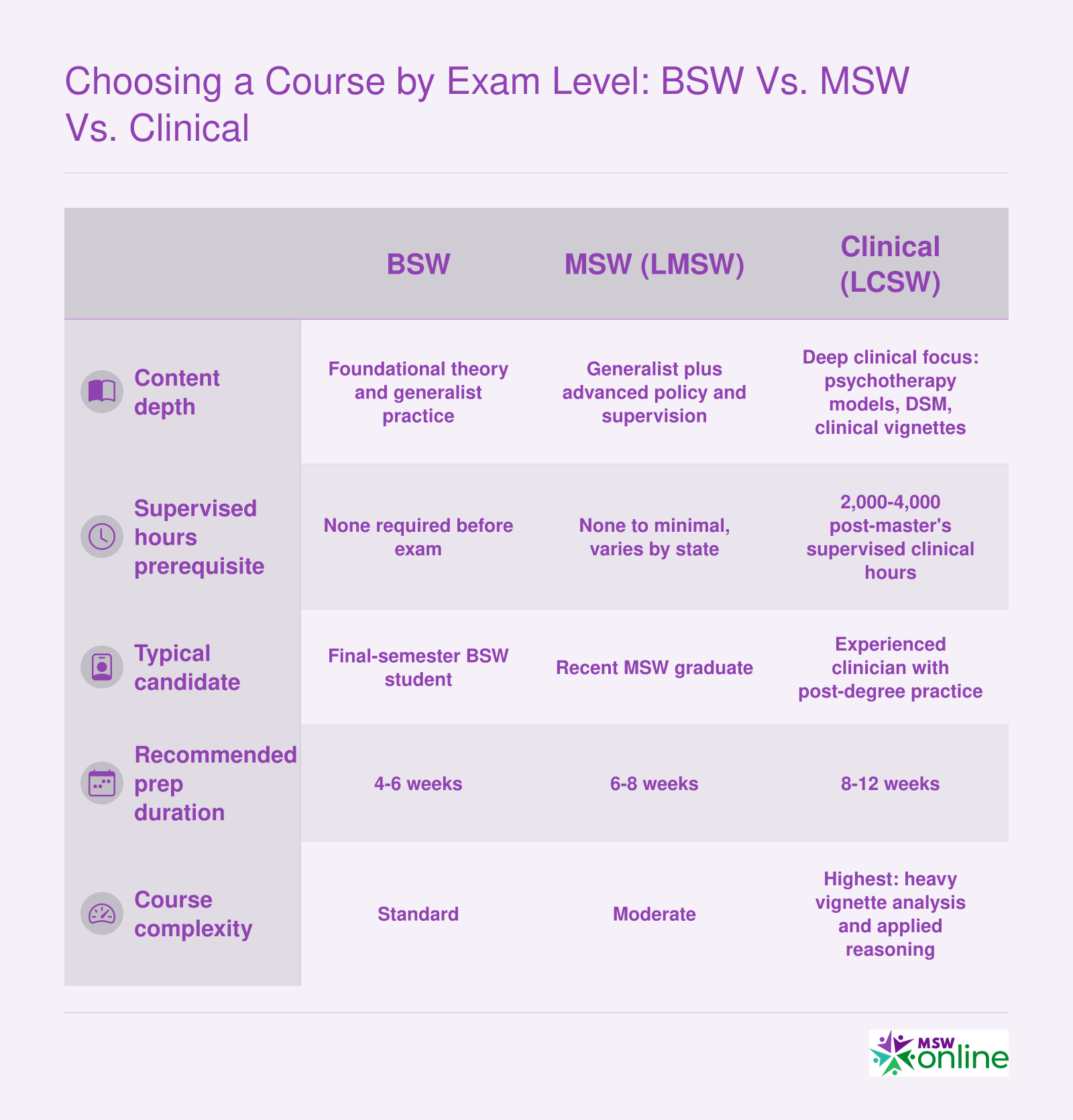
Choosing a Course by Exam Level: BSW Vs. MSW Vs. Clinical
Not every licensure prep course covers every exam level with equal depth. Before you enroll, confirm that the course you are considering offers level-specific content, practice vignettes, and study plans calibrated to your particular ASWB exam. A generic social work review may leave Clinical candidates underprepared on psychotherapy models and advanced clinical reasoning, while BSW candidates may waste time on material outside their exam blueprint.
How to Evaluate Pass Rates and Student Outcomes
Do advertised pass rates from social work exam prep providers actually mean what they seem to mean? The short answer is: not always, and understanding why will save you from choosing a course based on inflated marketing claims rather than genuine outcomes.
The Problem With Self-Reported Pass Rates
Many prep providers advertise pass rates between 80% and 95% or higher. These numbers look impressive on a sales page, but there is an important caveat: no ASWB-audited database tracks pass rates by prep provider. Every figure you see is self-reported by the company itself. That means no independent body has verified the claim, and you have no way to confirm it without digging deeper.
The methodology behind each number matters enormously. Ask yourself what the denominator actually includes:
- Does it count everyone who purchased the course, or only those who completed every module?
- Does it include only students who voluntarily reported their results, excluding those who failed and stayed silent?
- Does it combine first-time and repeat takers, potentially inflating the overall figure?
A provider reporting a 96% pass rate among "course completers who responded to our survey" is telling a very different story than one reporting success among all purchasers. If the provider does not clearly define these terms, treat the statistic with caution.
National Baselines You Can Actually Trust
ASWB exam pass rate reports published each year give you a factual baseline for comparison. For the 2024 testing period, national first-time pass rates across exam levels were:1
- Bachelors exam: 67.2% (over 3,080 first-time test takers)
- Masters exam: 73.0% (over 20,500 first-time test takers)
- Clinical exam: 75.3% (over 23,400 first-time test takers)
- Advanced Generalist exam: 50.0% (a much smaller pool of 84 first-time test takers)
These figures represent tens of thousands of candidates and offer the most reliable comparison point available. If a prep provider claims a pass rate that dramatically exceeds the national average across all exam levels, scrutinize how the number was calculated before accepting it at face value. A legitimate boost of several percentage points is plausible; a claim that virtually everyone passes is statistically implausible at scale.
Red Flags to Watch For
Beyond vague denominators, watch for these warning signs:
- Pass rate claims with no sample size or time period attached.
- Testimonials that lack verifiable details such as the exam level taken, the year, or the candidate's preparation timeline.
- Providers that refuse to share any aggregate completion or outcome data publicly.
- Guarantees described in vague language without clear refund terms or conditions spelled out in writing.
Stronger Indicators of Course Quality
Since pass rates alone are unreliable, look for secondary outcome signals that are harder to fake:
- Money-back guarantees: A provider willing to refund your fee if you complete the course and still do not pass has financial skin in the game. Read the fine print to understand what "completion" requires.
- Completion rates: Courses that track and share what percentage of enrolled students finish the full program demonstrate confidence in engagement and content quality.
- Transparent testimonials: Student reviews that name the specific exam level, the preparation timeline, and measurable details (such as practice exam score improvements) carry more weight than generic praise.
- Published outcome data: Providers that share aggregate statistics publicly, even when results are imperfect, signal a level of honesty that marketing-only competitors avoid.
What the Research Says
Peer-reviewed studies specifically measuring the effect of commercial exam prep courses on ASWB outcomes remain limited. A small body of social work research and practice literature has explored factors correlated with licensure exam success, including GPA, field placement quality, and program accreditation status. However, rigorous controlled studies isolating the impact of a particular prep course from other variables are scarce. This gap means that even well-intentioned providers have limited independent evidence to support effectiveness claims. When a provider references "research-backed" methods, ask whether they are citing their own internal data or published, peer-reviewed findings.
The bottom line: treat any single pass rate figure as one data point, not proof. Cross-reference it with ASWB's national baselines, examine the provider's transparency practices, and prioritize courses that earn your trust through verifiable outcomes rather than headline numbers alone.
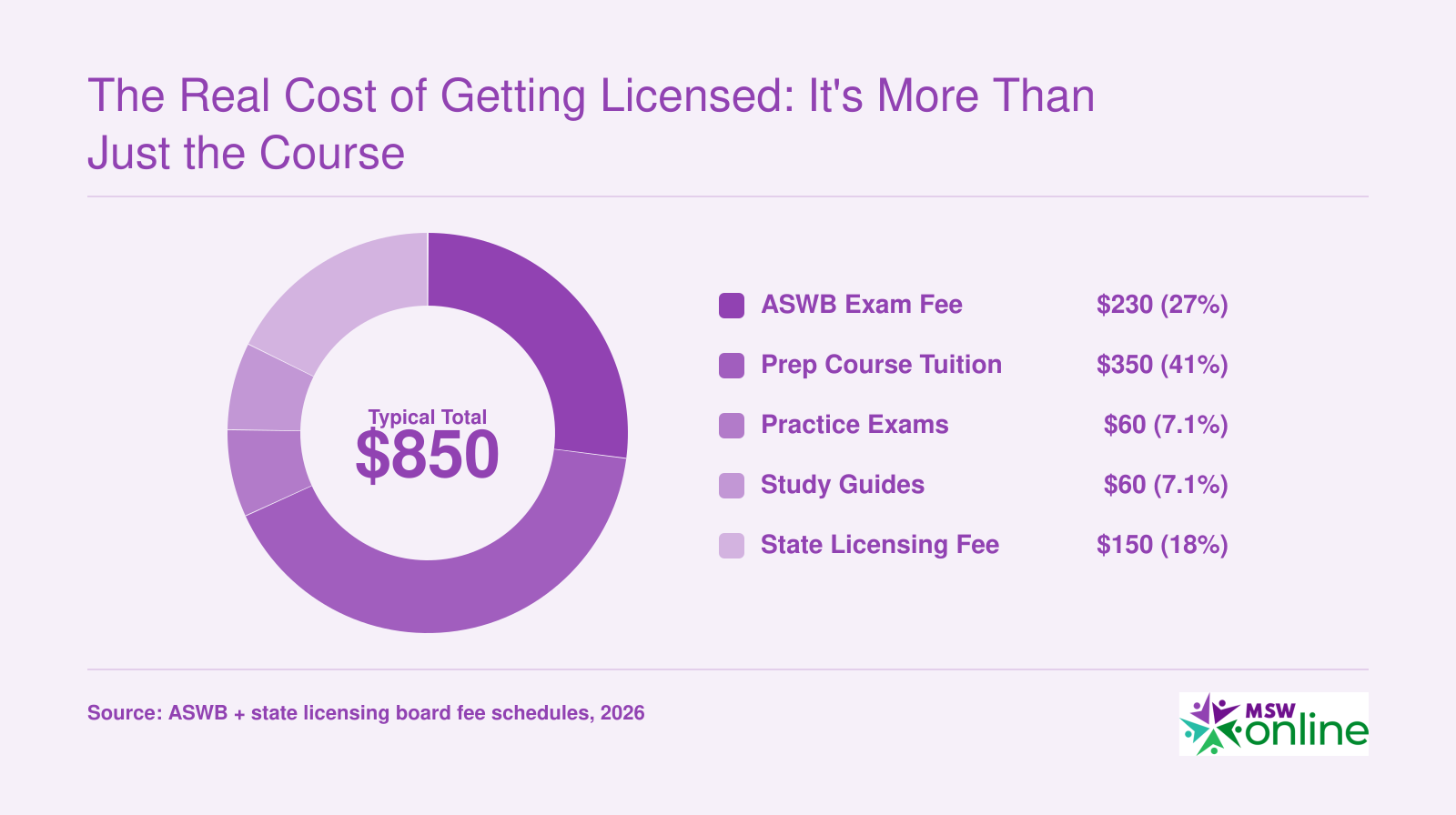
The Real Cost of Getting Licensed: It's More Than Just the Course
Many social work students budget only for a prep course and are caught off guard by the other fees that stack up on the path to licensure. The total out-of-pocket cost can range from under $200 when you pair free study resources with the exam fee alone, to $1,500 or more when you add a premium prep course, supplemental materials, and state application charges. The donut below breaks down a typical mid-range scenario so you can see every piece of the financial picture at a glance.
Budgeting for Licensure Prep: Free Options, Scholarships, and Equity
Budgeting for licensure prep means planning for two separate costs: the prep course or materials you use to study, and the ASWB exam fee itself (which runs $230 for the Bachelors and Masters exams and $260 for the Clinical exam, plus any state licensing fees on top). The good news is that prep does not have to be expensive. With some research, most candidates can assemble a solid study package for under $200.
Free and Low-Cost Options Worth Knowing
Several NASW chapters offer free or near-free prep designed by social workers for social workers:
- NASW Ohio Chapter: A free recorded license prep training is available year-round1, and a free three-hour live Zoom course ran on March 6, 2026 (watch for repeats).2
- NASW Illinois Chapter: Their zero-profit review course costs $124 to $174, with a $25 early-registration discount.3
- NASW Iowa Chapter: Offers a free one-hour exam prep webinar periodically, plus a curated resource list.4
- NASW Metro DC/Virginia Chapter: Workshops include six months of access to study materials.5
- NASW free 2026-updated guide: A no-cost study guide refreshed for the August 2026 exam changes.6
- ASWB Online Practice Test: $85 for a four-hour, full-length simulated exam (registered candidates only).7 This is the closest you will get to the real thing.
- Social Work Test Prep: A free 10-question practice test for a quick diagnostic.8
A Three-Tier Budgeting Framework
- Under $100: Stack the NASW free guide, a chapter webinar, the ASWB practice test ($85), and a free practice set. Sufficient for disciplined self-studiers.
- $100 to $300: Add an NASW chapter review course (like Illinois at $124 to $174) for structured content review with live instruction.
- $500 and up: Expect AI-assisted study planning, full-length practice exams, content libraries, and either coaching access or a pass guarantee. Only worth it if you need accountability or have failed a prior attempt.
Equity, Employer Reimbursement, and Asking First
Exam and prep costs are a real barrier for students from under-resourced backgrounds, and the field has been slow to address it. Before paying out of pocket, ask three questions: Does my MSW program include licensure prep in tuition? Does my employer reimburse exam prep or exam fees? (CareSource, for example, sponsors free prep for affiliated workers.) Does my state NASW chapter offer social work scholarships or member discounts? Many candidates pay full price for resources their program or employer would have covered.
The most common failure pattern is not choosing the wrong prep course but never finishing the one you bought. Motivation fades, work gets busy, and materials sit untouched. Before you spend a dollar, commit to a realistic weekly study schedule you can actually follow. A prep course is a tool, not a solution.
Building a Study Plan: 4-, 8-, and 12-Week Frameworks for Working Professionals
A study plan you actually follow beats a perfect plan you abandon by week two. The 2026 ASWB exam rewards sustained practice with applied reasoning scenarios, not last-minute cramming of definitions. Building a realistic schedule around your work, coursework, and personal commitments determines whether you walk into the testing center prepared or panicked.
The 4-Week Intensive: For Dedicated Study Time
This framework requires 15 to 20 hours weekly and suits candidates with a clear calendar, perhaps between jobs or during a semester break.
- Week 1: Complete content review for Human Development and Behavior plus Diversity, Equity, and Inclusion domains. Aim for 150 practice questions across these areas.
- Week 2: Cover Assessment and Intervention domains. Another 150 practice questions, now timed at exam pace.
- Week 3: Review Professional Relationships, Ethics, and Supervision content. Take your first full-length practice exam under strict test conditions. Analyze every missed question.
- Week 4: Light content review focused on weak areas identified in your practice exam. Take a second full-length exam early in the week. Reserve the final two days for rest, light review, and confidence-building.
The 8-Week Standard: For Working Professionals
Most candidates preparing while employed find 8 to 12 hours weekly sustainable. This pace allows deeper processing without burnout.
- Weeks 1 through 2: Human Development, Behavior, and Diversity domains. Complete 100 practice questions per week.
- Weeks 3 through 4: Assessment and Intervention content. Increase to 125 questions weekly, introducing timed sets.
- Weeks 5 through 6: Professional Relationships, Ethics, and Supervision. First full-length practice exam at the end of week 6.
- Week 7: Targeted review of weak domains. Second full-length practice exam.
- Week 8: Light review, rest days, and exam day logistics planning.
The 12-Week Gradual: For Those Balancing MSW Coursework
At 5 to 8 hours weekly, this framework prevents academic overload while maintaining steady progress. For students also navigating MSW field placement, it is especially important to map your prep schedule against your agency hours before committing to a timeline.
- Weeks 1 through 3: One content domain per week with 75 practice questions each.
- Weeks 4 through 6: Continue through remaining domains at the same pace.
- Weeks 7 through 9: Cycle back through all domains with timed practice sets. First full-length exam at week 9.
- Weeks 10 through 11: Intensive weak-area focus based on practice exam results. Second full-length exam.
- Week 12: Rest, light review, and mental preparation.
Managing Test Anxiety
The shift toward applied reasoning means you will encounter questions where multiple answers seem defensible. This uncertainty is normal, not a sign you are failing. Build tolerance by practicing under timed conditions regularly, not just once before the exam. Before each study session, try a simple breathing technique: inhale for four counts, hold for four, exhale for six. This physiological reset reduces cortisol and improves focus. Normalize the discomfort of hard questions during practice so it does not derail you on test day.
Timing Your Prep Around Academic Demands
MSW students should start licensure preparation during a lighter semester, not when field placement hours peak. If your program front-loads coursework, the final semester may offer breathing room. If field placement dominates your last year, begin prep earlier. Review your academic calendar before committing to a timeline.
Tracking Your Progress
Accountability tools matter. Options include a simple spreadsheet logging hours, domains covered, and practice scores. App-based study trackers can send reminders and visualize progress. Platforms like ExamPrepConnect offer built-in personalized study planning that adjusts recommendations based on your performance data. Choose whatever system you will actually use consistently: complexity does not equal effectiveness.
What Licensed Social Workers Earn: A Quick Reality Check
Licensure is not just a professional milestone. It directly affects your earning potential. The table below, drawn from the Occupational Employment and Wage Statistics published by the U.S. Bureau of Labor Statistics (2024 data), shows how salaries vary across social work specializations and reinforces why investing in exam prep pays off over a career. Notice that healthcare social workers, a role that typically requires clinical licensure (LCSW), earn a median salary roughly $9,500 higher than child, family, and school social workers, many of whom hold BSW-level credentials. The spread from the 25th to the 75th percentile also reveals meaningful room for growth as you gain experience, pursue advanced licensure, and specialize.
| Social Work Occupation | Total Employment | 25th Percentile Salary | Median Salary | 75th Percentile Salary | Mean Salary |
|---|---|---|---|---|---|
| Healthcare Social Workers | 185,940 | $55,360 | $68,090 | $83,410 | $72,030 |
| Mental Health and Substance Abuse Social Workers | 125,910 | $46,550 | $60,060 | $78,980 | $68,290 |
| Child, Family, and School Social Workers | 382,960 | $47,480 | $58,570 | $74,060 | $62,920 |
| Social Workers (All Specializations) | 759,740 | $48,680 | $61,330 | $78,500 | $67,050 |
Frequently Asked Questions About Social Work Exam Prep
Licensure prep is one of the most practical investments you can make on the path to becoming a licensed social worker. Below are answers to the questions MSW candidates and BSW graduates ask most often, updated to reflect the August 2026 ASWB exam changes and the latest course options.