Points of interest…
- A 2026 study of 34 Black men in mental health found mentorship is critical for persistence and success.
- The LCSW licensure exam forces Black male candidates to shift from their cultural perspective to a dominant one.
- HBCUs like Howard and Clark Atlanta produce a disproportionate share of Black MSW graduates.
- The NASW Verne LaMarr Lyons Memorial Scholarship grants $4,000 to MSW students serving African American communities.
Why do Black men make up less than 7% of licensed social workers when they face disproportionately high rates of untreated mental health conditions? A June 2026 study in the Journal of Black Psychology, which interviewed 34 Black male mental health professionals, confirms that the motivation to serve is strong, yet financial strain, cultural stigma, and structural gatekeeping push many out before they reach licensure.1
Closing the gap requires concrete fixes: licensure exams that do not penalize cultural perspective, sustained mentorship, targeted scholarships, and robust pipelines through HBCU MSW programs online and on campus. Without systemic change, the profession will keep losing the clinicians best equipped to rebuild trust in communities that need it most.
What Is Diversity in Social Work and Why Does It Matter?
The social work profession champions serving marginalized communities, yet its own workforce remains overwhelmingly white and female. That gap between stated values and lived representation is the central challenge diversity efforts aim to close.
Diversity as an Ethical Imperative
Diversity in social work extends far beyond race and gender. It encompasses ethnicity, language, socioeconomic background, sexual orientation, and lived experience. The National Association of Social Workers (NASW) Code of Ethics frames cultural competence and social diversity as fundamental to ethical practice. Similarly, the Council on Social Work Education (CSWE) requires accredited programs to demonstrate commitment to diversity in admissions, curriculum, and faculty. For social work, diversity is not a nice-to-have; it is a professional obligation grounded in the belief that clients deserve providers who reflect the communities they serve.
The Numbers Behind the Gap
Despite this commitment, the profession remains strikingly homogenous. According to the 2023-2024 CSWE Annual Survey, fully 81.4% of MSW students are female, while just 15.0% are male.1 Racially, 52.0% of MSW students are white; Black students make up only 3.0% of enrollment.1 Among licensed social workers, the 2024 ASWB Practice Analysis confirms a workforce that is predominantly white and female.2 Black men are estimated to represent well under 1% of practicing social workers, a reality that mirrors broader underrepresentation in mental health fields.
Why Representation Affects Outcomes
Research consistently shows that clients are more likely to seek help, stay engaged in treatment, and report satisfaction when they work with providers who share their cultural background. For Black individuals, therapist matching can reduce the perceived stigma of mental health care and increase trust. Without a diverse pool of social workers, agencies often struggle to connect with communities of color. Cultural competence training helps, but it cannot fully bridge the gap created by a workforce that does not look like the populations it serves.
Beyond Cultural Competence Training
Training clinicians in cultural responsiveness is necessary, but it is not a substitute for structural change. A curriculum can teach awareness, but it cannot replicate the lived perspective a Black male social worker brings to a session with a young Black client navigating systemic racism. Notably, the gender gap in social work leadership compounds the problem, as leadership pipelines also remain narrow and unrepresentative. Closing the diversity gap requires intentional recruitment pipelines, targeted financial aid, mentorship, and licensure reforms that address the specific barriers outlined across this article. Without these, social work will continue to fall short of its own ideals.
Why Are There so Few Black Men in Social Work?
A 2026 study titled 'Breaking Barriers: Understanding the Motivations and Challenges of Black Men in Mental Health Careers,' published in the Journal of Black Psychology, interviewed 34 Black men working or training in fields like counseling, psychology, and social work.1 Reported by Yahoo News and WMBD on June 25, 2026, during Men's Mental Health Month, the study identifies why Black men remain dramatically underrepresented in social work despite a strong desire to serve their communities.
Groundbreaking Study on Black Men in Mental Health
The 'Breaking Barriers' study, led by researcher Aaron Mallory, founder and CEO of GRO Community, an organization providing mental health aid for Black boys, documented a powerful paradox: the very men motivated to expand access to mental health care in Black communities face systemic barriers that often push them out before they can become licensed practitioners.1 The interviews revealed that Black men enter the field driven by community service and a desire to change the face of mental health. Yet financial, cultural, and structural obstacles combine to create a leaky pipeline that few navigate successfully.
Financial Barriers: Debt and Funding Gaps
Graduate social work education is expensive, and Black men often shoulder disproportionate student debt. The study found that limited funding for advanced degrees is a primary deterrent.1 Many aspiring social workers work multiple jobs to afford tuition, but the financial strain is compounded by the fact that MSW programs typically require two to three years of study, often followed by 2,000 to 3,000 hours of supervised clinical experience that may be unpaid or low-paid. Without targeted scholarships and stipends, the economic burden pushes many Black men toward more immediately lucrative careers. Resources on MSW financial aid and scholarships can help students identify funding options before the burden becomes unmanageable.
Cultural Stigma: Masculinity and Helping Professions
Cultural narratives around masculinity and mental health create another barrier. The study participants described how social work and counseling are often perceived as feminine or non-masculine professions within Black communities.1 Men reported feeling that seeking help or working in mental health contradicts expectations for strength and self-reliance. This stigma discourages young Black men from considering social work as a viable career, and it can persist even after entering the field, leading to isolation and attrition. It is also worth noting that social work is a female-dominated field broadly, which shapes program cultures in ways that can compound that sense of isolation for Black men.
Structural Barriers: Licensure as a Gauntlet
Even after earning an MSW, the path to clinical licensure presents unique challenges. The study highlighted the LCSW exam as a significant hurdle. Aaron Mallory, reflecting on the test, stated, "I couldn't think from our cultural perspective, I had to shift from the dominant perspective to be able to navigate it."1 This suggests that the exam's structure and content may favor a White, middle-class viewpoint, forcing test-takers from diverse backgrounds to suppress their cultural lenses. Combined with costly exam fees and required supervision hours that can take two to four years to complete, the licensure process becomes a prolonged and costly journey that disproportionately filters out Black men.
The Power of Mentorship and Representation
A striking finding from the study is that mentorship and professional representation were critical factors in whether Black men persisted in the field.1 Those who had Black male mentors or peers in social work reported feeling more supported and were significantly more likely to stay. Conversely, men who lacked representation in their programs or workplaces described feeling isolated and were more likely to leave. This underscores the urgent need for intentional mentorship programs that connect Black male students and early-career professionals with seasoned practitioners who understand their specific challenges.
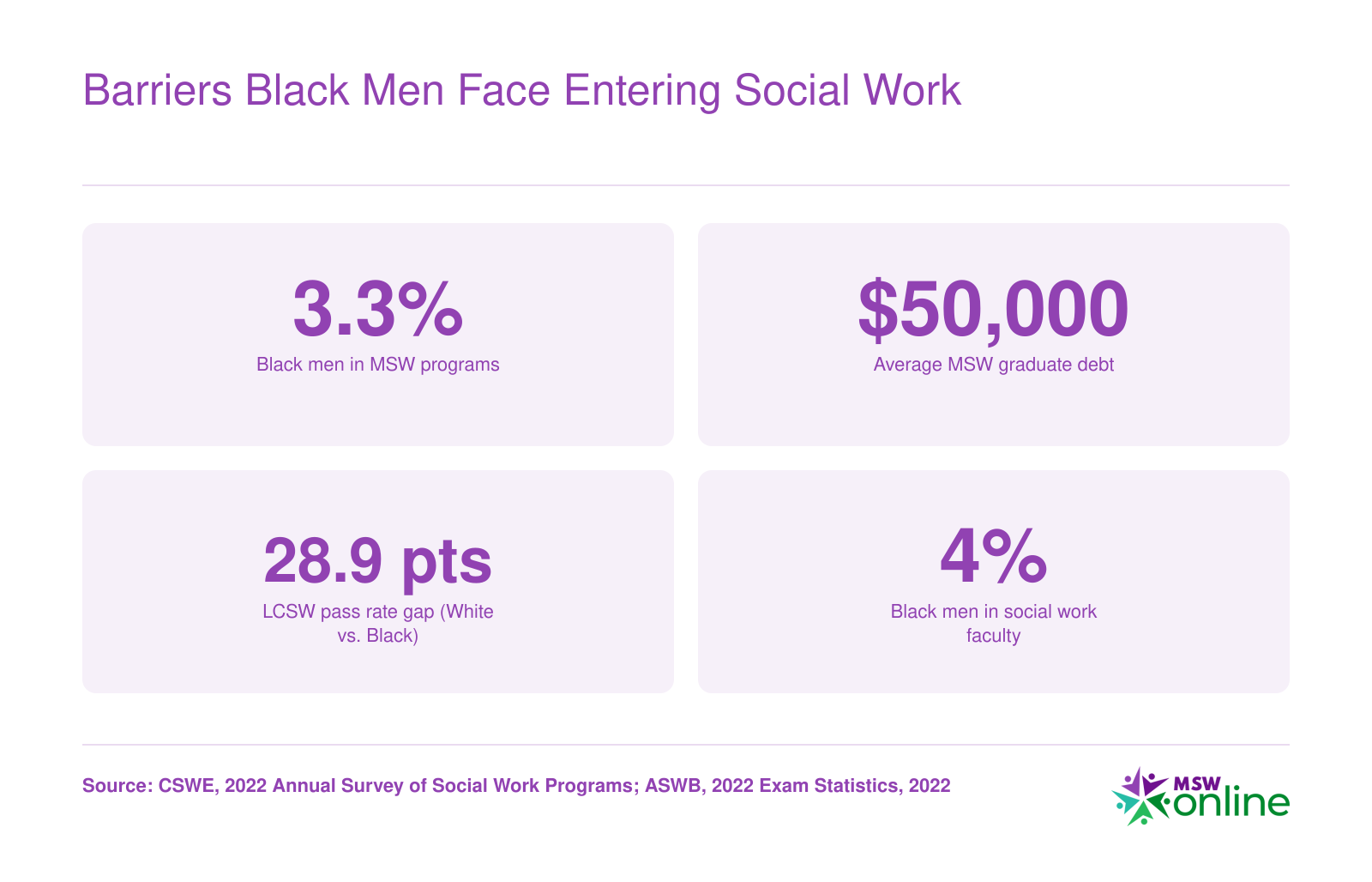
Barriers Black Men Face Entering Social Work
Systemic barriers disproportionately impact Black men pursuing social work careers. Data from CSWE and ASWB reveal stark underrepresentation, heavy financial burdens, and disparities in licensure outcomes that limit diversity in the profession.
Licensure Barriers: How the LCSW Pathway Disadvantages Black Men
The clinical licensure exam serves as a powerful gatekeeper that systematically filters out Black male candidates despite their deep commitment to community mental health. The very structure of the exam, combined with financial and mentorship gaps, creates a prolonged and costly pathway that discourages many otherwise qualified professionals from entering the field.
The Testing Bottleneck
Passing the ASWB licensing exam is required for Licensed Clinical Social Worker (LCSW) credentialing in most states. While the exam is intended to ensure competency, its design and administration have drawn sharp criticism for cultural narrowness. Researchers and advocacy groups note that the exam often measures knowledge through a lens that privileges dominant cultural frameworks, forcing Black test-takers to set aside their own cultural understandings of mental health, family dynamics, and help-seeking behaviors. A 2026 study published in the Journal of Black Psychology highlighted this tension, quoting lead researcher Aaron Mallory: "I couldn't think from our cultural perspective, I had to shift from the dominant perspective to be able to navigate it."1 This pressure to code-switch cognitively adds stress and can depress performance.
Cultural Bias in Standardized Assessments
Concerns about bias are not new. White papers from professional organizations like the National Association of Social Workers have documented how standardized testing can disadvantage candidates from non-majority backgrounds. Pass-rate data by race, when obtained through direct requests to the ASWB or analyzed in independent studies, consistently show significant disparities. The exam's multiple-choice format and case scenarios often reflect middle-class, Eurocentric norms, leaving Black men to parse questions that feel alien to the communities they aim to serve. Such barriers undermine the profession's stated commitment to cultural competence and equitable care.
State-Level Reforms Offer Alternatives
In response to persistent inequities, several states have begun rethinking the licensing process. California, Oregon, and Illinois, among others, have explored alternatives to the high-stakes exam. Legislative actions from 2023 onward have established task forces, piloted portfolio-based assessments, or introduced supervised-practice pathways that bypass the exam requirement altogether. These reforms recognize that clinical competence can be demonstrated through direct practice evaluation, not just a single standardized test. For those who have faced repeated setbacks, ASWB retake policy and strategy by state can clarify options and next steps. Tracking these efforts through state licensing board portals and legislative websites reveals a growing movement to remove racial and cultural barriers from the licensure pipeline.
Bridging the Gap
For Black men in MSW programs, awareness of these systemic hurdles is the first step. Many CSWE-accredited schools now offer licensure prep courses that address cultural bias explicitly and connect students with mentors who have successfully navigated the exam. While broad-scale reform is slow, the combination of state-level innovation, institutional support, and the passionate drive of Black male social workers is steadily reshaping a more equitable pathway to clinical practice.
I couldn't think from our cultural perspective, I had to shift from the dominant perspective to be able to navigate it.
HBCU MSW and BSW Programs: A Directory of Key Options
Why HBCUs Are Uniquely Positioned to Support Black Social Work Students
Historically Black Colleges and Universities have long served as critical pipelines for Black professionals in social work, a field where cultural congruence and representative role models profoundly shape educational outcomes. For Black men, who account for a disproportionately small share of licensed social workers, HBCU MSW programs offer more than academic training. They provide culturally affirming settings where curriculum often integrates the historical and systemic contexts of Black communities, and where faculty and mentors are more likely to share students' lived experiences. This supportive infrastructure helps counteract the isolation and financial strain that often derail Black students in predominantly white institutions. By design, HBCU social work programs emphasize community engagement, social justice, and mentorship networks that extend into licensure and career placement, directly addressing the structural barriers documented in recent research. The directory below highlights CSWE-accredited3 undergraduate and graduate programs at HBCUs, all committed to equipping practitioners who reflect the communities they serve.
CSWE-Accredited HBCU Social Work Programs
- Alabama A&M University (Normal, AL): BSW and MSW programs delivered on-campus. Concentrations include Community Mental Health and Family and Child Welfare.1
- Alabama State University (Montgomery, AL): BSW and MSW programs available on-campus.1
- Albany State University (Albany, GA): Offers BSW and MSW degrees on-campus.1
- Clark Atlanta University (Atlanta, GA): BSW, MSW, and PhD programs on-campus.2 Concentrations: Child and Family Practice, Health and Mental Health.
- Delaware State University (Dover, DE): BSW and MSW programs on-campus with a concentration in Advanced Generalist Practice.1
- Fayetteville State University (Fayetteville, NC): BSW and MSW programs delivered on-campus.1
- Florida A&M University (Tallahassee, FL): BSW and MSW programs on-campus.1
- Howard University (Washington, DC): BSW, MSW, and PhD programs available on-campus and online. Concentrations span Community Administration and Policy Practice, Direct Practice, Criminal Justice, Family and Child Welfare, Mental Health, Social Gerontology, Social Work in Healthcare, and Displaced Populations.1
- Jackson State University (Jackson, MS): BSW and MSW programs on-campus with a concentration in Children, Youth, and Families.1
- Mississippi Valley State University (Itta Bena, MS): BSW and MSW programs delivered on-campus.1
- Morgan State University (Baltimore, MD): BSW and MSW programs on-campus. Concentrations include Addictions and Urban Children Youth and Families.1
- Norfolk State University (Norfolk, VA): BSW and MSW programs delivered fully online.1
- North Carolina A&T State University (Greensboro, NC): MSW program available on-campus and online, with a concentration in Multicultural Clinical Practice.1
- North Carolina Central University (Durham, NC): BSW and MSW programs on-campus.1
Related Articles
Scholarships, Grants, and Fellowships for Black Social Work Students
The National Association of Social Workers (NASW) Foundation's Verne LaMarr Lyons Memorial Scholarship provides $4,000 to MSW students committed to African American community mental health practice.1 This is one example of targeted financial support that helps reduce student debt and open doors for Black men and women in social work. Securing funding requires knowing where to look and applying strategically across multiple sources. A broader overview of social work grants for minority students can help you map the full landscape before deadlines arrive.
Professional Association Awards
Major social work organizations offer scholarships and fellowships specifically for minority students. The Council on Social Work Education (CSWE) administers the Minority Fellowship Program, which supports full-time MSW students in their final year who plan to practice in mental health or substance use with racial/ethnic minority populations.2 Award amounts vary, and applications are typically due between January and March. CSWE also offers the Carl A. Scott Memorial Book Scholarship, a $500 award for BSW or MSW students demonstrating commitment to equity and social justice, with a deadline of March 16.2
The National Association of Black Social Workers (NABSW) provides multiple scholarships ranging from $1,962 to $2,500 for Black/African-descended social work students at all degree levels.3 Eligibility often requires NABSW membership and a demonstrated commitment to Black communities. Deadlines fall in January or February. Regional chapters, like the Northern New Jersey NABSW chapter, also offer funds with separate applications; the 2026 deadline for one such award was February 23.4
Beyond CSWE and NABSW, the NASW Foundation manages several relevant awards. The Consuelo W. Gosnell Memorial Scholarship ($4,000) targets MSW students working with American Indian/Alaska Native and Hispanic/Latino communities, though other underserved populations may qualify.3 Another option is the Lawanna Renee Barron Scholarship Endowment Fund, providing $1,000 to $2,000 for BSW or MSW students in rural practice or health/mental-health fields.3 NASW membership is required for most foundation scholarships, and deadlines generally cluster from January to March.
HBCU-Specific Funding
Many Historically Black Colleges and Universities (HBCUs) offer HBCU MSW program funding through dedicated financial aid not broadly advertised. Prospective students should visit each HBCU's social work department website and contact the financial aid office to ask about institution-specific grants, tuition remission, or stipends tied to community service. For example, the University of Maryland School of Social Work, though not an HBCU, provides SWCOS Scholarships ($2,500 to $5,000) for full-time MSW students completing practicums in Baltimore City through approved partnerships, illustrating how program-based aid can target local underserved areas.5 HBCU programs may have similar partnerships or alumni-funded scholarships that prioritize Black students.
External Databases and Search Tools
Federal resources and graduate social work scholarships aggregators can surface additional opportunities. Platforms like Fastweb and Scholarships.com let users filter by ethnicity and field of study, generating customized alerts. Setting up a profile with keywords such as "Black social work scholarships," "MSW minority funding," and "mental health diversity grants" can ensure new postings reach your inbox. Always verify eligibility through the sponsoring organization's official site before applying.
Questions to Ask Yourself
Mentorship and Representation: Building a Pipeline for Black Men
Mentorship is the single most critical factor determining whether Black men persist in mental health careers, according to a study published in the Journal of Black Psychology.1
The Groundbreaking GRO Community Study on Black Men in Mental Health
The study, led by Aaron Mallory, founder and CEO of GRO Community, interviewed 34 Black men working or training in counseling, psychology, and social work. It revealed that despite strong motivation to serve their communities, systemic barriers often derail their paths. Mentorship emerged as the decisive element separating those who stay from those who leave. Mallory's organization, GRO Community, provides mental health aid for Black boys and models how culturally grounded mentorship can counteract isolation in predominantly white institutions.
Key Organizations Building the Mentorship Pipeline
- GRO Community: Founded by Aaron Mallory, it offers direct mental health services and mentorship to Black boys, demonstrating how early exposure to Black male professionals in helping roles can shape career aspirations.
- National Association of Black Social Workers (NABSW): NABSW chapters nationwide run mentorship programs connecting students and early-career social workers with seasoned Black practitioners. These relationships provide not only career guidance but also cultural affirmation that is vital for navigating licensure and workplace challenges.
- 100 Black Men of America: Recognized as the nation's top African American led mentoring organization, it focuses on improving educational and economic outcomes for Black youth and young adults.2 Its local chapters, such as the 100 Black Men of Los Angeles and their "See Your Future Male Mentoring Program," actively steer young men toward higher education and professional careers.3
- Improve Your Tomorrow: This California-based college pipeline and mentoring program combines mentoring with academic support, targeting young men of color who are underrepresented in higher education.
- Concerned Black Men of Los Angeles: With 74 active volunteers, this group offers group and one-on-one mentoring, tutoring, and scholarships, a direct model for how community organizations can bridge the gap before graduate school.4
- Academy of Social Work and Social Welfare Mentoring Program: Designed for early-career social work faculty, specifically assistant professors, with a 2025 application deadline of September 12, it signals the field's recognition that mentorship must extend to the professoriate to diversify the educators who become role models.5
The Faculty Diversity Gap and Its Impact on Student Success
Representation in the classroom is a quiet but powerful retention lever. While exact figures fluctuate, the Council on Social Work Education consistently reports that Black men make up a small single-digit percentage of full-time social work faculty. This scarcity means Black male students rarely see themselves reflected in the instructor who assigns readings, grades licensing exam prep, or writes a recommendation. The absence of same-race faculty mentors contributes to a sense of tokenism and accelerates attrition. Programs that intentionally hire and support Black male faculty and pair them as formal advisors report stronger persistence rates among Black male students.
How to Find a Mentor and How to Become One
For students: Join organizations like NABSW or the NASW-MA Professional Mentor Program state chapter mentorship programs. Attend conferences such as the CSWE Annual Program Meeting, where networking events for students of color are common. Reach out to faculty of color at your institution, even if they are not in your department; cross-department mentorship can be just as valuable.
For social work programs: Build formal mentorship infrastructure. Assign every incoming Black male student a faculty or alumni mentor from day one. Compensate mentors through stipends, course release, or continuing education credits. Partner with community organizations like GRO Community or My Brother's Keeper to create a wrap-around support system that extends beyond campus.
For licensed practitioners: Volunteer as a field supervisor for BSW or MSW students. Sign up with Big Brothers Big Sisters, Mentor California, or the California Men's Service Challenge, which aims to recruit 10,000 men as mentors to address the mental health crisis among young men and boys.6 Become an LCSW clinical supervisor; your guidance through the licensure maze can be the difference between a Black man becoming a licensed clinician or leaving the field entirely.
Online Vs. Campus MSW Programs: Which Are More Diverse?
When deciding between an online or campus-based MSW, diversity-minded students must weigh key trade-offs. Online programs can expand access to social work education for students in underserved areas, while campus programs, especially at HBCUs, foster crucial in-person mentorship and community. Many HBCU MSW programs now offer online or hybrid formats, blending flexibility with culturally grounded support.
Pros
- Online MSW programs eliminate geographic barriers, allowing students in rural or underserved communities to earn a degree without relocating.
- Flexible scheduling enables working students, including those from low-income backgrounds, to balance employment with coursework, increasing economic access.
- Many HBCU MSW programs now offer online or hybrid options, combining digital flexibility with culturally responsive curricula and faculty.
Cons
- Online formats often reduce spontaneous in-person mentorship and networking opportunities that are critical for career advancement and cultural support.
- Campus programs, particularly at HBCUs, provide immersive environments that foster solidarity and culturally relevant dialogue that can be hard to replicate online.
- Virtual program settings may require students to seek out mentorship and professional representation more actively, which can be a barrier without structured support.
Social Work Salaries and Career Outlook by Demographics
Transparent salary data helps prospective students and career changers weigh the financial realities of social work. Financial barriers, including student debt and low starting wages, are a major reason Black men leave or avoid the field, so understanding earnings potential is crucial. The figures below are from the U.S. Bureau of Labor Statistics (2024) and represent broad occupational categories; actual salaries vary by specialization, location, and licensure level.
| Occupation | Total Employment | 25th Percentile Wage | Median Annual Wage | 75th Percentile Wage |
|---|---|---|---|---|
| Social Workers | 759,740 | $48,680 | $61,330 | $78,500 |
| Child, Family, and School Social Workers | 382,960 | $47,480 | $58,570 | $74,060 |
| Healthcare Social Workers | 185,940 | $55,360 | $68,090 | $83,410 |
| Social Workers, All Other | 64,940 | $52,010 | $69,480 | $95,390 |
Black men often enter social work driven by a strong commitment to community service and expanding access to mental health care. However, financial burdens, cultural stigma around masculinity, and structural licensure barriers frequently push them out. Achieving true diversity requires reforming the entire educational and licensure pipeline, not simply increasing recruitment efforts.
Common Questions About Diversity in Social Work
The lack of diversity in social work, particularly the underrepresentation of Black men, has profound implications for client care and community trust. This FAQ addresses common questions about the barriers, opportunities, and resources shaping the profession's efforts to become more inclusive.