
Points of interest…
- The Social Work Interstate Compact allows licensed social workers to practice across state lines within 30 days.
- Public Service Loan Forgiveness requires 120 payments, or 10 years of service, for full debt relief.
- By 2030, the U.S. faces a shortage of over 195,000 social workers, impacting millions of vulnerable individuals.
- Some states now offer experience-based licensure, bypassing the traditional master’s plus supervised experience track.
By 2030, the United States will need over 195,000 more social workers than training programs are expected to produce, a shortage that risks leaving millions without mental health and child welfare services. Yet the very mechanisms designed to ensure quality: expensive master’s degrees, inconsistent state licensing rules, and unpaid supervision requirements, consistently block dedicated candidates from even starting their careers.
Federal and state policymakers are now dismantling these barriers through targeted reforms. The Social Work Interstate Compact improves licensing portability across state lines, while student loan forgiveness expansions and alternative credentialing pathways begin to ease the financial and bureaucratic burden. For anyone contemplating social work, these shifts fundamentally change the timeline and cost of entering the profession.
The Current Landscape: Barriers to Becoming a Social Worker
The path to becoming a social worker is littered with avoidable obstacles that push capable candidates out of the field before they ever start practicing. From expensive licensure exams and hundreds of hours of underpaid supervision to inconsistent state requirements and a stark gap between education costs and starting pay, these barriers collectively fuel the nation’s social worker shortage.
Licensure: A Costly and Fragmented Process
To practice at the clinical level, aspiring social workers face a gauntlet of licensure requirements that demand significant time and money. The Association of Social Work Boards (ASWB) exam fees alone can exceed $250 per attempt, and many graduates face multiple attempts, grappling with passing ASWB exam after multiple attempts, before they must complete two to three thousand hours of supervised post-degree experience, often at low or unpaid rates. This supervision period, which can stretch over two years, creates a financial strain that discourages those without family support or savings. For candidates of color and first-generation students, these hidden costs compound existing barriers, shrinking the pipeline at its narrowest point.
State-Specific Hurdles Trap Professionals
Licensure rules are not portable. Each state sets its own standards for exam scores, supervision hours, and course content, meaning a social worker licensed in one state cannot simply move and begin practicing in another. This balkanized system locks professionals into place, preventing them from relocating to areas with acute workforce needs. For military spouses and others who move frequently, the process of re-licensing can be so burdensome that many leave the profession entirely. The result is a rigid labor market that cannot flex to meet demand where it is most urgent.
The Education Cost-Salary Mismatch
The financial equation for social work students is deeply imbalanced. A Master of Social Work (MSW) degree, the standard entry credential for clinical practice, can cost anywhere from $30,000 to over $80,000; even with msw financial aid and scholarships, typical starting salaries hover in the $45,000 to $55,000 range. This debt-to-income ratio forces graduates into years of repayment, often requiring them to take on second jobs or delay major life purchases. When loan payments consume a significant share of modest earnings, the return on investment shrinks, and the profession loses appeal to those weighing it against more lucrative fields.
These Barriers Feed the Workforce Crisis
The cumulative effect of these hurdles is a severe and persistent workforce shortage. High-stress settings like child welfare, rural clinics (where workforce shortages in rural social work are most pronounced), and community mental health agencies struggle to fill openings, leading to inflated caseloads and burnout for those who remain. Data shows that the United States will need tens of thousands of additional social workers in the coming years, yet enrollment in MSW programs has declined in many regions. The barriers do not merely inconvenience individuals; they systematically starve the labor market of needed expertise, harming the very populations social work purports to serve. This frustrating reality sets the stage for policy interventions aimed at dismantling these roadblocks.
Social Worker Salary and Employment at a Glance
Social workers fill critical roles across healthcare, schools, and community services, with salaries that reflect their expertise and demand. According to 2024 Bureau of Labor Statistics data, the median annual wage for social workers nationally was $61,330, while healthcare social workers earned a median of $68,090. These figures highlight the financial viability of the profession as workforce shortages persist.
| Occupation | Total Employment | Median Annual Wage | 25th Percentile | 75th Percentile |
|---|---|---|---|---|
| Social Workers | 759,740 | $61,330 | $48,680 | $78,500 |
| Child, Family, and School Social Workers | 382,960 | $58,570 | $47,480 | $74,060 |
| Healthcare Social Workers | 185,940 | $68,090 | $55,360 | $83,410 |
| Social Workers, All Other | 64,940 | $69,480 | $52,010 | $95,390 |
Workforce Shortages: The Data Behind the Demand
Workforce shortages in social work mean that far fewer qualified professionals are available to fill open positions than communities need. This gap is not an abstract concern: it affects real people waiting for mental health support, child welfare services, and substance use treatment. The numbers show why policy changes are not just helpful but urgent.
National Projections: A Growing Demand
Nationwide, the social work field is projected to grow 6% from 2024 to 2034, translating to roughly 74,000 job openings each year.1 These openings stem from both new positions and the need to replace workers who leave the profession. With over 650,000 social workers already employed2, this growth rate outpaces many other occupations, yet the median annual wage of $61,3301 does not fully reflect the educational investment required. The combination of high demand, moderate pay, and rigorous licensure requirements creates a persistent bottleneck.
The State-Level Crisis: Texas and Beyond
National figures only tell part of the story. In Texas, the current workforce meets just 56% of the need, with unmet demand already at 27%. By 2036, that unmet demand is projected to climb to 36%, contributing to a deficit of nearly 34,000 social workers by 2030.3 Similarly, North Carolina anticipates a shortfall of 30,000 social workers by the same year, while current plans aim to add only 2,000 new professionals.4 These imbalances leave entire regions, especially rural and underserved areas, without adequate support.
A Nationwide Mental Health Access Crisis
The shortage extends beyond social work into the broader behavioral health workforce. Approximately 40% of the US population lives in a federally designated mental health professional shortage area.5 In Texas, that figure is a staggering 97%.3 Minnesota reports 72% of its counties as shortage areas, affecting over two million residents.5 Nationwide, the behavioral health sector is projected to face a shortfall of 10,000 professionals by 2025.6 These numbers illustrate why the demand for social workers, who make up a critical portion of that workforce, is so pressing.
How Shortages Fuel Policy Reforms
When vacancy rates climb and caseloads exceed safe limits, employers, educators, and lawmakers are forced to reconsider barriers to entry. The data makes a clear case for initiatives like the Social Work Interstate Compact, which allows license portability, and for expanding loan forgiveness programs to attract more candidates. Without targeted action, the gap between need and availability will only widen, burdening a system already stretched thin by post-pandemic mental health demands.
By 2030, the United States is projected to face a shortage of more than 195,000 social workers, according to a workforce modeling study by Lin and colleagues. That shortfall means millions of vulnerable individuals and families may lack access to essential mental health and support services.
Licensure Reforms: The Social Work Interstate Compact
What is the Social Work Interstate Compact and how does it actually make it easier to practice across state lines? The answer lies in a single, portable license that eliminates the patchwork of individual state applications. Instead of managing social work license reciprocity for each state, the compact lets a licensed social worker in one member state obtain a multistate privilege to practice in all other member states, without taking additional exams or meeting different supervision requirements.
How the Compact Simplifies Cross-State Practice
Before the compact, a social worker moving or seeing clients across borders had to research each state's unique licensure rules, submit new paperwork, and often wait weeks or months. The compact replaces that with a uniform, streamlined system. Once your home state issues a multistate license, you can provide services in person or via telehealth to clients located in any member state, as long as you follow the laws of the client's state. This is a game-changer for military spouses, travel social workers, and clinicians serving rural or underserved areas where the nearest provider might be across a state line.
Which States Have Joined the Compact?
As of June 2026, 35 states have joined the Social Work Interstate Compact.1 The first seven states to enact legislation activated the compact on April 12, 2024, when Kansas became the seventh state to sign on.2 Early adopters included Missouri (enacted 2023)1, Washington (enacted 2024)1, Georgia (enacted May 2, 2024)2, and South Carolina (enacted 2025, though with material language changes)3. More states have steadily joined, building momentum toward full implementation.
When Will Multistate Licenses Be Available?
Although the compact is active, the multistate license itself is not yet being issued. The Association of Social Work Boards (ASWB) is currently building the technical infrastructure to support the new license type, with the first multistate licenses expected to launch later in 2026.4 Member states like Missouri and Georgia are waiting for that system to go live before they can begin offering the privilege.5 In the meantime, social workers cannot yet apply for a multistate license, but they can prepare by ensuring their home state license is in good standing.
How the Compact Works in Practice
The process is straightforward: a social worker applies to their home state for a multistate license. The home state verifies that the social worker meets the compact's uniform eligibility criteria, typically an active, unencumbered license at the clinical or master's level and a clean disciplinary record (meaning no social work license denial history). Once approved, the social worker receives a single license that authorizes practice in all member states. Importantly, the social worker must always adhere to the laws and regulations of the state where the client is located, not the provider's home state. This structure preserves state authority over professional conduct while removing administrative barriers to workforce mobility.5
Alternative Licensure Pathways: State Innovations
Alternative licensure pathways are state-level policy options that allow social workers to obtain a license through routes other than the standard master's degree plus supervised experience and examination track. These can include experience-based licensure for bachelor's-level workers, provisional or temporary licenses that enable immediate supervised practice while meeting full requirements, and reduced or restructured supervision mandates. Many states have recently updated these pathways in response to workforce shortages and the growing need for mental health services.
Common Types of Alternative Pathways
Some states now issue provisional or associate licenses to graduates who have finished their MSW but have not yet passed the clinical exam. This allows them to accumulate supervised hours and start working sooner. Other pathways recognize extensive post-degree experience in lieu of certain educational coursework, particularly for BSW-level professionals moving into advanced roles. Additionally, emergency or temporary licenses have become more common during public health crises, with some states making these options permanent.
Recent Supervision Changes
A growing number of state boards have eased supervision requirements to speed up licensure. Changes include reducing the total number of required state supervised hours for lcsw, permitting group supervision to count for a larger share, and allowing supervisors to oversee more candidates at once. Telehealth supervision, once restricted, has been widely adopted and in many states is now permanently allowed, removing geographical barriers for candidates in rural areas.
How to Research Your State’s Alternative Pathways
Because rules vary significantly by state, always confirm details with official sources:
- State licensing board: Visit your state's social work board website for the most current regulations on alternative licenses, supervision ratios, and fee structures. Look for updates or public notices.
- Professional associations: The National Association of Social Workers (NASW) and the Council on Social Work Education (CSWE) publish policy updates and state-level guides that summarize new legislation and board changes.
- University social work programs: Many MSW and BSW program websites offer dedicated advising sections outlining alternative licensure options and supervision resources for their state.
- Targeted search queries: Use specific search phrases such as “alternative social work licensure [state]” or “telehealth supervision social work [state]” to locate official board announcements and recent articles on policy shifts.
Staying informed about these innovations can reduce how long it takes to become a social worker and open a faster, more flexible path to licensure.
The Social Work Interstate Compact has been adopted by many states, allowing licensed social workers to practice across state lines in as little as 30 days, compared to the previous months-long process. This portability measure reduces barriers for professionals, directly addressing workforce shortages by making it easier to move, serve multiple regions, or respond to crises.
Addressing the Cost Crisis: Student Loan Forgiveness and Education Funding
The Public Service Loan Forgiveness (PSLF) program requires 120 qualifying monthly payments, equivalent to 10 years of service, while working full-time for a qualifying employer.
Understanding PSLF Eligibility
To qualify, you must make 120 on-time payments under an income-driven repayment (IDR) plan or the 10-year Standard Repayment Plan. Only Direct Loans are eligible; if you hold FFEL or Perkins loans, you must consolidate them first. Your employer must be a government organization (federal, state, local, or tribal) or a tax‑exempt 501(c)(3) nonprofit.1 A new rule effective July 1, 2026 clarifies qualifying employers and simplifies the review process.2 Certify your employment annually using the PSLF Help Tool at studentaid.gov to track progress.3
Income-Driven Repayment Changes for 2026
Major IDR plan changes took effect in 2026. The SAVE, PAYE, and ICR plans have been phased out, leaving Income‑Based Repayment (IBR) as the primary option for most borrowers. IBR caps payments at 10% or 15% of discretionary income (depending on when loans were first disbursed), often lowering monthly bills for social workers.4 IDR forgiveness occurs after 20, 25 years of payments, but forgiven amounts are taxable income in 2026 unless Congress extends a temporary tax exemption.6 Additionally, Graduate PLUS Loans were eliminated as of July 1, 2026 by the One Big Beautiful Bill Act, reshaping how future MSW students finance their education, with grants for social work students providing an essential alternative.5
Defining Public Service
The federal definition of “public service” under PSLF includes any full-time employment (30+ hours per week) with a government entity or a 501(c)(3) nonprofit. This covers social workers in child welfare agencies, public schools, VA hospitals (a key setting for military social work careers), and community mental health centers. For‑profit contractors providing public services generally do not qualify unless they meet narrow exceptions. The 2026 rule update tightens employer eligibility checks, making it easier for borrowers to confirm their jobs count.2
How to Apply: A Step‑by‑Step Example
Take an MSW graduate with $60,000 in Direct Loans who accepts a role at a nonprofit community mental health center. She enrolls in the IBR plan, which sets her monthly payment at 10% of discretionary income, around $180 based on a $48,000 starting salary. After 10 years of qualifying payments and annual employment certification, her remaining balance (roughly $40,000) is forgiven tax‑free under PSLF. She tracks her payment count online and recertifies income and family size each year. Social workers in underserved areas may also pursue the NHSC Loan Repayment Program, a separate $50,000 award for two years of service.5
Legislative Developments
PSLF remains protected by statute, but proposals periodically emerge to cap forgiveness at $60,000 or expand it for certain professions. The 2026 elimination of Graduate PLUS Loans could limit borrowing if private loans fill the gap, so advocacy groups are pushing to preserve affordable federal options and make IDR forgiveness permanently tax‑free. As budget negotiations continue, monitoring these debates is essential for anyone planning a social work career, especially those considering a public policy fellowship msw to engage in advocacy.5
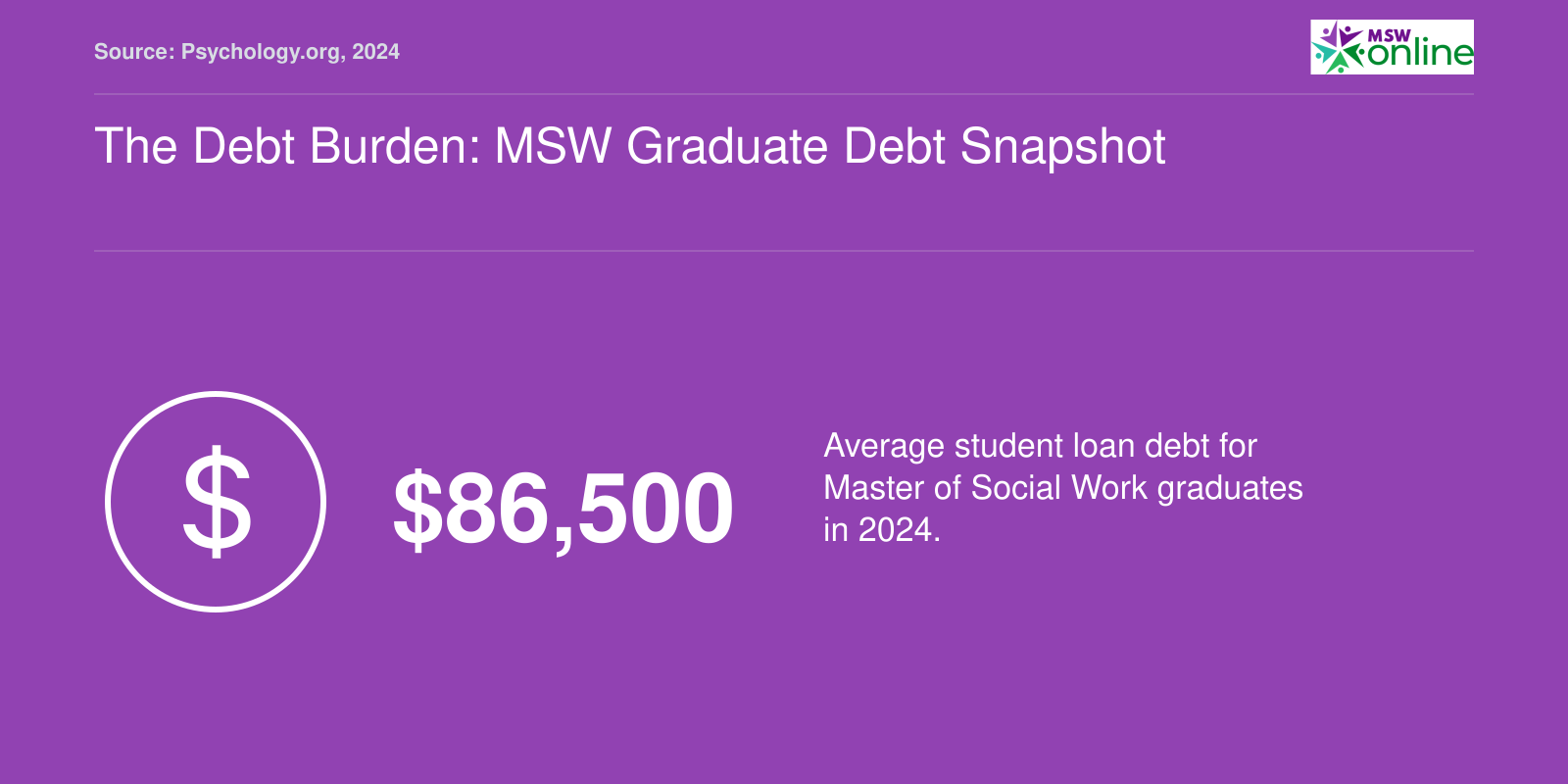
The Debt Burden: MSW Graduate Debt Snapshot
Social work is a calling, but the financial reality can be daunting. The average MSW graduate leaves school with substantial debt, which can affect career choices and financial stability. This stat captures the scale of that burden.
Advocacy in Action: NASW and the Push for Systemic Change
The National Association of Social Workers (NASW) remains the driving force behind federal and state-level reforms that directly lower barriers to becoming a social worker.
NASW's Federal Legislative Priorities
The association's legislative agenda targets two perennial obstacles: inadequate mental health reimbursement and chronic underinvestment in the profession. The Improving Access to Mental Health Act would boost reimbursement rates for clinical social workers serving Medicare beneficiaries, addressing a decades-old pay disparity that discourages practitioners from accepting Medicare patients. Equally transformative is the Social Work Reinvestment Act, which proposes a national commission to study workforce challenges and authorizes grants for education, training, and retention. These bills collectively aim to build a pipeline that keeps pace with a growing mental health crisis.
CSWE and Education Funding Advocacy
The Council on Social Work Education (CSWE) amplifies these efforts by focusing on the academic pipeline. The organization consistently urges Congress to preserve Public Service Loan Forgiveness (PSLF) and expand Title IV-E training funds, which offset tuition for students committing to public child welfare roles. CSWE also defends the value of accredited BSW and MSW programs, arguing that alternative pathways must not erode quality standards. Their advocacy emphasizes that making social work education more accessible should not mean lowering the bar, but rather removing financial and logistical hurdles that disproportionately impact students of color and first-generation graduates.
Grassroots Momentum: Macro Social Work in Action
Beyond institutional lobbying, a groundswell of grassroots advocacy is reshaping how the profession engages with policy. The "Macro Social Work" movement encourages practitioners and students to embrace policy practice as a core skillset, not a niche specialization. National campaigns like Social Work Day on the Hill and virtual advocacy trainings equip participants to meet with legislators, submit testimony, and organize peer networks. These efforts have strengthened the voice of frontline workers in conversations that traditionally excluded them, ensuring that policy reforms reflect on-the-ground realities of caseloads, supervision gaps, and occupational stress and social worker safety.
Recent Wins and the Role of Students and Faculty
Tangible progress is mounting. As of 2026, over 30 states have enacted the Social Work Interstate Compact, allowing license portability across member jurisdictions. Meanwhile, the Biden administration's expansions of PSLF and income-driven repayment forgiveness have already discharged billions in debt for social workers. Students and faculty have been instrumental in these victories: MSW students run voter registration drives, faculty publish policy analyses, and campus chapters of NASW mobilize letter-writing campaigns. Their sustained advocacy proves that policy change is not merely top-down, but a collective effort powered by those who understand the profession's challenges most intimately.
Questions to Ask Yourself
What These Policy Changes Mean for Aspiring Social Workers
The policy shifts discussed in this article directly affect how quickly and affordably you can enter social work practice. By lowering the financial and logistical walls that have long delayed or derailed licensure, these changes create a more predictable pipeline from classroom to career.1
A Clearer Path with the Compact and Loan Relief
The Social Work Interstate Compact dramatically reduces the friction of moving between states, allowing you to secure work without restarting your social worker licensure timeline. Coupled with expanded student loan forgiveness programs, the net result is faster licensure portability, lighter debt burdens, and increased job opportunities in a field straining under workforce shortages. For many, this means the difference between years of underemployment and a direct, stable entry into the profession.
Remaining Hurdles: Exam Failures and Incomplete Recognition
Not every barrier has fallen. High exam failure rates persist in several states, stalling licensure for otherwise qualified graduates. The Clinical Social Work Intern license (CMSW) pathway, while promising, is not yet recognized in every jurisdiction, creating patches of inconsistency. Additionally, funding for federal loan forgiveness programs remains politically uncertain, meaning promised relief could narrow or disappear. Relying solely on these mechanisms without a backup plan is risky.
Action Steps for Aspiring Social Workers
- Check compact status: Regularly verify whether your state has enacted the interstate compact legislation, as this unlocks mobile licensure.
- Explore alternative pathways: In states with high exam barriers, investigate supervised practice or experience-based licensure routes that bypass single-exam hurdles.
- Start PSLF early: Begin the Public Service Loan Forgiveness employment certification process immediately upon qualifying employment; delay can cost years of progress.
Looking Forward with Vigilance
The overall trajectory is positive: more states join the compact, loan relief conversations intensify, and workforce demand drives innovation. But the landscape will continue shifting. Staying informed through state boards, professional associations, and sites like mastersinsocialworkonline.org ensures you adapt quickly to new opportunities or tightening restrictions.
A Look Ahead: The Future of Social Work Policy
Social work policy is approaching a critical juncture: one path strengthens the safety net and workforce, while the other dismantles decades of progress. As advocacy efforts bear fruit, newly proposed federal directions threaten to erase those gains. Understanding these opposing forces is essential for anyone entering or advancing in the field.
The Threat of Project 2025
A sweeping policy blueprint known as Project 20253 proposes to fundamentally restructure the federal government. For social workers, the implications are direct and alarming. Key proposals include eliminating the Department of Education, which would jeopardize Title I funding and oversight for special education1. Public Service Loan Forgiveness (PSLF) would end entirely, and income-driven repayment plans would be phased out1. These changes would pull the financial floor from under countless social work students and practitioners who rely on loan relief to justify lower public-sector salaries.
Project 2025 also targets the programs that employ social workers. It calls for cuts to food assistance2, tightening work requirements3, and weakening regulatory protections3. Agencies that safeguard workers, like the National Labor Relations Board and the Equal Employment Opportunity Commission, would be rolled back4. For the social work profession, which is embedded in public service, these shifts would mean fewer jobs, reduced client supports, and a more precarious work environment.
Reversing Gains: What's at Stake
Recent policy victories, such as the Social Work Interstate Compact and expanded loan forgiveness, could evaporate if these proposals advance. The compact's promise of seamless licensure across states would be undermined by a fragmented federal landscape that no longer prioritizes workforce mobility. Similarly, state-level innovations in alternative licensure pathways might stall without federal grants or guidance. Advocates note that even partial implementation of Project 2025, already being tested in states like Texas5 and Washington6, could trigger a chilling effect, discouraging new entrants to the field precisely when shortages are most acute.
Legislative Countercurrents
Not all movement is toward regression. Pending federal bills aim to cement and expand progress. The SMART Act would permanently authorize telehealth flexibilities that proved crucial during the pandemic, making mental health and casework services more accessible. Efforts to reform income-driven repayment on a permanent basis also continue, with some proposals streamlining enrollment and reducing paperwork burdens. These bills face an uphill battle in a polarized Congress, but they represent a counterweight to the most severe cuts.
The 2026 Midterms and Your Role
The upcoming midterm elections will heavily influence which path prevails. Congressional control will determine whether Project 2025-style legislation advances or is blocked. Social workers are uniquely positioned to advocate for policies that protect vulnerable communities and sustain the profession. Staying informed through organizations like the National Association of Social Workers (NASW) and your state chapter is vital. These groups track legislation, issue action alerts, and mobilize voters. Your voice, combined with collective advocacy, can help steer the future toward strengthening, not dismantling, the social work infrastructure.
Related Articles
Tangible progress is underway: licensure reform, student debt relief, and workforce advocacy are dismantling barriers that have long kept qualified social workers from practice. The interstate compact enables practice across state lines in as little as 30 days. Public Service Loan Forgiveness eases the debt burden for those in qualifying roles. The NASW continues to press for funding and licensure portability.
The projected shortage of over 195,000 social workers by 2030 demands urgent action. Check your state's compact adoption status, verify your PSLF eligibility, and join advocacy efforts. The path is clearer than ever, but sustained progress depends on collective action.