

Points of interest…
- A CSWE-accredited MSW is the only path to social work licensure in every state; without it, degrees are non-viable.
- CSWE requires programs to teach anti-racism and cultural competence, directly clashing with state anti-DEI laws.
- In Texas alone, 26 public universities with 4,000 students face threats to accreditation from SB 17 and SB 37.
- Students must verify their program's accreditation status and plan for transfer or advocacy if it falters.
In 2024, more than 4,000 students were enrolled in CSWE-accredited social work programs at Texas public universities, according to a Texas Observer investigation. Their degrees' professional value hinges entirely on that accreditation stamp.
Social work is built on cultural competence, yet a wave of state anti-DEI laws now threatens to unravel the very standards that equip graduates to serve diverse communities.
Without CSWE accreditation, graduates cannot sit for licensure in any U.S. jurisdiction, rendering their degrees worthless for clinical practice. The collision between state mandates and accreditation requirements has turned the educational pipeline into a political battleground. MSW students must understand what's at risk before committing years and tens of thousands of dollars to a program that may lose its gatekeeping power.
Why Accreditation Is Non-Negotiable for Social Work Licensure
Accredited versus unaccredited: one path opens every door to licensed social work practice; the other slams them shut before you ever begin.
The Licensure Chain: Accreditation as the First Domino
In every U.S. jurisdiction, the pathway to a social work license starts with a degree from a CSWE-accredited program. Without that stamp of approval, your application to take the Association of Social Work Boards (ASWB) licensing exam is automatically rejected. No exam, no license. No license, no clinical practice, no independent billing, and no career progression in almost any direct-service or supervisory role.
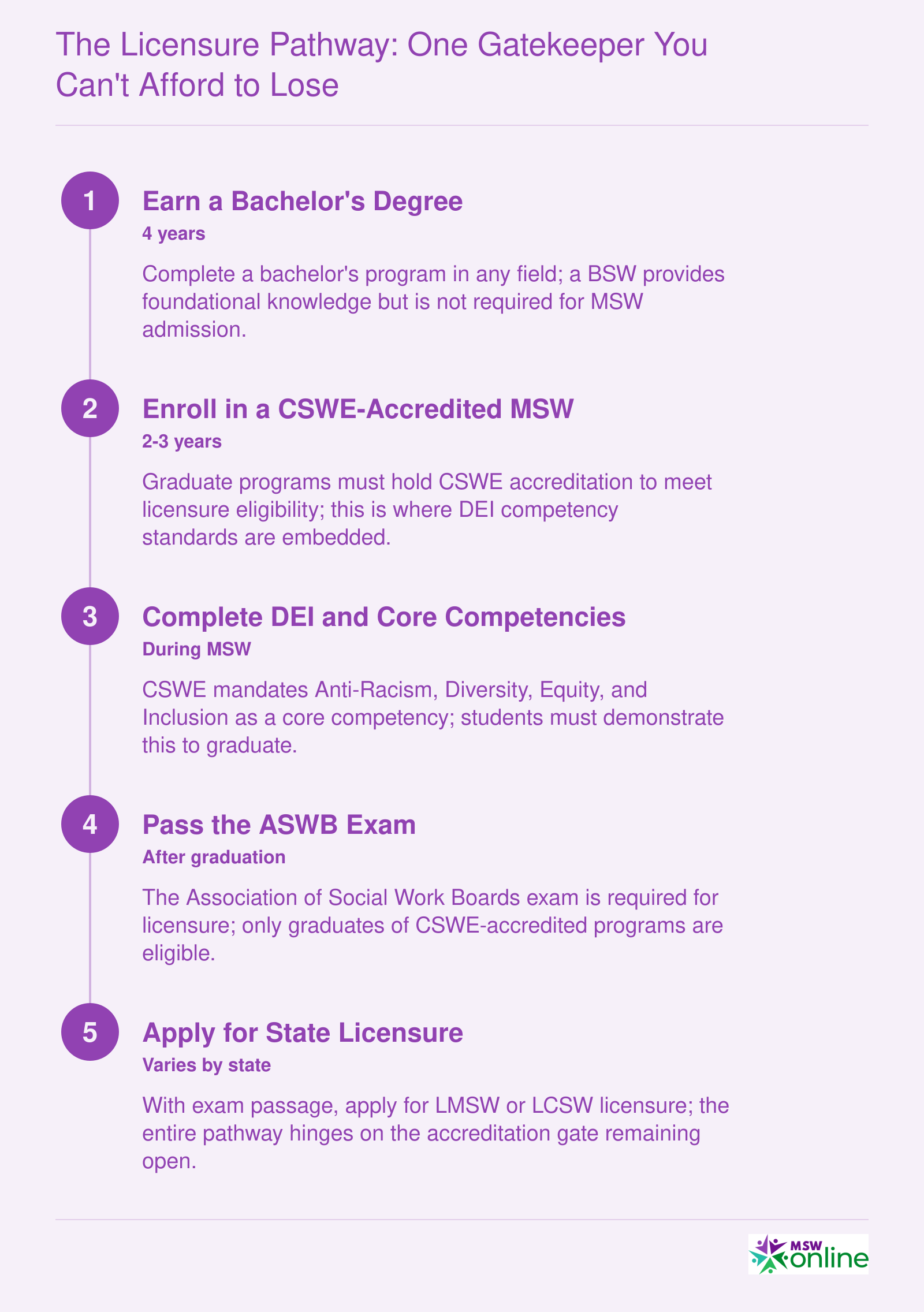
The sequence is unforgiving: CSWE accreditation → degree eligibility → ASWB exam → state licensure. Break the first link, and the entire chain collapses. This isn't a suggestion; it's written into the licensing regulations of all 50 states and Washington, D.C. Even if you complete every required course and field placement, an unaccredited degree simply does not count.
Financial Aid and Employment: What Else You Lose
Accreditation isn't just about licensure. It also controls your access to federal financial aid. The U.S. Department of Education ties Title IV funding (Pell Grants, direct loans, and work-study) to program accreditation. If your social work program loses CSWE recognition, your financial aid package could vanish overnight. Many private scholarships and employer tuition reimbursement plans follow the same rule.
On the employment side, the damage is just as severe. Even macro-level roles in policy, advocacy, or administration increasingly demand a license or, at minimum, a degree from an accredited program. Hiring managers know that unaccredited graduates can't be licensed, so they often screen them out immediately. You might invest two or more years of your life and tens of thousands of dollars into a master's degree that employers won't recognize.
Why an Unaccredited Program Is a Dead End
Some students assume they can simply transfer credits or bridge into a licensed profession later. That's rarely possible. State licensing boards won't credit coursework from unaccredited programs, and CSWE-accredited schools seldom accept transfer credits from non-accredited institutions. You'd essentially be starting over.
In essence, accreditation functions as the gatekeeper for the entire social work profession. It validates that your education meets rigorous standards, including competency in anti-racism, diversity, equity, and inclusion. When state laws pressure programs to abandon those standards, accreditation hangs in the balance, and with it, your future.
Losing CSWE accreditation means your MSW degree fails to meet state licensure requirements. Without licensure, you cannot practice clinical social work, and many agencies mandate an accredited degree for employment. Even if you complete the program, you won't qualify for the licensing exam, and your career path in social work abruptly ends.
The Licensure Pathway: One Gatekeeper You Can't Afford to Lose
Every social worker's path to licensure runs through a single make-or-break checkpoint: a CSWE-accredited graduate program. If that gate closes, the entire pathway collapses. Here's how the pieces fit together.
How DEI Became Baked Into Social Work Education Standards
Since 1952, the Council on Social Work Education (CSWE) has required accredited programs to prepare students to challenge injustice,2 a mandate that in 2022 took its strongest form yet with the release of the Educational Policy and Accreditation Standards (EPAS).1 Central to these standards is Competency 3: Engage Anti-Racism, Diversity, Equity, and Inclusion (ADEI) in Practice, which declares that social workers must understand how racism and oppression shape human experiences and influence practice at every level, including individual, family, group, organizational, and community, as well as in policy and research.1
The 2022 Mandate: Competency 3 Makes ADEI Central
The competency definition directly links anti-racist and anti-oppressive practice to the profession’s ethical core. Graduates are expected to demonstrate anti-racist and anti-oppressive social work practice at multiple levels,3 and programs must provide evidence that students can do so. This isn’t a standalone elective. Educational Policy 2.0 requires integration of ADEI across the entire curriculum,1 and Accreditation Standard 2.0.1 mandates that explicit curriculum engage in specific, continuous efforts related to ADEI.1 The dimensions of diversity named in the standards, age, caste, class, color, culture, disability, ethnicity, gender, immigration status, political ideology, race, religion, sex, sexual orientation, and tribal sovereign status, among others, reflect the profession’s commitment to meeting clients within their full lived contexts.1
Embedding ADEI in Curriculum and Field Education
ADEI competency threads through both the explicit curriculum (what is taught in courses) and the implicit curriculum, which includes program climate and the diversity of faculty and field instructors. Social work field placements, a cornerstone of social work education, must provide opportunities for students to explore ADEI issues and advocate for change in real practice settings.social work field placements Moreover, the 2022 EPAS introduced a new requirement: programs must assess ADEI within the implicit curriculum, examining everything from the demographic makeup of the faculty to how power dynamics operate inside the classroom.4 This means that a program cannot simply add a single diversity lecture and call it sufficient; it must weave anti-racist perspectives into course objectives, assignments, supervision, and institutional culture.
Why Social Work Education Cannot Separate Diversity from Practice
The rationale for these mandates traces directly to the National Association of Social Workers (NASW) Code of Ethics and the profession’s historical commitment to challenging injustice.2 The 2022 EPAS explicitly state that requiring competency in diversity, privilege, oppression, and intersectionality has been central to accreditation since the 1950s.2 In 2024, CSWE reaffirmed its steadfast commitment to these standards, refusing to retreat even as political pressures mount.5 For the profession, there is simply no way to practice ethically with individuals, families, or communities without understanding how systemic inequities affect well-being. Removing ADEI from the curriculum would mean graduating social workers unprepared to serve the very populations they are sworn to help, a position that would violate both educational integrity and the public trust.
State Anti-Dei Laws Threatening Higher Education: A Growing Patchwork
As of mid-2026, a wave of state-level legislation targeting diversity, equity, and inclusion (DEI) in higher education is reshaping the academic landscape. For social work programs, whose accreditation hinges on anti-racism and cultural competence, these laws create a precarious legal and educational environment. While Texas has been at the forefront, similar restrictions are spreading, each with unique implications for social work curricula and institutional support.
Texas: The Epicenter of DEI Restrictions
Texas lawmakers have passed two pivotal bills that directly threaten the infrastructure of DEI within public universities. Senate Bill 17, effective since January 2024, prohibits DEI offices, mandatory DEI training, and the use of diversity statements in hiring.1 Although academic instruction is exempt, the law severs the institutional backbone that social work programs rely on for cultural competence resources. Senate Bill 37, signed in May 2025 as part of the "Protect Truth in Education" package, further restricts how discrimination and civil rights histories are taught, creating a chilling effect on courses that address structural racism, even when they are technically protected under SB 17’s academic freedom carve-out.2
A National Patchwork of Anti-DEI Measures
Other states have enacted or proposed comparable legislation, each carrying campus-level consequences for social work education:
- State: Florida. Bill: HB 7 (2022). Key Restrictions: Limits instruction that suggests individuals bear responsibility for past discrimination based on race, sex, or national origin. Threat to Social Work: Curriculum covering privilege, oppression, and systemic inequality faces potential censorship; faculty risk disciplinary action for teaching foundational social work concepts. Status: Enacted; remains under legal challenge.
- State: Ohio. Bill: SB 83 (2025). Key Restrictions: Overhauls DEI structures by banning mandatory diversity training, prohibiting diversity statements in hiring, and restricting DEI-related spending. Threat to Social Work: The anti-racism competency required by CSWE could be directly undermined if mandatory training is classified as prohibited DEI activity. Status: Enacted, effective January 2026.
- State: Texas. Bill: SB 17. Key Restrictions: Closes DEI offices, forbids DEI trainings, and bans diversity statements in hiring; exempts academic instruction. Threat to Social Work: Programs lose centralized DEI resources; CSWE-mandated anti-racism coursework may conflict with institutional risk-aversion, even if technically legal. Status: Enacted since January 2024.1
- State: Texas. Bill: SB 37. Key Restrictions: Restricts education about discrimination history and civil rights; part of a broader "truth in education" package. Threat to Social Work: Creates legal ambiguity around courses on structural racism, discouraging faculty from fully engaging with CSWE competencies. Status: Enacted since June 2025.2
- State: Multiple (e.g., Iowa, North Dakota, Georgia). Similar Bills: Proposals to ban mandatory DEI training, limit curriculum on race, or eliminate DEI offices have been introduced or passed in several states since 2024. Threat to Social Work: A growing number of programs face the risk of accreditation non-compliance if state laws are interpreted to override CSWE’s anti-racism standards.
The Direct Link to Accreditation and Licensure
What makes this patchwork alarming for MSW students is the direct pipeline from accreditation to licensure. If a program cannot fully implement CSWE’s anti-racism, diversity, equity, and inclusion competency, whether because of inaccessible DEI offices, chilled faculty, or ambiguous legal threats, it risks losing accreditation. Without accredited preparation, graduates in these states may face social work license denial and find their degrees unviable. As more states layer restrictions on higher education, the patchwork creates a high-stakes map that social work students and educators must navigate carefully.
Questions to Ask Yourself
When State Law and Accreditation Standards Collide
Social work programs in states with anti-DEI laws face a direct conflict between meeting accreditation standards and obeying state mandates. The Council on Social Work Education (CSWE) requires programs to teach an “Anti-Racism, Diversity, Equity, and Inclusion” competency, yet laws like Texas’s Senate Bill 17 have shuttered DEI offices and curricula1. This collision forces programs to choose: dilute DEI content and risk losing accreditation, or uphold CSWE competencies and invite state sanctions. For students, the stakes are licensure and career viability.
The Core Dilemma: Obey the State or Keep Accreditation?
Without CSWE accreditation, graduates cannot sit for social work licensure, rendering their degrees nearly useless. Programs that comply fully with state anti-DEI mandates may strip out the diversity, equity, and inclusion content that accreditors require. Conversely, programs that maintain robust ADEI curricula risk state investigations, funding cuts, or administrative retaliation. This is not hypothetical: 28 anti-DEI bills were tracked by CSWE between 2023 and 2025, affecting dozens of public university social work programs1. The impossible choice pits legal compliance against social work ethics.
CSWE’s Nuanced Response to Legislative Pressure
CSWE has taken a flexible but firm stance. The accreditor will not require any program to violate state law2, but its standards remain unchanged3. Critically, CSWE permits any terminology when discussing ADEI concepts, programs are not bound to politically charged labels3. The organization asks programs to document the legal factors that affect their ability to meet standards, and site visitors are instructed not to offer legal advice or interpretation3. Specialized accreditation staff provide individualized guidance to help programs navigate this tension4. This approach creates breathing room: programs can reframe content without abandoning core competencies.
Tactical Adaptations: How Programs Are Threading the Needle
Two public university MSW programs in anti-DEI states have demonstrated practical survival strategies. One program renamed its course from “Anti-Racism and DEI” to “Power, Privilege, and Social Structures,” while preserving substantive content on oppression, racism, sexism, ableism, and heterosexism. Its mission statement was reframed around ethical, evidence-informed practice that upholds human dignity, language that satisfied state reviewers without violating CSWE expectations3. Another program relabeled DEI training as “professional ethics seminars”5 and tied field education6 and curricular framing7 to federal civil rights compliance. Both programs retained full accreditation2 by transparently documenting their legal constraints and demonstrating that core competencies were still being taught.
These examples show that the collision between state law and accreditation standards is navigable, but it requires strategic language shifts and unwavering commitment to social work values. As legal challenges mount, the resilience of these programs offers a roadmap for others facing similar pressures.
Texas as a Cautionary Tale: Restructuring Higher Ed and Silencing DEI
Texas has become a cautionary tale for social work educators and students watching the collision between state politics and professional accreditation. At the University of Texas at Austin, students staged a mock funeral with a black hearse in May 2026 to protest the dissolution of four long-standing academic departments: African and African Diaspora Studies, Mexican American and Latina/o Studies, Women’s, Gender and Sexuality Studies, and American Studies, into a single, consolidated Department of Social and Cultural Analysis.1 The restructure, though framed as an administrative efficiency, sent a chilling signal that critical frameworks for understanding race, power, and identity were being sidelined on the very campuses that produce the state’s social work workforce.
How Texas Laws Directly Challenge CSWE Standards
Two Texas laws turn this cultural shift into a direct threat to social work accreditation. Senate Bill 17, effective January 1, 2024, ordered the closure of Diversity, Equity, and Inclusion (DEI) offices at all public universities. Senate Bill 37, signed in May 2025, goes further by granting university governing boards the power to reject courses, veto provost hires, and eliminate degree programs they deem misaligned with “workforce needs.” For social work educators, these laws create a legal haze around the Council on Social Work Education (CSWE) competency requiring students to “engage anti-racism, diversity, equity, and inclusion” in practice. A program that cannot demonstrate it teaches this competency risks losing CSWE accreditation. Without accreditation, graduates cannot sit for state licensure.
The View from the Classroom
Will Francis, executive director of the National Association of Social Workers (NASW) Texas and Louisiana chapters, offered a carefully worded assurance to the Texas Observer: “We allow for the introduction of DEI concepts to meet accreditation standards, and we allow for students to essentially engage in free speech around classroom discussion.”1 The statement underscores a key tension: programs are trying to navigate between what is required for licensure and what state lawmakers permit. Faculty report self-censoring lectures and fearing that required material on systemic racism or implicit bias could be misconstrued as violating the new laws.
The Scale of What’s at Stake
Texas is not an outlier in size. According to the Texas Higher Education Coordinating Board, over 4,000 students were enrolled in CSWE-accredited social work programs at four-year public universities in 2024, spread across 26 institutions offering more than 45 bachelor’s and master’s tracks. All of these students depend on their programs maintaining accreditation. The Texas Observer investigation, led by social work student Miranda Williamson, documented how the restructuring at UT Austin and the broader legislative climate are forcing program directors to rethink curricula while students worry whether their degrees will remain viable.1 The Texas example is a preview of what could spread to other states with similar anti-DEI bills, making it a critical case study for anyone pursuing an MSW today.
Related Articles
What Happens if My MSW Program Loses Accreditation?
If your MSW program loses accreditation, your path to licensure becomes extremely difficult, and in most cases, it’s blocked unless you act quickly and strategically. Here’s what you need to know and the steps to take right away.
Can You Still Get Licensed Without an Accredited Degree?
In every state, the social work licensing board requires that you hold a degree from a Council on Social Work Education (CSWE) accredited program to sit for the ASWB licensing exam. Without accreditation, your degree is not recognized for licensure, even if you completed all the required coursework and field hours. You would not be eligible for licensure as an LMSW or LCSW, effectively closing the door on clinical practice and most macro-level social work roles. Some states may offer a provisional or alternative pathway if you can demonstrate equivalent education, but these options are rare and not guaranteed. You should contact your state’s licensing board directly to ask if any exceptions exist for students caught in an accreditation lapse.
Locate and Read the CSWE Teach-Out Policy
When a program loses accreditation, CSWE typically requires the institution to provide a teach-out plan for currently enrolled students. This plan is designed to allow you to finish your degree under the auspices of an accredited program, often through a partnership with another CSWE-accredited institution. Go to the CSWE website and search for official policies on accreditation withdrawal, student protections, and teach-out agreements. These documents outline your rights and what the program is obligated to provide. Understanding this policy will help you hold your school accountable.
Contact Your Program Administration Immediately
Do not rely on rumors or general campus announcements. Reach out directly to your MSW program director, department chair, or dean and ask pointed questions:
- Is the program’s accreditation status currently under review or probation?
- If accreditation is lost, what specific teach-out plan is in place?
- Will my degree be conferred by an accredited partner institution if I remain enrolled?
- Has this program or any predecessor ever lost accreditation before?
Document their responses in writing. If the program is not transparent or fails to provide a clear plan, that is a red flag that may accelerate your need to transfer.
Verify State Licensing Board Requirements
Even if you complete a teach-out, you must confirm that your state’s social work board will accept the resulting degree. Some boards require that the degree-granting institution be accredited at the time of graduation, not just at the time of enrollment. Contact the board that oversees social work licensure in the state where you plan to practice and ask:
- Does your board accept degrees earned through a CSWE-approved teach-out?
- Would credits from a non-accredited program count toward licensure in any way?
Get these answers early. If the board will not recognize your path, you may need to transfer out immediately to a fully accredited program to protect your career.
Did you know that more than 4,000 social work students were enrolled in Texas public universities in 2024? With 18 states now restricting DEI, thousands more could see their degree programs and future licensure eligibility put at risk.
Protecting Your MSW Investment: Questions to Ask and Steps to Take Now
In 2024, more than 4,000 students were enrolled in CSWE-accredited social work programs at Texas public universities, degrees that hinge on a single accreditation status. With anti-DEI laws now threatening to sever that accreditation, protecting your educational investment requires proactive, informed steps. Below is a practical checklist for current and prospective MSW students navigating this uncertain terrain.
Questions to Ask Admissions and Program Leadership
Start direct conversations with program officials before committing or as soon as possible. Ask pointed questions that reveal how a program is managing the conflict between state mandates and CSWE standards:
- Accreditation contingency: What is the program's plan if CSWE accreditation is challenged due to compliance with state DEI restrictions? Has the program discussed alternative pathways to licensure or teach-out agreements?
- Curriculum adjustments: How are diversity and anti-racism competencies being taught this year? Has any coursework or field placement content been altered, reduced, or removed to satisfy state law?
- Faculty and leadership stability: Have there been recent departures or vacancies in roles tied to DEI education, such as diversity coordinators or field placement directors? Are faculty able to freely facilitate discussions on race, gender, and oppression?
- Legal monitoring: Is the university actively tracking pending legislation and coordinating with CSWE? Have they issued any internal guidance to students about their licensure pathway?
Programs that offer vague or defensive answers should raise red flags. Transparency signals an institution that is seriously managing risk and is committed to preparing students for the licensure process, including how to become an LCSW after MSW.
Monitor Legislation and Join Advocacy Networks
State bills targeting DEI in higher education are moving quickly, and their language often carries implications for social work education that aren't immediately obvious. Two concrete steps:
- Track legislative calendars: Bookmark your state legislature's website and set alerts for keywords like “social work,” “accreditation,” or “diversity training.” NASW state chapters often publish bill trackers and policy analyses, subscribe to their newsletters.
- Join advocacy efforts: Organizations like NASW, Influencing Social Policy, and student-led groups mobilize rapidly when accreditation is threatened. Membership gives you access to policy briefs, legal updates, and collective advocacy actions. Will Francis of NASW Texas emphasized that “[students] are allowed to essentially engage in free speech around classroom discussion,” meaning strong student advocacy can help preserve educational integrity.
Location Strategy: Choosing Programs with Stability
If you have geographic flexibility, consider this factor in your school search:
- Evaluate state legal climates: As of 2026, some states have no anti-DEI laws affecting higher education, while others are aggressively restricting curriculum. A program in a state without such laws faces fewer immediate risks to accreditation. However, balance this with program quality, cost, and your career goals.
- Consider licensure portability: If you plan to move after graduation, check whether the state where you intend to practice has its own additional DEI coursework requirements or reciprocity complications. Your MSW must meet both the educational standards of the state where it was earned and the licensure board of your future state.
- Online program caution: Many online MSW programs enroll students from multiple states. Ask specifically how the program ensures compliance with both CSWE standards and the varying regulations of each state where a field placement occurs. A patchwork of state laws can complicate field education in ways that threaten your graduation timeline.
Staying informed and vocal is not just self-protection, it's a direct form of advocacy for the profession. The hundreds of hours you invest in an MSW deserve a foundation that won't crack under political pressure.
Common Questions About Anti-Dei Laws and MSW Accreditation
With anti-DEI legislation reshaping higher education in several states, MSW students are rightfully concerned about accreditation and licensure. Below are answers to the most pressing questions, along with steps you can take to protect your investment in social work education.
The Future of Inclusive Social Work Education: Legal Challenges and Advocacy
The future of social work education depends on preserving the profession's mandate to teach anti-racism and cultural competence, and the field is mobilizing to defend that standard.
A Profession United in Defense of Accreditation Standards
In 2026, the National Association of Social Workers (NASW) and the Council on Social Work Education (CSWE) have intensified their coordinated advocacy. CSWE's fellows forum brought 80 social work students to Washington, D.C., in May1 to meet with lawmakers and press the case for preserving DEI as an accreditation pillar. State chapters like NASW Maryland held advocacy days where members lobbied legislators directly.3 Both organizations have issued action alerts urging members to oppose bills that restrict diversity education2, and CSWE maintains an advocacy resource hub with talking points and legislative trackers. They have also fought federal policy changes that could harm students: NASW and CSWE opposed a 2026 rule that would cut graduate student loan borrowing capacity by half, arguing that limiting financial access would disproportionately reduce enrollment in programs that embed DEI training, thereby shrinking the pipeline of culturally competent practitioners.2 While no lawsuits challenging state anti-DEI laws have been filed as of mid-2026, CSWE has expanded individualized program consultations to help schools navigate the legal gray zones, and the organization's annual conference featured dedicated sessions on legal defense strategies.4
Framing the Legal Argument: Academic Freedom and Professional Ethics
Social work leaders are building a legal case that state bans on DEI content violate the First Amendment rights of educators and students, and encroach on the profession's ethical mandate. The NASW Code of Ethics obligates social workers to challenge social injustice and respect diversity, competencies that cannot be taught without discussing systemic racism, privilege, and oppression. CSWE's accreditation standard requires explicit instruction in "Anti-Racism, Diversity, Equity, and Inclusion," so a state law that prohibits such content forces programs into an impossible double bind. Legal scholars within the field argue that the state cannot compel a profession to abandon its core educational standards without undermining the profession's own regulatory authority. This sets the stage for potential future litigation invoking academic freedom, equal protection, and the due process rights of students who would be denied a fully accredited degree. Although no sweeping federal intervention has yet materialized, CSWE issued a Statement on Federal Executive Orders in 2026 reaffirming its commitment to diversity competencies in response to executive orders targeting federal DEI initiatives, signaling that it is prepared to engage at the federal level if needed.
Why Inclusive Education Remains Non-Negotiable
The battle over DEI in social work education is not a partisan skirmish; it is a fight for clinical competence. Social workers serve clients from every background, and research consistently shows that culturally responsive care leads to better outcomes. Stripping DEI content from curricula would leave graduates ill-equipped to understand how race, gender, sexual orientation, and ability shape life experiences and access to services. The profession's unified front, from student coalitions to national organizations, underscores that accreditation standards exist precisely to protect the public by ensuring every licensed social worker can practice ethically and effectively. As statehouses continue to pass restrictive laws, the social work community is demonstrating that inclusive education is not a luxury subject to political whims; it is a foundational requirement for a field dedicated to human dignity and justice. Students entering MSW programs today can take comfort in knowing that their future licensure is being actively defended by a profession that refuses to compromise on what it means to be prepared for real-world practice.