
Points of interest…
- Most hospital and clinical medical social work positions require a CSWE-accredited Master of Social Work degree.
- The path from freshman year to full clinical licensure typically takes 6 to 8 years, including supervised practice hours.
- BLS projects 8% employment growth for healthcare social workers from 2024 to 2034, roughly double the national average.
- Top-paying states and metros cluster along the coasts, where salaries often exceed the national median of about $62,000.
Hospitals, hospices, and oncology units now routinely embed social workers directly into care teams, a structural shift that reflects how thoroughly psychosocial factors affect patient outcomes. The Bureau of Labor Statistics counted roughly 185,940 healthcare social workers employed nationally as of 2024 and projects the occupation will grow 8% through 2034, about twice the average rate across all fields.
Medical social workers differ from generalist practitioners primarily by setting and scope. They coordinate discharge planning, connect patients with community resources, provide crisis counseling, and navigate end-of-life conversations, all within the constraints of a clinical environment and often alongside physicians, nurses, and case managers. If you are weighing this specialty against other career opportunities in social work, the healthcare niche stands out for its clinical depth and interdisciplinary collaboration.
The practical tension for most candidates is this: a BSW can open entry-level doors, but the majority of hospital and hospice positions, especially those involving independent clinical practice or insurance billing, require an MSW plus state licensure. That credential gap, and the time and cost it takes to close it, is the central reality shaping most decisions in this field.
What Is a Medical Social Worker?
A medical social worker is a licensed professional who helps patients and their families navigate the emotional, financial, and logistical challenges that accompany illness, injury, or chronic health conditions. Working within hospitals, rehabilitation centers, hospice programs, outpatient clinics, and other healthcare settings, these professionals serve as a critical bridge between clinical care teams and the broader support systems patients need to recover or manage ongoing conditions.
Day-to-day responsibilities typically include conducting psychosocial assessments, coordinating discharge plans, connecting patients with community resources, advocating for insurance coverage, and providing short-term counseling during health crises. Medical social workers also educate patients about their diagnoses, help families make difficult end-of-life decisions, and collaborate with physicians, nurses, and other providers to ensure holistic, patient-centered care.
What sets this role apart from other careers in social work is its deep integration into the healthcare delivery system. Medical social workers must understand medical terminology, hospital workflows, and health policy, while also applying the person-in-environment perspective that defines the social work profession. The intersection of health care and social work creates a practice environment where clinical skills, cultural competence, and systems-level thinking converge.
Because the role spans everything from trauma response to chronic disease management, medical social workers often pursue specialized training or social work certifications to sharpen their expertise. Whether you are drawn to pediatric oncology, organ transplant coordination, or geriatric palliative care, the medical social work field offers meaningful, high-impact career paths that place you at the heart of patient well-being.
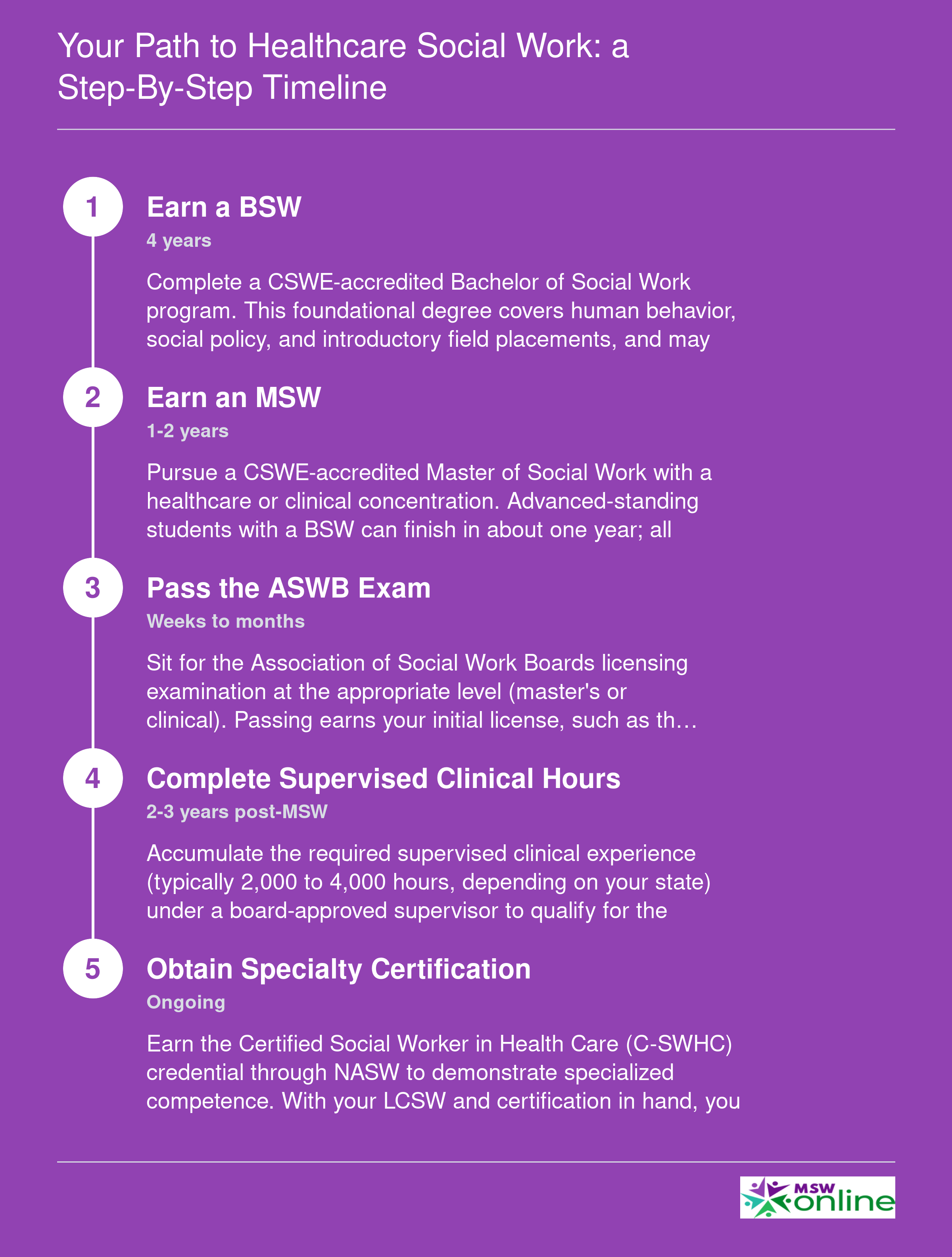
Your Path to Healthcare Social Work: A Step-by-Step Timeline
The journey from college freshman to licensed clinical healthcare social worker typically spans 6 to 8 years. If you already hold a non-social-work bachelor's degree, you can compress the timeline to roughly 3 to 4 years by entering a regular MSW program directly.
Steps to Becoming a Medical Social Worker
Becoming a medical social worker requires a deliberate, multi-step educational and licensing journey. Below is a clear roadmap from your first degree to independent clinical practice.
Step 1: Earn a Bachelor's Degree. Start with a bachelor's degree, ideally a Bachelor of Social Work (BSW) from a CSWE-accredited program. A BSW provides foundational coursework in human behavior, social welfare policy, and introductory field experience. Students who choose a BSW often qualify for advanced-standing MSW programs, which can shorten graduate study by a year. Degrees in psychology, sociology, or public health are also acceptable starting points, though they may require additional prerequisite coursework.
Step 2: Complete a Master of Social Work (MSW). An MSW is the standard credential for medical social work practice. During your program, concentrate on a health care or clinical track and complete your MSW field placement in a hospital, hospice, or rehabilitation facility. Online master's in social work programs offer flexibility for students balancing work or family obligations, provided the program holds CSWE accreditation.
Step 3: Obtain Initial Licensure (LMSW or Equivalent). After earning your MSW, pass the ASWB Masters exam to qualify for a non-clinical license such as the LMSW. Licensure structures vary by state: New York and Texas use the LMSW designation, California issues an ASW (Associate Social Worker), and Florida grants the RCSWI (Registered Clinical Social Work Intern). At this level, your scope of practice typically covers psychosocial assessment, case management, and supervised psychotherapy, but you cannot bill independently for psychotherapy services.3
Step 4: Accumulate Supervised Clinical Hours. To advance toward full clinical licensure, you must complete supervised practice under an LCSW. Requirements range from 2,000 to 4,000 hours depending on the state. For example, California and Texas each require 3,000 hours, New York requires between 2,000 and 3,000 hours, and Florida mandates 1,500 hours specifically in psychotherapy. Many medical social workers fulfill these hours while employed in health care settings.
Step 5: Earn Clinical Licensure (LCSW). Once you complete your supervised hours, pass the ASWB Clinical exam to earn the Licensed Clinical Social Worker (LCSW) credential. The LCSW grants you the authority to independently diagnose mental health conditions, provide psychotherapy, bill insurance directly, and supervise LMSWs and associates.3 This license is essential if you want to lead clinical teams or open a private practice alongside hospital-based work.
Step 6: Pursue Continuing Education and Specialization. After licensure, deepen your expertise by pursuing specialized certifications in areas such as palliative care, oncology social work, or behavioral health. Ongoing continuing education is required to maintain your license in every state, and the emerging Social Work Licensure Compact may soon simplify practicing across state lines at the BSW, LMSW, and LCSW levels.4
Education Requirements: BSW, MSW, and Healthcare Concentrations
Education for medical social work follows a two-tier degree structure: a Bachelor of Social Work (BSW) gets you into the field, and a Master of Social Work (MSW) opens the door to most hospital, hospice, and clinical positions.
Can You Be a Medical Social Worker With a Bachelor's Degree?
Yes, a BSW can qualify you for entry-level healthcare roles in some states. These positions typically involve care coordination, discharge planning support, connecting patients with community resources, and assisting families with insurance paperwork. You will find BSW-level openings more often in outpatient clinics, rehabilitation centers, and long-term care facilities than in acute-care hospitals. However, most hospital systems, oncology programs, and palliative care teams list an MSW as a minimum requirement. If your goal is independent clinical practice, such as providing psychotherapy to patients coping with chronic illness, you will need the master's degree plus supervised clinical hours and licensure.
MSW Healthcare Concentrations
Many CSWE-accredited Master's in social work (MSW) degree programs offer a concentration, specialization track, or elective cluster focused on health and behavioral health. Coursework in these tracks typically covers:
- Medical ethics: Decision-making frameworks for end-of-life care, organ donation, and patient autonomy.
- Health policy: How Medicare, Medicaid, and managed care systems shape access to services.
- Psychosocial assessment: Evaluating the emotional, social, and financial stressors that affect patient outcomes.
- Grief and loss: Interventions for patients and families facing terminal diagnoses or sudden medical crises.
Employers in hospital settings tend to prefer candidates whose MSW included health-focused coursework because the learning curve on the job is shorter. A healthcare concentration also positions you well for specialty certifications later in your career.
Online MSW Programs and Flexibility
CSWE-accredited online MSW programs have expanded significantly, making the degree more accessible for working professionals and career changers. Online formats let you complete didactic coursework on your own schedule, which is especially useful if you are already employed in a healthcare setting and want to move up. The primary logistical constraint remains field placement: you will need to complete a set number of supervised practicum hours (typically 900 or more) at an approved site, usually arranged in or near your local area. Most online programs have placement coordinators who help you secure a site, but rural students should confirm placement support before enrolling.
Advanced-Standing MSW Programs
If you already hold a BSW from a CSWE-accredited program, an advanced-standing MSW track is the fastest route to a master's degree in social work. These programs waive the foundation-year coursework and can be completed in about 12 months of full-time study, compared to the standard two-year timeline. This option saves both time and tuition, which matters if you are eager to move into clinical or hospital-based roles without delay. Not every program offers an advanced-standing option with a healthcare concentration, so check curriculum details carefully when comparing schools.
Questions to Ask Yourself
Licensure and Certification for Healthcare Social Workers
Choosing between a non-clinical master's-level license and a clinical license is one of the most consequential decisions you will make in healthcare social work, because it determines the roles you can fill, whether you can bill insurers independently, and how much you can expect to earn over a career.
LMSW/LSW vs. LCSW: Scope, Roles, and Earning Power
After completing a CSWE-accredited MSW and passing the ASWB master's-level exam, most states grant a Licensed Master Social Worker (LMSW) or Licensed Social Worker (LSW) credential. This license authorizes you to practice social work in healthcare settings under supervision, but it carries important limits:
- Scope of practice: Case management, discharge planning, patient and family education, resource coordination. You typically cannot diagnose mental health conditions or provide psychotherapy independently.
- Typical healthcare roles: Hospital discharge planner, patient navigator, hospice social worker, care coordinator in a primary-care clinic.
- Independent billing: Generally not permitted. Third-party payers require clinical-level licensure for independent reimbursement.
- Salary impact: LMSW holders often earn less than their LCSW counterparts in the same facility, though exact differentials vary by employer and region.
The Licensed Clinical Social Worker (LCSW) credential requires additional supervised clinical hours, typically two to three years of post-master's practice, followed by the ASWB clinical exam. With it, you gain the authority to diagnose, treat, and bill independently for behavioral health services. In hospital behavioral health units, emergency departments, and outpatient oncology programs, the LCSW opens doors to leadership and direct-practice roles that an LMSW alone does not. Clinicians interested in psychotherapy delivery may also want to explore behavioral therapist education requirements, which overlap significantly with the LCSW pathway.
The C-SWHC Specialty Credential
If you want to signal healthcare-specific expertise beyond your state license, the Certified Social Worker in Health Care (C-SWHC) credential from the National Association of Social Workers (NASW) is the recognized benchmark. Key details:
- Eligibility: An MSW from a CSWE-accredited program, a current state social work license at the master's level or above, a passing score on the ASWB MSW-level licensure exam, and at least two years of paid, post-MSW healthcare social work experience. A portion of that experience must include direct supervision in a healthcare context.
- Exam: There is no separate certification exam. Eligibility is established through documentation of education, licensure, and practice hours.
- Renewal: Every two years, with at least 20 continuing education hours in health care social work topics.
- Value to employers: Hospitals and health systems increasingly look for the C-SWHC when hiring for specialized positions such as transplant coordinators, palliative care social workers, or integrated behavioral health consultants. It does not replace your state license but layers on a credential that demonstrates focused competence to hiring committees and interdisciplinary teams.
The C-SWHC is one of several MSW specializations worth investigating as you map out a healthcare-focused career.
State-Specific Considerations
Licensure titles and requirements are not uniform. Some states use different designations for the same practice level, and a handful impose additional requirements for social workers practicing in healthcare or medical settings. Supervision hour thresholds for clinical licensure range from roughly 2,000 to over 4,000 hours depending on the state, and continuing education mandates vary as well; for example, the LMSW-level renewal standard cited by some state boards is around 48 hours per cycle, while others set different totals. Before committing to a supervision plan, verify your state board's exact requirements so you do not accumulate hours in a format or setting your board will not accept.
The bottom line: an MSW and an LMSW or equivalent get you into healthcare social work. An LCSW expands what you are legally permitted to do and bill for, and the C-SWHC adds a nationally recognized specialization that can set your resume apart in competitive hospital and health-system job markets.
What Do Medical Social Workers Do? Duties by Healthcare Setting
Across every healthcare environment, medical social workers share a core skill set: psychosocial assessments, brief counseling, systems navigation, discharge planning, advocacy, and interdisciplinary team coordination. However, the pace, patient population, and day-to-day rhythm vary dramatically depending on where you practice. Below is a breakdown of duties by setting.
Emergency Department
ED social workers serve patients of all ages in high-acuity situations, including substance use crises, mental health emergencies, violence-related injuries, and homelessness and social work intersections. Core duties include crisis and risk assessments, emergency placements, death notifications, short-term discharge planning, and navigating legal or forensic issues. The work is fast-paced and interrupt-driven; you are called to the bedside as crises arise, and patient relationships typically last only hours.
Oncology
Oncology social workers support adults (and sometimes adolescents) facing new, recurrent, or metastatic cancer, along with their families. Responsibilities include psychosocial assessments, adjustment counseling, treatment logistics, support groups, discharge planning, and advance care planning. The pace is mostly appointment-based, with crisis visits triggered by bad news or rapid decline. Patient relationships are longitudinal but episodic, following individuals at key points along the illness trajectory.
Palliative Care and Hospice
In palliative and hospice settings, social workers engage with patients who have advanced or life-limiting illnesses and with their families. Duties center on ongoing counseling, goals-of-care discussions, caregiver burden assessment, practical and legal planning, bereavement support, and ethical mediation. Compared to the ED, the pace is less rushed, allowing deep, repeated visits. Hospice relationships are time-limited but intensive (weeks to months), while palliative care relationships can be longitudinal.
Pediatric Hospital
Pediatric hospital social workers serve infants, children, and adolescents with acute or chronic conditions, along with their caregivers. Key duties include family-centered psychosocial assessments, developmentally appropriate support, child safety and neglect assessments, school coordination, family meetings, and support groups. The pace is moderate but can spike during child protection situations. Patient relationships may be brief for acute admissions or long-term for chronic illness clinics.
Nephrology and Dialysis Centers
Dialysis social workers primarily serve adults with end-stage renal disease who are on chronic dialysis, many of whom face multiple comorbidities and high social vulnerability. Duties include psychosocial assessments at dialysis initiation and annually, adjustment counseling, depression and anxiety screening, transportation and insurance assistance, transplant coordination, and education sessions. The work is outpatient, scheduled, and longitudinal, and patient relationships often span years.
Rehabilitation
Rehabilitation social workers support adults (and sometimes children) with new or worsening functional impairments resulting from injury or illness. Core duties involve psychosocial and discharge planning assessments, adjustment counseling for new disability, discharge coordination, equipment and services arrangement, and family conferences. The pace is moderate, less chaotic than the ED but more time-limited and goal-focused than dialysis or hospice work. Inpatient rehab relationships are intensive over weeks to months, while outpatient relationships tend to be episodic.
Because each setting demands distinct competencies, pursuing a case management certification can strengthen your ability to coordinate care across complex systems, regardless of the environment you choose.
Related Articles
Clinical vs. Non-Clinical Healthcare Social Work
One of the most consequential decisions you will make as a healthcare social worker is whether to pursue the clinical track or remain in a non-clinical role. Both paths serve patients in hospitals, rehabilitation centers, and other medical settings, but they differ sharply in scope of practice, time investment, and long-term earning potential. Use the comparison below to weigh which direction fits your career goals.
Pros
- Clinical (LCSW): Allows independent practice and the authority to diagnose and provide psychotherapy in healthcare settings.
- Clinical (LCSW): Generally commands higher salaries, with greater earning potential over the course of a career.
- Clinical (LCSW): Offers broader role autonomy, including the ability to bill insurance and open a private practice.
- Non-clinical (LMSW/LSW): Shorter path to employment because you can begin working immediately after earning your MSW and passing the licensing exam.
- Non-clinical (LMSW/LSW): No post-degree supervised clinical hours are required, removing two to three years of structured oversight.
- Non-clinical (LMSW/LSW): Strong and consistent demand in care coordination, discharge planning, and patient navigation roles across hospitals and health systems.
Cons
- Clinical (LCSW): Requires roughly 2,000 to 4,000 hours of supervised clinical experience after the MSW, typically spanning two to three additional years.
- Clinical (LCSW): Supervision costs, additional exam fees, and continuing education requirements add time and expense before full licensure.
- Non-clinical (LMSW/LSW): Scope of practice is limited; you cannot independently provide psychotherapy or make clinical diagnoses.
- Non-clinical (LMSW/LSW): Earning ceiling is lower over time, and advancement into leadership often still favors candidates who hold clinical licensure.
Medical Social Worker Salary: National Overview
The figures below reflect approximate 2024 data from the Bureau of Labor Statistics for all healthcare social workers nationally, regardless of clinical licensure status. With roughly 185,940 professionals employed across the country, healthcare social work represents a sizable labor market. Keep in mind that earning your LCSW and accumulating several years of clinical experience typically moves compensation toward the 75th percentile or higher, so the median figure may understate what seasoned, licensed practitioners actually earn.
| Salary Metric | Annual Wage |
|---|---|
| National Median Salary | $68,090 |
| National Mean (Average) Salary | $72,030 |
| 25th Percentile | $55,360 |
| 75th Percentile | $83,410 |
| Total National Employment | 185,940 |
Highest-Paying States for Healthcare Social Workers
Geography plays a significant role in healthcare social worker compensation. According to BLS data, the top-paying states are concentrated along the coasts and in areas with a higher cost of living. Before relocating for a higher salary, factor in housing, taxes, and everyday expenses; a $93,000 salary in California, for example, may not stretch as far as $78,000 in New Hampshire or Vermont.
| Rank | State | Median Annual Salary | Total Employment |
|---|---|---|---|
| 1 | California | $92,970 | 19,680 |
| 2 | District of Columbia | $92,600 | 490 |
| 3 | Oregon | $85,150 | 2,050 |
| 4 | Hawaii | $84,640 | 680 |
| 5 | Connecticut | $81,900 | 2,010 |
| 6 | New Jersey | $81,710 | 4,390 |
| 7 | Rhode Island | $79,460 | 570 |
| 8 | Vermont | $78,390 | 300 |
| 9 | New Hampshire | $78,000 | 530 |
| 10 | Alaska | $77,990 | 290 |
The Bureau of Labor Statistics projects healthcare social worker employment will grow 8% from 2024 to 2034, adding about 15,000 new positions. That rate is roughly double the average for all occupations, reflecting expanding healthcare needs across the country.
Top-Paying Metro Areas for Healthcare Social Workers
Location matters when it comes to healthcare social worker compensation. The metros with the highest median salaries tend to be anchored by major academic medical centers, large health systems, and higher regional costs of living. If you are weighing a relocation or targeting specific job markets, the BLS data below can help you compare both pay and employment volume across leading metro areas.
| Metro Area | Total Employment | Median Salary | 25th Percentile | 75th Percentile |
|---|---|---|---|---|
| San Francisco-Oakland-Fremont, CA | 2,730 | $103,440 | $76,880 | $135,720 |
| Riverside-San Bernardino-Ontario, CA | 1,630 | $92,790 | $67,550 | $127,110 |
| Los Angeles-Long Beach-Anaheim, CA | 7,960 | $85,770 | $66,300 | $108,530 |
| Portland-Vancouver-Hillsboro, OR-WA | 1,490 | $84,930 | $66,650 | $103,840 |
| San Diego-Chula Vista-Carlsbad, CA | 1,520 | $83,120 | $61,460 | $102,380 |
| Seattle-Tacoma-Bellevue, WA | 2,700 | $82,140 | $57,620 | $99,410 |
| Washington-Arlington-Alexandria, DC-VA-MD-WV | 2,530 | $78,010 | $57,410 | $94,230 |
| New York-Newark-Jersey City, NY-NJ | 18,860 | $77,210 | $59,840 | $96,310 |
| Boston-Cambridge-Newton, MA-NH | 5,270 | $75,210 | $60,200 | $89,770 |
| Chicago-Naperville-Elgin, IL-IN | 3,950 | $74,700 | $60,730 | $80,640 |
| Dallas-Fort Worth-Arlington, TX | 2,580 | $74,590 | $61,010 | $85,620 |
| Houston-Pasadena-The Woodlands, TX | 3,120 | $73,030 | $51,170 | $82,960 |
| Minneapolis-St. Paul-Bloomington, MN-WI | 1,680 | $72,590 | $60,830 | $85,690 |
| Philadelphia-Camden-Wilmington, PA-NJ-DE-MD | 3,270 | $71,220 | $60,920 | $79,350 |
| Phoenix-Mesa-Chandler, AZ | 2,030 | $69,620 | $59,920 | $83,010 |
| Cleveland, OH | 1,900 | $68,800 | $58,960 | $80,670 |
| Indianapolis-Carmel-Greenwood, IN | 1,840 | $68,420 | $59,410 | $80,560 |
Job Outlook and Career Advancement in Healthcare Social Work
The outlook for healthcare social work is strong, though the field comes with challenges professionals should prepare for. According to a 2026 report, medical and hospital social workers account for roughly 23% of all social workers nationally.1 That same report found that 37% of social workers indicated a likelihood of changing jobs within the next 12 months, reflecting ongoing workforce turnover that creates consistent openings for new entrants.1 At the same time, burnout remains a serious concern: a 2026 NAMI-Ipsos poll found that 61% of healthcare workers reported experiencing burnout.2 Understanding these dynamics is essential for building a sustainable career.
Despite these challenges, advancement opportunities in healthcare social work are plentiful. Many medical social workers move into supervisory or administrative roles within hospitals, rehabilitation centers, or hospice organizations. Others pursue clinical specialization by earning an LCSW and focusing on areas such as oncology, palliative care, or trauma-informed practice. Reviewing available MSW specializations can help you identify a clinical niche early in your career.
Some professionals branch out into related fields. Experienced healthcare social workers may transition into private practice social work, offering therapy or consultation services on their own terms. Others move into policy, program development, or quality improvement roles within large health systems.
To stay competitive and avoid burnout, invest in continuing education, seek supervision from seasoned clinicians, and build a professional network. Joining professional organizations, attending conferences, and staying current with evidence-based interventions will position you for long-term growth in this demanding but deeply rewarding field.
Common Questions About Becoming a Medical Social Worker
Below are answers to some of the most common questions prospective medical social workers ask. Each response draws on the education, licensure, and career details covered throughout this guide.