

Points of interest…
- An MSW plus roughly 2 to 3 years of supervised clinical hours leads to LCSW licensure in all 50 states.
- The national median wage for mental health and substance abuse social workers is $60,060 according to BLS data.
- Expect roughly 6 to 8 years from your first undergraduate course to independent clinical practice.
- Thirty states have now enacted the social work licensure compact, with a 2026 implementation target expanding cross-state practice.
Demand for behavioral health providers has outpaced supply for over a decade, and psychiatric social workers now fill more clinical treatment roles than any other master's-level discipline in community mental health settings. Unlike licensed professional counselors or marriage and family therapists, mental health social workers operate from a person-in-environment framework, integrating clinical diagnosis with advocacy, case coordination, and systems-level intervention.
The distinction matters at the credential level, too. An LCSW requires a CSWE-accredited MSW, supervised post-graduate clinical hours (typically 2,000 to 4,000 depending on the state), and a licensing exam, a pipeline that takes most practitioners six to eight years from undergraduate enrollment to independent practice. With the national median wage for this occupation at $60,060 and BLS-projected growth well above average, the field rewards persistence. However, the timeline and state-by-state licensure variation demand careful planning from the start. This guide walks you through every milestone, from choosing the right MSW concentration to earning your LCSW and building a career in social work that matches your goals.
What Is a Mental Health Social Worker?
Mental health social workers are licensed clinical professionals trained to assess, diagnose, and treat mental health conditions and substance use disorders, making them one of the largest groups of behavioral health providers in the country.
The Core Role
At its foundation, the job combines clinical therapy with case management. A mental health social worker evaluates a client's psychological functioning, establishes diagnoses using the DSM-5-TR, develops treatment plans, provides individual or group therapy, and connects clients to community resources. That dual orientation, clinical and practical, is what separates the role from other careers in social work that focus primarily on therapy or primarily on coordination.
Sorting Out the Title Confusion
Several related titles circulate in the field, and the overlap can be confusing for anyone entering it.
- Mental health social worker: The broadest term, covering any licensed social worker whose practice centers on psychiatric and behavioral health.
- Psychiatric social worker: Functionally interchangeable in most hiring contexts; the title is more common in hospital and inpatient settings.
- Substance abuse social worker: A narrower focus on addiction and co-occurring disorders, though the licensure pathway is typically the same.
- Clinical social worker: A credential-based title tied to the LCSW (Licensed Clinical Social Worker) license, which authorizes independent diagnosis and treatment across all of these practice areas.
The distinctions matter most when reading job postings. In practice, a single clinician often carries all of these responsibilities.
Credentials That Define the Role
The credential threshold is what separates mental health social workers from BSW-level practitioners. Most positions require a Master of Social Work (MSW) with a clinical concentration, followed by post-graduate supervised hours and passage of the ASWB Clinical exam to earn LCSW licensure. Choosing the right MSW specialization is a critical early decision, since it shapes both your clinical training and your eligibility for specific roles. A BSW-level social worker can support mental health services but cannot independently diagnose or run a therapy caseload in most states.
Where They Work
Mental health social workers practice across a wide range of settings: inpatient psychiatric units, community mental health centers, VA medical facilities, outpatient clinics, schools, and private practice. Each setting shapes the daily workflow considerably, which the next section covers in detail.
What Does a Mental Health Social Worker Do Day to Day?
A mental health social worker's daily routine shifts dramatically depending on the setting, the population served, and the level of clinical autonomy. Understanding these differences helps you choose a path that aligns with your strengths and lifestyle preferences.
Hospital settings. Social workers embedded in inpatient psychiatric units or emergency departments typically carry 12 to 25 patients at a time. Roughly 30 to 50 percent of each shift involves direct client contact: crisis assessments, safety planning, and coordinating discharge with community providers. Documentation, including progress notes, insurance authorizations, and interdisciplinary reports, consumes 40 to 60 percent of the workday. If you thrive in fast-paced, team-based environments, hospital psychiatric social work may suit you well. The role shares significant overlap with medical social worker requirements, though the clinical focus is narrower.
Private practice. Licensed clinical social workers (LCSWs) who open their own practices manage larger caseloads of 30 to 60 clients but spread sessions across a full week. Most practitioners log 18 to 28 weekly billable hours, with direct contact accounting for 50 to 70 percent of their time and documentation filling 30 to 50 percent. Some clinicians incorporate telehealth social work sessions, which adds scheduling flexibility but also requires familiarity with digital platforms and state-specific telehealth regulations.
VA mental health. Social workers serving veterans through the Department of Veterans Affairs carry caseloads of 25 to 45 veterans. Direct contact ranges from 40 to 55 percent of their time, while documentation, often in the VA's electronic health record system, occupies 45 to 60 percent. VA social workers frequently coordinate with psychiatrists, occupational therapists, and peer support specialists to deliver integrated care.
Across all settings, common daily tasks include:
- Conducting biopsychosocial assessments
- Developing and updating individualized treatment plans
- Facilitating individual, group, or family therapy sessions
- Connecting clients to housing, benefits, and community resources
- Attending multidisciplinary team meetings
- Completing clinical documentation and case notes
No matter the setting, the thread that ties everything together is advocacy: mental health social workers spend their days ensuring clients receive the services and support they need to stabilize and recover. For a broader look at where these skills can take you, explore other careers in social work.
Your Path to Psychiatric Social Work: A Step-by-Step Roadmap
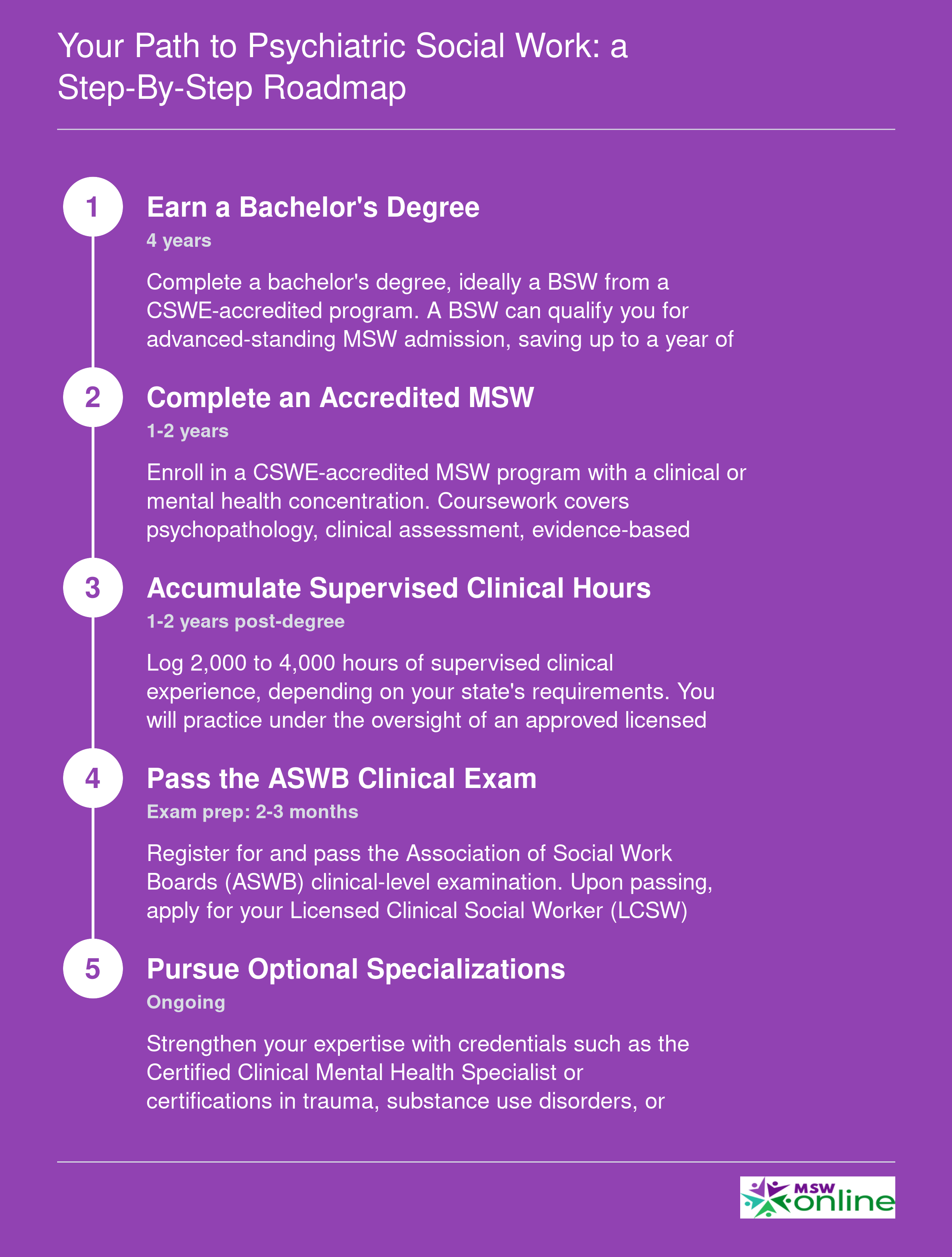
Becoming a licensed mental health social worker is a structured but achievable process. From your first undergraduate course to independent clinical practice, expect a total investment of roughly 6 to 8 years. The timeline below breaks down each milestone so you can plan ahead.
Steps to Becoming a Mental Health Social Worker
The path to becoming a mental health social worker asks you to navigate a tradeoff early: speed through accelerated training or deeper immersion at each stage. Every decision, from your undergraduate major to your licensure timeline, shapes how quickly you enter independent practice and how well prepared you feel when you get there.
Step 1: Complete a Bachelor's Degree
Any bachelor's degree qualifies for MSW admission, but a BSW from a CSWE-accredited program opens the door to advanced standing MSW programs that trim roughly one year off the graduate timeline. Common feeder majors (psychology, sociology, human services, child development) provide a strong foundation, but a tailored BSW already embeds social work practice and field experience. If you hold a non-BSW, expect a traditional two-year full-time MSW program; advanced standing typically condenses the MSW into about one year.
Step 2: Earn a CSWE-Accredited MSW with a Mental Health Concentration
CSWE accreditation is non-negotiable for licensure and employment. Most MSW programs offer a clinical or mental health track, combining coursework in psychopathology, evidence-based therapies, and crisis intervention with field placements in psychiatric hospitals, community mental health centers, or outpatient clinics. These practicums let you log direct client hours under supervision and test your fit for psychiatric settings. When comparing programs, look beyond the concentration name to the field placement contracts, faculty clinical backgrounds, and whether alumni consistently pass the ASWB clinical exam on their first attempt.
Step 3: Accumulate Supervised Clinical Hours Post-MSW
After graduating, you must complete 2,000 to 4,000 hours of supervised clinical work; the range depends entirely on your state board. Most candidates take two to three years of full-time post-graduate work to hit the requirement. Your supervisor must hold an LCSW (or equivalent) and sign off on your hours. This period is effectively a paid apprenticeship: you assess, diagnose, and treat clients while your supervisor reviews cases and approves documentation. The setting, whether inpatient, outpatient, private practice, or school-based, shapes the clinical skills you develop, so choose a role that aligns with any eventual sub-specialty.
Step 4: Pass the ASWB Clinical Exam and Obtain LCSW Licensure
The ASWB Clinical Exam is the gateway to independent practice and insurance billing. It uses a four-option multiple-choice format, tests clinical judgment, diagnosis, treatment planning, and ethics, and requires registration through your state board. Most test-takers prepare with ASWB-approved study guides and practice tests. Once you pass, you apply for LCSW licensure in your state, which permits you to practice independent clinical social work. Some states use a different title (e.g., LISW, LICSW), but the substance remains: this credential unlocks private practice and many supervisory roles.
Step 5: Pursue Optional Board Certifications and Sub-Specializations
After licensure, board certifications like the C-ASWCM (Certified Advanced Social Work Case Manager) or C-SWHC (Certified Social Worker in Health Care) signal deep expertise in a niche. Equally valuable are non-credentialed sub-specializations built through focused clinical practice and continuing education: trauma-focused cognitive behavioral therapy, child social worker pathways, substance use disorder treatment, or military and veteran behavioral health. Those interested in substance use work specifically may also explore chemical dependency counseling as a complementary credential. These trails often lead to roles in specialized units, higher reimbursement rates, and greater professional satisfaction. While optional, they distinguish a generalist LCSW from a sought-after expert.
Questions to Ask Yourself
MSW Programs with a Psychiatric or Mental Health Concentration
A generalist MSW prepares you to work across multiple populations and settings. A psychiatric or mental health concentration narrows that training toward clinical assessment, diagnosable conditions, evidence-based treatment modalities, and the biological underpinnings of mental illness. The difference shows up immediately in the classroom: instead of broad policy and community-practice courses alone, you are covering psychopathology, psychopharmacology, trauma-informed care, cognitive behavioral therapy (CBT), dialectical behavior therapy (DBT), and structured clinical interviewing. Students drawn to modality-focused roles may also want to explore behavioral therapist education requirements.
What a Mental Health Concentration Actually Looks Like
Programs with a dedicated psychiatric or clinical mental health track typically require you to complete a set of concentration-level courses before entering advanced field placement. Those courses vary by school, but the core sequence usually includes abnormal psychology or psychopathology, a survey of psychotropic medications and their side effects, at least one evidence-based modality course (CBT and DBT being most common), and a clinical assessment course that covers tools like the DSM-5-TR and standardized screening instruments. Field hours are structured around clinical sites such as community mental health centers, inpatient psychiatric units, and behavioral health clinics, not just general social services agencies.
Programs Worth Looking At
Several CSWE-accredited programs stand out for the depth of their psychiatric or clinical training.
- University of Denver (GSSW): Offers a Mental Health and Trauma concentration available in both on-campus and online formats. Advanced-standing students with a BSW can complete the program in 12 months. The concentration integrates trauma theory directly into clinical practice coursework.
- Columbia University (School of Social Work): The Advanced Clinical Social Work Practice concentration is available online and on-campus. Columbia's clinical sequence is detailed and its New York City location provides access to a wide range of clinical field placement settings, though online students arrange local placements.3
- Indiana University: The Clinical and Community Practice concentration is available on-campus and online. Advanced standing is available, and the program has a strong record in both urban and rural mental health placement contexts.
- Capella University: A fully online CSWE-accredited MSW with a Clinical Practice concentration. Advanced standing is available. Capella's self-paced structure suits working students, and field placements are coordinated locally.
- Campbellsville University: Offers a Clinical Practice concentration in online and hybrid formats with advanced-standing options, making it accessible for BSW holders who need schedule flexibility.
- Arizona State University: The MSW is framed as an Advanced Generalist Practice program available online and on-campus. While not labeled psychiatric-specific, ASU's clinical courses and electives allow students to build a mental health-focused course sequence, and advanced standing is available.
Online Programs and Field Placement
Online MSW programs with mental health or clinical concentrations have expanded considerably over the past decade. Nearly every major online master's in social work program now requires the same field hours as an on-campus option, typically 900 to 1,000 hours across foundation and advanced placements. The difference is logistics: online students arrange placements in their local community rather than through a campus placement office, though most programs provide coordination support. If you are already employed in a behavioral health setting, some programs allow you to use your current employer as a placement site, subject to approval. For a deeper look at how placements work, see our guide to MSW field placement.
Advanced Standing and CSWE Accreditation
If you already hold a CSWE-accredited BSW, advanced-standing tracks let you skip the foundation year and move directly into concentration coursework. That typically compresses the degree to about 12 months of full-time study, though part-time advanced-standing options exist at several of the programs listed above. The savings in time and cost are significant.
On accreditation: CSWE accreditation is the only credential that matters here. State licensing boards require that your MSW come from a CSWE-accredited program before you can sit for the ASWB clinical exam and pursue LCSW licensure. A program without it, regardless of reputation or price, will block your path to licensure. Confirm accreditation status directly through the CSWE directory before you apply.
Related Articles
Licensure and Certification: LCSW Requirements by State
The interstate social work licensure compact, now enacted by 30 states with a 2026 implementation target, is poised to transform cross-state practice for mental health social workers.1
The LCSW: Clinical Licensure Standard
In all 50 states, the licensed clinical social worker (LCSW) credential, or its state-specific equivalent, remains the non-negotiable gateway to independent mental health practice. Holding an LCSW qualifies you to diagnose mental and emotional disorders, provide psychotherapy, and bill insurance under your own provider number. Without it, even a master's degree leaves you working under supervision. The state issues the license, but the path almost always hinges on two universal milestones: passing the ASWB clinical exam and amassing thousands of supervised clinical hours.
Mastering the ASWB Clinical Exam
The ASWB clinical-level exam is the single assessment required across all jurisdictions. Expect 170 multiple-choice questions delivered in a 4-hour testing window. The exam covers assessment, diagnosis, treatment planning, ethics, and intervention strategies at the independent-practice level. Pass rates have historically held steady around 70 to 75 percent for first-time test-takers from CSWE-accredited programs, though results vary by preparation method. Registration fees are set by ASWB, and the exam is administered year-round at Pearson VUE centers or through live online proctoring.
Supervised Hours: A Range That Demands Planning
State requirements for post-degree supervised clinical experience typically fall between 2,000 and 4,000 hours, accumulated over two to three years.3 The floor can be surprisingly low: Nevada mandates 2,000 hours, while high-hour states like Iowa and Michigan require 4,000. Between those extremes sit California and Alabama at 3,200 hours, New Mexico at 3,600 hours, and Colorado with a 3,000 to 3,600 hour band.3 Because the hours must be earned under a board-approved supervisor, often an LCSW, licensed psychologist, or psychiatrist, many new graduates choose their first employer partly by whether the setting can provide the required supervision. This planning step is just as important for professionals pursuing other forensic social work pathways that also require extensive supervised practice.
Extra State-Specific Hurdles
Beyond clinical hours, a handful of states layer on additional requirements. Texas and California are the most cited examples: Texas adds a jurisprudence exam on state social work laws, while California requires a separate Law and Ethics exam before granting the LCSW. Continuing education mandates also vary. While most states align with a 30 to 45 hour renewal cycle every two years, Alaska stands out at 45 hours per renewal period, while Colorado and Tennessee settle at 30 hours.4 Some boards specify content areas, such as ethics, suicide prevention, or cultural competence, that must be covered within those hours.
The Compact and Telehealth's Future
The 2026 Social Work Licensure Compact, enacted by 30 states, introduces a multistate privilege that allows an LCSW to practice in any member state without obtaining a separate license.1 For mental health social workers using telehealth, this removes a major barrier: you will no longer need to hold licenses in every state where a client resides. The compact sets a floor of 3,000 supervised clinical hours for eligibility, which could nudge lower-hour states toward higher minimums over time.1 As implementation rolls out, keeping an eye on your state's compact status will be essential for anyone planning a multi-state career.
Frequently Asked Questions About Mental Health Social Work
Below are straightforward answers to the questions prospective mental health social workers ask most often. Where timelines or requirements vary by state, the figures shown reflect the most common benchmarks recognized by the Association of Social Work Boards (ASWB) and the National Association of Social Workers (NASW).
Mental Health Social Worker Salary: National Overview
According to the most recent Bureau of Labor Statistics data, the national median annual wage for mental health and substance abuse social workers sits at $60,060. Approximately 125,910 professionals work in this occupation across the United States. The spread between the 25th and 75th percentiles reflects meaningful earning potential as you gain experience, pursue licensure, and move into supervisory or specialized roles.
| Wage Metric | Annual Salary |
|---|---|
| 25th Percentile | $46,550 |
| Median (50th Percentile) | $60,060 |
| Mean (Average) | $68,290 |
| 75th Percentile | $78,980 |
Highest-Paying States for Mental Health Social Workers
Geography plays a major role in mental health social worker compensation. The table below ranks states by median annual wage for Mental Health and Substance Abuse Social Workers (BLS, May 2024). Keep in mind that higher pay in states like New York and California often reflects elevated costs of living, so weigh salary figures against local expenses before relocating.
| State | Total Employment | 25th Percentile | Median Salary | 75th Percentile | Mean Salary |
|---|---|---|---|---|---|
| New York | 14,180 | $63,720 | $80,230 | $98,100 | $96,240 |
| Connecticut | 1,350 | $51,250 | $78,820 | $92,270 | $75,190 |
| Minnesota | 3,430 | $61,300 | $77,100 | $89,470 | $77,190 |
| California | 18,020 | $55,440 | $75,320 | $105,020 | $83,110 |
| District of Columbia | 640 | $55,360 | $72,720 | $106,720 | $81,300 |
| Oregon | 2,160 | $57,990 | $71,830 | $86,080 | $74,310 |
| New Jersey | 3,140 | $48,170 | $70,420 | $88,000 | $72,450 |
| Hawaii | 410 | $53,720 | $70,340 | $83,430 | $70,960 |
| Vermont | 370 | $61,260 | $69,540 | $80,850 | $74,120 |
| Washington | 3,490 | $56,220 | $69,060 | $84,180 | $71,660 |
| Maine | 1,120 | $52,820 | $67,820 | $86,100 | $71,820 |
| New Mexico | 620 | $55,060 | $65,600 | $81,220 | $70,620 |
| Colorado | 1,980 | $51,820 | $65,080 | $76,840 | $65,530 |
| Massachusetts | 6,790 | $56,660 | $64,960 | $78,980 | $69,990 |
| New Hampshire | 460 | $59,980 | $63,810 | $79,120 | $71,030 |
Top-Paying Metro Areas for Mental Health Social Workers
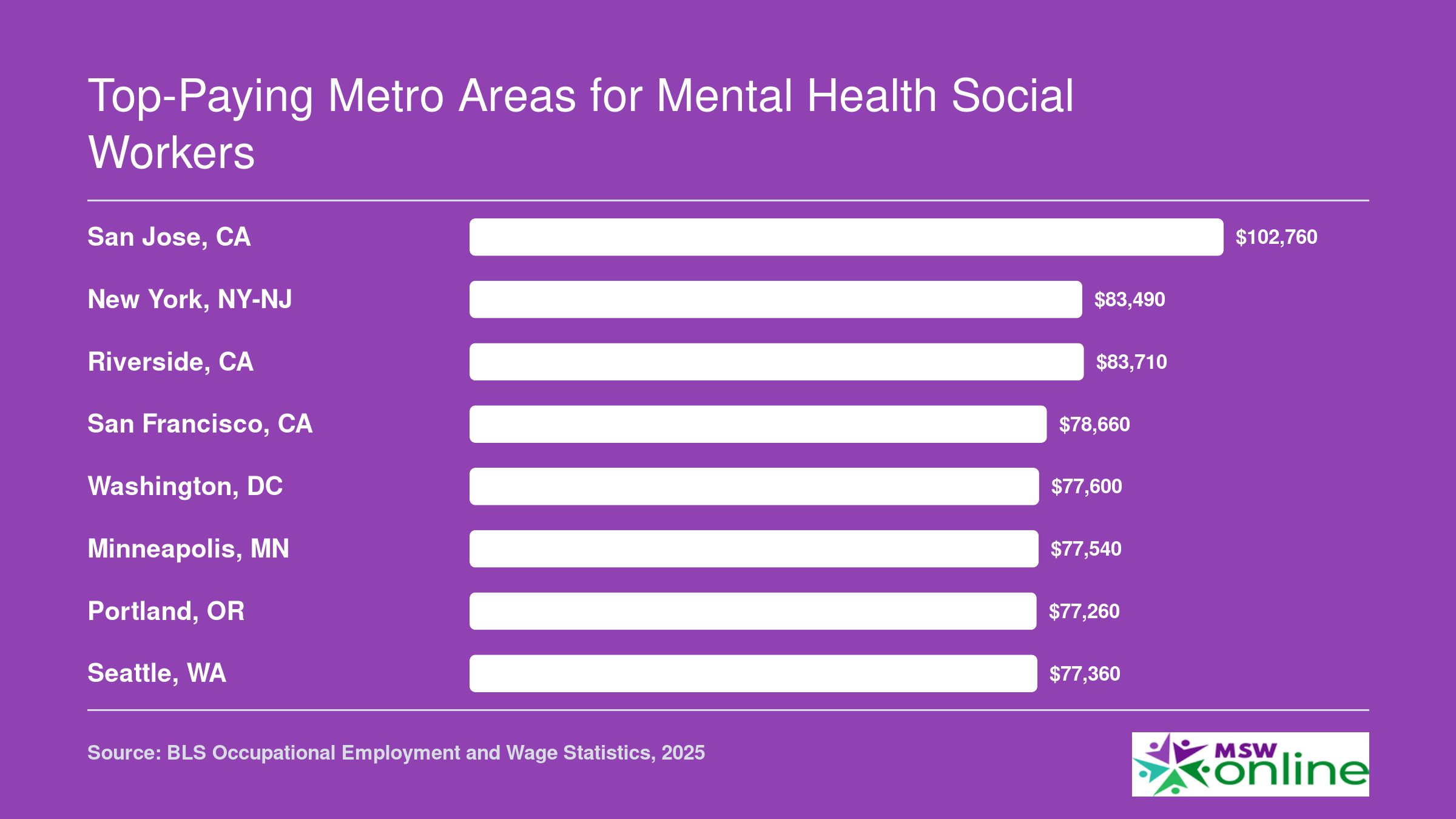
Pay for mental health and substance abuse social workers varies dramatically by metro area. The highest-paying regions tend to cluster in coastal cities where the cost of living is steep, state behavioral-health funding is robust, and demand for licensed clinicians outpaces supply. California metros dominate the top tier, while large East Coast and Midwest hubs also pay well above the national median.
Job Growth and Demand for Psychiatric Social Workers
Are mental health social workers in high demand right now?
The short answer is yes, and the data suggests that demand will hold for the next decade. While the Bureau of Labor Statistics has not yet published 2024, 2034 projections for mental health and substance abuse social workers, the last full projection period (2022, 2032) pegged the field's growth at 10.6%. That is more than triple the 3.1% average growth projected for all occupations from 2024 to 2034, and it outpaces even the broader healthcare and social assistance sector (8.4%). In raw numbers, the BLS expects roughly 12,000 additional jobs in this specialty by 2032, a figure that does not account for the thousands of openings created each year as experienced practitioners retire or move into other roles.
Projected Growth Outpaces Most Occupations
- Growth rate: 10.6% for mental health and substance abuse social workers (2022, 2032) vs. 3.1% for all occupations (2024, 2034).
- Net new jobs: An estimated 12,000 positions added across the country over the decade.
- Replacement openings: Tens of thousands more as the current workforce ages out; combined with new jobs, this keeps the hiring pipeline reliably open.
What's Driving the Demand?
Several converging forces are lifting employer appetite for psychiatric social workers:
- Mental health parity laws and the Affordable Care Act expanded insurance coverage for behavioral health services, funneling more patients into care.
- The post-pandemic period has normalized mental health treatment, lowering stigma and increasing the number of people actively seeking therapy and crisis intervention.
- The opioid and broader substance abuse crisis continues to require specialty clinical social workers in both outpatient and inpatient settings.
- An aging population brings more cases of dementia, depression, and anxiety, all of which fall within the scope of mental health social work practice. Professionals interested in serving older adults specifically may also consider geriatric social work as a complementary specialization.
Workforce Shortages Create Opportunity for New Graduates
The Health Resources and Services Administration (HRSA) designates Mental Health Professional Shortage Areas (HPSAs) across the United States. As of the most recent data, more than 160 million Americans live in an area with a shortage of mental health providers, a gap that includes licensed clinical social workers. For new MSW graduates pursuing psychiatric specialization, these shortage designations translate into a genuine hiring advantage, especially in rural and underserved urban communities. Employers often offer loan repayment incentives and signing bonuses to attract clinicians to designated shortage regions.
Telehealth Expands the Addressable Market
Telehealth has evolved from a stopgap measure into a permanent delivery model. Many states now participate in a Social Work Interstate Compact, allowing licensed clinical social workers to practice across state lines via teletherapy. This effectively multiplies the geographic market where a single LCSW can find clients, and digital platforms (teletherapy apps, virtual crisis lines, integrated primary care portals) are actively recruiting mental health social workers to staff their networks.
Settings Experiencing the Fastest Growth
- Community health centers: Federally qualified health centers are integrating behavioral health at a rapid clip, creating team-based roles for social workers.
- Integrated primary care: Co-located behavioral health consultants, roles that LCSWs often fill, are becoming standard in medical practices.
- School systems: Schools are adding mental health staff to address student anxiety, trauma, and behavioral issues, with funding expanding through grants and local budgets.
- Telehealth-native companies: Venture-backed platforms and insurer-owned virtual clinics are hiring directly, often offering remote-first compensation packages.
Telehealth has turned geography into a career lever. LCSWs licensed in lower-paying states can now serve clients in higher-paying markets by obtaining compact membership or dual licensure in a target state. If your state joins the Social Work Licensure Compact, that process becomes significantly faster. Treat multi-state licensure as a deliberate income strategy, not just an administrative detail.
Mental Health Social Worker vs. Counselor, Psychologist, and Psychiatric NP
Prospective students often confuse mental health social workers with other behavioral health professionals. While these roles overlap in their commitment to treating mental illness, they differ significantly in education, scope of practice, and professional philosophy.
Mental health social workers hold an MSW and typically earn clinical licensure (LCSW). Their training emphasizes a person-in-environment framework, meaning they assess how social systems, family dynamics, and community resources shape a client's mental health. They provide psychotherapy, coordinate care, and advocate for systemic changes. Unlike other providers, mental health social workers often operate across micro, mezzo, and macro levels, addressing individual therapy needs while also tackling policy barriers that affect vulnerable populations.
Licensed professional counselors (LPCs) complete a master's in counseling rather than social work. Their coursework centers on therapeutic techniques and human development, and they typically focus on individual or group talk therapy. Counselors are less likely to engage in case management or community-level advocacy, making the counselor role narrower in scope than psychiatric social work.
Psychologists earn a doctoral degree (PhD or PsyD) and undergo extensive training in psychological testing, research methods, and evidence-based interventions. They can administer and interpret diagnostic assessments that social workers and counselors generally cannot. However, psychologists rarely coordinate housing, benefits, or social services the way mental health social workers do.
Psychiatric nurse practitioners (PMHNPs) are advanced-practice registered nurses who can prescribe medication, a capability no other role on this list shares. Their medical training equips them to manage pharmacological treatment plans, but they spend less time on psychotherapy or social determinants of health compared to mental health social workers.
In short, mental health social workers are uniquely positioned at the intersection of clinical therapy and social advocacy. If you are drawn to a holistic, systems-oriented approach to mental health care, psychiatric social work may be the strongest fit.