Points of interest…
- Utah has two CSWE-accredited MSW programs, so choosing between them hinges on cost, format, and field support.
- Every accredited option requires roughly 900 supervised field hours, even for fully online students.
- Utah's licensure ladder runs from CSW to LCSW, requiring the ASWB Masters exam and post-degree clinical hours.
- Public Service Loan Forgiveness and state stipend programs can significantly offset MSW debt for Utah graduates.
Rural Utah counties face a measurable shortage of licensed clinical social workers, with many communities relying on practitioners who drive hours or telehealth providers licensed elsewhere. That structural gap is pushing more students toward MSW programs that do not require relocating to Salt Lake City or Provo.
Utah has only two CSWE-accredited MSW programs, which makes the decision unusually consequential. There is no large pool of programs to compare, so small differences in tuition structure, field placement support, and licensure pass rates carry real weight. Both programs offer some form of online or hybrid delivery, but the details matter considerably.
The sections below cover ranked program profiles, cost and debt comparisons, field placement logistics for remote students, and the CSW-to-LCSW licensure sequence administered by Utah DOPL. Accreditation status is non-negotiable for licensure eligibility, and in a state with this few options, understanding exactly what each program delivers is the practical starting point.
Top Online MSW Programs in Utah for 2026
Utah currently has two CSWE-accredited MSW programs, each serving distinct student profiles. We evaluated them using net price, institution-wide graduation rates, median graduate debt, and post-graduation earnings drawn from College Scorecard and IPEDS data. Program-level earnings and employment outcomes are not yet available for either school, so the figures below reflect institution-wide medians. Both programs hold Council on Social Work Education accreditation, meaning graduates meet the educational requirements for Utah licensure.
- Net price after financial aid
- Institution-wide graduation rates
- Median graduate debt at completion
- Post-graduation earnings trajectory
- Accreditation and licensure alignment
- Independent program research
- Internal program database
- NCES-IPEDS federal institutional data — nces.ed.gov
- College Scorecard graduate earnings — collegescorecard.ed.gov
Utah Valley University
#1Orem, UT · $5,000 – $10,000/yr
Best for: Budget-minded working professionals near Orem
Utah Valley University delivers an Advanced Generalist MSW through a hybrid format that pairs online coursework with weekly Friday classes on the Orem campus. With the lowest net price among Utah MSW options and a reported 90% job placement rate at graduation, UVU is built for working professionals who can attend one day a week in person. Its crisis intervention course is approved by the Utah Department of Health and Human Services, and graduates may earn a state-recognized Crisis Worker Certification alongside their MSW.
- Hybrid format with online coursework and Friday in-person classes
- Advanced Standing track completable in roughly 12 months
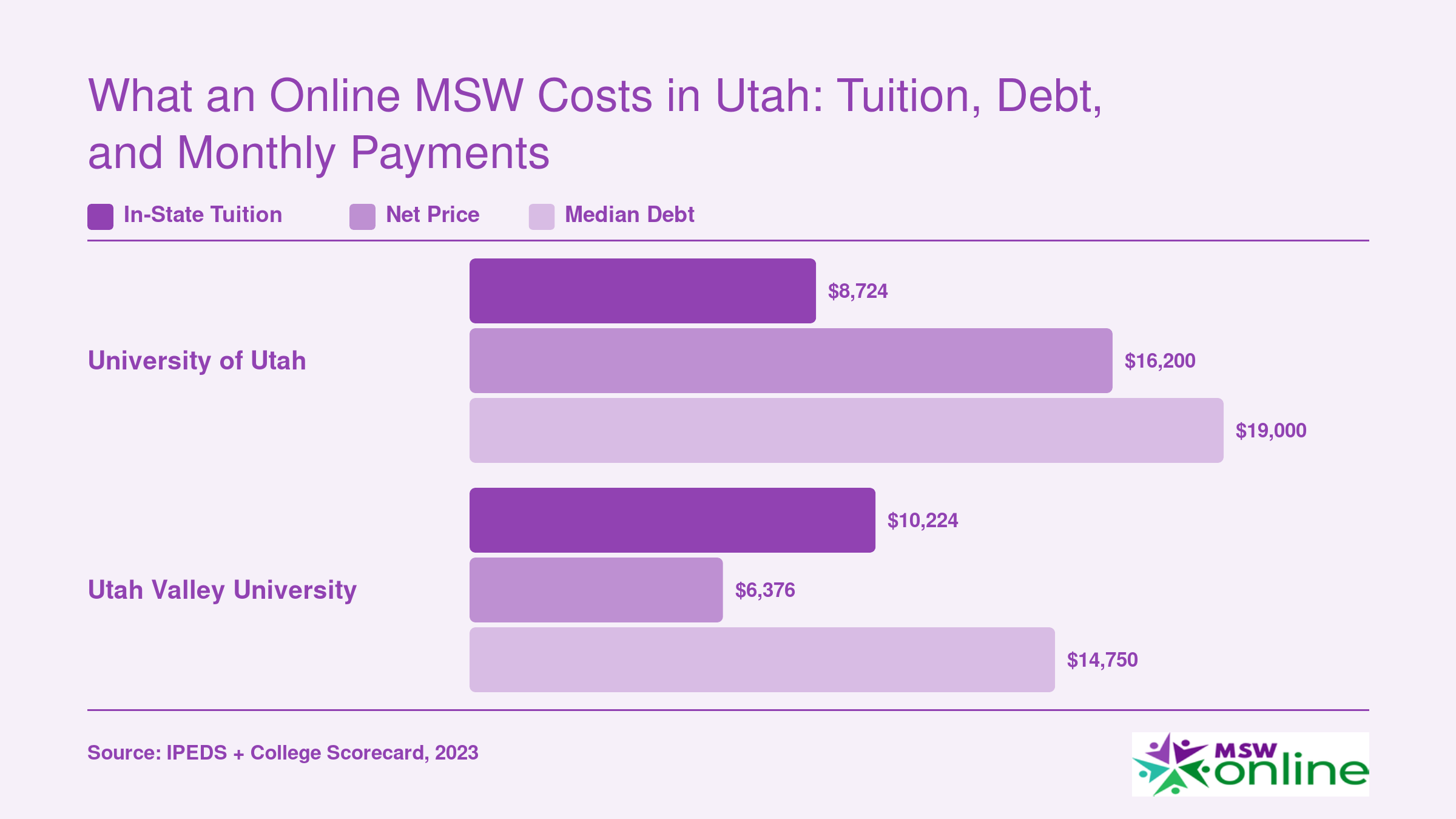
- In-state tuition approximately $10,224; out-of-state approximately $22,834
- Net price after aid around $6,376 (institution-wide average)
- Median graduate debt of $14,750 (institution-wide)
- Crisis intervention course approved for Utah Crisis Worker Certification
- Directly fulfills requirements for CSW licensure in Utah
- Advanced Standing applicants must hold a BSW and meet a 3.0 GPA minimum
University of Utah
#2Salt Lake City, UT · $10,000 – $31,000/yr
Best for: Remote learners wanting clinical concentrations
The University of Utah offers the most flexible MSW pathway in the state, with fully online, hybrid, and campus-based tracks spanning 45 to 60 credits. Online students choose from Advanced Standing, Two-Year, or Three-Year cohort schedules, and coursework is largely asynchronous with occasional synchronous sessions. The program partners with more than 500 social service agencies for field placements, and students can arrange practicums in their own geographic area. Note that the Three-Year online cohort accepts students only once every three years; the next cohort begins Fall 2026 with an application deadline of March 1, 2026.
- Fully online option with asynchronous coursework and limited Zoom sessions
- Advanced Standing (45 credits), Two-Year (60 credits), and Three-Year (60 credits) tracks
- Seven concentrations on campus; online Advanced Standing limited to Mental Health
- In-state tuition approximately $8,724; out-of-state approximately $27,983
- Net price after aid around $16,200 (institution-wide average)
- Median graduate debt of $19,000 (institution-wide)
- Field placements coordinated through 500+ partnered agencies nationwide
- Three-Year online cohort opens Fall 2026, next intake not until Fall 2029
Fully Online, Hybrid, or Campus-Based: Choosing a Format for Your Utah MSW
Utah MSW candidates have two distinct program formats to weigh, and the right choice depends on your schedule, location, and learning preferences.
The University of Utah offers a fully online MSW that pairs asynchronous coursework with a field practicum completed at local agencies near the student. This format works well for working professionals, parents, or anyone living outside the Salt Lake City metro area. You log in on your own schedule, connect with classmates through virtual discussions, and still gain supervised clinical hours in a real-world setting.
The same university also runs a traditional on-campus MSW with in-person, synchronous classes held on weekdays. Students in this track benefit from face-to-face faculty interaction, immediate peer collaboration, and direct access to campus resources such as research labs and career services. The trade-off is a fixed class schedule that demands physical presence in Salt Lake City.
Utah does not currently offer a hybrid MSW that blends online lectures with periodic campus intensives, so the decision comes down to fully online or fully on-campus. Here are key factors to consider:
- Work obligations: If you hold a full-time job, the online format's flexibility is difficult to match.
- Learning style: Students who thrive on in-person discussion and structured routines often prefer the campus track.
- Geographic access: Residents of rural counties or neighboring states can earn a Utah-accredited MSW without relocating by choosing the online option.
- Field placement logistics: Both formats require practicum hours, but online students arrange placements closer to home rather than near campus.
If your long-term plan includes doctoral study, completing a campus-based MSW can build stronger faculty relationships that translate into research mentorship and recommendation letters for social work phd programs.
Questions to Ask Yourself
What an Online MSW Costs in Utah: Tuition, Debt, and Monthly Payments
The figures below compare annual tuition, institution-wide average net price (what students actually pay after grants and scholarships), and median debt at graduation for each ranked Utah MSW program. Net price is an institution-wide average reported by IPEDS, not a program-specific figure, so your actual cost will vary with financial aid. Median debt translates to roughly $155-$200 per month on a standard 10-year repayment plan at current federal loan rates. The University of Utah offers the lowest annual in-state tuition of the two, though Utah Valley University's substantially lower net price may make it the more affordable option once aid is factored in.
Completing Field Placements as an Online MSW Student in Utah
How does field placement work when you're earning your MSW online? In short, the same way it does on campus, just with extra logistics. Every CSWE-accredited MSW program in the country requires roughly 900 hours of supervised practicum, and that requirement does not bend for distance learners. You will be physically present at an approved agency, working under a licensed supervisor, for the duration of your program. For a broader look at securing and succeeding in placements, see our guide to MSW internships.
How Utah Programs Handle Placement Logistics
At the University of Utah's three-year online MSW, the College of Social Work's practicum team takes the lead on matching students to sites rather than leaving the search entirely to the student. Online students receive referrals through the practicum process and are placed in their general geographic area, which is the mechanism that lets out-of-area Utahns (and some out-of-state students) complete the degree without relocating to Salt Lake City. If you already have a relationship with an agency you'd like to work with, a direct-to-agency arrangement is possible, but only with explicit approval from your practicum professor.
The U's curriculum splits the requirement into a generalist practicum (SW6511, 3 credits) and a specialist practicum (SW6521, 4 credits), each paired with an integrative seminar. Other Utah programs follow a similar two-stage structure, though the exact credit weighting and the degree to which students self-source sites vary by school. Ask each program directly whether you can place at your current employer, whether out-of-state sites are reviewed case by case, and how far in advance the matching process begins.
Where Utah MSW Students Actually Train
Common placement settings across the state include:
- Utah Division of Child and Family Services (DCFS) regional offices
- Community mental health centers and behavioral health agencies
- Hospital social work departments and integrated primary care clinics
- K-12 school districts and school-based mental health teams
- Veterans, refugee resettlement, and substance use treatment programs
Students pursuing a clinical concentration typically land in mental health or healthcare settings, while those on a child welfare track often place at DCFS.
The Title IV-E Stipend Pathway
If child welfare is your intended specialization, Utah participates in the federal Title IV-E child welfare education program, which pairs a DCFS field placement with tuition support and a stipend in exchange for a post-graduation work commitment at the agency. It functions as both a practicum pipeline and a major financial aid source, and it is worth weighing alongside the scholarship options covered later in this article.
Related Articles
Utah's Licensure Ladder: From CSW to LCSW
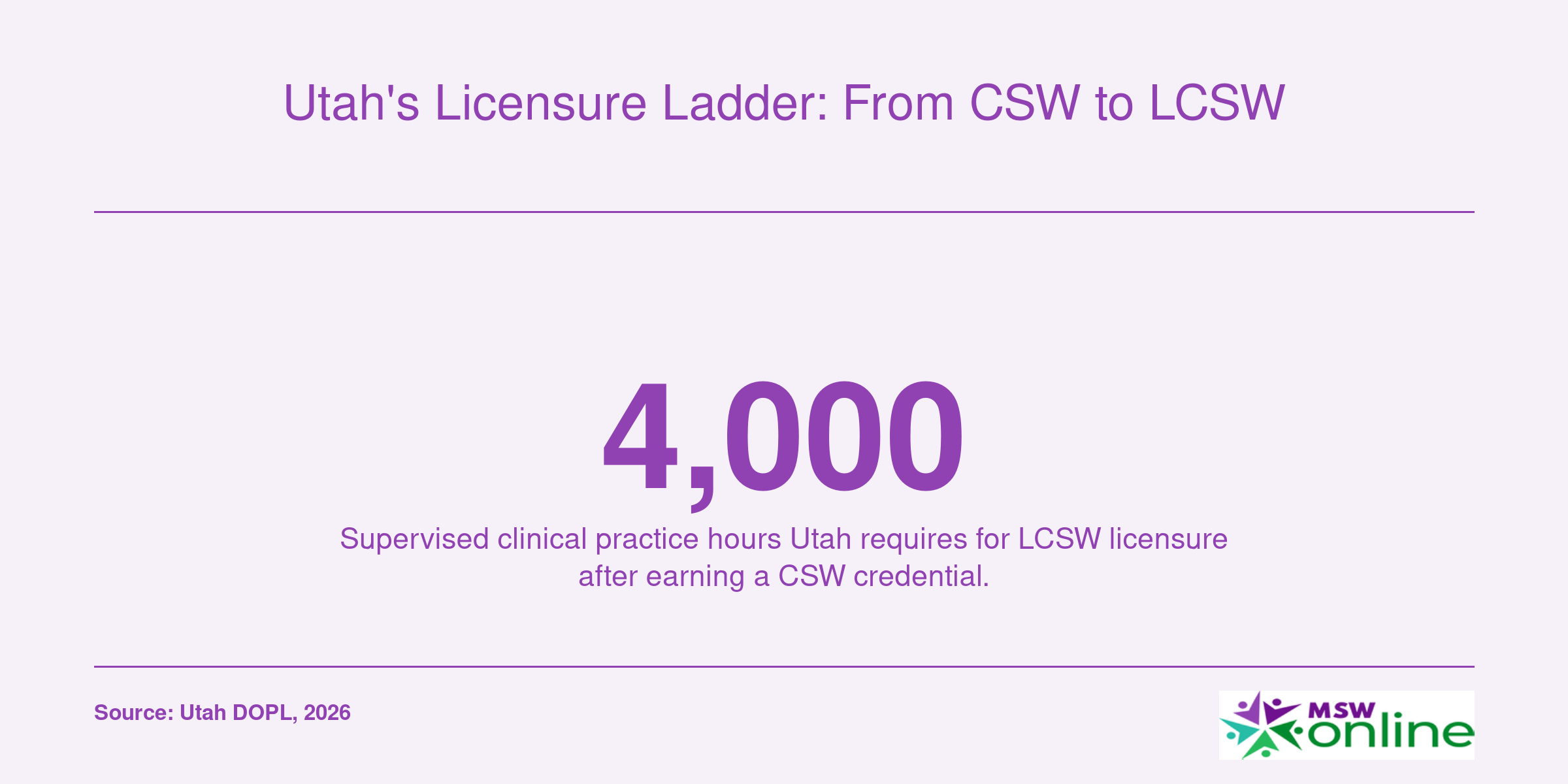
Utah's Division of Occupational and Professional Licensing (DOPL) oversees a multi-tier licensure path for social workers. After earning your MSW, you first qualify for the Certified Social Worker (CSW) license by passing the ASWB Masters exam. To advance to Licensed Clinical Social Worker (LCSW), you must complete supervised clinical hours and pass the ASWB Clinical exam. Requirements can shift, so verify current rules directly on the DOPL website under Social Work license types, and check the NASW Utah chapter for regulation updates. ASWB pass rates by program may not be publicly posted; contact your school's MSW program office for the most accurate data.
Common Questions About Earning an MSW in Utah
Prospective students weigh cost, accreditation, and logistics before committing to a graduate social work program. The answers below address the questions Utah residents ask most often when comparing online MSW options.
Utah MSW Earnings, Debt, and Return on Investment by Program
Understanding the financial picture before committing to an MSW program in Utah helps you make a confident decision. Tuition varies considerably depending on the institution, residency status, and whether you enroll in an on-campus or online format.
At the University of Utah, in-state graduate tuition runs roughly $8,000 to $10,000 per year, making the total cost for a two-year program approximately $16,000 to $20,000 before fees and living expenses. Brigham Young University offers competitive rates as well, especially for LDS members who receive a tuition discount. Utah State University's program tends to fall in a similar range for residents. Out-of-state students at any of these schools can expect to pay two to three times more, though online programs sometimes offer flat-rate or reduced non-resident tuition.
On the earnings side, social workers in Utah with an MSW and clinical licensure (LCSW) typically earn between $50,000 and $65,000 annually, with experienced practitioners in healthcare, administration, or private practice exceeding $70,000. Entry-level MSW holders without clinical licensure generally start in the $40,000 to $50,000 range. Choosing a high-demand MSW specialization such as mental health, substance abuse, or medical social work can push your earning potential toward the upper end of those ranges.
To evaluate return on investment, compare total program cost against your expected salary increase post-degree. A resident student who completes a master's in social work at roughly $20,000 in total tuition and moves from a $35,000 BSW-level salary to a $55,000 MSW-level salary recoups that investment within two to three years. Minimizing student debt through scholarships, employer tuition assistance, and federal loan repayment programs (such as Public Service Loan Forgiveness) further strengthens the financial case for earning your MSW in Utah.
Scholarships, Stipends, and Loan Forgiveness for Utah MSW Students
Funding an MSW degree in Utah is more manageable than many students expect, thanks to institutional aid, assistantships, and federal repayment programs. Knowing what is available, and when to apply, can shave thousands of dollars off the total cost.
The University of Utah College of Social Work plans to distribute 137 scholarship awards totaling $463,000 for the 2025-2026 cycle, with individual awards averaging $3,000 to $4,000. Awards are based on both need and merit, and students apply through the university's Scholarship Universe portal. The application window opens October 6, 2025, and closes March 31, 2026, with notifications going out in May 2026.2
Brigham Young University offers graduate assistantships that pay $1,120 per semester for roughly 70 hours of work. BYU MSW students can also earn paid fieldwork stipends: $4,500 during the spring/summer term and $6,000 during the fall/winter term. These stipends help offset tuition while giving students hands-on clinical or community experience.
Beyond institutional support, Utah MSW graduates who enter public service roles may qualify for the federal Public Service Loan Forgiveness (PSLF) program, which forgives remaining federal loan balances after 120 qualifying payments. Many positions in state agencies, hospitals, and nonprofit organizations meet PSLF employment requirements, making it a practical long-term strategy for reducing debt.
For a broader look at funding opportunities across programs, explore our graduate social work scholarships guide, which covers national awards, application tips, and deadlines relevant to MSW students in any state.
With only a handful of CSWE-accredited MSW programs in Utah, affordability, field support, and licensure outcomes matter more than rankings. Choose the program format and financial aid that match your practice location and career goal. The best value is not always the cheapest sticker price but the school that positions you for success.