
Points of interest…
- NASW Foundation and CSWE Minority Fellowship awards offer MSW students between $2,000 and $13,000 each.
- Most major national MSW scholarships accept online students from CSWE-accredited programs on equal footing.
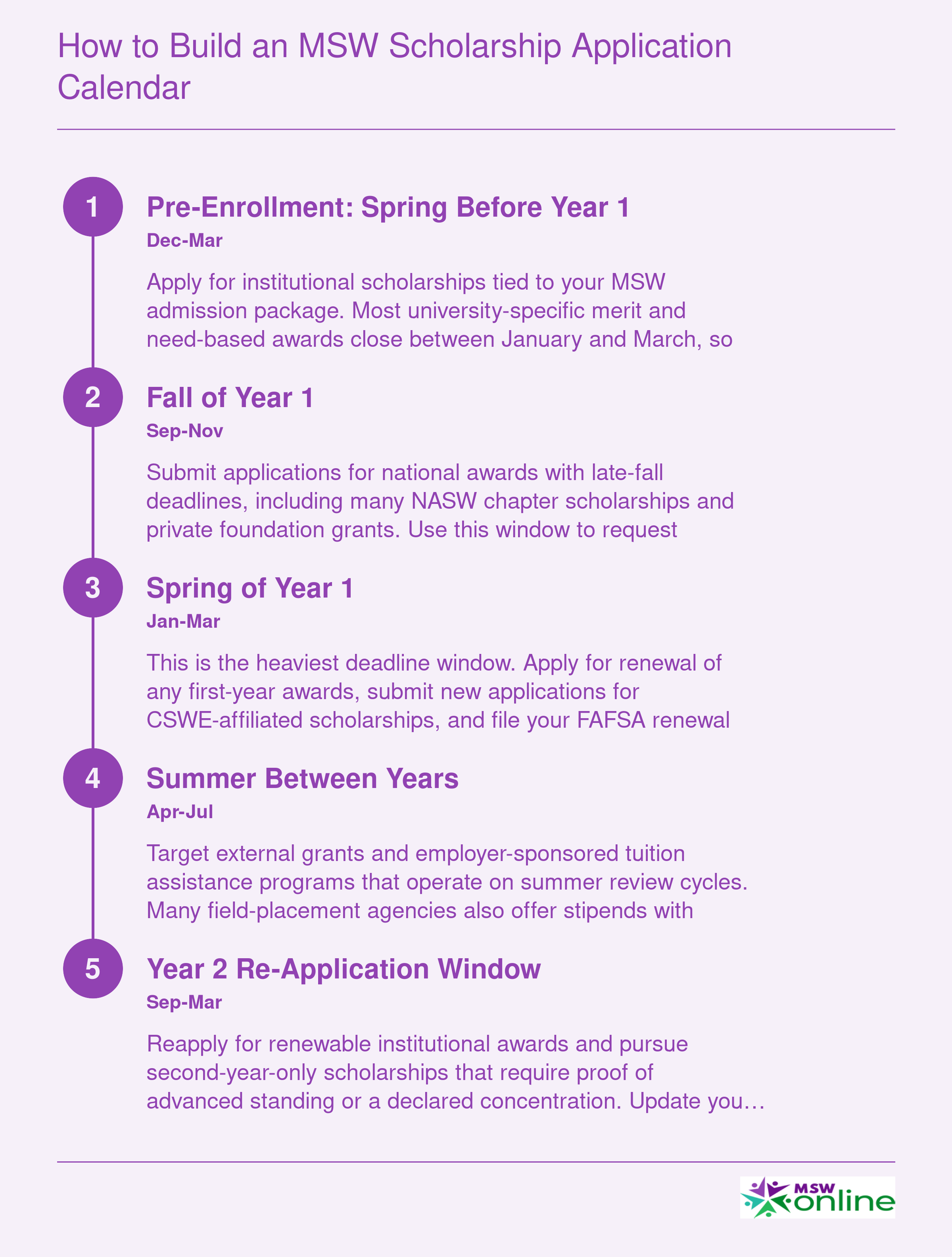
- Key scholarship deadlines cluster between January and March, so December prep work is critical.
- Over 20,000 social workers have already received Public Service Loan Forgiveness, with more eligible each year.
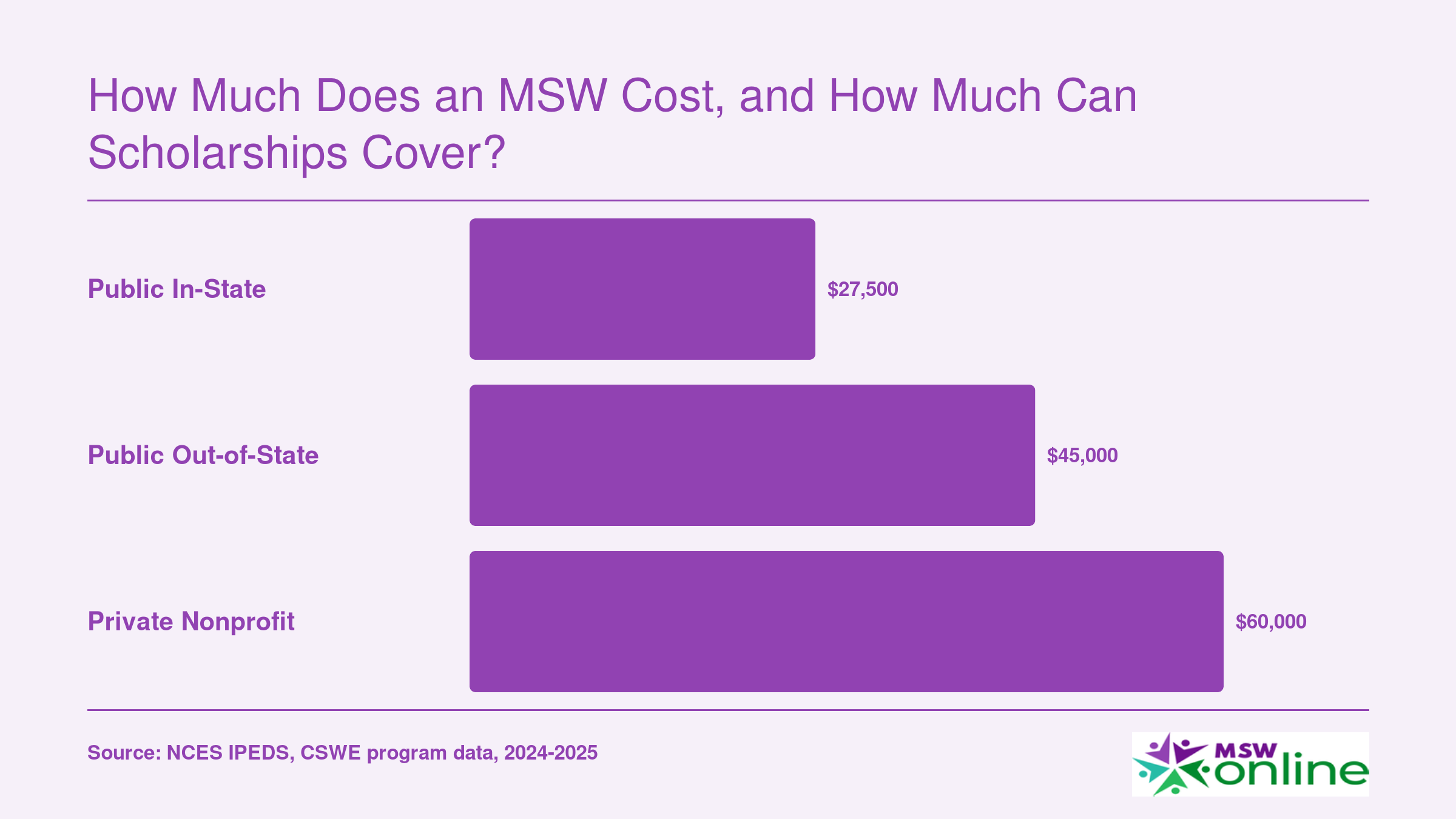
How much can scholarships actually reduce the cost of an MSW? With graduate tuition at CSWE-accredited programs ranging from roughly $15,000 to over $80,000 for the full degree, that question shapes every enrollment decision.
Social work attracts people driven by public service, not high salaries. The median pay for social workers nationally sits well below what comparably educated professionals earn in adjacent fields, making graduate debt a serious career constraint. Dedicated MSW scholarships, identity-based awards, and smart aid-stacking strategies can close the gap between program cost and what graduates realistically earn, sometimes eliminating tuition entirely.
The pool of available funding is larger than most applicants realize, but it is scattered across national organizations, individual schools, and state agencies, each with different deadlines, eligibility rules, and application requirements. Whether you are comparing accredited online MSW programs or planning an on-campus path, this guide maps every major funding source from BSW through doctoral study.
How Much Does an MSW Cost, and How Much Can Scholarships Cover?
MSW tuition varies dramatically depending on institution type. Understanding these ranges helps you set realistic targets for scholarship coverage. Most institutional merit awards fall between $2,000 and $8,000 per year, meaning a single scholarship may cover 10% to 40% of your total bill at a public school but only a fraction at a private university. Fully funded MSW packages do exist, though they are rare and highly competitive. The scholarship lists that follow break down where to find awards at every level, from partial merit aid to full-tuition fellowships. Keep in mind that tuition is only part of the picture: fees, practicum travel, and textbooks can add thousands more, and many scholarships do not cover those ancillary costs.
Top MSW-Specific Scholarships and Grants
The NASW Foundation administers four MSW-restricted scholarships ranging from $2,000 to $4,500, while CSWE's Minority Fellowship Program for master's students awards roughly $10,000 to $13,000 per fellow.12 Together, these national awards represent the most consistent, MSW-only funding pool outside individual school aid.
NASW Foundation Scholarships (Spring Deadlines)
All four NASW Foundation awards listed below share a March to April application window, require current MSW enrollment, and are one-time (non-renewable) awards. NASW membership is required to apply for NASW Foundation scholarships, which is a meaningful cost consideration when budgeting your applications.1
- Consuelo W. Gosnell Memorial Scholarship: $4,000 to $4,500 from the NASW Foundation. Eligibility: MSW students demonstrating commitment to working with American Indian/Alaska Native or Hispanic/Latino populations, plus leadership and financial need.
- Verne LaMarr Lyons Memorial Scholarship: $4,000 from the NASW Foundation. Eligibility: MSW students with a demonstrated commitment to health or mental health practice in African American communities.
- Lawanna Renee Barron Scholarship: $3,000 to $4,000 from the NASW Foundation. Eligibility: MSW students with leadership and community service records, with a focus on African American communities.
- Neysa Fanwick Memorial Scholarship: $2,000 to $3,000 from the NASW Foundation. Eligibility: MSW students pursuing clinical social work with an emphasis on mental health advocacy.
CSWE Minority Fellowship Program
The Council on Social Work Education administers the Minority Fellowship Program (Master's), funded through federal behavioral health agencies, with awards in the $10,000 to $13,000 range.2 Applications typically open in winter and close between January and March. Eligibility requires MSW enrollment, U.S. citizenship or permanent residency, and a commitment to behavioral health practice serving racial and ethnic minority populations. The fellowship is one-time per recipient at the master's level, though awardees join a national network with ongoing professional development. NASW membership is not required.
What This Pool Actually Looks Like
Treat these awards as competitive, not guaranteed. The NASW Foundation slate is concentrated in a single spring application cycle, which means one strong essay and two solid recommendation letters can position you for multiple awards simultaneously. The CSWE fellowship is the largest single MSW-restricted national award on this list and carries the most prestige on a resume.
Beyond these named national awards, your strongest MSW funding leads are almost always school-based: graduate assistantships, dean's scholarships, and Title IV-E child welfare stipends administered through individual MSW programs. Identity-based national awards are covered in the next section.
Questions to Ask Yourself
Identity-Based and Demographic Social Work Scholarships
Identity-based scholarships are among the most underutilized funding sources in social work education, and they exist because the profession has actively recruited practitioners who reflect the communities it serves. If you belong to a historically underrepresented group in social work, you have access to a parallel track of awards that runs alongside general MSW funding, and most of these can be combined with the broader scholarships covered elsewhere in this guide.
Awards for Students of Color
The NASW Foundation administers two of the most established identity-based awards.1 The Consuelo W. Gosnell Memorial Scholarship offers $8,500 for MSW students of American Indian, Alaska Native, or Hispanic/Latino heritage who are committed to working with these populations, with applications open from January through March. The Verne LaMarr Lyons Memorial Scholarship provides $4,000 for African American MSW students pursuing health or mental health practice, on the same January to March cycle.
The CSWE Minority Fellowship Program supports racial and ethnic minority students preparing for behavioral health practice.2 Award amounts vary by fellowship track, and the application window typically runs January through March. The Latino Social Work Coalition Scholarship serves Hispanic/Latino MSW students with awards of varying size and a March 31, 2026 deadline.
Equity-Focused and Regional Awards
Not every identity-based scholarship is tied to a single demographic. The Carl A. Scott Book Scholarship awards $500 to students with a demonstrated commitment to social justice and ethnic minority issues, with a March 16, 2026 deadline. The Laurel House Social Work Racial Equity Scholarship offers $10,000 for students focused on racial equity work, due May 15, 2026.
For Native students, the Native Hawaiian Health Scholarship Program provides $500 plus additional health-service-tied benefits to Native Hawaiian students, with a May 12, 2026 deadline. Indigenous and Native American students should also investigate tribal nation scholarships and the American Indian College Fund, which routes graduate awards through partner institutions.
Stack These With General Awards
Nearly every scholarship listed above can be layered with the MSW-specific and program-based awards covered in this guide. Students pursuing a master's in social work who qualify for the Gosnell ($8,500), a university tuition waiver, and a federal Pell-eligible grant package can stack all three. The stacking-aid section later in this article walks through how to coordinate these funds without triggering aid-displacement clauses at your school's financial aid office.
BSW and Undergraduate Social Work Scholarships
Undergraduate social work remains the essential entry point into the profession, but the scholarship landscape tilts heavily toward master's and doctoral candidates. BSW students navigate a smaller, more fragmented pool of awards, yet several national and local opportunities can meaningfully offset costs. Knowing where to look, and starting early, matters just as much for freshmen as it does for juniors preparing for graduate school. If you are still exploring online BSW programs, locking down scholarship timelines early gives you a head start.
National BSW and Undergraduate Awards
A handful of scholarships explicitly support BSW students at the national level. The Patty Gibbs-Wahlberg Scholarship, administered by the NASW Foundation, awards $1,000 to $3,000 to BSW students who hold a minimum 3.0 GPA and demonstrate commitment to the profession.1 The Lawanna Renee Barron Scholarship, open to both BSW and MSW candidates, provides $1,000 to $2,000 with a focus on leadership and service. The CSWE Carl A. Scott Book Scholarship offers a modest $500 to BSW or MSW students from underrepresented groups, emphasizing social justice.3 Phi Alpha Honor Society, present on many campuses, grants competitive scholarships to its undergraduate members; amounts vary but can complement institutional aid.
State and Community-Based Funding
Local sources often prove more accessible. NASW state chapters routinely offer BSW-eligible scholarships; these typically range from $1,000 to $5,000 and carry a 3.0 GPA minimum, though criteria differ by state.3 Community foundations and regional philanthropic trusts, such as the Alice M. Yarnold and Samuel Yarnold Scholarship Trust, which provides $1,000 to $5,000 to social work students in certain states, are worth investigating.3 Do not overlook your own program: departmental scholarships funded by alumni and donors can be the most plentiful BSW awards, sometimes based on financial need, field placement excellence, or specific practice interests.
Leveraging BSW Success for MSW Funding
Strong undergraduate performance does more than open doors to graduate school; it directly funds it. A high GPA, stellar field evaluations, and faculty relationships built during the BSW become the foundation for competitive advanced standing online MSW scholarship applications. Many graduate awards, including the Consuelo W. Gosnell Memorial Scholarship, are reserved for MSW students but value a documented BSW track record. Begin a scholarship tracking spreadsheet no later than junior year. That way, when acceptance letters arrive, you can immediately pivot to MSW-specific deadlines without scrambling.
Online MSW vs. On-Campus: Scholarship Eligibility Differences
Online MSW students sometimes assume they are second-class citizens in the scholarship landscape. That assumption is largely outdated. Most major national awards judge applicants by accreditation and academic fit, not by whether they attend class in a building or on a screen. That said, a few funding streams still favor on-campus students, so it pays to know where the lines fall.
National Scholarships: Modality Rarely Matters
The big national awards generally do not restrict by delivery format. The NASW Foundation scholarships require NASW membership and enrollment in a CSWE-accredited program, with no online exclusion. The CSWE Minority Fellowship Program (MFP) operates the same way: any CSWE-accredited MSW counts, online or in-person.3 If a program holds CSWE accreditation, treat these national pools as fully open to you.
Institutional Aid and Assistantships: Read the Fine Print
Institutional merit scholarships at most universities apply to online MSW students through the same internal channels as on-campus peers.4 The catch is in the language. Some institutional awards still list "full-time, on-campus enrollment" as a condition, often as leftover policy from before online programs existed. Always confirm with the financial aid office before assuming eligibility.
Graduate assistantships are where the gap is real. Teaching and research assistantships are typically tied to physical presence: staffing labs, holding office hours, supporting on-site faculty. Remote assistantships exist, but they are rare, limited, and highly competitive.4 Some state-funded grants and workforce programs also require in-state, on-campus attendance, so check residency and modality clauses carefully. Students weighing on-campus options may also want to explore social work internships that pair naturally with assistantship roles.
The Practical Tradeoff
Losing assistantship access stings, but online students gain something on-campus students often cannot: schedule flexibility. Many online MSW students continue working part-time or full-time in social services roles, which can offset, and sometimes exceed, the income a graduate assistantship would have provided. Combined with employer tuition benefits, this tradeoff often nets out in the online student's favor.
Most major national MSW scholarships judge applicants on academic merit and professional commitment, not whether courses are delivered online or in a classroom. Unless the award's eligibility criteria explicitly restrict enrollment to on-campus students, online MSW students should treat themselves as fully eligible and apply without hesitation.
How to Build an MSW Scholarship Application Calendar
Most major MSW scholarship deadlines cluster between January and March, which means December prep work is critical. The timeline below maps key scholarship windows from the semester before you enroll through your second year. Before you begin, set up filtered alerts on NASW, CSWE, and FastWeb for social work awards so new opportunities land in your inbox automatically.
Application Tips: Essays, Recommendations, and Standing Out
Winning a social work scholarship hinges not on polished prose but on demonstrated professional readiness and systemic awareness. Reviewers are practitioners and faculty who can spot a recycled template in seconds. They want evidence that you understand the work, not just that you want the credential.
Write the Personal Statement as a Professional, Not a Memoirist
A common mistake is opening with a childhood memory of helping others. Instead, lead with a specific client interaction or field placement moment that reveals your clinical or community practice judgment. Describe a dilemma you navigated, what you learned about systems or positionality, and how that shapes your social work concentration. This signals you are already thinking like a practitioner. For example, a moment when you recognized a policy barrier affecting a client and adjusted your advocacy approach shows far more than a general passion for justice.
Secure Recommendations That Speak to Clinical Competence
Recommendation letters should come from field supervisors or faculty who can detail your practice skills, not just your academic diligence. A professor who observed you in a practice lab or a supervisor who watched you de-escalate a tense family session can offer concrete examples of your readiness. Avoid generic letters from employers outside the field. Provide your recommenders with a brief list of specific interactions they might highlight, such as your ability to engage reluctant clients or your integration of theory into practice.
Three Moves That Separate Your Application from the Stack
- Quantify community impact: Instead of stating you volunteered, note the hours, populations served, and measurable outcomes, like 200 hours facilitating a grief group for 35 recently incarcerated women, with a 90% participant retention rate.
- Connect your MSW concentration to a demonstrated gap: If you plan to focus on school social work, explain how your experience as a tutor in under-resourced schools exposed a mental health social worker service void and how your graduate training will directly address it.
- Tailor each essay to the funder's stated mission: Research each scholarship's origin and values. A veteran's foundation may prioritize resilience and reintegration language; a child welfare endowment will weigh family preservation outcomes. Weave their language naturally into your narrative.
Know the GPA Thresholds for Your Target Awards
Most competitive national awards, such as the CSWE's Minority Fellowship Program, expect a 3.5 GPA or higher. However, many institutional and identity-based awards remain accessible with a 3.0 or above, especially when accompanied by strong practice experience. Verify requirements early so you can strategically apply to those where you meet the baseline. For a full breakdown of academic benchmarks, learn more about MSW admission requirements.
Avoid the Generic Essay Trap
Scholarship reviewers in social work are trained to detect self-awareness about positionality and systems thinking. An essay that merely recites a desire to help people without analyzing structural oppression or acknowledging one's own social location reads as naive. Challenge yourself to articulate how your identity, privilege, or lived experience informs your approach, and always tie your goals back to systemic change, not just individual intervention.
According to the National Association of Social Workers, at least 20,000 social workers have received Public Service Loan Forgiveness, and that figure is considered a minimum count. Given how many social workers spend careers in nonprofit and government agencies, the actual number benefiting from PSLF is likely higher.
Stacking Aid: Combining Scholarships with Federal Aid, Assistantships, and Loan Forgiveness
Federal Direct Unsubsidized Loans currently allow graduate students to borrow up to $20,500 per academic year, which rarely covers the full cost of an online master's in social work on its own. That gap is exactly where stacking multiple funding sources becomes essential. The goal is to layer scholarships, federal aid, assistantships, and post-graduation forgiveness programs so that out-of-pocket borrowing stays as low as possible.
How Stacking Works (and the Displacement Risk)
Most schools apply external scholarships to your remaining unmet need first, meaning your existing institutional aid stays intact. However, this is not universal. Some financial aid offices reduce institutional grants dollar-for-dollar when outside awards come in, a practice known as aid displacement. Before you accept any external scholarship, call your school's financial aid office and ask two direct questions: will this award reduce my current grant package, and does it lower my loan eligibility? Getting a clear answer early prevents unpleasant surprises when your revised aid letter arrives.
Building a Realistic MSW Funding Package
A well-stacked package for a two-year MSW might look like this:
- Institutional merit scholarship: $5,000 to $10,000 per year, awarded by the program at admission.
- External scholarships: One or two awards totaling $2,000 to $8,000 per year from professional associations or foundations.
- Graduate assistantship: A 10- to 20-hour-per-week position that often includes a tuition waiver plus a modest stipend, commonly $8,000 to $15,000 annually.
- Federal Direct Unsubsidized Loans: Borrowed only to fill whatever gap remains after free money is applied.
- Grad PLUS Loans: Available up to the full cost of attendance minus other aid, but carrying higher interest rates. Treat these as a last resort.
Layering free money before loans is the simplest principle, but it requires tracking deadlines, renewal conditions, and award terms across every source simultaneously.
PSLF as a Post-Graduation Strategy
Social workers employed full-time by qualifying nonprofits, government agencies, or tribal organizations are eligible for Public Service Loan Forgiveness. After making 120 qualifying monthly payments under an income-driven repayment plan, any remaining federal loan balance is forgiven. Given that many MSW graduates enter exactly these types of employers, PSLF effectively functions as a long-term tuition discount. Enroll in the PSLF program and submit your employer certification form as soon as you begin qualifying employment, not years later. Understanding social worker salary expectations can also help you choose the right repayment plan from day one.
Renewability and Employer Tuition Reimbursement
Before counting on any scholarship for both years of your MSW, confirm its renewal terms. Some awards are one-time only; others renew automatically if you maintain a minimum GPA (often 3.0 or higher) and remain enrolled at least half-time. Ask every provider directly: does this award renew for Year 2, and what conditions apply?
Finally, do not overlook employer tuition reimbursement. A number of social service agencies, hospitals, and community mental health centers offer tuition assistance to employees pursuing an MSW, sometimes covering $3,000 to $5,250 per year (the IRS tax-free threshold). If you are already working in the field, check with your HR department before assuming you need to borrow the full balance. Even a modest employer benefit, combined with scholarships and federal aid, can meaningfully shrink your total debt at graduation.
Frequently Asked Questions About Social Work Scholarships
These are the questions prospective MSW and BSW students ask most often about funding their degrees. Each answer points to specific programs, thresholds, or strategies you can act on right away.
Explore More
- Bilingual Social Worker
- Continuing Education for Social Workers
- COVID-19 Guide for Social Workers
- CSWE Accreditation
- Environmental Social Work
- Free Implicit Bias Tests & Training Resources
- How Social Work Reduces Healthcare Costs
- How to Find a Social Work Job
- Levels of Social Work Licensure
- LGBTQIAP in Social Work
- Mental Health & Homelessness
- Micro, Mezzo & Macro Social Work
- MSW Admission Requirements
- MSW Specializations
- MSW vs. MSSW
- Remote Resources for Mental Health Workers
- Social Work & Food Insecurity
- Social Work & Gun Violence Prevention
- Social Work Ethics
- Social Work Field Placement Guide
- Social Work Internships
- Social Work vs. Psychology
- Social Worker Salary Guide
- Social Worker's Guide to Cyberbullying
- Student Mental Health & Social Work on College Campuses
- Why Is Research Important in Social Work? A Complete Guide
- Women in Social Work Leadership