
Points of interest…
- Post-MSW clinical fellowships are salaried positions lasting one to two years that pair direct client work with formal supervision.
- Fellowship stipends typically range from $44,000 to $60,000, roughly 60 to 80 percent of standard entry-level clinician pay.
- Structured supervision hours in a fellowship can compress the typical two to three year LCSW licensure timeline significantly.
- Hiring managers at hospitals and academic medical centers frequently prefer fellowship-trained clinicians for specialized clinical roles.
Most states require between 2,000 and 4,000 post-graduate supervised clinical hours before a social worker can sit for the Licensed Clinical Social Worker exam. That requirement is straightforward on paper. In practice, finding a position that provides high-quality, consistent supervision, documented hour tracking, and real clinical breadth all at once is considerably harder than the licensure boards make it sound.
A post-MSW clinical fellowship is a structured, salaried training position that bundles all three into a single role, typically lasting one to two years at a host agency, hospital, or community organization.
The tension most new graduates face is not a lack of jobs. Entry-level clinical openings are plentiful. The tension is between taking any position that moves the hour count forward and choosing a training environment that builds the clinical foundation employers actually value once licensure is in hand. Fellowship-trained clinicians consistently report faster credentialing timelines and stronger preparation for specialized roles, but understanding how to become a licensed clinical social worker and what the tradeoff in stipend versus standard salary looks like is worth doing before you apply.
What Is a Post-MSW Clinical Fellowship?
A post-MSW clinical fellowship is a structured, salaried training position designed for recent MSW graduates who want intensive clinical experience before pursuing independent licensure. These programs typically last one to two years and combine direct client work with formal supervision and educational seminars, creating a bridge between graduate school and fully licensed practice.
How Fellowships Differ from Field Placements and Postdoctoral Programs
Field placements, sometimes called practica or internships, are part of your MSW degree requirements. You complete them while still a student, and they are supervised learning experiences embedded in your coursework. Once you graduate, field placements end.
Postdoctoral fellowships, by contrast, are designed for individuals who hold doctoral degrees such as a PhD or PsyD in psychology or a related field. These positions assume you have already completed extensive research or clinical training at the doctoral level.
Post-MSW clinical fellowships occupy the space between these two. You have earned your master's degree but have not yet accumulated enough supervised hours to sit for the clinical licensure exam. During a fellowship, you work under a provisional or associate license, depending on your state's terminology, while building the supervised hours for LCSW or equivalent credentials.
The Apprenticeship Model in Action
Fellowships follow an apprenticeship model that balances learning with real clinical responsibility. As a fellow, you carry a reduced caseload compared to full-time staff clinicians. This lighter load gives you time to absorb feedback, attend training seminars, and develop your clinical identity without the pressure of managing a full productivity schedule.
Supervision is the cornerstone of the experience. Most fellowships provide:
- Individual supervision: Weekly one-on-one sessions with a licensed clinical supervisor who reviews your cases, observes your technique, and helps you develop treatment plans.
- Group supervision: Regular meetings with other fellows or early-career clinicians to discuss cases, share perspectives, and learn from peers.
- Didactic seminars: Structured educational sessions covering topics like evidence-based interventions, diagnostic assessment, ethics, and cultural humility.
Many programs also offer specialization in a particular clinical area, such as trauma-focused care, child and adolescent therapy, substance use treatment, or integrated behavioral health. Choosing a fellowship that aligns with your intended MSW specialization can accelerate both your skill development and your long-term career focus.
Typical Duration and Employment Status
Most post-MSW fellowships run for one to two years, though some shorter programs last nine months. During this time, you are a paid employee of the sponsoring organization, not a student or unpaid trainee. Stipends and salaries vary widely depending on the setting, geographic location, and funding model, but you can expect compensation that reflects entry-level clinical work.
Throughout the fellowship, you remain pre-licensure. You practice under the supervision of licensed clinicians and cannot yet see clients independently or bill insurance under your own credentials. This supervised status is precisely the point: the fellowship gives you the hours, mentorship, and skill development you need to qualify for full clinical licensure.
Why Pursue a Clinical Fellowship After Your MSW?
A post-MSW clinical fellowship is not the only route to licensure, but it offers advantages that are hard to replicate in a standard agency job. Before committing, weigh the professional benefits against the real costs so you can make a decision that fits your timeline, finances, and clinical goals.
Pros
- Provides a structured path to accumulate the supervised clinical hours required for LCSW licensure, often completing them faster than in a typical agency role.
- Delivers expert clinical supervision, usually weekly individual sessions plus group consultation, at a level most entry-level positions cannot match.
- Allows deep specialization in a focused area such as trauma, pediatric behavioral health, substance use disorders, or integrated primary care.
- Builds a stronger clinical identity and greater confidence through intensive caseload review, didactic seminars, and evidence-based practice training.
- Creates networking and mentorship opportunities within major institutions like academic medical centers, VA systems, and large hospital networks.
- Gives fellows a competitive edge in the job market, as hiring managers often view fellowship training as a mark of advanced clinical readiness.
Cons
- Fellowship stipends are frequently lower than entry-level MSW salaries at the same institution, sometimes by $5,000 to $15,000 per year.
- Most programs are concentrated in major metropolitan areas, limiting options for graduates in rural or smaller urban regions.
- Admissions are highly competitive, with many programs accepting only a handful of fellows each cycle from a large applicant pool.
- Completing a one- or two-year fellowship delays the timeline for earning a full clinical salary, which can strain finances, especially for those carrying student loan debt.
- Program structures vary widely, so fellows may have less flexibility to choose their own client populations or therapeutic modalities than they would in an open job.
Questions to Ask Yourself
Types of Post-MSW Fellowship Programs by Setting
Post-MSW clinical fellowships are offered across a wide range of settings, and each type shapes the clinical skills you develop in distinct ways. Understanding where fellowships exist helps you target your search and match opportunities to your professional goals.
Hospital and Academic Medical Center Fellowships
Large hospital systems and academic medical centers are among the most common sponsors of post-MSW fellowships. These programs typically place fellows in departments such as emergency psychiatry, trauma, transplant services, or integrated behavioral health. They tend to be structured, often lasting one to two years, and combine direct clinical hours with didactic seminars, grand rounds, and research exposure. Many of these positions are posted on the institution's own careers page rather than on a centralized job board, so checking hospital websites directly is an important step.
VA Medical Center Fellowships
The U.S. Department of Veterans Affairs operates fellowship and training programs at VA medical centers nationwide. VA social work careers span areas directly relevant to veteran populations, including PTSD, substance use disorders, military sexual trauma, and homelessness interventions. VA fellowships often provide structured clinical supervision that counts toward LCSW licensure requirements. Openings are typically listed through the VA Careers portal.
University and College Counseling Center Fellowships
Some colleges and universities offer post-MSW fellowships within their campus counseling centers. Fellows in these settings work with young adults navigating identity development, anxiety, depression, and crisis intervention. These programs can be a strong fit if you are drawn to brief therapy models and campus-based multidisciplinary teams.
Community Mental Health and Specialty Settings
Community mental health centers, children's hospitals, pediatric systems, and palliative or oncology care programs also sponsor fellowships, though these are less uniformly advertised. Specialty fellowships in pediatric or end-of-life care tend to emphasize family systems work and interdisciplinary collaboration.
How to Find Programs Across Settings
Because there is no single national directory that lists every post-MSW fellowship, a multi-channel search strategy works best.
- Professional organizations: The National Association of Social Workers (NASW) and the Council on Social Work Education (CSWE) maintain resources, job boards, and directory listings that can surface fellowship opportunities.
- Occupational outlook resources: The Bureau of Labor Statistics provides broader workforce data that can help you identify growing specialty areas where fellowships are emerging.
- LinkedIn and job boards: Filtering for terms like "post-MSW fellowship" combined with a setting type (for example, "academic medical center" or "community mental health") can uncover openings that are not widely publicized.
- Direct outreach to program directors: Faculty and program directors at schools of social work often maintain internal lists of affiliated or partner fellowships. Reaching out by email or phone can give you access to opportunities, application timelines, and details on clinical focus areas that are not posted publicly.
Casting a wide net and combining these approaches will give you the best picture of what is available in your preferred setting and geographic area.
Related Articles
Cswe-Accredited Fellowship Programs: What Accreditation Means for Your Career
CSWE fellowship accreditation is a meaningful quality signal, but it is not yet a hiring requirement, and the vast majority of clinical fellowships operate without it.
A New Standard, Still Taking Shape
The Council on Social Work Education launched its post-master's fellowship accreditation standard in 2021, making it one of the newer credentialing frameworks in the profession. As of 2025-2026, only five fellowship programs have earned this designation.1 That number is small by design: the process is rigorous, cohort-based, and not retroactive, meaning programs must apply going forward and cannot receive accreditation for past cohorts.2
CSWE fellowship accreditation is entirely separate from the standard program accreditation that covers MSW and BSW degree programs.3 It specifically evaluates practice-based, competency-driven training at the post-graduate level. To qualify, a program must require an MSW from a CSWE-accredited institution as a prerequisite, and the fellowship itself must deliver at least 1,000 total hours of training, structured as 900 practice hours, 100 didactic hours, and 100 supervision hours, across a program spanning nine to thirty-six months.4
One structural note worth knowing: this accreditation is not recognized by the Council for Higher Education Accreditation (CHEA).4 That distinction matters in narrow contexts, such as certain federal tuition benefit programs, but it has no bearing on clinical licensure eligibility or direct employer hiring in most states.
Does Accreditation Affect Licensure or Hiring?
Currently, no state licensing board requires that post-MSW supervised hours come from a CSWE-accredited fellowship. Hours supervised by a qualified licensed clinician count toward state supervised hours for LCSW requirements regardless of whether the fellowship program carries this designation. Accreditation does not accelerate licensure, expand portability across states, or unlock a salary tier that non-accredited programs cannot.
Employer preference for accredited fellowships is also not yet established as a consistent pattern. Most hiring managers focus on where you trained, the clinical population you worked with, and the quality of supervision you received, not whether the fellowship program holds a formal accreditation stamp.
What This Means for Your Decision
Do not rule out a fellowship simply because it lacks CSWE accreditation. The five currently accredited programs represent a small slice of available opportunities. A fellowship at a respected health system, community mental health center, or federally qualified health center can deliver equally strong clinical training and supervision.
When evaluating any fellowship, accredited or not, prioritize these factors:
- Supervision structure: How many hours per week, and is the supervisor licensed at the clinical level?
- Clinical caseload: Does the population and setting match your intended specialty?
- Licensure alignment: Will documented hours meet your state's LCSW requirements?
- Institutional reputation: Does the organization's name carry weight in the regional job market?
CSWE accreditation is a green flag, not a golden ticket. Use it as one criterion among several, not as the primary filter for your search.
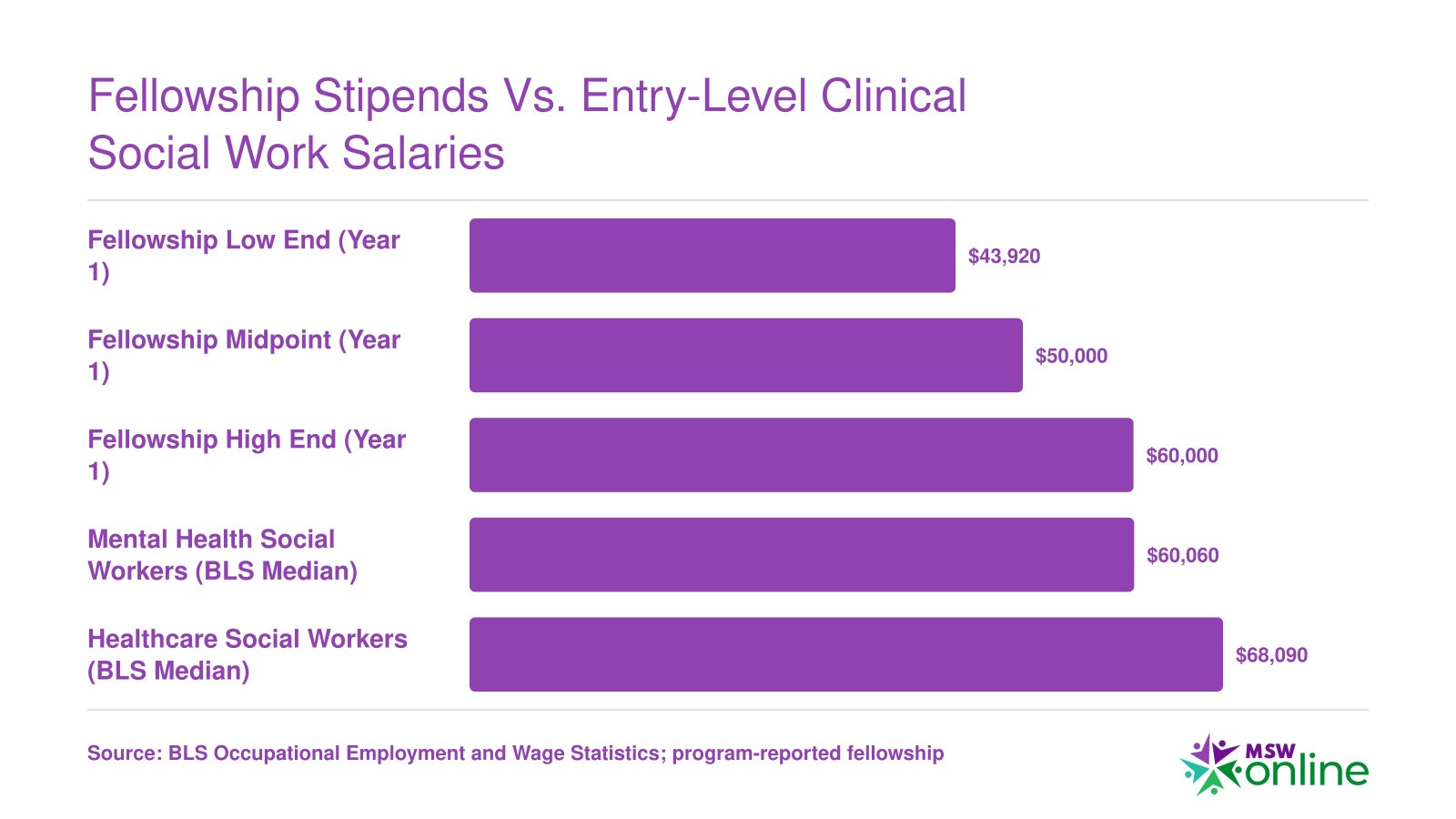
Fellowship Stipends Vs. Entry-Level Clinical Social Work Salaries
Post-MSW clinical fellowship stipends typically range from about $44,000 to $60,000 in the first year, placing fellows at roughly 60-80% of what a non-fellowship entry-level clinician earns. That gap narrows quickly: many fellowship-trained social workers report accelerated salary growth within two to three years of completing their programs. Importantly, most fellowships at major medical centers and universities include health insurance, paid time off, and continuing education funds, which significantly close the total compensation gap even during the training period.
How Fellowship Hours Count Toward LCSW Licensure
One of the most practical advantages of a post-MSW clinical fellowship is how efficiently it can move you toward independent licensure. Understanding how your hours accumulate, and where state rules introduce wrinkles, will help you choose a program that genuinely accelerates your career.
The General Licensure Framework
Most states require new MSW graduates to complete a defined period of post-degree supervised clinical practice before they can sit for the ASWB Clinical exam and earn LCSW licensure hours. Hour requirements across the ten most populous states cluster between 1,500 and 4,000 total supervised hours, with individual states specifying how many of those must involve direct clinical contact.1
A quick look at the variation:
- Florida: 1,500 total supervised hours, with at least 100 hours of supervision contact1
- New York: 2,000 client contact hours, with at least 100 hours of supervision contact1
- California: 3,000 total hours, of which 2,000 must be clinical, including at least 750 hours of face-to-face psychotherapy and 104 hours of supervision contact2
- Texas, Illinois, Ohio, Pennsylvania, North Carolina, and Georgia: 3,000 total hours, with supervision contact requirements ranging from 100 to 150 hours depending on the state1
- Michigan: The highest bar at 4,000 total hours, with at least 2,000 in direct clinical work and 100 hours of supervision contact1
All ten of these states require a provisional or associate-level license before you can begin accumulating hours, so confirm you have that credential in place before your fellowship start date.1
Do Fellowship Hours Count?
In nearly every case, yes. Hours worked under qualified supervision during a structured fellowship count toward state licensure requirements, provided two conditions are met. First, your supervisor must hold the correct credential, which is typically an LCSW. Second, hours must be documented according to your state board's standards, including the format of logs, frequency of supervision, and the nature of clinical contact.
Do not assume a fellowship program has already sorted this out on your behalf. Confirm directly with your state licensing board that the fellowship's supervision arrangement meets their specific rules before you accept an offer.
State-by-State Differences That Matter
States differ not just in total hours but in how they define clinical work. California distinguishes sharply between psychotherapy, assessment, and case management, and each category has its own floor.2 Georgia and North Carolina both require that at least 2,000 of their 3,000 hours involve direct clinical services.1 New York counts client contact hours rather than total employment hours, which rewards fellows in high-volume settings.1
Texas does not publish a sub-category breakdown in the same way, but it does require that supervision be structured around specific clinical activities.1 Ohio and Pennsylvania require 150 hours of supervision contact, higher than most states, so fellows in those states need to ensure their program schedules supervision frequently enough to meet that threshold within the fellowship term.1
A Practical Payoff
A full-time, one-to-two-year fellowship in a clinical setting commonly yields between 1,500 and 3,000 supervised hours, depending on caseload and program structure. For fellows in states with lower total requirements like Florida or New York, a single fellowship year can satisfy the entire supervised practice requirement. Even in higher-hour states like Michigan, a two-year fellowship can cover 50 percent or more of the total, compressing what might otherwise take three or four years of piecemeal employment into a structured, documented, and career-building experience. Levels of social work licensure vary considerably by state, so reviewing your board's specific rules early is essential.
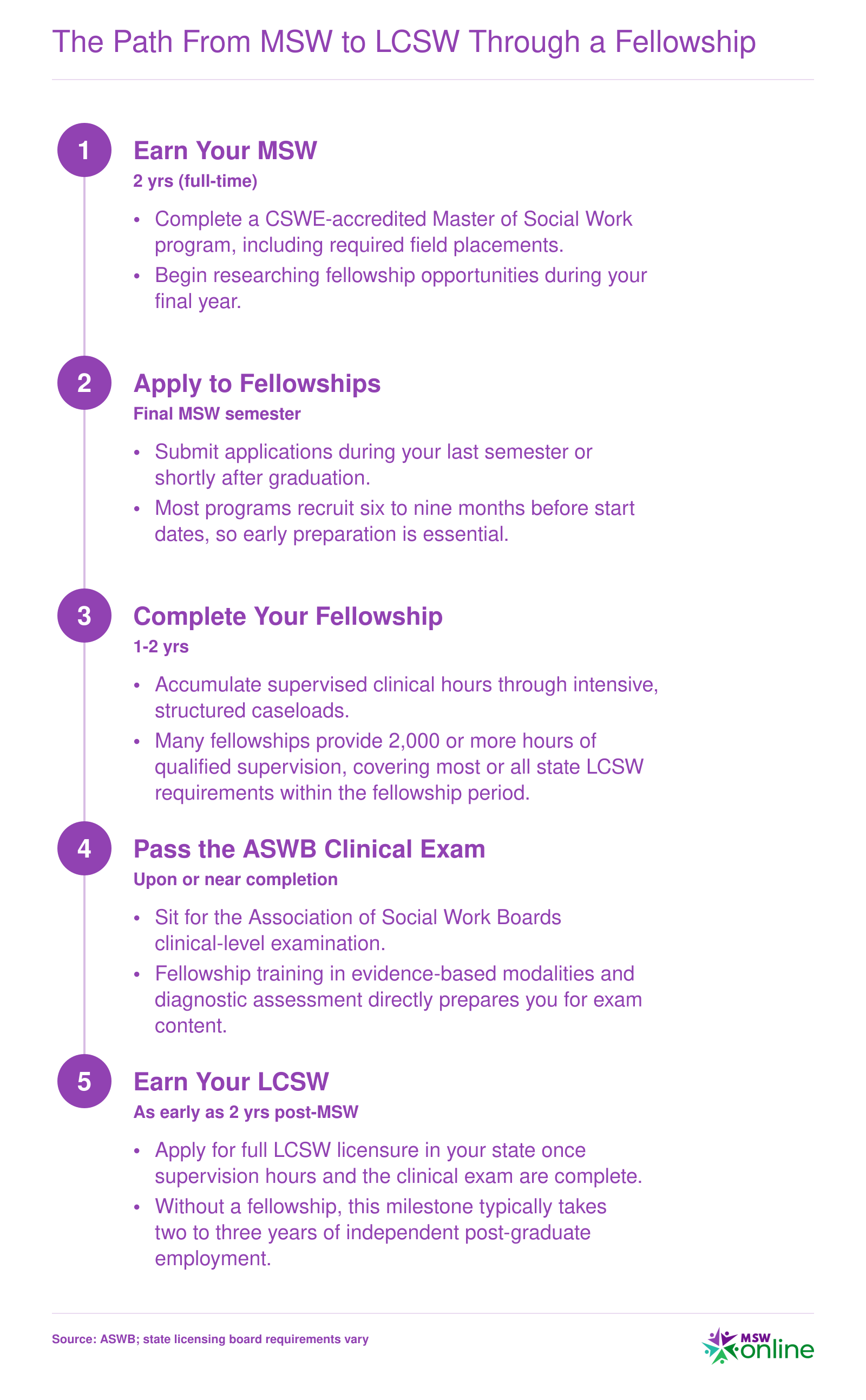
The Path From MSW to LCSW Through a Fellowship
A post-MSW clinical fellowship can compress the typical two to three year post-graduate licensure timeline into a more structured, accelerated track. Here is how the journey unfolds from degree completion to independent clinical practice.
How to Apply for a Post-MSW Fellowship
Fellowship application cycles have crept earlier over the past few years, with several hospital-based programs now closing applications before the holidays of an applicant's final MSW year. That compressed window means you need to start planning in the summer before your final fall semester, not after graduation.
Timeline: Plan Backward From Fall of Your Final Year
Most post-MSW clinical fellowships open applications between September and January of your final MSW year for cohorts starting the following summer or fall. Competitive programs at academic medical centers and VA sites often have November or December deadlines, with interviews running January through March and offers extended by early spring. A few programs use rolling admissions. Build your timeline backward: by August, your CV should be polished, recommenders identified, and a target list of 6 to 12 programs drafted.
Required Documents
Expect to submit a fairly standard package:
- CV or resume: Highlight clinical hours, modalities used, populations served, and any research or program development work.
- Personal statement: Most programs ask for an essay on your clinical interests, theoretical orientation, and why their setting fits your training goals.
- MSW transcripts: Official transcripts, sometimes including in-progress coursework.
- Letters of recommendation: Typically 2 to 3 letters, with at least one from a field placement supervisor who can speak to your clinical work.
- Clinical writing sample: Some programs request a de-identified process recording, assessment, or case formulation.
Strengthening Your Candidacy
The strongest fellowship applicants align their MSW field placements with their target settings. If you want a trauma fellowship at a children's hospital, a pediatric or community mental health placement carries more weight than a generalist setting. Beyond placements, pursue clinical electives and short-form certifications that signal commitment: trauma-focused CBT, motivational interviewing, DBT foundations, or perinatal mental health training. Attend information sessions and open houses when programs offer them, both to learn the culture and to be remembered.
Finding Openings That Are Not Centrally Listed
There is no single national clearinghouse for post-MSW fellowships. Check individual hospital and medical center career pages directly, the CSWE fellowship listing, state NASW chapter job boards, and social work professional listservs. Networking with current and recent fellows remains the single best way to hear about new or low-visibility openings, so reach out by email or LinkedIn well before application season.
Hiring managers at hospitals and academic medical centers frequently prefer fellowship-trained clinicians for specialized roles. Fellowship graduates bring intensive supervision experience, proficiency in evidence-based modalities, and the ability to collaborate seamlessly within multidisciplinary teams. This advanced preparation gives them a clear competitive edge over peers who moved directly into agency positions after earning their MSW.
Career Outcomes and Salary Growth After a Clinical Fellowship
Fellowship-trained social workers typically bypass entry-level compensation and step into mid-level or senior clinical roles, especially when the fellowship provides structured supervision that accelerates LCSW licensure. The table below shows national salary benchmarks from the Bureau of Labor Statistics for the occupations most relevant to post-fellowship careers. Healthcare social workers earn a median annual salary of $68,090, while mental health and substance abuse social workers earn a median of $60,060. Both fields are growing faster than the national average, with projected growth rates of 10% and 11% respectively from 2024 to 2034. Fellowship completers who move into clinical supervisor positions, program director or coordinator roles, or academic appointments often exceed the 75th percentile figures shown here. Those who obtain their LCSW and launch a private practice can earn well above BLS medians, with experienced clinicians in private practice frequently reporting incomes that surpass the top quartile by a significant margin. Across all social work categories, the Bureau of Labor Statistics projects roughly 74,000 annual openings over the coming decade, reflecting both growth and replacement needs in the field.
| Occupation | Total National Employment | Median Annual Salary | 25th Percentile Salary | 75th Percentile Salary | Mean Annual Salary | Projected Growth (2024 to 2034) |
|---|---|---|---|---|---|---|
| Healthcare Social Workers | 185,940 | $68,090 | $55,360 | $83,410 | $72,030 | 10% |
| Mental Health and Substance Abuse Social Workers | 125,910 | $60,060 | $46,550 | $78,980 | $68,290 | 11% |
| Child, Family, and School Social Workers | 382,960 | $58,570 | $47,480 | $74,060 | $62,920 | 5% |
| Social Workers (All Categories) | 759,740 | $61,330 | $48,680 | $78,500 | $67,050 | 6% |
Frequently Asked Questions About Post-MSW Fellowships
Below are answers to the questions new MSW graduates most often ask about post-graduate clinical fellowships. Where possible, each answer references specific details covered in earlier sections of this guide.