Points of interest…
- Newman University’s MSW costs $640 per credit and offers 62-credit traditional or 34-credit advanced standing tracks.
- Three concentrations, clinical, school, and administration, build on a trauma-informed practice framework.
- Online, hybrid, and once-weekly evening courses let working adults earn the degree without quitting their jobs.
- No GRE is required, and graduates qualify for Kansas LMSW licensure upon program completion.
Kansas faces a persistent shortage of mental health professionals, acute in rural communities, and Newman University's newly launched Clinical MSW program offers a direct educational remedy for working adults who cannot pause their careers for graduate study. The program holds continuous CSWE accreditation since 2000, reaffirmed in June 2023, and builds its curriculum around a trauma-informed practice framework, a meaningful differentiator in MSW concentration selection for prospective students comparing programs.
Courses are delivered online, hybrid, and in evening sessions, letting students maintain full-time employment while progressing through the part-time degree.1 This design directly addresses the state's growing demand for licensed clinical social workers without forcing students to choose between earning a degree and holding a job.
Why Newman University Launched a Clinical MSW for Working Adults
Kansas, like much of the Midwest, is grappling with a persistent shortage of mental health professionals, particularly in rural and underserved communities where access to clinical social workers and school-based practitioners remains critically low. Newman University designed its new Clinical Master of Social Work program as a direct response to this workforce gap, targeting adults who already live and work in these communities but lack a feasible path to advanced licensure.
Addressing a Regional Shortage
The need for clinical social workers in Kansas has intensified as demand for mental health services outpaces the supply of licensed practitioners. State data consistently shows that rural counties face the steepest deficits, with many residents traveling long distances for therapy or crisis intervention. School districts also struggle to hire qualified school social workers, leaving students without essential behavioral health support. Newman's program explicitly aims to remove barriers for working adults, particularly those in education, healthcare, and human services, by offering evening, hybrid, and fully online asynchronous courses that fit around full-time employment. This structure allows paraprofessionals and career-changers to advance their credentials without leaving their jobs or communities.
A Trauma-Informed Foundation
What sets this MSW apart is the trauma-informed practice framework that runs through all three concentrations: Clinical Social Work, School Social Work, and Social Work Administration. Rather than treating trauma-informed care as a single elective, Newman embeds it across the curriculum, preparing graduates to recognize and respond to the effects of trauma in diverse settings. This approach is especially relevant in Kansas, where adverse childhood experiences, rural isolation, and economic stress contribute to complex community health challenges. Students learn not just diagnostic and intervention skills, but how to create organizational cultures that prioritize safety, trustworthiness, and empowerment. Understanding the levels of social work practice, from direct client care to systems-level administration, helps contextualize why all three concentrations share this common foundation.
An Established Accreditation History
According to the June 2026 announcement,1 Newman's social work programs have been accredited by the Council on Social Work Education (CSWE) since 2000, with the most recent reaffirmation in June 2023. This is not a provisional or new accreditation; it carries the full weight of a program that has met rigorous standards for over two decades. For graduates, that history matters: CSWE accreditation ensures coursework is recognized for licensure in Kansas and most other states, which simplifies the path to LMSW eligibility and later LSCSW certification. It also means the program has a track record of integrating evolving best practices, such as the trauma-informed framework, without the curricular upheaval that newer programs sometimes experience. Prospective students evaluating how to choose an online MSW program should weigh this kind of accreditation continuity heavily when comparing options.
Three Concentration Areas: Clinical, School, and Administration
Newman University's Clinical MSW program is built around three focused concentrations that align with distinct career paths in social work. Each track adds specialized knowledge to the core trauma-informed practice framework, so graduates leave prepared for the specific demands of their chosen setting.
Clinical Social Work: Diagnosis and Treatment
The Clinical concentration prepares students to assess, diagnose, and treat mental health and behavioral disorders. Coursework covers psychopathology, evidence-based interventions, and clinical practice methods. Graduates typically work in hospitals, community mental health centers, clinics, or private practice. This track meets the educational requirements for clinical licensure, including the Licensed Specialist Clinical Social Worker (LSCSW) credential in Kansas and equivalent credentials in other states. Salary growth in clinical roles remains strong, with recent industry surveys showing an average projected increase of 3.3% for mental health practitioners.2
School Social Work: Supporting Students and Systems
For those drawn to educational settings, the School concentration develops skills in assessment, crisis intervention, and consultation within K-12 environments. Students learn to navigate multi-tiered systems of support (MTSS), collaborate on individualized education plans (IEPs), and address barriers to learning. Career paths include school social worker, special education liaison, or school-based mental health provider. Because demand for student mental health services continues to rise, salary data reflects a 4.2% projected increase for school social work professionals.2 Licensure typically requires a state-issued school social worker or school counselor credential.
Social Work Administration: Leading Programs and Policy
The Administration concentration focuses on leadership, program evaluation, budgeting, and public policy social work. Graduates often move into roles like director of behavioral health, student services coordinator, or higher education administrator. While no single license governs this track, employers place a premium on advanced administrative skills. Survey data indicates that nearly 79% of organizations offer higher compensation for professionals with demonstrated expertise in program management and compliance.1 Current salary ranges for administrative social workers span roughly $43,750 to $84,750, with a projected 1.6% increase in 2026, reflecting steady demand for seasoned leaders.1
Traditional Vs. Advanced Standing: Credit Requirements and Timeline
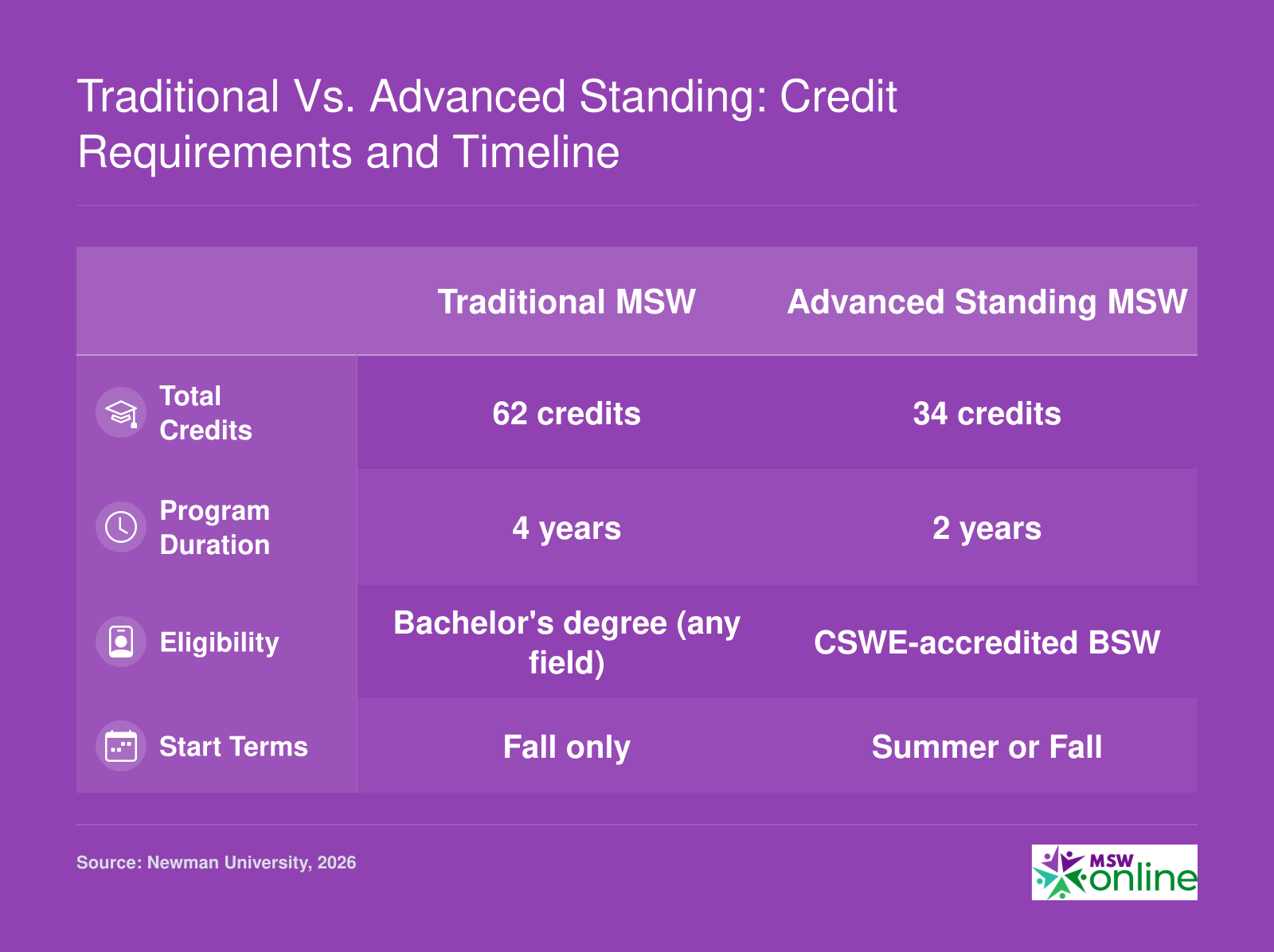
Newman University's Clinical MSW offers two part-time tracks designed for working adults, with courses delivered via online, hybrid, and evening formats. The Traditional track spreads 62 credits across four years of study, while the Advanced Standing track accelerates to 34 credits over two years for applicants who already hold a CSWE-accredited BSW.
How Online, Hybrid, and Evening Scheduling Works
How do you fit a clinical MSW into a 40-hour workweek without burning out? Newman University designed its new program around that exact question.
How the Scheduling Options Fit Your Life
You choose the delivery mode that matches your job and learning style.1 The MSW offers three paths: - On-campus: Attend class in person at Newman's Wichita campus, with evening sessions designed for commuters. - Hybrid: Combine on-campus evening meetings with asynchronous online work, reducing commute time. - Fully online asynchronous: Complete all coursework remotely, with no required in-person sessions. You engage with materials, discussion boards, and assignments on a flexible schedule.
All formats center on a once-weekly evening session, typically three hours long (for example, 6 p.m. to 9 p.m. Central).2 In the online asynchronous track, those live sessions become optional or are replaced by structured independent activities. This structure lets you keep your day job while advancing toward licensure.
What a Typical Week Looks Like
For a working MSW student balancing time, plan on 15 to 20 hours of total weekly work when taking two courses. That includes: - 3 hours of live class (synchronous evening session) - 6 to 8 hours of reading and multimedia engagement - 4 to 6 hours of writing discussion posts, completing assignments, and collaborating with peers - 2 to 3 hours of field placement tasks once practicum begins
Because the program is built for working adults, faculty expect you to fit those hours around a job. Many students batch coursework on weekends or evenings after the live session. Your actual weekly load may vary, but budgeting 15 to 20 hours keeps you on pace.
Synchronous vs. Asynchronous: Finding Your Balance
The live evening sessions (whether in-person, via video conference, or as optional check-ins) are the synchronous core. These meetings foster discussion, case consultation, and skills practice. Outside of that live window, the rest of the week is asynchronous, giving you control over when you review lectures, read, and submit work.
If you choose the fully online asynchronous track, you may never step on campus.1 The program does not require on-campus intensives or weekend residencies, which is a deliberate choice to reduce travel costs and scheduling conflicts. For students who want face-to-face connection, the hybrid and on-campus tracks offer that in structured, predictable time blocks.
Cohort Model and Peer Support
You will move through the program with a small cohort of fellow students. This group starts together and takes core courses in the same sequence, creating a built-in study network. In the online environment, that cohort stays connected through discussion boards, group projects, and sometimes optional live study sessions. The small size ensures you are not lost in a virtual crowd, a common complaint in larger online programs.
Questions to Ask Yourself
Tuition, Total Costs, and Financial Aid Options
Some MSW programs charge by the credit hour, while others offer flat-rate tuition. Newman University uses a per-credit model that keeps costs transparent and tied directly to the courses you take. For working adults, this also means you only pay for the credits you enroll in each semester, making part-time or accelerated pacing easier on your budget.
Breaking Down the Per-Credit and Total Program Tuition
Newman's MSW tuition is set at $640 per credit hour.1 The total credit requirement differs by track, so total tuition follows two clear paths:
- Traditional track: 62 credits, with an estimated total tuition of $39,680.
- Advanced Standing track: 34 credits, with an estimated total tuition of $21,760.
These figures reflect tuition only, with no additional fees, course materials, or living expenses included. Because the program uses a per-credit model, part-time students who take fewer credits each term can spread the cost over more months without a lump-sum semester charge.
Scholarships and Grant-Supported Stipends
Newman does not currently advertise institutional MSW scholarships or graduate assistantships connected to this program.1 However, the university holds a $2.3 million HRSA Behavioral Health Workforce Education and Training (BHWET) grant that provides substantial support for up to 16 MSW students each year through 2029.2 Selected students receive a $25,000 stipend in exchange for a commitment to work in underserved behavioral health settings after graduation. For Kansas residents, the state's Comprehensive Grant can add up to $3,500 annually for eligible graduate students with financial need.3
The university also accepts employer tuition reimbursement plans and offers an interest-free monthly payment plan to spread charges across each semester.1 Working adults can coordinate tuition reimbursement benefits directly with their human resources office.
Federal Loans and FAFSA Requirements
All MSW applicants who wish to borrow federal loans must complete the FAFSA.1 Newman participates in the William D. Ford Direct Loan Program, making unsubsidized loans of up to $20,500 per academic year available to graduate students. Graduate PLUS loans can cover remaining expenses up to the cost of attendance. To maintain loan eligibility as a full-time student, you must enroll in at least 6 credits per semester; summer aid requires at least 3 credits.
How Does Newman's Tuition Compare Regionally?
In the Kansas and Midwestern context, Newman's per-credit rate sits above public university MSW programs but remains competitive with other private institutions. For example, in-state tuition at Kansas public research universities often falls in the $400, $500 per-credit range, while comparable private MSW programs may charge $600, $800 per credit. Prospective students can also review online MSW programs in Kansas to compare accredited options across the state. The Advanced Standing total of $21,760, in particular, places Newman's program near the median cost for a private MSW in the region. The availability of HRSA stipends can reduce the net price significantly for qualifying students, making the clinical focus more affordable.
Budgeting Beyond Tuition
When planning financially, budget for additional costs beyond the per-credit tuition. Typical expenses include a one-time university fee per semester, books and course materials (estimated $500, $1,200 per year for graduate programs in social work), and transportation or lodging related to field practicum placements. While fieldwork sites are often arranged near your community, occasional travel may be necessary. Newman's online and hybrid delivery helps limit on-campus costs, but students should still account for technology fees and reliable internet access.
Field Education and Practicum for Working Professionals
Field education is the hands-on, supervised practice component of an MSW program where students apply classroom learning in a real social work setting. For working adults, this practicum can feel like the most logistically demanding part of the degree. Newman University structures its clinical MSW to accommodate employed students, but the exact placement requirements , total hours, acceptable sites, and supervision models , vary by track and concentration. The following guide outlines what to expect and how to plan ahead.
What Field Education Typically Involves
All CSWE-accredited MSW programs require a minimum of 900 total practicum hours, often split over two academic years. Advanced standing students may complete fewer hours. Placements occur in agencies, hospitals, schools, or community organizations under a licensed social worker's supervision. Students must also attend integrative seminars, usually online or in the evenings, to process their experiences. Newman's program leans heavily on trauma-informed practice, so expect placements that emphasize client-centered, strengths-based work.
Flexibility for Working Professionals
Newman's design acknowledges that many students keep full-time jobs during their MSW. Evening courses reduce scheduling conflicts, and the program may allow some remote or asynchronous tasks during practicum when appropriate. While you cannot fully replace direct client contact with virtual work, hybrid supervision and flexible site hours can ease the load. Some programs let employed students complete a portion of hours within their current workplace if it offers new learning , check with the field education coordinator about employer-based placement policies. Reviewing MSW internship placement strategies before you begin can help you approach this conversation with the right questions.
Finding a Placement That Matches Your Schedule
The placement search starts early. You'll work with the field education office to identify approved agencies within commuting distance, particularly in Wichita and across Kansas. The program maintains a list of partner sites, and many of these organizations are accustomed to evening or weekend availability for practicum students. Start by downloading the field education handbook from the Newman MSW website for a full list of approved sites and the exact hour requirements per track.
Preparing as an Online or Hybrid Student
If you are completing coursework fully online but live far from campus, your field placement will be arranged near your home. Newman's field education coordinator can help coordinate out-of-area sites, but you may need to take initiative in identifying potential agencies. Supervision is usually in person, though some programs include virtual check-ins with faculty liaisons. For students juggling employment alongside managing MSW field placement while working full time, clarifying the supervision structure early is essential , email or call the field education coordinator, whose contact details are posted on the program site.
Where to Get Current Details
Field education policies evolve, so rely on official channels: - Program handbook: Download it from the Newman MSW webpage for placement hours, site lists, and employer-based policies. - Field education coordinator: Direct contact ensures you get answers about online supervision, out-of-state placements, and practicum timelines. - CSWE standards: Review the Council on Social Work Education's accreditation benchmarks to understand baseline requirements. - Kansas NASW chapter: The chapter's directory and networking events can connect you with potential placement sites and professional contacts.
Related Articles
Licensure Pathways: LMSW and LSCSW in Kansas and Beyond
Newman University's clinical MSW program creates a direct pathway to both the master's and clinical social work licenses in Kansas, and its CSWE accreditation opens doors across state lines. Understanding the two-tier licensure system early equips you to plan your career from the first day of class.
LMSW Licensure: The First Step After Graduation
Upon completing the MSW, you are immediately eligible for the Licensed Master Social Worker (LMSW) credential through the Kansas Behavioral Sciences Regulatory Board (BSRB). This license allows you to practice clinical social work under supervision and is required before you can begin accruing the post-graduate hours needed for independent licensure.
- Exam: ASWB Master's exam
- Application fee: $502
- Original license fee: $1502
- Exam fee: $2302
- No post-degree supervised hours required for initial LMSW issuance
The LMSW exam fee is paid directly to the ASWB when you register, and the BSRB processes your application once you submit all documentation, including official transcripts showing your MSW from a CSWE-accredited program. Newman's curriculum covers the knowledge areas tested on the ASWB Master's exam, so students are prepared to sit for the test soon after graduation.
Advancing to the LSCSW: Independent Clinical Practice
The Licensed Specialist Clinical Social Worker (LSCSW) is the independent practice license in Kansas. It authorizes you to diagnose mental disorders, provide psychotherapy without supervision, and receive third-party reimbursement, all essential for a clinical career. Becoming a licensed clinical social worker follows a consistent pattern nationally, though state-specific requirements like those in Kansas add their own structure.
The Clinical Social Work concentration at Newman fulfills the educational component for LSCSW eligibility, which requires at least 15 graduate credits in diagnosis and treatment of mental disorders. With that coursework completed, you must then accumulate supervised clinical experience and pass the ASWB Clinical exam.
- Required supervised clinical hours: 4,000 total, of which at least 1,500 must be direct client contact
- Supervision: 150 hours by a Kansas-licensed LSCSW who has held the license for at least two years
- Timeframe: 24 to 72 months
- Exam: ASWB Clinical exam
- Application fee: $502
- Original license fee: $1502
- Exam fee: $2602
Renewing either license requires 40 continuing education hours every two years, including three hours in ethics, six hours in safety awareness, and, effective July 2025, three hours in diagnosis and treatment.3 These CE requirements apply to both LMSW and LSCSW holders.
Licensure Portability for Online Students Outside Kansas
Newman's fully online and hybrid formats attract students from beyond Kansas. CSWE accreditation is recognized nationally, so graduates typically meet the educational prerequisites for licensure in any state. However, the path to clinical licensure varies significantly by state. If you are weighing the MSW degree versus the LCSW license as distinct milestones, understanding how each state maps its requirements matters early.
- Exam portability: ASWB Clinical exam scores are transferable, but some states require the Clinical exam while others accept the Advanced Generalist version. Confirm with your target state board.
- Supervised hours: The 4,000-hour Kansas requirement is common, but a few states require 3,000 or up to 5,000 hours. The ratio of direct-to-indirect hours and supervision hours also differs.
- Reciprocity and compacts: Kansas does not participate in a social work licensure compact and reviews out-of-state license endorsements on a case-by-case basis.4 If you plan to practice outside Kansas after earning your LSCSW, start the reciprocity inquiry early, as processing times and supplemental requirements can be significant.
Online students should contact their home state's social work licensing board before enrolling to map out the exact supervised-practice and exam requirements, ensuring the Newman program aligns seamlessly with their long-term location goals.
CSWE-accredited since 2000, Newman University's MSW program costs $640 per credit and offers evening and online classes with trauma-informed clinical training, providing a direct path to LMSW and LSCSW licensure without requiring you to leave your job.
How to Apply: Deadlines, Requirements, and Next Steps
Ready to apply to Newman University's Clinical MSW program? Here's what you need to know.
- Choose your track and deadlineTraditional track: Fall start, apply by July 31. Advanced Standing: Summer start by April 30, or Fall start by July 31.
- Prepare your application materialsYou'll need a bachelor's degree from an accredited institution, official transcripts, a personal statement, professional references, and a resume.
- Advanced Standing applicants: Hold a CSWE-accredited BSWIf applying for the 34-credit Advanced Standing track, you must have a Bachelor of Social Work from a CSWE-accredited program.
- No GRE requiredNewman University does not require GRE scores for admission to the MSW program.
- Submit your applicationVisit Newman University's MSW application page to begin your online application and review full instructions.
Frequently Asked Questions About Newman University's MSW Program
Newman University's clinical MSW program is designed for working adults, blending flexibility with rigorous preparation for social work licensure. Below are answers to common questions about accreditation, cost, format, and licensure pathways.