
Points of interest…
- Licensed clinical social workers are explicitly eligible for the Registered Play Therapist (RPT) credential through the Association for Play Therapy.
- Earning the RPT typically requires 150 hours of specialized play therapy education plus 350 hours of supervised play therapy experience.
- Most social workers complete RPT requirements in two to four years after obtaining their clinical license.
- A 2005 meta-analysis found play therapy produces an effect size of 0.80, placing it among the most evidence-supported child interventions.
Play therapy certification signals that a clinician has completed structured training in using play as the primary medium for child-focused assessment and intervention. For social workers, who already staff the front lines in schools, child welfare agencies, and pediatric hospitals, adding this credential expands both clinical scope and marketability in a tight labor market for child mental health specialists.
The Registered Play Therapist (RPT) credential, issued by the Association for Play Therapy, remains the field's benchmark. Licensed clinical social workers qualify for it, though the pathway differs slightly from counselors in how graduate coursework is counted. Completing the process typically takes two to four years after clinical licensure, depending on access to approved training and supervision.
What Is Play Therapy Certification?
A generic play therapy certificate program and a nationally recognized credential from the Association for Play Therapy (APT) may sound similar, but they represent very different levels of professional preparation. Understanding the distinction is essential before you invest time and tuition.
Play Therapy in Plain Terms
Play therapy is the structured, clinical use of play to help children express emotions, process trauma, and develop coping skills. Rather than relying on traditional talk-based methods, a trained therapist uses toys, art, games, and imaginative scenarios as the child's primary language of communication. The approach is grounded in developmental science: children naturally make sense of their world through play, and a skilled clinician can channel that process toward therapeutic goals.
Research consistently supports play therapy's effectiveness. A comprehensive meta-analysis published through the University of the Pacific found an overall effect size of 0.66, meaning treated children improved by roughly 25 percentile units compared to untreated peers.1 Optimal outcomes tended to emerge after 30 to 35 sessions, with a recommended minimum of about 20 sessions.1 Separately, a 2020 review reported effect sizes ranging from 0.35 to 0.80 depending on the outcome measured.2 Child-centered play therapy, one of the most widely practiced models, showed a moderate effect size of 0.47 in a 2015 analysis.2 These findings, taken together, position play therapy as a well-supported intervention for externalizing behaviors, anxiety, trauma responses, and relational difficulties in children.
Recent APT conference presentations have continued to strengthen this evidence base, highlighting emerging research on play therapy's application with neurodivergent populations and children affected by community violence. While some of these findings are still in early stages of publication, the overall trajectory points toward broader clinical applicability.
The Two APT Credentials
APT offers two credentials that carry national recognition:
- Registered Play Therapist (RPT): Signals to employers, insurance panels, and families that you have completed specialized education, supervised clinical hours in play therapy, and met continuing education requirements. The RPT is the standard professional credential.
- Registered Play Therapist, Supervisor (RPT-S): An advanced designation for experienced RPTs who are qualified to supervise other clinicians pursuing their own RPT credential. Holding an RPT-S can open doors to training roles, clinical program leadership, and higher reimbursement in some settings.
APT Credential vs. Generic Certificates
Many universities, training institutes, and online platforms offer play therapy certificate programs. These can be valuable for building foundational knowledge or earning continuing education credits, but they are not the same as APT credentialing. APT is the only nationally recognized body that grants the RPT and RPT-S designations, and those designations carry weight with licensing boards, employers, and third-party payers in ways that a stand-alone certificate typically does not. For context on how play therapy credentials compare to other social work certifications, it helps to see how specialized credentials function within the broader professional landscape.
When evaluating any training, check whether its hours count toward APT requirements. Some certificate programs are designed to align with APT standards, while others cover related material without meeting the specific criteria you need. That distinction matters if your end goal is the RPT credential, which is the recognized benchmark in the field.
Can a Social Worker Become a Registered Play Therapist?
Yes. Licensed clinical social workers are explicitly eligible for the Registered Play Therapist (RPT) credential issued by the Association for Play Therapy (APT)1, and many of the field's most active RPTs come from social work backgrounds. The credential is open to clinicians who hold an independent mental health license, and the LCSW qualifies.
LCSW vs. LMSW Eligibility
The LCSW is the clean path. Once you hold independent clinical licensure, you meet APT's licensure prerequisite and can begin accumulating the required play therapy education, supervised play therapy experience, and direct client contact hours. For a detailed breakdown of how social work licensure levels differ, including the distinction between independent and supervised licenses, see APT's published requirements alongside your state board rules.
LMSWs sit in a grayer zone. APT requires independent licensure to sit for the RPT, so an LMSW practicing under supervision typically cannot complete the credential until advancing to clinical social work licensure. You can, however, start banking continuing education and supervised hours while still pre-licensed, as long as your state scope of practice allows you to deliver therapy under a qualified supervisor. Check your state board before counting any pre-licensure hours toward RPT requirements.
Why Social Workers Are Well-Positioned
Social work training maps unusually well onto play therapy practice:
- Field placements: MSW internships in schools, child welfare agencies, pediatric hospitals, and community mental health centers give early exposure to child clients.
- Systems perspective: Play therapy with children almost always involves parents, schools, and child welfare systems, terrain social workers are trained to navigate.
- Clinical licensure: The LCSW already authorizes diagnosis and psychotherapy, so adding play therapy is an expansion of modality rather than scope.
The Coursework Gap
Unlike some counseling master's programs, MSW curricula rarely include dedicated play therapy coursework. Expect to complete the full 150 hours of play therapy specific instruction post-degree through APT-approved providers.
State Regulation
No state currently licenses the RPT title or has enacted a play therapy practice act.1 The RPT is a trademark held by APT, not a state credential, so it does not expand your legal scope; your LCSW does. That said, social workers cannot advertise as a Registered Play Therapist without holding the APT credential, since APT enforces the trademark.1 Always verify your state board's stance on advertising specialty titles.
RPT Requirements: Step-By-Step for Social Workers
Earning the Registered Play Therapist (RPT) credential follows a clear sequence, but the timeline depends on how quickly you can access specialized training and supervision. Most social workers complete the process in two to four years after obtaining their clinical license. Here is exactly what to expect at each stage.
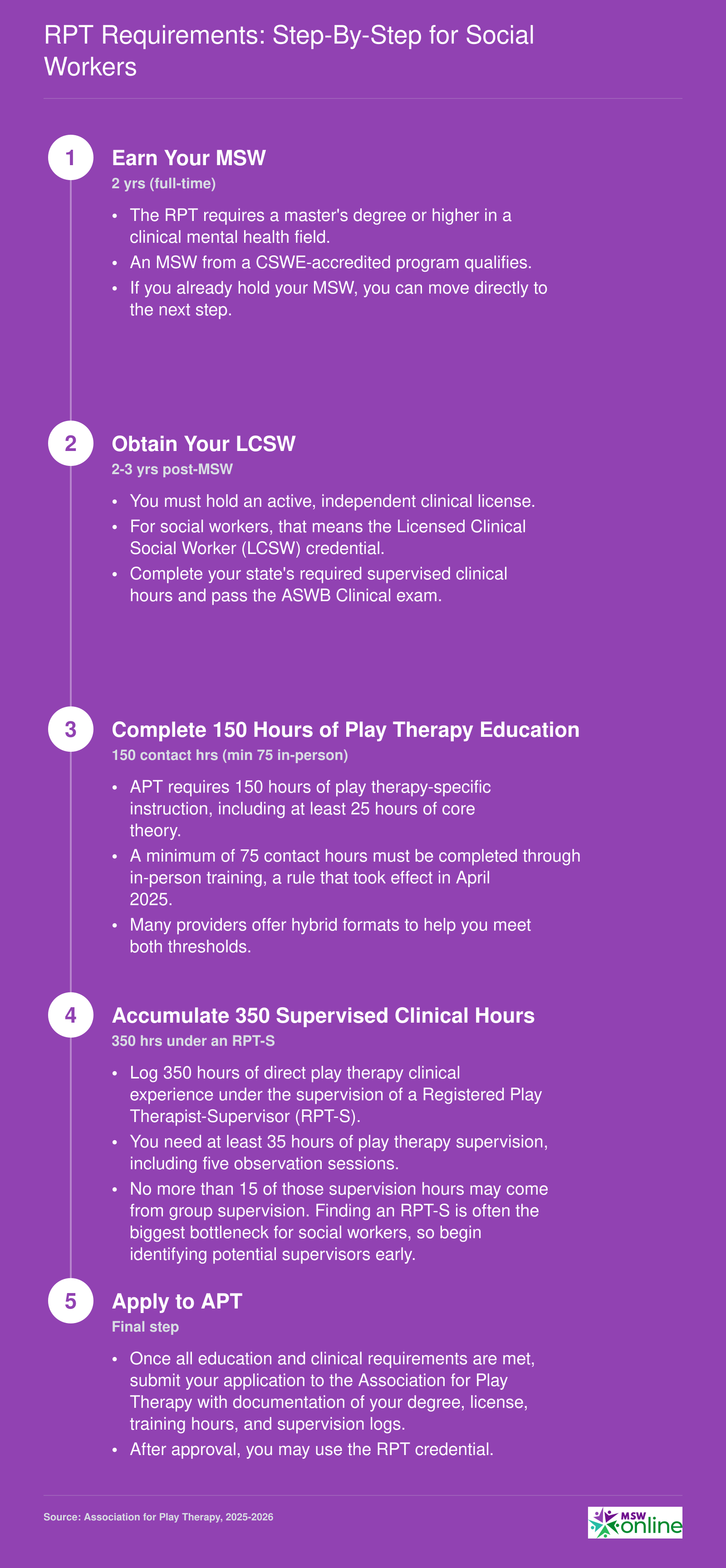
Use the Association for Play Therapy's online directory to find a Registered Play Therapist Supervisor (RPT-S) near you or one who offers remote supervision. Since 2020, telehealth supervision has opened access for social workers in rural areas who previously had few local options. If your employer does not cover the cost, budget roughly 75 to 150 dollars per supervision hour when planning your training timeline.
Top Play Therapy Certificate Programs Open to Social Workers
Social workers exploring play therapy training have a growing menu of certificate programs to choose from. Some are designed specifically to feed into the Registered Play Therapist (RPT) credential, while others offer continuing education hours without a formal certificate endpoint. Before you enroll, confirm two things: that the program accepts MSW-prepared clinicians, and that the coursework counts toward the Association for Play Therapy's (APT) education requirement. If you are still weighing social work certificate programs more broadly, reviewing the full certifications landscape first can help you prioritize.
Capella University Graduate Certificate in Play Therapy
Capella's fully online certificate is one of the more visible APT-aligned options, but it comes with an important caveat for social workers. As of the 2025-2026 academic year, the program requires a master's degree in counseling or psychology and does not currently list the MSW as an accepted prerequisite degree.2 Applicants also need a minimum 3.0 GPA.2
Key details at a glance:
- Format: 100% online, asynchronous coursework1
- Length: 16 quarter credits1
- Tuition: $540 per credit, or roughly $8,640 total1
- Additional fees: A resource kit fee of approximately $160 for play therapy materials1
- RPT alignment: Yes, coursework maps to APT education hours1
- MSW eligibility: Not currently accepted; verify directly with admissions before applying2
If you hold an MSW and want Capella specifically, contact the program to ask whether a waiver or bridge pathway is available. Policies change, and some programs evaluate clinical social work coursework on a case-by-case basis.
Other Programs Worth Investigating
Several universities and independent training institutes have built reputations in play therapy education and are commonly referenced by social workers pursuing the RPT credential. These include programs housed at Loma Linda University, Azusa Pacific University, the University of Kentucky, and the Play Therapy Training Institute (PTTI). Tuition, credit loads, and delivery formats vary widely across these providers, and APT-approved provider status can change from year to year.
Rather than rely on outdated marketing copy, verify the following directly with each program before you commit:
- Whether the program currently holds APT Approved Provider status
- The exact number of contact hours the certificate awards
- Whether MSW or LCSW credentials satisfy admission requirements
- Delivery format (fully online, hybrid, or in-person intensives)
- Total cost, including any supervision or materials fees
A Practical Note on Program Selection
Not every play therapy certificate is built to support RPT applicants. Some are continuing education bundles that count toward license renewal but fall short of the 150 instructional hours APT requires. If your goal is the RPT credential, ask the program coordinator to confirm in writing how many APT-recognized hours the certificate carries before you pay tuition.
Play Therapy Certificate Vs. Continuing Education: Which Path Is Right?
Social workers pursuing play therapy credentials face a fork in the road: enroll in a formal graduate certificate program or piece together continuing education workshops. Both routes can satisfy requirements for Registered Play Therapist status, but they differ sharply in structure, cost, and career signal.
Academic Certificate Programs
Graduate certificate programs in play therapy are credit-bearing, semester-based courses offered by universities. California State University Sacramento,1 Old Dominion University,2 and similar institutions require applicants to hold a master's degree in counseling, social work, or a related field, maintain a minimum 3.0 GPA, and often possess current licensure or associate status. Curricula are aligned with Association for Play Therapy education and training standards and typically include supervised practicum hours embedded in the program. Graduates emerge with a formal credential that signals dedicated specialization to employers in schools, hospitals, and private practice. Research on play therapy training published in the International Journal of Play Therapy found that structured certificate curricula improved students' knowledge, skills, and professional attitudes more consistently than ad hoc training models.3 The downside: tuition ranges from several thousand to over ten thousand dollars, and coursework follows a fixed academic calendar.
Continuing Education Workshop Tracks
CE-based training, by contrast, is modular and open-enrollment. Heartland Play Therapy Institute,4 Play Strong Institute,5 and regional trainers offer one-day to multi-day workshops that award continuing education hours applicable toward RPT requirements. These sessions have no admission prerequisites beyond licensure or student status, making them accessible to social workers at any stage. A social worker can attend workshops sporadically over several years, paying only for the sessions she completes, and apply those hours to both RPT eligibility and license-renewal mandates. The flexibility is significant, but the trade-off is structure: CE workshops vary widely in depth and coherence, and employers may view a transcript of scattered trainings as baseline professional development rather than a formal specialization.5
Choosing Your Path
Academic certificates suit social workers planning to build a dedicated play therapy practice or to market themselves as specialists in child trauma certification settings. CE tracks work well for generalists who want to integrate play interventions incrementally while maintaining license requirements. Neither path is inherently superior; your choice should align with your timeline, budget, and career goals.
Questions to Ask Yourself
Is Play Therapy Certification Worth It for Social Workers?
As pediatric mental health crises escalate and school districts embed therapists directly into classrooms, play therapy certification has shifted from a voluntary endorsement to a strategic career asset for clinical social workers. But the path requires significant investment, so the value depends heavily on your career goals.
The Financial Equation
The U.S. Bureau of Labor Statistics reports a median annual salary of approximately $52,000 for child, family, and school social workers. Social workers who earn the Registered Play Therapist (RPT) credential and move into private practice or specialized hospital roles often exceed that baseline, though formal survey data remains limited. Practitioners in private pay models can charge $100 to $200 per session and frequently earn $70,000 to $90,000 or more in areas with strong demand for child mental health services. In school-based settings, an RPT credential may qualify you for advanced-tier pay scales or leadership roles that boost earnings by 10 to 15 percent.
Career Mobility and Market Demand
Beyond salary, the credential differentiates you in competitive job markets. Children's hospitals, child advocacy centers, and integrated pediatric clinics increasingly list RPT as a preferred qualification. School districts nationwide are expanding mental health staff under Title IV-A grants and state-level trauma-informed initiatives, making a play therapy specialization a strong asset for landing stable, full-time positions with benefits. For social workers wanting to open a niche private practice, the RPT signals expertise that attracts referrals from pediatricians, schools, and family therapists.
Client Outcomes and Professional Fulfillment
Play therapy has a robust evidence base for treating trauma, anxiety, disruptive behavior, and adjustment disorders in children. RPTs report greater confidence in conceptualizing and treating child cases, which translates into better therapeutic engagement and measurable improvement. This clinical effectiveness builds a referral pipeline and professional reputation, creating a virtuous cycle that rewards the investment over time.
Weighing the Costs and Time Commitment
- Training costs: Certificate programs and CE coursework range from $3,000 to over $10,000 total.
- Supervision: You must complete 50 hours of play therapy supervision with an RPT-S, which may cost $100 to $200 per hour.
- Timeline: After earning an LCSW licensure, you generally need two to four years to complete the required clinical hours and instruction.
A Practical Verdict
Play therapy certification is a worthwhile investment for social workers committed to child-focused clinical work, particularly those eyeing private practice or hospital-based roles. For clinicians who work primarily with adults or use play strategies only sparingly, targeted continuing education courses are a more cost-effective route.
Career Settings and Salary Outlook for Play Therapists
The Bureau of Labor Statistics does not track play therapists as a standalone occupation, so the closest proxy is Child, Family, and School Social Workers (SOC 21-1021). The table below shows national salary benchmarks across related social work categories. Social workers who hold the Registered Play Therapist (RPT) credential often command earnings above these medians, particularly in private practice, hospital, or specialized pediatric settings where play therapy skills carry a premium. Employment in the child, family, and school social work category is projected to grow 5% from 2024 to 2034, faster than the national average for all occupations. The broader behavioral health counseling field is growing even more rapidly at 18% over the same period, signaling strong long-term demand for professionals trained in child-focused therapeutic modalities like play therapy.
| Occupation | Total Employment | 25th Percentile Salary | Median Salary | 75th Percentile Salary | Mean Salary |
|---|---|---|---|---|---|
| Child, Family, and School Social Workers | 382,960 | $47,480 | $58,570 | $74,060 | $62,920 |
| Healthcare Social Workers | 185,940 | $55,360 | $68,090 | $83,410 | $72,030 |
| Social Workers, All Other | 64,940 | $52,010 | $69,480 | $95,390 | $74,680 |
| Social Workers (All Categories) | 759,740 | $48,680 | $61,330 | $78,500 | $67,050 |
Highest-Paying States for Child and Family Social Workers
The table below ranks the top 10 states by median annual salary for child, family, and school social workers, based on 2024 data from the Bureau of Labor Statistics Occupational Employment and Wage Statistics program. Keep in mind that higher salaries in states like Connecticut, New Jersey, and California often reflect elevated costs of living rather than stronger demand for play therapy specifically. Social workers considering relocation or telehealth practice should weigh local living expenses, licensing reciprocity, and employer availability alongside raw pay figures.
| State | Median Annual Salary | Mean Annual Salary | 25th Percentile | 75th Percentile | Total Employment |
|---|---|---|---|---|---|
| Connecticut | $78,940 | $80,180 | $63,730 | $98,060 | 5,360 |
| District of Columbia | $78,920 | $80,040 | $59,280 | $95,820 | 2,800 |
| New Jersey | $78,150 | $79,610 | $59,590 | $98,920 | 6,410 |
| Washington | $72,290 | $73,080 | $58,250 | $84,180 | 10,570 |
| Maryland | $70,840 | $73,490 | $52,350 | $93,810 | 5,030 |
| California | $69,250 | $73,150 | $54,890 | $88,190 | 55,220 |
| Massachusetts | $67,880 | $70,620 | $55,510 | $87,150 | 9,830 |
| Rhode Island | $67,150 | $69,960 | $50,770 | $83,910 | 2,320 |
| North Dakota | $66,900 | $67,350 | $58,840 | $77,480 | 780 |
| Hawaii | $66,450 | $68,790 | $58,550 | $77,100 | 1,080 |
Related Articles
A landmark 2005 meta-analysis found that play therapy produces a large effect size of 0.80, meaning the average child in play therapy functions better than roughly 79 percent of children who do not receive it. The Association for Play Therapy continues to cite this research as foundational evidence for the modality's effectiveness with young clients.
Frequently Asked Questions About Play Therapy Certification
Play therapy certification raises practical questions for social workers at every career stage. Below are direct answers to the most common concerns about eligibility, timelines, training formats, and professional requirements.