Points of interest…
- Full-time MSW students should expect 40 to 50 hours per week of classes, fieldwork, and independent study combined.
- Building relationships with faculty and peers early creates the professional network that drives post-graduation job opportunities.
- Proactive financial planning, including program-specific scholarships and employer tuition benefits, can significantly reduce MSW debt.
- Establishing structured self-care routines before the semester peaks is the single best defense against first-year burnout.
The first year of an MSW program typically delivers twelve to fifteen months of foundation coursework, field placement, and professional socialization all at once. Most students describe it as a combination of intellectual excitement and logistical overwhelm, especially in the first six weeks when syllabi, placement schedules, and financial aid all require active management.
The foundation year differs from the concentration year in structure and purpose. Foundation courses build generalist competencies across micro, mezzo, and macro social work practice, policy, human behavior, and research methods. Concentration courses, which follow in year two, allow you to specialize in clinical practice, community organizing, school social work, or another area. Understanding that distinction matters because your first year lays the groundwork for specialization choices you will make later.
This guide addresses the mechanics of surviving and succeeding in your foundation year: managing the workload, preparing for field placement, protecting your mental health, funding your degree, and adapting these strategies if you are studying online. First-year attrition in MSW programs is not negligible, and most students who withdraw do so not because they lack aptitude but because they underestimate the coordination required to keep all systems running simultaneously.
What to Expect in Your First Year of an MSW Program
Your first year in an MSW program follows a carefully structured sequence designed to build foundational generalist skills before you specialize. Understanding what that sequence looks like helps you pace yourself, make informed decisions about your career path, and avoid surprises when the workload intensifies.
The Foundation Year: Building Core Competencies
In a traditional two-year MSW, the first year is the generalist or foundation year. CSWE accreditation standards require all programs to ensure students master generalist social work practice, which means your initial semesters will cover the same broad subject areas regardless of your eventual concentration.1 Typical courses include Human Behavior in the Social Environment (HBSE), social welfare policy, generalist practice methods, and research. These courses are sequenced this way because they provide the theoretical grounding and ethical framework you need before you can responsibly intervene in complex client situations. Without this base, advanced clinical or macro social work practice would lack context.
Weekly Time Commitment: What the Numbers Look Like
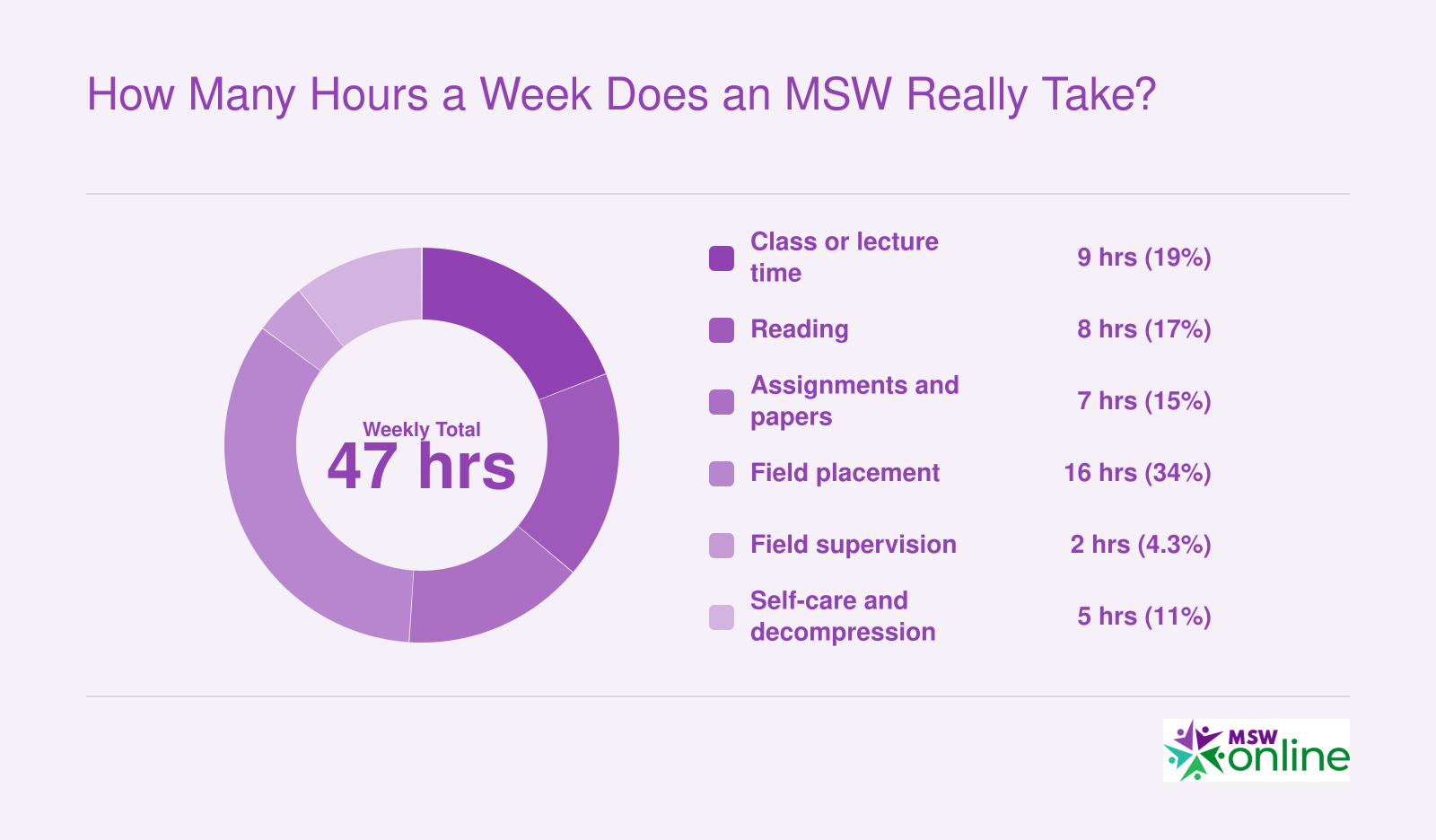
MSW students often underestimate how their time will be distributed. Most programs schedule 6 to 12 hours per week in live or asynchronous class sessions.3 Outside class, plan on 10 to 20 hours of reading, discussion posts, and assignment work. Then field placement adds another layer. CSWE mandates a minimum of 900 total field hours.1 In the concurrent model common in full-time programs, you are in placement roughly 16 hours per week spread over several terms.2 Some programs use a block placement of about 35 hours per week in a single term, while hybrid models average around 15 hours per week.2 Combined, a first-year student might commit 30 to 40 hours per week to their MSW, equivalent to a full-time job. Treat it accordingly.
Traditional vs. Advanced Standing: Two Distinct First-Year Paths
If you hold a Bachelor of Social Work (BSW) from a CSWE-accredited program, you may qualify for advanced standing. This pathway compresses the MSW into roughly 12 months and skips the foundation year entirely.2 Your first year is actually the concentration year, so you dive directly into specialized coursework and field placements aligned with your chosen track, for example clinical or macro. Accelerated online MSW programs follow the same advanced standing logic, letting BSW holders move straight into concentration coursework. Traditional students, by contrast, spend their first 12 months in the generalist curriculum and typically complete the degree in 24 months.2 Know which path you are on, because the pace and expectations are very different.
Licensure Implications: Plan with the End in Mind
Your first-year course and field choices can affect your licensure trajectory, particularly if you aim for the Licensed Clinical Social Worker (LCSW) credential. While the foundation year is generalist by design, many programs allow you to express a clinical interest early, and your field placement site can provide clinical exposure even during the first year. Discuss your long-term goals with your advisor now. If you are advanced standing, you are already in the concentration year, so every field hour should align with your licensure plans. Understanding the differences between an MSW and an LCSW early helps you map out the supervised hours and exams that follow graduation. The LMSW (Licensed Master Social Worker) exam is often the first step after graduation, but the clinical hours you accrue in field can later count toward LCSW eligibility. Intentional planning from day one prevents costly catch-up later.
The Emotional Arc: From Shock to Routine
Most students experience a jarring adjustment in the fall. The volume of reading, the emotional weight of field work, and the return to academic rigor can trigger self-doubt. This is normal and temporary. By the time spring semester rolls around, you will likely have developed coping strategies, study routines, and a peer support network that make the load feel manageable. Expect the dip, and know that it levels off.
How Many Hours a Week Does an MSW Really Take?
Full-time MSW students often compare the workload to a demanding job, and the numbers back that up. The breakdown below shows where a typical week goes when you add classroom time, independent study, and field requirements together. Part-time and online students may spread these same hours across more days or semesters, but the total commitment per course or placement remains similar.
Managing Coursework, Reading, and Assignments
Graduate coursework in social work means juggling theoretical frameworks, policy analysis, practice skill-building, and reflective writing, often all at once and across three or four courses simultaneously. The students who handle it best are not the ones who work the hardest in any given week; they are the ones who see the whole semester coming before it arrives.
Map Your Semester Before It Starts
On the first day you receive each syllabus, open a single shared calendar or a printed monthly grid and plot every due date across all your courses together. Midterms, policy briefs, field logs, and final papers all go on the same view. What you will immediately notice are the crunch weeks, those two or three points in the semester where three deadlines land within five days of each other. Seeing them early gives you time to start a paper two weeks before it is due rather than two nights before. This syllabi-mapping technique takes about an hour at the start of the semester and saves dozens of hours of panic later.
Read Strategically, Not Exhaustively
MSW reading loads are heavy. Trying to deep-read every assigned page from the start is a fast path to burnout and falling behind. Instead, use a skim-then-deep-read approach: read the abstract, introduction, and conclusion of any article first, then scan the headings and any discussion questions your professor has provided. That preview tells you what the piece is actually arguing. Then, and only then, decide how deeply to read. Policy documents and theoretical chapters often require annotation in layers: one pass for the core argument, a second pass for evidence, and margin notes for anything that connects to your field placement or other coursework. For a broader look at how social work research and practice intersect with your readings, it helps to understand why evidence-based inquiry underpins every course you take.
Take Notes That You Will Actually Use
For lecture-based classes, the Cornell method works well for social work content. Divide your page into a narrow left column for cues or questions and a wide right column for notes; at the bottom, write a summary in your own words after class. For dense policy or practice readings, annotate directly in the text or in a running document, grouping ideas by theme rather than page number.
Form a Study Group Early
Do not wait until the week before finals. Connect with two or three classmates in the first few weeks and set a recurring meeting, even if it is just sixty minutes on a video call. Study groups do two things: they create accountability that reduces procrastination, and they deepen your understanding of practice frameworks because explaining a concept to someone else forces you to actually know it. Time management tips for social work students apply just as much to study group scheduling as they do to field hours. Social work theory, in particular, tends to click faster when you talk through it with peers who are applying it in different field placement contexts than your own.
Questions to Ask Yourself
Preparing for and Navigating Your First Field Placement
What exactly is field placement, and how many hours will you spend in it? Field placement is the supervised practice component of your MSW program, where you work in a social service agency under the guidance of a licensed social worker. The Council on Social Work Education (CSWE) requires a minimum of 900 field hours across your entire MSW program. Many programs require more: some allocate 1,000 to 1,200 hours, and at least one program assigns 1,032 hours spread across three semesters at roughly 336 hours per semester.2 You will typically spend 16 to 24 hours per week in the field, depending on your program's calendar and whether you are enrolled full-time or part-time.
Field placement often begins in the spring semester of your first year or runs concurrently starting in the fall, depending on program design. Advanced standing students, who bring credit from a BSW degree, may complete a shorter field requirement of 500 to 650 hours because their undergraduate field work (typically 400 hours) is recognized.
The Placement Selection and Matching Process
Your field education office manages the matching process. Most programs collect a profile from you (preferred populations, settings, and schedule constraints) and then propose one or more site options. Our social work field placement guide covers what to expect from this process in detail. Before you accept, clarify these details with your field coordinator:
- Schedule flexibility: Does the site accommodate evening, weekend, or block hours? Can you shift days if your course schedule changes?
- Population and setting: Will you work with children, older adults, or individuals with substance use disorders? Is the setting a hospital, school, community agency, or government office?
- Learning opportunities: Does the site offer exposure to the practice methods or clinical skills you want to develop?
- Employment-based placement: If you already work in a social service role, some programs allow you to count employment hours toward field requirements, provided your employer meets CSWE standards. Your field instructor must hold an MSW from a CSWE-accredited program and have at least two years of post-MSW experience, and your placement activities must be distinct from your regular job duties and provide educational supervision.3
You have more negotiating power than you may think. Programs want a good fit. Speak up if a proposed site does not align with your goals or logistical needs before you sign the placement agreement.
What to Do If Your Placement Is a Poor Fit
A mismatch can happen. Perhaps the site does not provide the learning opportunities promised, your field instructor is absent or unavailable, or the environment feels unsafe or unsupportive. If social worker safety is a concern, treat it seriously from day one. CSWE standards give you the right to educational supervision and a placement that builds competency across nine core practice areas.3 If you have concerns, document them immediately and bring them to your field liaison or field education director. Most programs have a formal process for requesting a site change:
- Document the issue: Keep notes on missed supervision sessions, tasks that fall outside your learning plan, or any incidents that compromise your education or wellbeing.
- Request a meeting: Schedule time with your field liaison and explain the problem in specific, professional terms.
- Know your timeline: Changing placements mid-semester is disruptive and may delay graduation, but staying in a harmful or unproductive site is worse. Programs typically try to resolve issues first and move students only when necessary.
You are not stuck. Programs have a responsibility to ensure your placement meets accreditation standards.
Preparation Tips for Day One and Beyond
Before your first day, review the agency's mission statement, recent annual reports, and any public information about its programs. This background helps you ask informed questions and shows your field instructor you are serious. During your first week, sit down with your field instructor and draft a learning plan that maps specific activities to the competencies you need to demonstrate. CSWE organizes field education around nine core competencies, and your program will give you a framework for tracking them.3
Start a reflective journal in week one. After each field day, write a few sentences about what you observed, what challenged you, and what questions arose. This practice helps you process experiences in real time, supports your integration seminar discussions, and gives you concrete material when it is time to evaluate your progress. Many students find that the journal becomes a record of their professional identity formation, not just a compliance exercise.
Balancing Work, Family, and Your MSW Program
Balancing work, family, and an MSW program means managing three full-time commitments at once, and the math rarely works in your favor. Most students carry at least one of these responsibilities alongside graduate school, and many carry all three. The National Association of Social Workers (NASW) has documented that the master's degree is the most common credential in the field,4 which means your peers are navigating the same tradeoffs you are. Understanding how program structure, employment flexibility, and household demands intersect will help you design a sustainable plan rather than hoping you can power through.
Part-Time and Extended Pathways Exist for a Reason
Standard full-time MSW programs run 24 months and require 60 to 65 credits.1 Advanced standing tracks compress that timeline to 9 to 12 months and 32 to 45 credits for students entering with a BSW.1 Part-time programs, by contrast, stretch the same coursework over 36 to 48 months, allowing you to carry fewer credits each term.1 If you are working more than 20 hours per week or managing dependent care, a part-time track is not a concession. It is a deliberate choice that reduces the risk of burnout and academic probation. Many programs now offer evening, weekend, or asynchronous online formats specifically to accommodate working adults.
When researching programs, consult their published completion rates and enrollment trends. Institutions that serve large numbers of part-time or employed students often provide more robust advising, flexible field placement schedules, and cohort models that keep evening students together. Choosing the right online MSW program requires weighing these structural factors alongside accreditation and cost.
Remote Work Helps, but Not as Much as You Think
Pew Research Center data from 2026 shows that 35 percent of working parents are able to work from home, while 65 percent cannot.3 If you fall into the latter group, commute time, rigid shift schedules, and limited leave will constrain your availability for daytime field placements, office hours, and live class sessions. Even remote-eligible workers often discover that Zoom fatigue, boundary erosion, and employer expectations leave less discretionary time than anticipated.
If your employer offers any form of tuition reimbursement, flexible scheduling, or unpaid educational leave, apply early and document everything in writing. Some social service agencies, hospitals, and government offices have formal MSW support programs that include reduced hours or guaranteed placement sites.
Financial Realities Shape Your Timeline
MSW holders earned a national median annual wage of $64,000 to $66,000 in 2024, with the 90th percentile reaching $99,500. If you are currently earning close to or above the median, stepping back to part-time work or taking unpaid leave represents a measurable opportunity cost. Run the numbers: how much income will you forgo, how much debt will you incur, and how long will it take post-graduation to break even? The Bureau of Labor Statistics' Occupational Outlook Handbook offers salary and job growth comparisons across social work specializations and related fields, which can help you project return on investment.
State social work boards and NASW chapters sometimes publish employer perception studies or salary surveys that break out earnings by credential, setting, and years of experience. These reports are worth requesting when you are deciding whether to pursue your MSW now or defer until your financial or family situation shifts.
Related Articles
Tips for Online MSW Students in Their First Year
Studying online offers flexibility, but it also introduces challenges that on-campus students rarely face. The strategies below will help you start your online MSW program on solid footing rather than scrambling to catch up once the semester is underway.
Get Your Tech Ready Before Day One
Technical hiccups during the first week of class create unnecessary stress. Well before orientation, take these steps:
- Test your learning management system (LMS): Log in, navigate the dashboard, locate the gradebook, and submit a practice assignment if the program offers a sandbox environment.
- Check your hardware: Make sure your webcam, microphone, and speakers work reliably. A cheap external webcam or headset can save you from embarrassment during a live session.
- Run an internet speed test: Most programs recommend a minimum download speed of 25 Mbps for smooth video streaming. If your connection is unreliable, identify a backup workspace such as a library, co-working space, or a friend's home before you need it in a pinch.
Thinking through these details early keeps small technical problems from snowballing into missed deadlines or awkward first impressions.
Combat Isolation Intentionally
Isolation is the single biggest risk for online MSW students. Without hallway conversations or post-class coffee runs, you have to manufacture connection on purpose.
- Join or organize a virtual study group within the first two weeks. Even a weekly 30-minute video call with two or three classmates creates accountability and camaraderie.
- Attend every optional synchronous session you can, especially early on. These live meetings are where relationships form.
- Treat discussion boards as genuine peer connection points, not just graded busywork. Ask follow-up questions, share relevant practice experiences, and respond to classmates by name. The students who engage authentically in forums tend to build networks that last well beyond graduation.
Master Asynchronous Learning
Falling behind on recorded lectures is one of the fastest ways to feel overwhelmed. Build a viewing schedule into your weekly calendar just as you would an in-person class time. Batch-watching two or three lectures on a set day keeps you current without fragmenting your focus across the entire week.
For dense theoretical or policy content, try the "2x speed plus pause" method: play lectures at double speed, then pause whenever a concept needs deeper processing or note-taking. This approach can cut viewing time nearly in half while actually improving retention because it forces active engagement. Keep a running question list as you watch so you arrive at office hours or live Q&A sessions with specific, focused queries instead of a vague sense of confusion.
Clarify Field Placement Logistics Early
Field placement requirements for online students can differ significantly from those of on-campus peers. Some programs allow remote or hybrid placements, while others require students to secure an in-person site in their own community. Do not assume the details will sort themselves out.
Contact your program's field education office during your first month to clarify placement timelines, geographic requirements, and whether telehealth or remote agency work counts toward required hours. If you live in a rural area or plan to relocate, early communication is especially important. The criteria vary widely, so online MSW field placements should be one of the first factors you research when evaluating programs. Sorting out placement logistics months ahead of time prevents last-minute scrambles that can delay your graduation.
The faculty member who supervises your first practicum, the classmate who runs a support group with you at 9 p.m., and the advisor who helps you pivot your concentration are not peripheral to your MSW. They become your references, your first job leads, your peer consultation calls five years out. Networking is not extra credit. It is part of the foundational training itself.
Building Relationships With Faculty, Advisors, and Peers
The professional network you build during your MSW program will outlast every exam, paper, and practicum log you complete. That is not hyperbole. Former professors write licensure letters, field supervisors pass along job openings, and cohort peers become the colleagues you call for clinical consultation years after graduation. Start building those relationships in the first semester, not the last.
Connecting with Faculty Early
Office hours exist for a reason, and most students do not use them. Go during the first few weeks, before you have a specific problem, so your professor recognizes your name as someone engaged rather than someone in crisis.
A short email is all it takes to get started. Here is a template you can adapt:
"Hi Professor [Last Name], I am a first-year MSW student in your [course name] course. I am particularly interested in [topic area] and would love to hear more about your work in this area. Would you be open to a brief meeting during office hours this week or next? Thank you for your time."
Keep it specific. Mentioning a paper they published or a practice area you share signals genuine interest, not flattery.
Using Your Academic Advisor Strategically
Advisors can do far more than approve your schedule if you come prepared. Instead of a generic check-in, arrive with pointed questions:
- Course sequencing: Which electives best support a clinical concentration if you plan to pursue licensure?
- Licensure timelines: What supervised hours does your state require post-graduation, and how does field placement factor in? Understanding the MSW degree vs LCSW license distinction early will help you plan the right sequence of courses and supervised hours.
- Elective tradeoffs: If two courses conflict, which one opens more doors in your target practice area?
Advisors see patterns across dozens of students. A specific question gets you a useful answer. A vague question gets you a list of deadlines you could have found on the program website.
Building Cohort Bonds That Actually Stick
Social work programs move fast, and cohort relationships can easily stay superficial if nobody takes initiative. A few low-effort structures go a long way:
- Organize a monthly coffee meetup, rotating who picks the location so responsibility spreads.
- Create a shared document where cohort members post field placement debriefs, practicum tips, and agency contacts.
- Start a group chat specifically for field placement questions, separate from general social conversation, so the signal-to-noise ratio stays useful.
These habits build trust across the first year and position your cohort as a resource, not just a group of classmates you happen to share courses with.
Financial Planning and Scholarship Strategies for MSW Students
Funding your MSW is a solvable problem, but it requires the same proactive habits you will need throughout the degree itself.
Start With Your Program's Own Resources
Your first stop should be the financial aid office at your own school. Many MSW programs offer internal scholarships, graduate assistantships, and research stipends that never appear on general scholarship databases. Assistantships in particular can reduce tuition substantially while giving you supervised professional experience. Ask directly rather than waiting to see postings, because award cycles often close earlier than students expect.
If your career interests include child welfare, ask your program coordinator whether the school participates in Title IV-E funding. These federally supported stipend programs are administered through state child welfare agencies in partnership with accredited MSW programs. Students who receive stipends typically commit to working in a public child welfare setting after graduation. The specifics vary by state, so get the details from your program rather than assuming eligibility.
National Fellowship and Scholarship Programs
The Council on Social Work Education (CSWE) administers the Minority Fellowship Program, which provides funding and professional development to master's and doctoral students from underrepresented groups who are pursuing careers in behavioral health. Application timelines and eligibility criteria are updated each cycle on the CSWE website, so bookmark that page rather than relying on secondhand summaries.
The NASW Foundation also maintains a portfolio of graduate social work scholarships for students at various stages of their education. Awards differ in focus, some targeting specific populations or practice areas, and application windows do not always align with the academic calendar. Checking the NASW Foundation's scholarships page at the start of each semester takes only a few minutes and can alert you to opportunities you would otherwise miss.
Setting up alerts or following these organizations on social media is a low-effort way to catch late-breaking announcements. Fellowships sometimes open with short windows, and students who are already watching tend to be the ones who apply in time.
Federal Loans, Work-Study, and Wage Context
Graduate students often underuse federal loan programs simply because they did not file the FAFSA after completing their undergraduate degree. The Department of Education's student aid site walks through eligibility for graduate unsubsidized loans and federal work-study. Neither option is ideal as a primary funding strategy, but both are worth understanding before you make decisions about part-time employment or program pace.
For longer-range financial planning, the Bureau of Labor Statistics publishes wage data for social workers across specializations and settings. That information can help you think realistically about return on investment as you weigh loan amounts against likely starting salaries in your intended field.
Build a Running List and Check It Regularly
No single database captures every MSW scholarship available to social work students. The most effective approach is to maintain a running list of sources, organized by deadline, and revisit it at the beginning of each semester. Include your program's internal awards, national organizations like CSWE and the NASW Foundation, your state chapter of NASW, and any specialty organizations connected to your practice area. Small awards add up, and many go unclaimed simply because students do not apply.
Protecting Your Mental Health and Preventing Burnout
Reactive coping versus proactive self-care: most first-year MSW students default to the first and suffer for it. Waiting until you feel depleted to address your mental health is far harder than building protective habits before the pressure peaks. Social work training is uniquely demanding because the material is not abstract. You spend your days absorbing stories of trauma, loss, poverty, and injustice, and that accumulates in ways that academic stress alone does not.
Secondary Trauma and Vicarious Traumatization
These are not dramatic edge cases. Many graduate social work students begin experiencing the effects of secondary trauma or vicarious traumatization before they finish their first year, sometimes in the classroom and well before field placement begins. The exposure comes through case readings, client simulations, and conversations with supervisors who share real-world experiences.
The National Association of Social Workers (NASW) and the Council on Social Work Education (CSWE) both publish practice guidelines and position statements on this topic. Reviewing those materials early, rather than waiting for a crisis, gives you a professional framework for understanding what you are experiencing. Searching your university library's databases for peer-reviewed journals such as the Journal of Social Work Education or Traumatology, using terms like "graduate social work students" and "compassion fatigue," will surface original research on coping strategies that go well beyond generic self-care advice. The mental health resources for social workers compiled in our resource guide can also point you toward telehealth and trauma recovery options if campus services are not enough.
Imposter Syndrome in Graduate Social Work Programs
Feeling like you do not belong, that your admission was a mistake, or that your peers are far more capable than you is extraordinarily common in MSW programs. This is not a character flaw or evidence of poor preparation. It is a documented psychological pattern, and it tends to spike during moments of high evaluation: your first major paper, your first client interaction, your first field supervision meeting.
The American Psychological Association offers accessible, research-informed writing on imposter syndrome. Free self-assessment tools, such as the Imposter Phenomenon Inventory, can help you name and measure what you are experiencing rather than dismissing it. Naming it is the first step toward managing it.
Using the Resources Your Program Offers
Your graduate program almost certainly has mental health supports built in, though they are often underused. Our guide to student mental health in social work outlines what campus-based and community resources are typically available to enrolled students. These supports may include:
- Counseling services: Many universities offer free or low-cost sessions for enrolled students; check your student services website for eligibility and scheduling.
- Peer support groups: Some programs facilitate cohort-based or issue-specific groups where students process shared experiences in a structured setting.
- Workshops: Burnout prevention and self-care programming is increasingly common in MSW programs; look for these at the start of each semester when schedules are posted.
Using these resources is not a sign that you are struggling more than your peers. It is a sign that you understand how social work actually works. You cannot sustain a career built on helping others if you do not apply the same evidence-based thinking to your own wellbeing that you are learning to apply to your clients.
Questions to Ask Yourself
Frequently Asked Questions About the First Year of an MSW Program
First-year MSW students tend to share a common set of concerns, from workload and scheduling to field placement logistics. The answers below address the questions that come up most often so you can plan with confidence.