
Points of interest…
- Trevecca's online MSW costs $27,300 and starts January 2027.
- Advanced standing BSW holders can finish in just 12 months.
- It prepares for LMSW, LAPSW, LCSW licensure, pending CSWE accreditation.
Tennessee's growing need for mental health providers gives social work graduates immediate job prospects, but affordable, licensure-aligned MSW programs remain scarce. Many prospective students must choose between high-cost private schools or relocating for a public option.
Trevecca Nazarene University's new online MSW, starting January 2027, addresses this gap with a faith-based curriculum and multiple pacing tracks, including advanced standing and a 4+1 option for current undergraduates. The program is designed to meet Tennessee's LMSW, LAPSW, and LCSW requirements at a cost below many online MSW programs in Virginia and other regional competitors.
The program's pre-accreditation status means early students will be monitoring CSWE candidacy, but the lower cost and faith-based design give Tennessee practitioners a timely new pathway at a moment of high demand. Prospective students weighing this option alongside other graduate routes may also find MSW student tips useful as they begin evaluating programs.
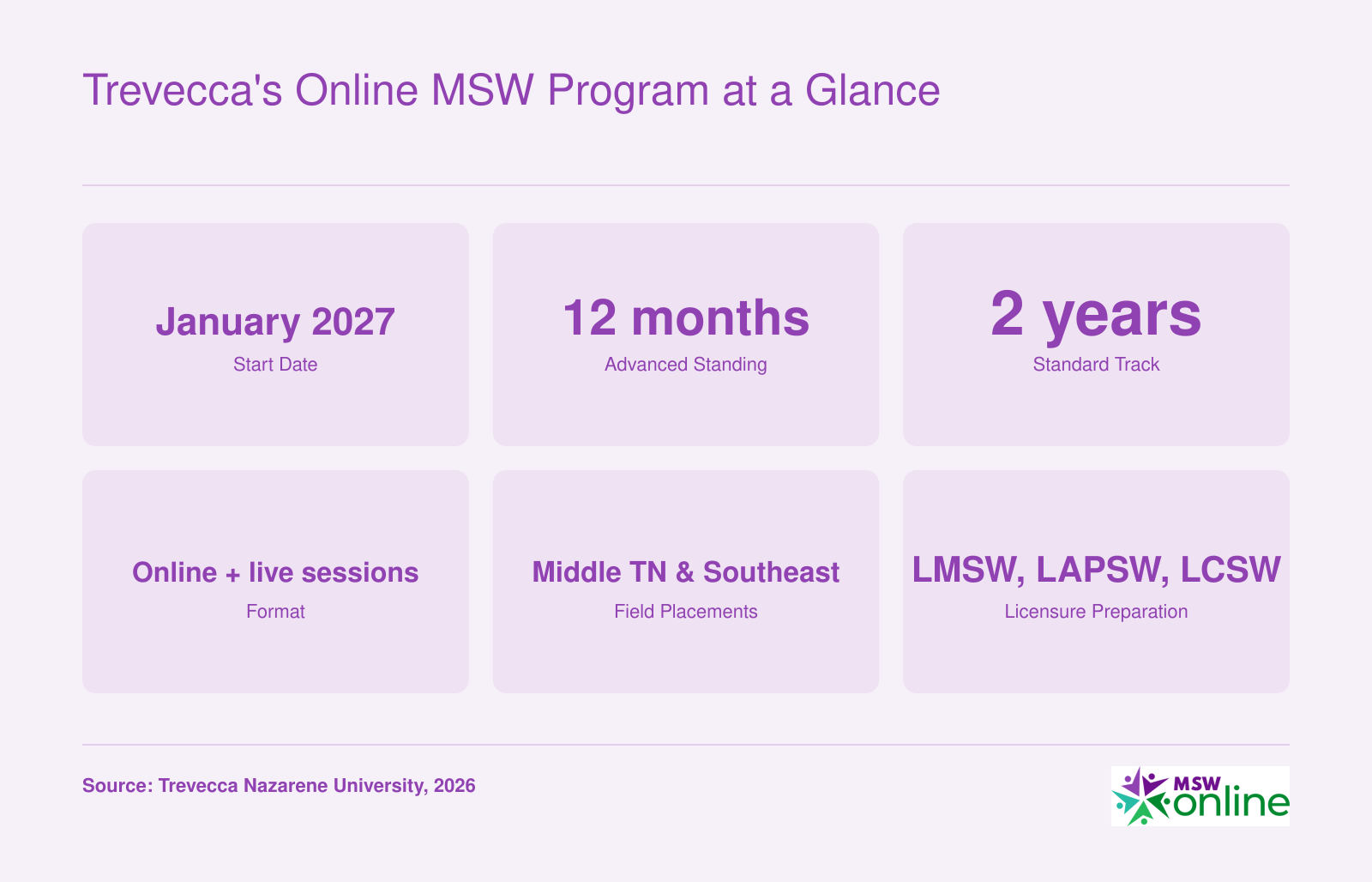
Trevecca's Online MSW Program at a Glance
Trevecca Nazarene University's new online Master of Social Work program launches in January 2027, offering flexible paths to licensure. Here are the key details at a glance.
Accreditation and CSWE Status for Trevecca's MSW
Current Accreditation Status
Trevecca Nazarene University's Master of Social Work program is not yet accredited by the Council on Social Work Education (CSWE).1 As a newly launched program with its first cohort starting in January 2027, it is currently pursuing CSWE accreditation through the standard process that all new social work programs must follow. The program's status in CSWE's directory is "Not accredited (2026)," which is typical for programs that have not yet admitted students. Trevecca has submitted its accreditation application and will undergo the candidacy process, where CSWE evaluates the program's design, resources, and curriculum. Full accreditation can only be granted after the program has enrolled and graduated students, with the first full review occurring after the initial cohort progresses. This timeline means that the earliest a decision on full accreditation could be reached is after the first students complete the program.
Implications for Licensure
Because the program is still in the early stages of the accreditation process, students should understand how this affects licensure eligibility. In Tennessee, the Board of Social Workers generally recognizes degrees from CSWE-accredited programs as well as those in candidacy status. Graduates from candidate programs are typically eligible to sit for the Association of Social Work Boards (ASWB) licensure exams and apply for the Licensed Master Social Worker (LMSW) credential. However, state regulations can change, and the program does not yet appear on the Tennessee Board of Social Workers' list of approved educational programs.2 Trevecca is working closely with the board to ensure that its MSW meets all state requirements. Prospective students are encouraged to verify the latest licensure pathway with the Tennessee Board before enrolling. For a broader look at how to choose an online MSW program, verifying accreditation and state board recognition should rank among your first steps.
Online Delivery and Accreditation
Trevecca's MSW is delivered fully online,3 and this format falls under the same CSWE accreditation umbrella as any campus-based program. CSWE accredits programs based on competency standards, not delivery mode. If the program achieves accreditation, the online option will be recognized identically to an on-ground program. Until then, the online nature does not create a separate accreditation hurdle; it is included in the overarching evaluation of the program's quality.
Trevecca's BSW Accreditation as a Foundation
While the MSW is new, Trevecca's online bachelor's in social work program has held CSWE accreditation for many years, with its next reaffirmation visit scheduled for October 2026.4 This established track record lends credibility to the MSW's pursuit of accreditation, as the same faculty and institutional standards guide both programs. The BSW program's success demonstrates the university's ability to meet CSWE's rigorous educational benchmarks.
Curriculum, Specializations, and Course Format
Trevecca's MSW program is built around a generalist foundation in the first year, covering human behavior, social policy, research methods, and ethics. Students then move into clinical concentration coursework in the second year, with a focus on direct practice skills that align with Tennessee licensure requirements for the LMSW, LAPSW, and LCSW credentials.
The program runs entirely online, but Trevecca avoids the fully asynchronous model common to many distance programs. Each course includes weekly live sessions, giving students structured contact with faculty and peers. This format suits working professionals who need schedule flexibility without sacrificing the interactive elements that reinforce clinical competency.
Field education is central to the curriculum, as it is in any social work field education experience. Trevecca has built placement partnerships across Middle Tennessee and the broader Southeast, so students outside Nashville can still access supervised practicum sites near them. Advanced-standing students, those entering with a BSW, complete a condensed field sequence as part of their 12-month path.
The program carries a faith-informed perspective, which Trevecca makes explicit rather than incidental. That commitment is reflected in a free four-part virtual symposium, "Beyond Technique: Integrating Christian Faith and Clinical Practice," launching in August 2026. Students interested in this intersection can also explore online Christian MSW programs more broadly to compare how different institutions approach values-based practice.
Whether students enter through the standard two-year track, the advanced-standing route, or the 4+1 fast-track option available to Trevecca undergraduates, the curriculum is structured to move them efficiently toward licensure eligibility.
Plans of Study: Full-Time, Part-Time, and Advanced Standing
Flexible degree pathways have become essential in social work education as students juggle professional, family, and academic commitments. Trevecca Nazarene University's online MSW addresses this need with three plans of study: a standard two-year full-time option, a part-time track, and an advanced standing path that credits a prior BSW for faster completion.
Full-Time and Part-Time Tracks
The full-time plan is designed for students who can dedicate substantial weekly hours to coursework and field practice. Over two years, participants engage in online classes with regular live sessions, building a cohort experience while moving through the curriculum at a steady pace. For those balancing work and an MSW program, the part-time option extends the timeline, allowing a lighter course load each term. While specific completion data varies, part-time enrollments have grown nationally as more schools recognize the importance of accommodating working adults.
Advanced Standing and Accelerated Options
Applicants who hold a Bachelor of Social Work from a CSWE-accredited program may qualify for advanced standing, which waives foundational courses and shortens the degree to as few as 12 months. This pathway is particularly efficient for recent BSW graduates or practitioners seeking to upgrade their credentials without repeating content. Trevecca also offers a 4+1 fast-track for its own undergraduate BSW students, enabling them to earn both degrees in five years total. Prospective students can compare accelerated online MSW programs to see how Trevecca's options measure up.
Selecting a Pace
When choosing a plan, prospective students typically weigh factors such as current employment, financial aid eligibility, and MSW program duration relative to licensure goals. Full-time study often expedites entry into the workforce, while part-time study provides steadier income during school. Advanced standing reduces overall cost and time, but requires a strong academic record and recent BSW coursework. Trevecca's admissions team can help applicants determine the best fit based on individual circumstances.
Admissions Requirements and Application Process
Trevecca Nazarene University is now accepting applications for its new online Master of Social Work program, with the first cohort starting in January 2027. Below are the key admissions components; prospective students should verify all current criteria at trevecca.edu/msw.
- Bachelor’s DegreeA bachelor’s degree from an accredited institution is required, in any field. No specific prerequisite coursework is listed.
- Minimum GPATrevecca’s graduate programs typically require a cumulative GPA of 2.7 or higher. Confirm whether this applies to the MSW.
- ReferencesTwo professional or academic references are required as part of the application.
- Standardized ExamsSome Trevecca master’s programs require GRE (minimum 290) or MAT (minimum 380). The MSW may offer a test-optional path; check the program page.
- English ProficiencyInternational applicants must submit TOEFL iBT (minimum 80) or equivalent, unless exempt.
- Advanced StandingApplicants with a bachelor’s in social work (BSW) from a CSWE-accredited program may qualify for advanced standing, completing the MSW in as few as 12 months. Additional eligibility criteria may apply.
- Application DeadlinesGraduate deadlines are typically May 1 (fall), October 1 (spring), and February 15 (summer). The MSW starts in a spring term; confirm the exact deadline at trevecca.edu/msw.
- How to ApplySubmit the online application through the School of Graduate and Continuing Studies. Visit trevecca.edu/msw to begin the process.
Field Placements Across Tennessee and the Southeast
Trevecca's MSW program integrates supervised field practice directly with online coursework, ensuring students translate theory into practice across a variety of community settings. While specific required hours are finalized as the program moves toward CSWE accreditation, the design follows standard MSW expectations: roughly 400, 500 hours of foundation placement and 500, 600 hours of advanced placement, with advanced-standing students completing a single, condensed field experience. Each student is matched with a site-based supervisor and receives oversight from Trevecca's field education faculty.
Placement Structure and Supervision
Field placements run concurrently with weekly live online classes, allowing students to apply what they learn in real time. The program uses a cohort model: students progress through a set sequence, so field hours align with the course schedule. Each student completes an agency-based internship under the joint supervision of a licensed social worker on site and a faculty liaison. The liaison provides regular virtual check-ins and site visits (in person or via video) to ensure quality and competency development. Students curious about what this stage of training involves can review MSW clinical year expectations before committing to a placement agency.
Geographic Reach and Agency Types
Trevecca has built partnerships with agencies across Middle Tennessee and the broader Southeast. Students can access social work field placement sites in schools, hospitals, mental health clinics, child welfare organizations, substance use treatment centers, and faith-based nonprofits. The Nashville metro area offers a dense network of placement sites, but the university also arranges field opportunities in rural communities and neighboring states to accommodate online learners. This geographic flexibility helps address workforce shortages in underserved areas.
Securing a Placement Outside the Nashville Metro Area
For students who live beyond Middle Tennessee, Trevecca's field education team works one-on-one to identify appropriate local agencies. The process begins early in the program: students submit a field interest form, and coordinators reach out to prospective sites. If a desired agency is not yet a partner, the team can vet and formalize a new affiliation agreement. While placements cannot be guaranteed in every location, the program actively prioritizes finding sites within a reasonable commute, drawing on a growing database of approved agencies throughout the Southeast. Those interested in eventual Tennessee social work licensure will find that building regional field experience early streamlines the post-graduation licensing process.
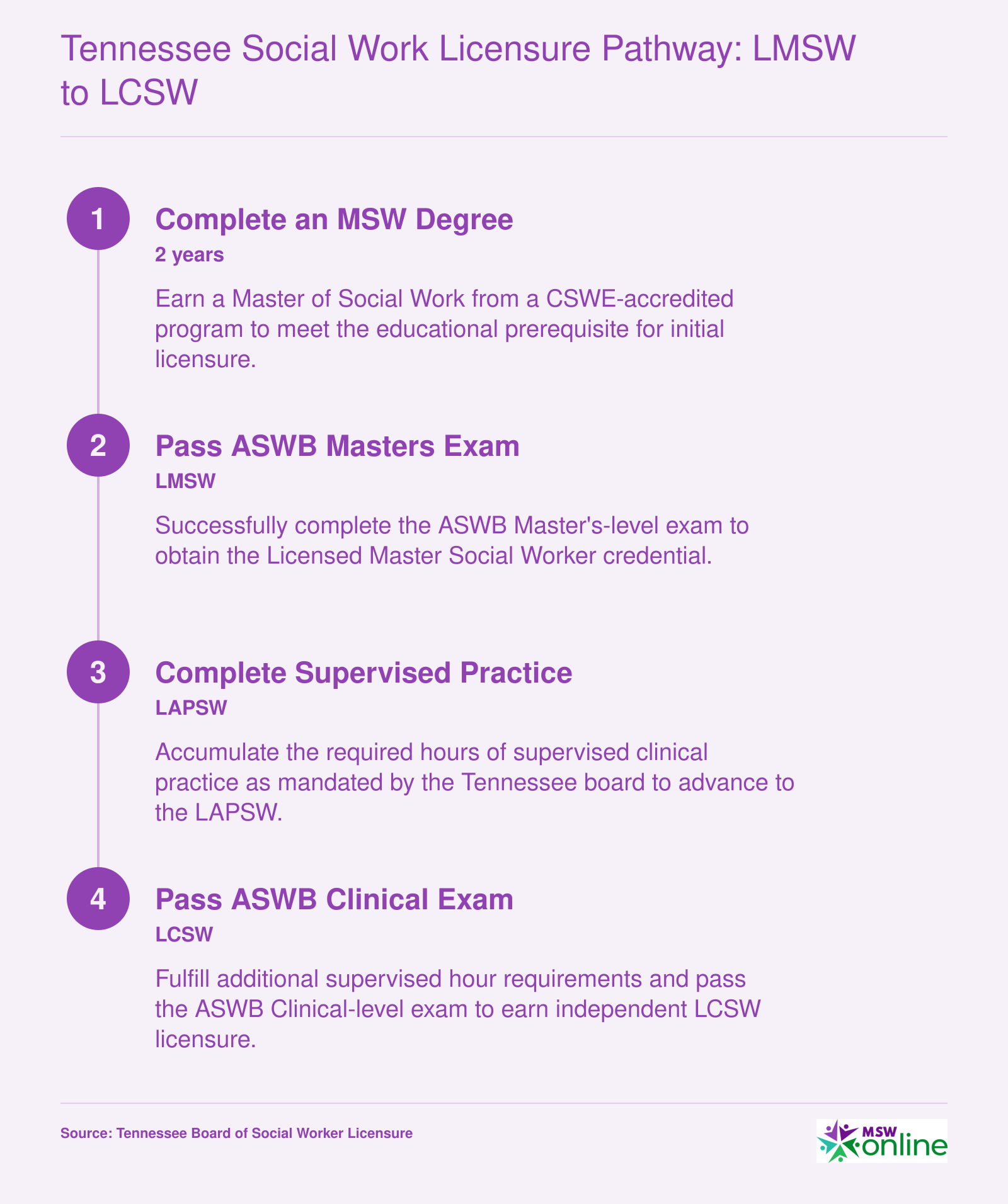
Tennessee Social Work Licensure Pathway: LMSW to LCSW
Tennessee offers a tiered social work licensure system progressing from the Licensed Master Social Worker (LMSW) to the Licensed Advanced Practice Social Worker (LAPSW) and ultimately the Licensed Clinical Social Worker (LCSW). Each stage requires a combination of graduate education, ASWB examinations, and supervised practice hours as defined by the state board.
How Trevecca's MSW Compares to Other Faith-Based and Regional Programs
With a total program cost of $27,300, Trevecca Nazarene University's new online MSW undercuts several regional faith-based competitors by a significant margin.1 Lipscomb University's CSWE-accredited MSW in Nashville costs $36,960, while Campbellsville University's online MSW totals $50,225 over a longer 36-month timeline. Students considering other online options like UNC Greensboro's 24-month program at $47,280 will also find Trevecca's price point attractive. Beyond cost, Trevecca differentiates itself through a blend of clinical focus, faith integration, and flexible pacing.
Faith Integration and Program Philosophy
Trevecca's program is explicitly grounded in a Christian worldview, offering a depth of faith integration that goes beyond a general mission statement. The upcoming 'Beyond Technique' symposium series signals a commitment to helping students weave spiritual practice into clinical work. While Lipscomb (Church of Christ) and Campbellsville (Baptist) also offer faith-informed MSWs, Trevecca's active programming around the intersection of faith and clinical practice gives it a distinctive edge for students seeking a vocationally aligned education. Each school's culture differs, so prospective students should evaluate how each program's specific faith tradition and integration model align with their own identity.
Online Format and Field Placement Reach
Trevecca's online coursework includes weekly live class sessions, blending structure with flexibility. This contrasts with fully asynchronous formats like LSU's online MSW, which delivers content through 7-week modules without set meeting times.3 For students who value real-time interaction and a cohort feel, the live session model may be a strong draw. Field placements for Trevecca span Middle Tennessee and the Southeast, offering proximity to Nashville's social work landscape. Lipscomb similarly taps the Nashville area, while Campbellsville's reach extends through Kentucky and surrounding states. Geographic placement options can be a deciding factor for those with regional ties or licensure plans.
Advanced Standing and Value
Trevecca's 12-month advanced standing path for BSW holders aligns with industry norms, but when paired with its lower tuition, the accelerated timeline becomes a particularly cost-effective route to an MSW. The standard two-year plan matches the pace of many competitors, and the part-time option accommodates working professionals. For those weighing multiple programs, reviewing social work exam prep course options early can help clarify how each curriculum maps to licensure requirements. In a region where faith-based, CSWE-accredited online MSWs with a clinical concentration are in demand, Trevecca's combination of price, flexible pacing, and intentional faith integration makes it a compelling new entry.
Frequently Asked Questions About Trevecca's MSW Program
Below are answers to some of the most common questions about Trevecca Nazarene University's new online Master of Social Work program, from accreditation to time commitment and licensure preparation.