Points of interest…
- CSWE is the sole accrediting body for BSW and MSW programs in the United States, founded in 1952.
- All nine EPAS core competencies must be met by every accredited program, whether on campus or online.
- Without a CSWE-accredited degree, candidates cannot sit for the ASWB licensing exam in most states.
- CSWE lists 347 accredited MSW programs as of 2025, and its searchable directory is the only authoritative verification source.
Accredited program or non-accredited program: in most fields, that distinction shapes prestige. In social work, it determines whether you can legally practice.
CSWE accreditation is the single credential that decides whether an MSW graduate can sit for the ASWB licensing exam, which is required for licensure in the vast majority of U.S. states and territories. Every state now ties its social work license to a degree from a CSWE-accredited program. No accreditation means no license, regardless of how rigorous the coursework was.
For prospective students, the practical tension is this: not every program that uses the word "social work" in its name holds CSWE accreditation, and some programs operate under candidacy or pre-candidacy status that does not yet qualify graduates for licensure. This guide breaks down what CSWE accreditation is, how the process works, and how to verify a program's status before you enroll.
What Is the Council on Social Work Education (CSWE)?
The Council on Social Work Education is the national membership organization that sets academic standards for social work degree programs in the United States and decides which programs meet them. Founded in 1952, CSWE is the sole accrediting body for baccalaureate (BSW) and master's (MSW) social work programs recognized by the Council for Higher Education Accreditation (CHEA). It does not accredit doctoral programs (DSW or PhD), though it does track and support them through its membership network. If you are considering a doctoral path, you can explore doctor of social work programs to understand how they relate to CSWE oversight.
Scope and Authority
CSWE's authority comes from two sources. First, CHEA, the main private body that vets U.S. accreditors, recognizes CSWE as the specialized accreditor for social work education. You can confirm this by searching the CHEA database at chea.org or reviewing the U.S. Department of Education's published list of recognized accrediting agencies. Second, every state licensing board for social work points back to CSWE-accredited degrees as the educational prerequisite for licensure at the LBSW, LMSW, and LCSW levels.
How Many Programs Are Accredited
The accredited program count shifts each academic year as new programs gain candidacy, reaffirm, or close. For the current 2025 to 2026 count of accredited BSW and MSW programs, go directly to the Accreditation section of cswe.org, which maintains a searchable, annually updated directory. Do not rely on third-party lists, including older versions of this page, for exact totals: they go stale fast.
Where CSWE Fits in the Broader Landscape
CSWE is one piece of the social work infrastructure. For employment projections, wage data, and job growth context, the U.S. Bureau of Labor Statistics Occupational Outlook Handbook is the primary source. For practice standards, ethics, and continuing education, the National Association of Social Workers (NASW) is the field's main professional body. Professionals looking to specialize beyond their degree can also pursue social work certifications aligned with their area of practice. For program-specific details (concentrations, field placement requirements, advanced standing eligibility), contact the social work department at the university directly. Accreditation status listed on a school's website should always be cross-checked against the CSWE directory.
What Is CSWE Accreditation and Why Does It Matter?
Accreditation in social work is not a credential schools earn once and forget; it is an ongoing commitment to meeting national standards that gets re-evaluated on a regular cycle.
What Accreditation Actually Means
CSWE accreditation is a voluntary, peer-review process through which the Council on Social Work Education evaluates whether a BSW or MSW program meets its established Educational Policy and Accreditation Standards (EPAS). Evaluators include practicing social workers, educators, and field supervisors who examine curriculum design, field education requirements, faculty qualifications, student support systems, and program outcomes. A program that passes earns the right to call itself CSWE-accredited, signaling to students, employers, and licensing boards that it delivers a qualifying education.
The word "voluntary" can be misleading. Technically, no law compels a school to seek accreditation. In practice, the downstream consequences of skipping it are severe enough that any program serious about preparing students for licensure pursues it.
The Three Stakes That Make Accreditation Non-Negotiable
For students, accreditation has three direct, practical consequences:
- Licensure eligibility: Most state licensing boards require graduation from a CSWE-accredited program before a candidate can sit for the Association of Social Work Boards (ASWB) licensing exam. This requirement holds across the majority of U.S. jurisdictions. A degree from a non-accredited program does not simply make licensure harder; in most states, it makes licensure impossible.
- Financial aid access: Federal Title IV funding, which includes Pell Grants and federal student loans, flows to students enrolled in programs at institutionally accredited schools. CSWE accreditation layers on top of that, and many scholarship programs, including those administered through state chapters of NASW, explicitly require enrollment in a CSWE-accredited program.
- Employer recognition: Hospitals, government agencies, community mental health centers, and private practices routinely use CSWE accreditation as a minimum hiring filter, particularly for positions that require or anticipate licensure.
How Important Is CSWE Accreditation?
The direct answer: it is effectively mandatory for anyone pursuing a career in licensed social work. If you plan to hold any clinical or licensed title, including LCSW, LMSW, or LGSW, your degree program needs CSWE accreditation. Prospective clinicians should start by comparing accredited online MSW programs or reviewing bachelor of social work programs to confirm accreditation status before enrolling. There is no workaround, no equivalency pathway, and no grandfather clause that substitutes for it in most licensing jurisdictions. Choosing a non-accredited program to save money or gain scheduling flexibility is a trade-off that can permanently close the door to licensure.
Without a CSWE-accredited degree, you are ineligible to take the ASWB licensing exam in the vast majority of states, which means you cannot become a licensed social worker, regardless of your program's reputation, your field placements, or your academic performance. Accreditation is the single non-negotiable step between your education and your career.
CSWE Accreditation Standards and the Nine Core Competencies
CSWE's Educational Policy and Accreditation Standards (EPAS) spell out exactly what an accredited BSW or MSW program must teach and how it must measure student learning. The current edition, the 2022 EPAS, was approved on June 9, 2022 and remains operative through at least 2026, with no replacement announced.12 Programs preparing for reaffirmation reviews can consult the 2022 EPAS Interpretation Guide, last updated in May 2025, for detailed compliance guidance.3
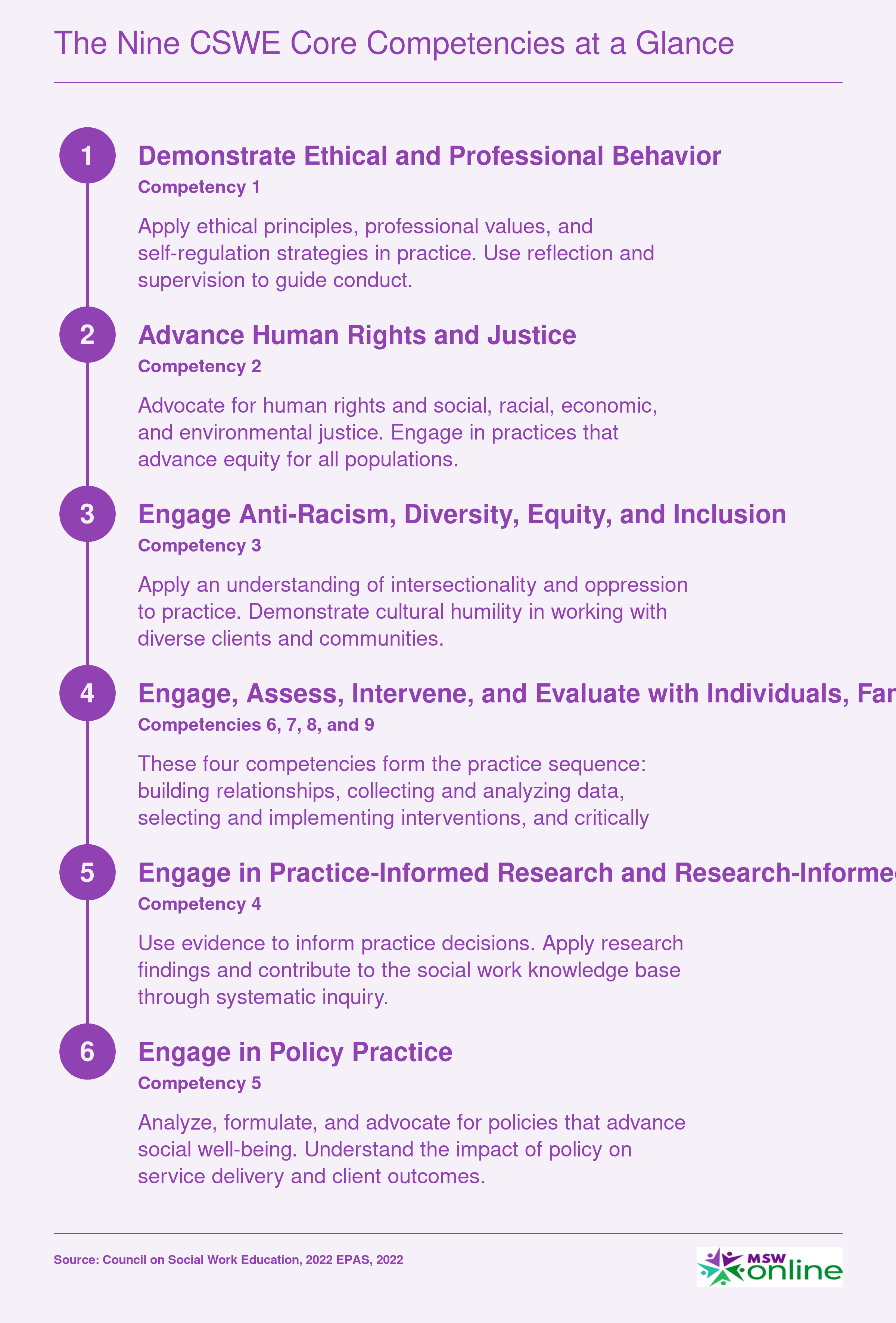
At the heart of the 2022 EPAS are nine core competencies that every accredited program must embed across its curriculum.4 Each competency is paired with observable behaviors students must demonstrate before graduation. The nine competencies are:
- Competency 1: Demonstrate Ethical and Professional Behavior
- Competency 2: Advance Human Rights and Social, Racial, Economic, and Environmental Justice
- Competency 3: Engage Anti-Racism, Diversity, Equity, and Inclusion (ADEI) in Practice
- Competency 4: Engage in Practice-Informed Research and Research-Informed Practice
- Competency 5: Engage in Policy Practice
- Competency 6: Engage with Individuals, Families, Groups, Organizations, and Communities
- Competency 7: Assess Individuals, Families, Groups, Organizations, and Communities
- Competency 8: Intervene with Individuals, Families, Groups, Organizations, and Communities
- Competency 9: Evaluate Practice with Individuals, Families, Groups, Organizations, and Communities
If you compare this list to the previous 2015 EPAS, you will notice that Competency 2 and Competency 3 were substantially revised to foreground anti-racism, diversity, equity, and inclusion.5 The remaining competencies carry forward largely unchanged, though updated language appears throughout.
For prospective students, these competencies serve as a quality benchmark. Whether you are exploring social work degree programs or evaluating an online bachelor's in social work, confirming that a program's curriculum maps to all nine competencies tells you it meets the profession's current practice expectations. CSWE also publishes a dedicated Accreditation Toolkit organized around these competencies, giving programs templates, rubrics, and assessment examples to streamline their self-study process.6
The Nine CSWE Core Competencies at a Glance
Every CSWE-accredited social work program, whether BSW, MSW, or DSW, must demonstrate that graduates achieve the same nine core competencies defined in the Educational Policy and Accreditation Standards (EPAS). These competencies form the professional foundation for ethical, effective practice across all settings and populations.
How the CSWE Accreditation Process Works
Understanding the CSWE accreditation process helps you evaluate whether a program has met the rigorous standards required for professional social work education. The process is thorough, structured in clearly defined stages, and designed to ensure that every accredited program prepares graduates for competent practice.
Step 1: Eligibility and Candidacy Application A social work program must first demonstrate that it meets basic eligibility requirements set by CSWE. The institution offering the program must hold regional accreditation, and the program itself must be housed within an accredited college or university. Once eligibility is confirmed, the program submits a formal candidacy application, which signals its intent to pursue accreditation and begins the formal review timeline.
Step 2: Self-Study Report The program prepares a comprehensive self-study document. This report details curriculum design, faculty qualifications, field education structure, student learning outcomes, and administrative resources. Programs must show alignment with CSWE's Educational Policy and Accreditation Standards (EPAS), which define nine core competencies every graduate should master. This stage is labor-intensive and can take a year or more to complete.
Step 3: Site Visit After CSWE reviews the self-study, a team of trained site visitors conducts an on-campus (or virtual) evaluation. The team interviews faculty, students, field supervisors, and administrators. They verify that the program's documented practices match what actually happens in classrooms and field placements. The site visit report is then submitted to the Commission on Accreditation for review.
Step 4: Commission Review and Decision The Commission on Accreditation, composed of social work educators and practitioners, reviews the self-study, the site visit report, and the program's response to any concerns. The commission then renders one of several decisions: grant initial accreditation, defer a decision pending additional information, or deny accreditation. Programs that receive accreditation enter a reaffirmation cycle, typically every eight years.
Step 5: Ongoing Compliance and Reaffirmation Accreditation is not a one-time achievement. Programs must submit periodic reports, maintain compliance with EPAS, and undergo full reaffirmation reviews on schedule. If a program falls short at any point, CSWE may place it on conditional status or revoke accreditation entirely.
This structured process applies to programs at every level, from BSW programs to PhD in social work programs. Choosing a CSWE-accredited program ensures your education meets the profession's highest benchmarks and qualifies you for licensure in all 50 states.
Accredited vs. Candidacy vs. Pre-Candidacy: What's the Difference?
Not every program listed in the CSWE Directory carries the same weight. Understanding the distinction between Accredited, Candidacy, and Pre-Candidacy status is critical before you enroll, because your licensure eligibility often depends on it.
Accredited. A program with full accreditation has completed the entire CSWE review process and is listed as "Accredited" in the official directory.1 This is the gold standard. Most U.S. jurisdictions require a degree from a fully CSWE-accredited program before you can sit for the licensing exam.2 Whether you are pursuing an accelerated BSW program or a clinical MSW program, confirming full accreditation should be your first step.
Candidacy. A program in candidacy is actively working through the multi-year accreditation process but has not yet earned full status. CSWE considers candidacy a pre-accreditation designation.3 Only a small, changing minority of states accept graduates from candidacy-status programs for licensure; most do not.2 Before enrolling in any candidacy program, contact your state licensing board directly to verify whether your degree will qualify you for the exam.
Pre-Candidacy. Pre-Candidacy is the earliest stage of the accreditation pipeline. Programs at this level have signaled their intent to pursue CSWE accreditation and may appear in the CSWE Directory, but they are even further from full accreditation than candidacy programs.3 The licensure risks here are significant: almost no state boards recognize a pre-candidacy degree as meeting education requirements.
The bottom line: if licensure is part of your career plan, enrolling in a fully accredited program is the safest path. Always cross-reference a program's status in the CSWE Directory and confirm your state board's requirements before committing.
Questions to Ask Yourself
How CSWE Accreditation Affects Social Work Licensure
Every U.S. state and territory now ties social work licensure to a degree from a CSWE-accredited program, making accreditation status the single biggest gatekeeper between you and a license to practice. The connection runs through two organizations: CSWE accredits the schools, and the Association of Social Work Boards (ASWB) develops the licensing exams that state boards administer. State boards set their own eligibility rules, but virtually all of them require that your BSW or MSW come from a CSWE-accredited program before they will let you sit for any ASWB exam.
The Four ASWB Exam Levels
ASWB offers four exam categories, and each maps to a specific degree requirement:
- Bachelors: For entry-level licensure (often LSW or LBSW). Requires a CSWE-accredited BSW.
- Masters: For post-MSW licensure without clinical hours. Requires a CSWE-accredited MSW.
- Advanced Generalist: For non-clinical macro, policy, or administrative practice. Requires a CSWE-accredited MSW plus two years of supervised non-clinical experience.
- Clinical: For LCSW licensure. Requires a CSWE-accredited MSW plus two years of supervised clinical experience.
A degree from a non-accredited program, no matter how rigorous, generally will not qualify you for any of these. If you are pursuing LCSW licensure specifically, reviewing clinical MSW programs early can help you align fieldwork requirements with your state's clinical-hour mandates.
The Candidacy Wrinkle
Candidacy status is where things get state-specific. CSWE treats degrees earned during candidacy as retroactively accredited once the program achieves full Initial Accreditation, and most state boards honor that. However, acceptance is not universal, and some boards have historically been more cautious about candidacy graduates than others. Before enrolling in a program with candidacy (rather than full accreditation) status, contact the licensing board in the state where you plan to practice and ask directly whether candidacy graduates qualify.
What Happens If a Program Loses Accreditation
CSWE requires every accredited program to maintain a teach-out plan as a condition of accreditation. If a program's accreditation is withdrawn or terminated, the teach-out plan allows currently enrolled students to either finish the existing curriculum under the accredited status or transfer to another CSWE-accredited program. Students who graduate before the loss generally retain their licensure eligibility, since their degree was earned while the program was accredited. Future applicants and students who do not complete the teach-out, however, face real risk: a degree conferred after accreditation is gone typically will not satisfy state licensure requirements. Large flagship MSW programs losing accreditation has not been a widely reported pattern between 2020 and 2026, but the structural risk is built into the system, which is why verifying current status before you enroll matters.
How to Verify a Program's CSWE Accreditation
CSWE maintains a publicly searchable directory of all accredited social work programs at cswe.org/accreditation/directory. That directory is the only authoritative source for confirming whether a BSW or MSW program holds genuine programmatic accreditation. A school's own marketing materials are not a reliable substitute.
Using the CSWE Directory
The search tool is straightforward. You can look up programs by school name, by state, or by degree level (BSW or MSW). Each listing in the directory tells you:
- Accreditation status: Whether the program is fully accredited, in candidacy, or in pre-candidacy.
- Most recent review date: When CSWE last formally evaluated the program.
- Next reaffirmation date: When the program is scheduled for its next comprehensive review cycle.
If a program you are researching does not appear in the directory at all, it is not CSWE-accredited, regardless of what the school's website says.
Why You Cannot Trust School Websites Alone
This is where prospective students frequently get misled. Many schools describe themselves as "accredited" in their admissions materials, but that language often refers to regional or institutional accreditation (from bodies such as HLC, SACSCOC, or MSCHE). Regional accreditation covers the institution as a whole. CSWE accreditation is programmatic, meaning it applies specifically to the social work program's curriculum, field education structure, and faculty qualifications. The two are entirely separate, and only CSWE programmatic accreditation qualifies graduates to sit for state licensure exams in virtually every U.S. jurisdiction.
When you read "nationally accredited" or "accredited institution" on a social work admissions page, pause and verify the program directly through the CSWE directory before drawing any conclusions.
A Note for Online Program Applicants
CSWE does not issue a distinct accreditation for online delivery. When a program is accredited, that status covers all formats the program offers, whether on-campus, hybrid, or fully online. If you are comparing accelerated social work programs online, keep in mind that some universities run multiple MSW programs under different administrative structures, and accreditation applies to specific programs, not to a university's brand as a whole. If you are enrolling in an online cohort, confirm that the specific program and campus (not just the parent institution) appears in the CSWE directory. Students considering an advanced standing MSW online track should apply the same verification step. When in doubt, contact the program's admissions office and ask for the program's CSWE accreditation number or directory link directly.
CSWE Accreditation for Online MSW Programs
Online MSW programs have grown substantially, and a common question is whether CSWE accreditation applies the same way to distance-based study as it does to traditional campus programs. The short answer is yes. CSWE's accreditation standards apply to programs regardless of delivery format. A program offered primarily online must meet the same competency-based educational requirements as one delivered in person.
How CSWE Addresses Distance Education
CSWE's Commission on Accreditation has published policies specific to distance and hybrid program delivery. These documents address how programs should demonstrate that online students receive an equivalent educational experience, including access to faculty, advising, and field education. To review those policies directly, visit the CSWE website and search under the Commission on Accreditation section for distance education guidance. Relying on the official Accreditation Handbook rather than third-party summaries is the most reliable way to understand what is actually required.
Field Placement in an Online Program
Field education is the area where online delivery raises the most practical questions. CSWE requires a supervised field practicum for both BSW and MSW programs, and that requirement does not change because a student attends class remotely. What does vary is how individual programs handle placement logistics. Some online programs coordinate placements in the student's local community; others maintain regional field offices or partnerships with agencies across multiple states. Before enrolling, review the specific program's field placement policies: where placements are arranged, what supervision standards apply, and what technology the program expects students and site supervisors to use. If you are weighing several schools, our guide on how to compare online MSW programs in terms of admission requirements, tuition, and time-to-degree covers the key decision factors.
Additional Resources Worth Consulting
Beyond CSWE, a few sources can help you evaluate online program quality:
- NASW guidance: The National Association of Social Workers has published position statements and resources on field education best practices that apply to online and hybrid programs.
- BLS labor market data: The Bureau of Labor Statistics provides employment and wage context for social workers nationally, which can inform your overall career planning even though it does not evaluate individual programs.
- Program websites: Individual MSW program pages typically detail technology requirements, synchronous versus asynchronous course structures, and how field liaisons support remote students.
An accredited online MSW gives you the same credential standing as an on-campus degree. Students interested in completing their degree on a shorter timeline should also explore accelerated online MSW programs. Verifying accreditation status and then examining a program's specific online infrastructure are both necessary steps before committing.
According to Council on Social Work Education statistics, there are now 347 accredited MSW programs in the United States as of 2025. That number has grown substantially over the past decade, driven in large part by the expansion of online delivery formats that have made graduate social work education accessible to students who cannot relocate for a traditional campus program.
Choosing a CSWE-accredited MSW program comes down to three steps. First, verify the program's status directly in the CSWE accreditation directory; do not rely solely on a school's marketing. Second, confirm that your target state's licensing board will accept that status for licensure, since candidacy or pre-candidacy programs may not qualify everywhere. Third, if you're studying online, make sure the program has a clear plan for securing local field placements. If you already hold a BSW and want to finish faster, consider advanced standing MSW programs online that build on your undergraduate preparation. Programs listed on this site have been vetted for accreditation, but always do your own check before enrolling.
Explore More
- Bilingual Social Worker
- Continuing Education for Social Workers
- COVID-19 Guide for Social Workers
- Environmental Social Work
- Free Implicit Bias Tests & Training Resources
- How Social Work Reduces Healthcare Costs
- How to Find a Social Work Job
- Levels of Social Work Licensure
- LGBTQIAP in Social Work
- Mental Health & Homelessness
- Micro, Mezzo & Macro Social Work
- MSW Admission Requirements
- MSW Scholarships
- MSW Specializations
- MSW vs. MSSW
- Remote Resources for Mental Health Workers
- Social Work & Food Insecurity
- Social Work & Gun Violence Prevention
- Social Work Ethics
- Social Work Field Placement Guide
- Social Work Internships
- Social Work vs. Psychology
- Social Worker Salary Guide
- Social Worker's Guide to Cyberbullying
- Student Mental Health & Social Work on College Campuses
- Why Is Research Important in Social Work? A Complete Guide
- Women in Social Work Leadership