
Points of interest…
- Four ASWB exam tiers (Bachelors, Masters, Advanced Generalist, Clinical) align directly with each license level.
- LCSW holders can practice therapy independently, bill insurance, and open a private practice; LMSW holders cannot.
- License titles, supervised practice hours, and renewal rules vary significantly from state to state.
- Climbing from LBSW to LCSW typically requires two degrees, two exams, and 2,000 to 4,000 supervised clinical hours.
All 50 states, the District of Columbia, and the U.S. territories regulate social work practice, yet no two jurisdictions use exactly the same license titles, hour thresholds, or supervision rules. Social work is one of the few professions built around a clear, multi-tier credential ladder (LBSW, LMSW, LISW/LICSW, LCSW), but state-by-state variation makes planning a career harder than it should be.
Each tier corresponds to a specific degree, a standardized ASWB exam, and a defined scope of practice. The gap between tiers is not trivial: salary differences between an LMSW and an LCSW can exceed $15,000 annually, and only the clinical license authorizes independent psychotherapy and direct insurance billing. Understanding the path to becoming a licensed clinical social worker early, and treating the ladder as a strategic career plan rather than a compliance checklist, changes which jobs, settings, and income levels stay within reach.
What Are the Four Levels of Social Work Licensure?
Social work licensure in the United States is organized into four distinct tiers, each corresponding to a specific level of education, experience, and clinical responsibility. Understanding these levels is essential for anyone planning a career in the field, because the license you hold determines the settings where you can practice and the services you can provide.
1. Licensed Baccalaureate Social Worker (LBSW) The LBSW is the entry-level credential. It requires a Bachelor of Social Work (BSW) from a CSWE-accredited program and a passing score on the Association of Social Work Boards (ASWB) Bachelors-level exam. LBSW holders typically work in case management, community outreach, and direct client services under supervision. Not every state offers this license category, so candidates should check their state's specific requirements.
2. Licensed Master Social Worker (LMSW) So, what is the LMSW meaning? An LMSW holds a Master of Social Work (MSW) and has passed the ASWB Masters-level exam. This license permits a broader scope of practice, including assessment, treatment planning, and some forms of counseling, though typically under supervision. Many professionals pursuing an online master's in social work use this credential as a stepping stone toward independent clinical practice.
3. Licensed Clinical Social Worker (LCSW) The LCSW is the most widely recognized advanced license. Beyond an MSW, candidates must complete a specified number of supervised clinical hours (often 2,000 to 4,000, depending on the state) and pass the ASWB Clinical-level exam. LCSWs can diagnose mental health conditions, provide psychotherapy, and, in many states, open a private practice social worker office.
4. Licensed Advanced Practice Social Worker or Other Specialty Designations Some states offer a fourth tier that recognizes advanced, non-clinical expertise in areas such as administration, policy, or macro-level practice. Titles vary: Licensed Certified Social Worker (LCSW-C), Licensed Independent Social Worker (LISW), or similar designations. These credentials often require additional post-master's experience and examinations.
Each level builds on the one before it, creating a clear professional ladder. If you are just starting to explore how to become a social worker, mapping out these four tiers early will help you set realistic timelines and educational goals.
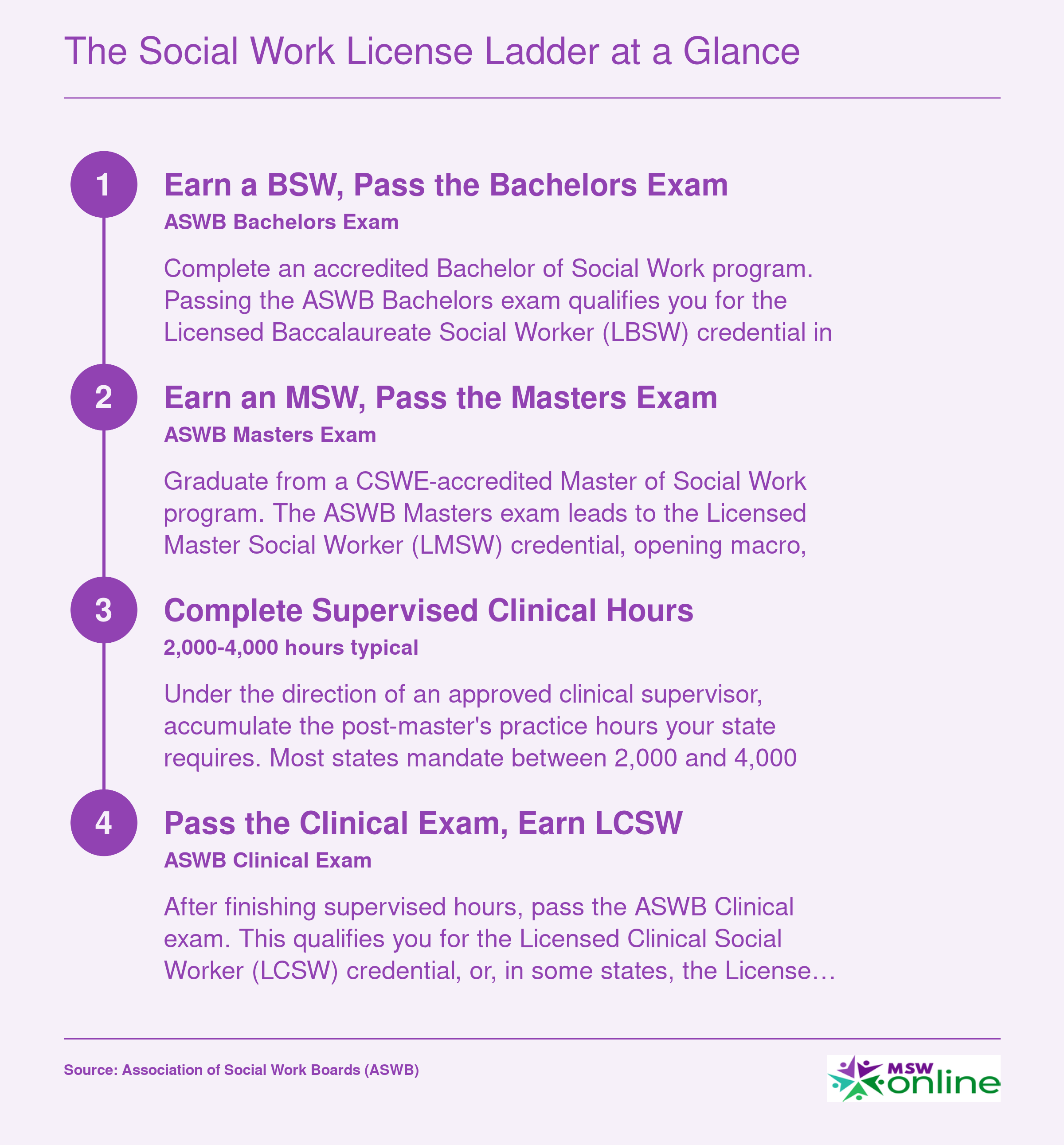
The Social Work License Ladder at a Glance
Social work licensure follows a clear, tiered progression. Each rung requires a specific degree, a corresponding ASWB exam, and (at the clinical levels) a defined period of supervised practice. The exact hour requirements and timelines differ by state, so always verify your state board's rules before mapping out your plan.
Social Work License Acronyms Explained: LBSW, LMSW, LISW, LCSW, and More
The alphabet soup of social work credentials is one of the first real barriers prospective practitioners face. Each acronym signals a specific license level, degree requirement, and scope of practice. Understanding the distinctions matters because using the wrong title in a job application, or practicing beyond your current license, carries serious consequences.
Entry-Level and Bachelor's-Degree Licenses
Two credentials cover the bachelor's level:
- LBSW (Licensed Baccalaureate Social Worker): Requires a BSW from a CSWE-accredited program. A state license, issued in states that recognize the bachelor's level.
- LSW (Licensed Social Worker): Also a state license, typically built on a BSW, though some states allow MSW holders to hold this designation before completing supervised post-degree hours.
If you are still exploring which degree fits your goals, a review of social work degree programs can help clarify the path from a BSW through an MSW and beyond.
Master's-Level Licenses Before Full Clinical Authorization
After earning an MSW, most social workers enter a provisional or associate period. Several acronyms mark this stage:
- LMSW (Licensed Master Social Worker): The most widely used MSW-level state license. Authorizes supervised practice but not independent clinical work in most states.
- LGSW (Licensed Graduate Social Worker): A state license functionally similar to the LMSW, used in a smaller set of states.
- LLMSW (Limited Licensed Master Social Worker): A provisional MSW-level state license, used in Michigan and a handful of other jurisdictions while supervised hours accumulate.
Clinical and Independent-Practice Licenses
Once supervised hours are complete, social workers advance to a clinical license. These go by different names depending on the state:
- LCSW (Licensed Clinical Social Worker): The most common clinical-level state license, requiring an MSW plus a defined number of supervised post-degree clinical hours.
- LICSW (Licensed Independent Clinical Social Worker): Used in states including Massachusetts, Minnesota, and Washington. Requires an MSW and substantial supervised clinical experience.
- LISW (Licensed Independent Social Worker): A clinical or advanced state license used in states such as Ohio and Iowa, requiring post-MSW supervised experience.
- LCSW-C: Maryland's specific designation for clinical social workers, functionally equivalent to the LCSW elsewhere.
- LCSW-S: A state-level supervisor designation, typically in Texas, earned by LCSW holders who complete additional supervision training and experience.
Social workers pursuing the LCSW often begin with a clinical social work MSW curriculum that aligns coursework with exam and supervision requirements.
National Professional Credentials
Two credentials from NASW operate outside state licensing systems. They do not replace a state license but signal advanced professional standing:
- ACSW (Academy of Certified Social Workers): Requires an MSW from a CSWE-accredited program, post-degree supervised experience, and a commitment to the NASW Code of Ethics. A national professional credential, not a state license.
- DCSW (Diplomate in Clinical Social Work): A national credential recognizing significant clinical experience and supervision, available to MSW and higher-degree holders.
A Note on RSW
The RSW (Registered Social Worker) designation appears in some U.S. states and Canadian provinces. Requirements vary by jurisdiction, with some accepting a BSW and others requiring an MSW. If you are considering practice across the U.S.-Canada border, verify the specific requirements in each province or state.
Knowing which acronym corresponds to your degree level and jurisdiction prevents missteps in job searches, licensure applications, and supervision agreements. When a job posting lists a required credential, cross-reference it against your state licensing board to confirm it matches the license you currently hold or are working toward.
ASWB Exams: Which Test Goes with Each License Level?
The ASWB (Association of Social Work Boards) administers the standardized exams that most states require before issuing a social work license. There are four distinct exams, each tied to a specific license tier, and passing the right one is a non-negotiable step in the licensing process regardless of which state you practice in.
The Four Exam Tiers
Each exam corresponds to a level of education and the scope of practice it authorizes:
- Bachelors exam: Required for the entry-level license (LBSW or equivalent). Covers generalist practice content appropriate to a BSW graduate.
- Masters exam: The most commonly taken exam, required for the LMSW or equivalent. Tests knowledge of social work theory, assessment, and non-clinical intervention.
- Advanced Generalist exam: Designed for practitioners in non-clinical supervisory or administrative roles who hold a master's or doctoral degree. Less common than the Masters or Clinical exams.
- Clinical exam: Required for the LCSW, LICSW, or equivalent independent clinical license. Covers diagnosis, psychotherapy, and clinical treatment planning.
What to Expect From Each Exam
All four exams are computer-based and consist of multiple-choice questions. Each includes a mix of scored items and unscored pilot questions, though test-takers cannot distinguish between the two during the exam. The number of questions, time allotted, and passing score thresholds differ across tiers.
Because ASWB periodically updates exam formats, question counts, time limits, fees, and passing score standards, the most reliable source for current figures is the ASWB website itself. Checking there directly before you register ensures you are working from the latest version of the candidate handbook, not outdated summaries.
Policy Changes and Equity Considerations
After 2024, ASWB undertook a significant review of its exam policies following scrutiny over pass-rate disparities across demographic groups. The organization committed to publishing disaggregated pass-rate data and evaluating whether exam content or scoring methodology contributed to inequitable outcomes. Any resulting changes to exam format, scoring, or candidate support resources would be posted on ASWB's official policy updates page.
If you are preparing to test in 2026, contact your state social work board alongside checking ASWB directly. Some states have specific rules about approved testing windows, score acceptance timelines, or additional requirements layered on top of ASWB's baseline standards. Candidates pursuing LCSW preparation programs, for example, should confirm that their supervised clinical hours meet both ASWB eligibility criteria and state-specific mandates. Once licensed, maintaining your credential typically involves continuing education for social workers, so factor those ongoing obligations into your planning as well.
Related Articles
Scope of Practice and Supervision Requirements by License
The decision to pursue a social work license often hinges on a single tradeoff: how much supervised experience you're willing to commit to gain the autonomy to practice on your own terms. Each tier along the license ladder opens a progressively wider scope of professional authority, but the path to independent clinical work demands a significant investment of time under structured oversight.
What Each License Tier Authorizes
- LBSW: At the foundational level, licensed baccalaureate social workers provide case management, connect clients to resources, and conduct referrals, always under the supervision of a more advanced practitioner. They do not engage in therapy or diagnostic processes.
- LMSW: With a master's degree and this license, social workers perform psychosocial assessments, develop treatment plans, and may offer some therapeutic interventions under clinical supervision. This is the gateway for accumulating the supervised hours required to become a fully independent clinical social worker.
- LISW: Independent social workers operate without mandated clinical oversight for non-clinical functions, such as macro-level program evaluation, administration, or community organizing, but their scope typically excludes psychotherapy and diagnosis unless they hold the clinical designation. In some states, an LISW can practice independently yet cannot bill insurance as a mental health clinician.
- LCSW: The highest clinical credential authorizes independent diagnosis, psychotherapy, and full psychosocial treatment. Only LCSWs, or their equivalents in states with different acronyms, may engage in unsupervised clinical practice, maintain private therapy practices, and directly bill insurance payers for clinical services.
Clinical Supervision vs. Administrative Oversight
For LMSW holders accumulating hours toward clinical licensure, the distinction between clinical supervision and administrative supervision is critical. Clinical supervision is a formal, evaluative process focused on developing diagnostic and intervention skills, led by a board-approved clinical supervisor, not merely a workplace manager. Administrative supervision, by contrast, oversees caseload management, documentation, and agency policy compliance. State boards universally require that the majority of supervised hours for LCSW eligibility be obtained under the direction of a qualified clinical supervisor, typically an LCSW or equivalent. Candidates enrolled in clinical MSW programs should familiarize themselves with these requirements early. Without this distinction, candidates risk invalidating months of work toward licensure.
Supervised Experience Hours: A State-by-State Puzzle
Most states mandate between 2,000 and 4,000 direct client-contact hours, completed over two to three years post-MSW.1 The total required supervised hours, which include indirect activities like case documentation and collateral contacts, often range even higher. In California, for example, aspiring LCSWs log 3,200 total supervised hours, with 1,700 in direct client contact and 104 in one-on-one supervision.1 New York requires 3,600 total hours and up to 2,400 direct contact hours across a minimum of 36 months.1 Texas sets its bar at 3,000 total hours and 1,500 direct hours, with supervision ratios of roughly one hour per 30 hours of practice.1 Florida calls for 2,400 total hours and 1,500 direct hours, while Illinois demands 3,000 total and 2,000 direct hours, the highest proportion of client-facing work among the six largest states.1 These examples underscore how supervision requirements (intensity, duration, and ratio) are the area where state licensing diverges most sharply.
Independent Practice Is Not Always Private Practice
The ability to practice independently does not automatically confer the right to launch a private therapy business. In several states, LISW holders may work autonomously in clinical-adjacent roles, such as in hospitals, schools, or child welfare agencies, but they cannot bill Medicaid, Medicare, or commercial insurers as the rendering clinician without an LCSW. This distinction matters deeply for career opportunities in social work: if your goal is a solo psychotherapy practice, you must progress through clinical supervision to the terminal license, even if your state's nomenclature seems to suggest independence at an earlier tier.
Why State Boards Are Your North Star
Because no two states enforce identical requirements, treat the constellation of supervision rules as the single most important variable in your licensure journey. The ASWB publishes a helpful comparison of supervision requirements1, but the definitive source is always the state social work board where you intend to practice. Before enrolling in a supervision program or accepting a position that promises clinical hours, verify the board's specific expectations for supervisor qualifications, hour ratios, and documentation formats. A proactive check can prevent costly detours.
Questions to Ask Yourself
Social Work License Requirements by State
Two social workers with identical MSW degrees and identical post-graduate experience can hold completely different license titles depending on which side of a state line they practice on. Social work licensure is regulated at the state level, not federally, so the credential you earn in one jurisdiction may not even exist in another, and the title alone tells you very little until you check the issuing board.1
State-by-State Title Variations
The master's-level license is the clearest illustration of this fragmentation. A few examples:
- New York: Uses LMSW for the master's-level license and LCSW for clinical practice.
- Michigan: Distinguishes between LLMSW (limited license, pre-supervision) and LMSW (fully licensed master's-level practitioner).
- District of Columbia: Uses LGSW at the graduate/master's tier and LICSW for independent clinical practice.
- Ohio and Iowa: Use LISW for independent social work licensure, where many other states would issue an LCSW.
- New Jersey and Indiana: Use LSW as an entry credential, while in other states LSW functions as a mid-level or master's title entirely.
You will also see RSW (registered social worker) in certain jurisdictions and in Canadian provinces, and Maryland uses LCSW-C for its clinical tier. The acronyms are not interchangeable, and assuming equivalence across borders is one of the most common mistakes career-changers make.
Portability and the Licensure Compact
The good news: portability is improving. ASWB has been actively coordinating license mobility, and the Social Work Licensure Compact, drafted with the Council of State Governments, has been advancing through state legislatures since 2023. Once enough states enact it and the commission becomes operational, licensed social workers in member states will be able to practice across borders without applying for full licensure in each one. Check ASWB's compact tracker for the current member list, as adoption is still rolling out.
What to Verify Before You Apply
State rules differ on more than titles. Confirm with your state board:
- Which ASWB exam is required for each tier
- Post-degree supervised hours (often 2,000 to 4,000 for clinical licensure)
- Continuing education hours per renewal cycle and any mandated topics (ethics, suicide assessment, cultural competence)
- Background check and jurisprudence exam requirements
If you are pursuing certifications for social workers beyond your state license, verify that the credential is recognized by your board. The state-specific licensing pages on this site break these requirements down jurisdiction by jurisdiction. Start there, then confirm directly with your board before submitting any application.
LMSW vs. LCSW: Pros and Cons of Each Career Path
Choosing between stopping at the LMSW level and pursuing the LCSW depends on your career goals, timeline, and tolerance for additional supervised practice. Both credentials open doors, but they differ in scope, earning potential, and autonomy.
The LMSW is a strong starting point. It allows you to begin practicing sooner after completing your MSW, and it qualifies you for roles in hospitals, schools, nonprofits, and government agencies. The median annual wage for LMSWs sits around $59,000, while the mean reaches roughly $59,824.1 However, LMSWs must work under supervision, cannot open a private practice, and have limited acceptance on insurance panels.
The LCSW removes those restrictions. After accumulating the required supervised clinical hours and passing the clinical exam, you gain the ability to practice independently, bill insurance directly, and open your own practice. LCSWs also earn more: the median annual wage climbs to approximately $64,000, and the mean annual wage jumps to $74,256, a difference of roughly $14,432 over the LMSW mean.1 Healthcare social workers, who frequently hold LCSW credentials, earn a median of $65,580.
The trade-off is time. Reaching LCSW status typically requires two to three years of post-MSW supervised experience, which delays full autonomy. For practitioners who prefer agency-based work and are less interested in clinical therapy or private practice, the LMSW may be the practical choice. For those aiming at independent clinical practice and higher long-term earnings, investing in the LCSW is usually worth the effort.
How to Advance Through the Social Work License Ladder
Moving up the license ladder is a substantial time commitment, yet many social workers find that the investment opens doors to higher pay and more autonomous roles. The path from a bachelor's degree to full clinical licensure is not a sprint. It is a marathon where each stage builds on the last.
The Realistic Timeline
- BSW to MSW: A typical full-time BSW takes about four years. A full-time MSW adds two more years, though advanced standing programs for BSW holders can shorten this to one year.
- Supervised practice: After earning your MSW and passing the ASWB master's exam to become an LMSW, you'll need two to three years of post-master's supervised clinical experience, depending on your state. This period involves direct client contact under a qualified supervisor.
- Total minimum: Counting four years of BSW, two years of MSW, and two years of supervision, the floor is about eight years from undergrad start to LCSW eligibility. Many people take longer to balance work and life.
Milestones and Practical Steps
Each license level requires a clear sequence: earn the degree, register for the right ASWB exam, pass it, and submit a complete application to your state board. Key things to keep in mind: - ASWB exam prep: Budget two to three months of focused study after your degree. Exam difficulty rises at each level, so don't underestimate the clinical exam. - State board timelines: Processing times vary wildly. Some states issue approvals in two weeks, while others take three months or longer. Apply early, keep copies of everything, and follow up if you hear nothing. - Supervision documentation: Track every supervised hour meticulously. State boards often audit applications and will reject incomplete logs.
The Choice to Stay at LMSW
Not everyone needs or wants an LCSW. Many social workers build satisfying, lifelong careers at the LMSW level, especially in macro practice, community organizing, school social work certification, or non-clinical agency leadership. Advancing is a career choice, not a mandatory next step. If your professional goals don't require independent diagnosis and treatment, remaining an LMSW can be a valid, low-stress path.
Lateral Moves and Specialty Credentials
You can deepen your expertise without pursuing higher licensure. The NASW's Academy of Certified Social Workers (ACSW) credential signals advanced practice competence. Hospice and palliative care certificates, clinical trauma certifications, and other social work certifications add professional value and may open niche roles without requiring LCSW-level diagnostic authority. These lateral moves let you specialize while working at the license level you already hold.
While an LMSW qualifies you for a wide range of social work roles, only the LCSW authorizes independent clinical therapy, private practice, and direct insurance billing. These privileges are not available at lower levels. Your decision to advance further or remain at a certain license tier is a career strategy, not just a routine step.
Renewal and Continuing Education Requirements
Earning a social work license is not a one-time achievement. Every state requires periodic renewal, and most mandate continuing education (CE) to ensure practitioners stay current with evolving best practices. Nationally, renewal cycles typically fall on a two- to three-year schedule, with states requiring 30 to 40 CE hours per cycle.1 Common mandated topics include ethics, cultural competency, suicide prevention, and opioid education.1
Requirements vary significantly by state and license level. Below is a snapshot of five high-population states:
- New York: 3-year renewal cycle, 36 total CE hours, including 3 hours of ethics.2
- California: 2-year renewal cycle, 36 total CE hours, including 6 hours of ethics and 6 hours of suicide prevention.2
- Texas: 2-year renewal cycle, 40 CE hours for LCSWs and 30 CE hours for LMSWs. Mandated topics include 6 hours of ethics, 3 hours of cultural competency, 1 hour of opioid education, and 20 hours of clinical practice for LCSWs.2
- Florida: 2-year renewal cycle, 30 total CE hours, including 3 hours of ethics and 2 hours of medical errors. A domestic violence course is required every third renewal.2
- Illinois: 2-year renewal cycle, 40 CE hours for LCSWs and 30 hours for LSWs. Mandated topics include 5 hours of ethics, 3 hours of cultural competency, and 1 hour of opioid education.2
Note how states like Texas and Illinois tie CE totals to the license level, requiring clinical licensees to complete more hours than those holding a bachelor's-level or master's-level non-clinical credential. This structure reinforces the principle that higher levels of social work licensure carry greater professional responsibility.
To stay organized, check your state board's website well before your renewal deadline, track completed hours throughout the cycle, and confirm that your CE provider is approved by your licensing board. Taking a proactive approach prevents last-minute scrambles and protects your ability to practice.
Social Worker Salaries by License Level
The Bureau of Labor Statistics (BLS) does not report salaries by specific license tier (LBSW, LMSW, LCSW, etc.), but its occupational categories align roughly with the license ladder. Entry-level roles such as child, family, and school social work typically require a BSW or MSW with a basic license, while healthcare social work and other specialized categories tend to require clinical or advanced licensure. The spread between the 25th and 75th percentiles within each category illustrates how experience, advanced credentials, and clinical licensure can push earnings well above the median. All figures below reflect national data from the BLS.
| BLS Occupational Category | Total Employment | 25th Percentile | National Median | 75th Percentile | Mean Salary |
|---|---|---|---|---|---|
| Social Workers (All Combined) | 759,740 | $48,680 | $61,330 | $78,500 | $67,050 |
| Child, Family, and School Social Workers | 382,960 | $47,480 | $58,570 | $74,060 | $62,920 |
| Healthcare Social Workers | 185,940 | $55,360 | $68,090 | $83,410 | $72,030 |
| Social Workers, All Other | 64,940 | $52,010 | $69,480 | $95,390 | $74,680 |
Highest-Paying States for Social Workers
The table below highlights top-paying states across three BLS social work occupation categories, ranked by median annual salary. Total employment figures are included so you can weigh earning potential against job availability. Keep in mind that a high median salary does not always translate to greater purchasing power. States like California, Hawaii, and the District of Columbia carry significantly higher costs of living, which can erode take-home earnings. A state like Georgia or Iowa, where salaries are still strong but housing and daily expenses run lower, may offer better real financial footing.
| State | BLS Occupation Category | Median Annual Salary | Total Employment |
|---|---|---|---|
| Washington | Social Workers, All Other | $96,550 | 870 |
| Massachusetts | Social Workers, All Other | $94,000 | 590 |
| California | Healthcare Social Workers | $92,970 | 19,680 |
| Georgia | Social Workers, All Other | $92,750 | 1,180 |
| District of Columbia | Healthcare Social Workers | $92,600 | 490 |
| South Carolina | Social Workers, All Other | $91,940 | 500 |
| Delaware | Social Workers, All Other | $91,710 | 140 |
| Mississippi | Social Workers, All Other | $89,860 | 280 |
| Texas | Social Workers, All Other | $89,520 | 2,700 |
| South Dakota | Social Workers, All Other | $89,320 | 140 |
| Alabama | Social Workers, All Other | $89,170 | 450 |
| Iowa | Social Workers, All Other | $88,000 | 250 |
| Oregon | Healthcare Social Workers | $85,150 | 2,050 |
| Hawaii | Healthcare Social Workers | $84,640 | 680 |
| Connecticut | Healthcare Social Workers | $81,900 | 2,010 |
| New Jersey | Healthcare Social Workers | $81,710 | 4,390 |
| Connecticut | Child, Family, and School Social Workers | $78,940 | 5,360 |
| District of Columbia | Child, Family, and School Social Workers | $78,920 | 2,800 |
| New Jersey | Child, Family, and School Social Workers | $78,150 | 6,410 |
Common Questions About Social Work Licensing
Social work licensing can feel confusing, especially when every state uses slightly different titles and requirements. Below are direct answers to the questions prospective and current social workers ask most often.
Explore More
- Bilingual Social Worker
- Continuing Education for Social Workers
- COVID-19 Guide for Social Workers
- CSWE Accreditation
- Environmental Social Work
- Free Implicit Bias Tests & Training Resources
- How Social Work Reduces Healthcare Costs
- How to Find a Social Work Job
- LGBTQIAP in Social Work
- Mental Health & Homelessness
- Micro, Mezzo & Macro Social Work
- MSW Admission Requirements
- MSW Scholarships
- MSW Specializations
- MSW vs. MSSW
- Remote Resources for Mental Health Workers
- Social Work & Food Insecurity
- Social Work & Gun Violence Prevention
- Social Work Ethics
- Social Work Field Placement Guide
- Social Work Internships
- Social Work vs. Psychology
- Social Worker Salary Guide
- Social Worker's Guide to Cyberbullying
- Student Mental Health & Social Work on College Campuses
- Why Is Research Important in Social Work? A Complete Guide
- Women in Social Work Leadership