
Points of interest…
- In 2022, only 45% of Black test-takers passed the ASWB clinical exam, compared to 83.9% of white test-takers.
- Financial barriers, such as student debt and costly licensure testing, disproportionately block Black men from clinical careers.
- Strong mentorship and professional networks are vital for Black men navigating social work education and licensure.
In a 2024 Journal of Black Psychology study, lead researcher Aaron Mallory interviewed 34 Black men in mental health careers and found that licensure exams for clinical social work systematically exclude Black candidates. 'I couldn't think from our cultural perspective, I had to shift from the dominant perspective to be able to navigate it,' Mallory said, describing an exam that many Black men fail repeatedly.
Black men make up a minuscule share of licensed social workers, yet they are urgently needed as the mental health provider shortage deepens in Black communities, where shared identity improves trust and outcomes. The financial burden of advanced degrees compounds the problem, with student debt and limited funding locking out promising candidates.
Closing the gap demands reforms in testing and funding, along with targeted mentorship that validates the lived experiences Black men bring to the profession.
The Crisis by the Numbers: Black Men’s Representation in Social Work
Understanding the diversity gap in social work starts with the data, but finding precise numbers on Black men in the profession requires persistence. National datasets often aggregate race and gender separately, making it hard to identify specific intersections. Still, the available figures from social work education and workforce surveys paint a stark picture.
A Glance at Graduation Data
The Council on Social Work Education (CSWE) tracks the demographics of graduates from accredited BSW and MSW programs. According to the most recent annual survey covering the 2023-2024 academic year, women make up the vast majority of social work degree recipients:
- BSW graduates: 85.6% identified as female.
- MSW graduates: 83.5% identified as female.
These numbers mean men represent less than 17% of graduates at any degree level. When you further narrow by race and ethnicity, the presence of Black men shrinks dramatically. While CSWE does not yet publish a detailed cross-tabulation of race by gender for all programs, the overall male share is so small that Black male graduates are a fraction of a fraction.
What About Black Men Specifically?
This data blind spot is beginning to close. Starting with the 2025-2026 academic year, CSWE will require all MSW programs to report graduate numbers in a matrix that breaks down race and ethnicity by gender. This change means by late 2026 or 2027, the field will have far clearer information on exactly how many Black men are entering social work at the master’s level. For now, though, we must rely on program-level snapshots and workforce proxies.
Where to Find More Granular Data
If you want to dig deeper, several sources can help you piece together the representation picture:
- Federal workforce data: The Bureau of Labor Statistics’ Occupational Employment Statistics and Current Population Survey allow you to filter social worker and mental health counselor demographics by race and gender, though race-by-gender intersectional data may be limited.
- University diversity reports: Many schools publish graduation data by race and gender through their Office of Institutional Research or Diversity and Inclusion pages. Reviewing these can reveal local trends.
- Professional associations: Organizations like the National Association of Black Social Workers sometimes conduct internal surveys or release advocacy reports that include member demographics not available in public datasets.
- State licensing boards: Some states publish demographic breakdowns of licensed clinical social workers. While these numbers don’t separate degree levels, they offer a useful workforce snapshot.
The data that does exist confirms what many in the field already sense: Black men are vastly underrepresented. Closing this gap starts with acknowledging the numbers, and then committing to collect and share them more transparently.
How to Become a Social Worker: A Step-By-Step Guide for Black Men
What steps does it take to become a licensed clinical social worker, and how can Black men navigate this path efficiently? The journey requires a clear educational roadmap, strategic choices about program format and cost, and persistence through licensure hurdles that have historically been less inclusive. This guide outlines the most direct route while acknowledging the barriers and the resources available specifically for Black men.
The Educational Foundation: From High School to Your MSW
You can begin preparing as early as high school by focusing on psychology, sociology, or any writing-intensive coursework that builds the communication skills essential for social work. The next step is a bachelor’s degree. While a Bachelor of Social Work (BSW) from a program accredited by the Council on Social Work Education (CSWE) is the most streamlined option, a degree in a related field like psychology, sociology, or human services also qualifies you for many Master of Social Work (MSW) programs. The MSW is the critical credential for clinical practice and is required for licensure as a Licensed Clinical Social Worker (LCSW) in every state.
When selecting an MSW program, prioritize CSWE accreditation. Many CSWE-accredited HBCU MSW programs provide culturally responsive training and strong community networks. For working adults, affordable online MSW programs have proliferated, with both public universities and private institutions offering asynchronous coursework that fits around job and family obligations. Look for programs that explicitly recruit and support Black male students, often through dedicated scholarships, mentorship cohorts, or minority fellowship programs. Examples include the HBCU-based programs at Howard University, Clark Atlanta University, and Morgan State University, as well as online options from state schools with lower tuition.
Navigating Licensure: LMSW, Supervised Hours, and the LCSW Exam
After earning your MSW, the licensure path typically unfolds in two major phases. First, you apply for the Licensed Master Social Worker (LMSW) or equivalent preliminary license in your state. This usually requires passing the Association of Social Work Boards (ASWB) Master’s exam. The LMSW allows you to begin supervised clinical practice. Next, you complete the required supervised experience hours (often 2,000 to 4,000 hours over two to four years) under a licensed clinical supervisor. Finally, you sit for the ASWB Clinical exam to earn the LCSW.
This process can be daunting, particularly because the LCSW exam has been criticized for cultural bias. Study strategies that reflect diverse perspectives and test-prep resources designed for Black social workers can make a difference. Some states are exploring alternative pathways or exam reforms, but for now, deliberate preparation and mentorship from those who have succeeded are essential.
Social Work vs. Counseling and Psychology: Choosing Your Path
Black men interested in mental health careers often weigh social work against counseling and psychology. All three fields allow you to provide therapy, but they differ in scope. Social work emphasizes a person-in-environment approach, addressing systemic factors alongside individual well-being. This means LCSWs can diagnose and treat mental illness while also connecting clients to housing, healthcare, and community resources. In contrast, licensed professional counselors (LPCs) focus more narrowly on therapy and clinical interventions. Psychologists (PhD or PsyD) concentrate on assessment, research, and testing, with longer and more research-intensive doctoral training. For many Black men, the broad practice of social work aligns with a commitment to community uplift and social justice, and the MSW-to-LCSW route is often faster and more flexible than a doctoral path.
In 2022, only 45% of Black test-takers passed the ASWB clinical exam on their first attempt, while 83.9% of white test-takers succeeded. That is a difference of nearly 39 percentage points, pointing to a severe licensure disparity for aspiring Black social workers.
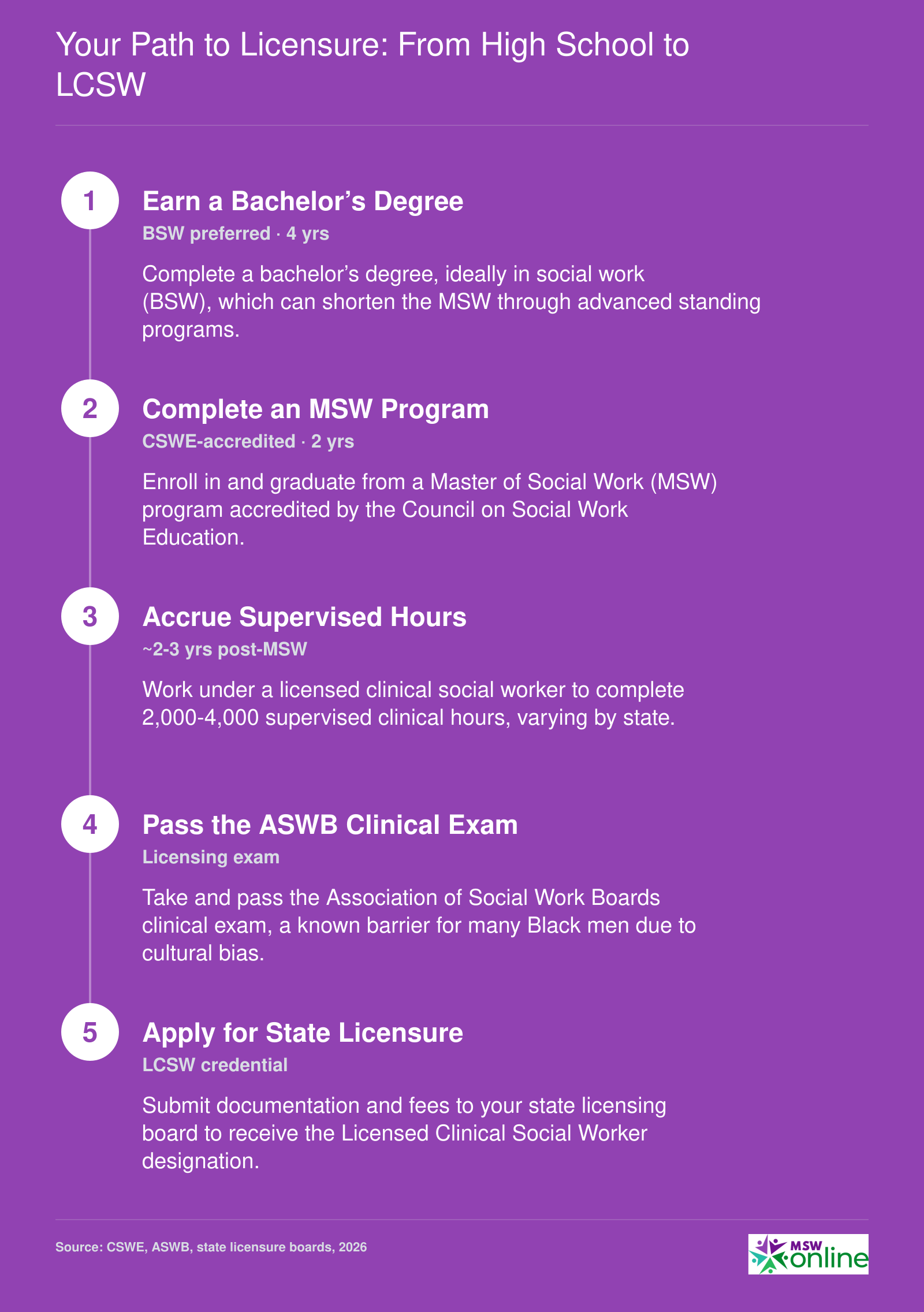
Your Path to Licensure: From High School to LCSW
For Black men entering social work, the route to clinical practice follows a clear sequence, though financial and licensure barriers can lengthen the timeline. This step-by-step pathway outlines the standard progression from undergraduate education to LCSW licensure.
Breaking Down the Barriers: Financial, Cultural, and Systemic Challenges
The official path to social work licensure promises a straightforward, merit-based journey, but for Black men, the reality is a labyrinth of financial strain, cultural bias, and systemic barriers. A study published in the Journal of Black Psychology, led by Aaron Mallory, founder of GRO Community, underscores how these hurdles compound, discouraging Black men from entering and advancing in mental health careers.
Financial Burdens and the Debt Trap
Pursuing a social work career demands significant financial investment. An MSW program alone can cost tens of thousands of dollars, and many Black students carry undergraduate debt before they begin. Mallory’s research identifies student debt and limited funding as primary barriers that delay or derail advanced degrees. For men of color, MSW scholarships and assistantships are scarce, and the low starting salaries in social work often fail to offset the debt load. This economic pressure forces many to either abandon the field or settle for nonclinical roles that do not require licensure.
Licensure Exam Bias and the Cost of Failing
The ASWB exam required for LCSW licensure has long faced scrutiny for cultural bias. Data from 2021 reveals a stark gap: among first-time test-takers, 45% of Black candidates passed compared to 85% of white candidates.1 Even after multiple attempts, eventual pass rates were 57% for Black test-takers versus 91% for their white peers. Mallory describes the exam as demanding “a shift from the dominant perspective,” forcing Black test-takers to set aside their own cultural frame. “Some people significantly struggle with being able to turn it on and off,” he notes, “so you have this situation where a lot of Black men try to get the license and just fail multiple times over and over.” Each failed attempt costs more money and prolongs the wait for a stable income, creating a punishing cycle.
Cultural Stigma and the Weight of Masculinity
Cultural stigma around mental health and traditional definitions of masculinity discourage many Black men from considering social work as a profession. Mallory’s interviews reveal that lived experiences with trauma, grief, and unmet mental health needs actually motivate Black men to enter the field, but they often face criticism from family and peers who view helping professions as “women’s work” or a sign of weakness. This internal conflict can undermine confidence and persistence, especially without strong mentorship.
Intersectional Challenges: LGBTQ+ and Immigrant Black Men
Black men who are also LGBTQ+ or immigrants navigate additional layers of discrimination. They may encounter homophobia within their communities, racism within the profession, and cultural isolation in educational settings. Emerging research highlights how these overlapping identities amplify financial insecurity, licensing stress, and mental health strain, making it even harder to thrive in social work.
Toward Systemic Reform
Addressing these barriers demands systemic change. Researchers and advocates call for redesigning the ASWB exam to eliminate cultural bias, expanding financial aid and loan forgiveness programs for men of color, and embedding culturally responsive curricula in MSW programs. Mentorship and professional representation are critical, but they must be supported by structural reforms that make the pathway financially viable and psychologically welcoming. Without such shifts, the social work field will continue to lose the diverse voices needed to serve Black communities effectively.
Questions to Ask Yourself
Mentorship, Scholarships, and Professional Networks
How can you fund your social work education and build the professional network that will carry you through licensure and career hurdles?
Scholarships and Fellowships for Black Men in Social Work
Several organizations directly invest in Black men entering social work. Start with these opportunities:
- NABSW Scholarships: The National Association of Black Social Workers awards funds to active NABSW members enrolled in BSW or MSW programs. Priority often goes to students demonstrating community leadership.
- Verne LaMarr Lyons Memorial Scholarship: Offered through the NASW Foundation, this scholarship supports MSW students committed to health or mental health practice in African American communities.
- CSWE Carl A. Scott Memorial Book Scholarships: Two $500 awards from the Council on Social Work Education go to BSW or MSW students each year who show a deep commitment to equity and social justice.
- Patty Gibbs-Wahlberg Scholarship: BSW students who are members of the Phi Alpha honor society can receive $1,000 to $3,000 to offset tuition and expenses.
- CSWE Minority Fellowship Program: This program provides stipends, training, and mentorship for racial and ethnic minority students in MSW programs focusing on mental health or substance use services with underserved populations.1
Additional school-specific diversity awards exist at many HBCUs and other universities. Check with your financial aid office for named scholarships targeting underrepresented groups, and browse our social work scholarships guide for additional funding.
Mentorship and Professional Networks
Structured mentorship often makes the difference between leaving and staying. Key networks include:
- Black Men in Social Work: An Instagram-based community that connects students and practitioners for peer support, job leads, and real-time career advice.
- NABSW Student Circles: Local and national circles offer mentoring, advocacy training, and a buffer against isolation during field placements.
- NASW Mentorship Initiatives: The National Association of Social Workers runs formal and informal mentorship programs through state chapters, matching early-career professionals with seasoned social workers.
- HBCU Alumni Groups: Many HBCU social work programs maintain active alumni networks that pair current students with graduates working in clinical, macro, and school settings.
Some fellowships embed mentorship directly. The CSWE Minority Fellowship Program assigns mentors,1 and the CSWE Substance Use Disorders Education and Leadership Scholars Program includes structured mentoring as part of the award.
How Support Translates to Career Success
Financial aid removes the paywall that blocks many Black men from completing advanced degrees. Mentorship provides the navigational capital to clear licensure exams, negotiate job offers, and sustain a career in a field where Black male representation remains low. Studies on pipeline programs consistently show that structured peer and professional support raises persistence rates, particularly through licensure testing. Social work demands emotional stamina; having a network that reflects your lived experience can be the single factor that keeps you in the profession long enough to change it.
Related Articles
Black Male Social Worker Salary: What You Can Earn by Setting and State
Black male social workers can earn a wide range of salaries depending on their setting, state, and years of experience. Because compensation is shaped by many variables, including employer type, licensure level, and local demand, prospective and current social workers should consult multiple data sources to build a realistic picture of earning potential.
National and State Trends from the U.S. Bureau of Labor Statistics
The U.S. Bureau of Labor Statistics (BLS.gov) is the most authoritative starting point for salary benchmarks. The BLS publishes national median wages for social workers overall and breaks them down by industry (e.g., hospitals, individual and family services, government) and by state or metropolitan area. You can also filter by years of experience by reviewing percentile wage estimates: entry-level salaries often fall near the 10th percentile, while seasoned clinicians may reach the 90th. For Black men entering the field, this data reveals which regions and workplaces offer the strongest compensation, which is crucial for planning where to build a career.
Professional Association Salary Surveys
The National Association of Social Workers (NASW) regularly conducts member salary surveys and publishes state-specific compensation reports. These resources often go deeper than government data, capturing nuances like salary differences by licensure level, such as the lcsw salary vs msw differential, and variations by practice area (e.g., school social work vs. clinical private practice). Membership may be required for some reports, but state chapters frequently release summary findings that can inform your job search or salary negotiation.
University Graduate Reports
Many universities with schools of social work track the early-career earnings of their alumni and publish starting salary ranges broken down by setting. These reports offer a ground-level view of what recent graduates, including Black men, are actually securing in their first roles. Check the career services pages of BSW and MSW programs in your target geographic area; even if you are not a student, these public documents can set realistic expectations for post-graduation income.
Real-World Data from Professional Networks
Platforms like LinkedIn Salary and Glassdoor let you filter compensation data by job title, location, and years of experience, adding a layer of real-world context. Searching for roles such as “Licensed Clinical Social Worker” or “School Social Worker” in a specific city can reveal current ranges posted by employers. While these figures are self-reported and may fluctuate, they help you benchmark offers and identify metropolitan areas where social worker salaries outpace the local cost of living. For Black male social workers, being armed with concrete, localized data is a powerful tool during hiring discussions and performance reviews.
For Black clients, a therapist who shares their racial and gender identity can dismantle decades of cultural mistrust. Black male social workers model that emotional wellness is not a betrayal of masculinity but a form of strength, leading to greater openness and better treatment outcomes. This representation is not symbolic: it is a direct intervention that makes care accessible and acceptable.
Making a Difference: Impact on Black Communities and Client Outcomes
Black male social workers deliver measurably stronger engagement and treatment outcomes for Black clients than any other provider group. When a client sees a clinician who not only understands systemic racism but has lived its effects, the entire therapeutic relationship shifts. This shared experience cuts through cultural mistrust, lowers stigma, and opens a door to authentic healing that generic cultural competency training cannot replicate.
Building Trust Through Shared Identity
For many Black men, entering therapy or social services means navigating a system they have learned to distrust. A practitioner who shares their racial and gender identity immediately reduces that instinctive wariness. Clients report feeling less need to explain cultural context, less fear of being judged through a pathological lens, and more willingness to disclose deeply personal struggles. This trust shortcut directly impacts attendance, medication adherence, and honest participation in treatment planning. The presence of a Black male social worker silently communicates that help is possible without abandoning one's identity.
The Evidence on Racial Matching
A growing body of social work research and practice confirms that racial matching between client and therapist strengthens the therapeutic alliance, which predicts positive outcomes. Research consistently shows that Black clients paired with Black clinicians report higher satisfaction, perceive greater empathy, and remain in treatment longer. These effects are especially pronounced when addressing trauma, substance use, and family dynamics where cultural nuance is critical. While a same-race match is not mandatory for effective care, it removes a barrier that many clients face: the emotional labor of educating a clinician about systemic racism before work on their own goals can begin.
Role Models and System-Level Advocates
Black male social workers do more than treat individuals. They model a new version of masculinity that values emotional health and help-seeking. In communities where mental health talk has long been silenced, seeing a professional who looks like them can reframe what strength means. Beyond direct practice, these professionals serve as relentless advocates for culturally responsive policies, pushing agencies to revise biased intake tools, hire diverse staff, and fund programs that actually reach Black men. Their influence multiplies: each Black male social worker trains non-Black colleagues, challenges clinical assumptions, and rewrites the script on who provides care.
The Road Ahead: Recruitment, Retention, and Policy Changes
Policy reforms can open doors, but without transformative mentorship and visible role models, those doors often remain unused. Increasing the number of Black men in social work demands both systemic change and interpersonal investment. The most effective strategies combine broad institutional overhaul with grassroots, person-to-person support that builds confidence and a sense of belonging.
Building the Pipeline from High School to Licensure
Proven pipeline programs often start early. Health and human services career academies in secondary schools introduce Black boys to social work long before college decisions are made, offering dual-enrollment credit and direct exposure to the field. When these academies partner with historically Black colleges and universities (HBCUs), the transition is seamless. Black students at HBCUs graduate at rates roughly 10 percentage points higher than their peers at non-HBCUs1, in part because these institutions embed cultural affirmation and targeted support into the curriculum. Several HBCU social work departments now offer accelerated BSW-to-MSW tracks that shorten time to licensure and reduce total tuition. For older career changers, bridge programs recognize frontline experience, such as community health work, and provide structured academic pathways that would otherwise feel out of reach.
Reforming Licensure and Removing Financial Barriers
Systemic reforms must address the licensure exam, widely criticized for cultural bias that forces test-takers to shift from their own lens to a dominant perspective. A thorough bias review of the ASWB clinical exam (with ongoing validation studies that include diverse panels) is long overdue. Policy levers also include expanding minority fellowship programs, such as the Council on Social Work Education’s Minority Fellowship, and tying loan forgiveness to years of service in underserved areas. These financial incentives do more than offset debt; they signal that institutions are serious about dismantling barriers that push Black men out of graduate programs before they reach the licensure gate.
Creating Supportive Climates Through Mentorship and Accountability
Formal mentorship programs can boost graduation rates for Black male students by up to 20 percent2. Universities and employers alike should invest in structured mentoring, pairing aspiring Black male social workers with seasoned practitioners who share similar backgrounds, and measure their effectiveness. Beyond mentorship, organizational climates must be intentionally inclusive: hiring panels should be diverse, curricula must reflect Black experiences, and faculty development should confront implicit bias. Finally, all stakeholders, schools, agencies, licensing boards, should publicly track and report diversity metrics, including enrollment, retention, and licensure pass rates disaggregated by race and gender. Transparency creates accountability, and accountability fuels progress that goes far beyond good intentions.
Frequently Asked Questions About Black Men in Social Work
Prospective Black male social workers often have unique questions about entering and thriving in the field. Here are answers to some of the most common queries, drawing on broad trends and reliable resources.