

Points of interest…
- MSWs pivoting to corporate or consulting roles can earn 50 to 100 percent more.
- Thunder Rosa moved from social work caseloads to an AEW championship.
- Licensure stays valuable but is not required for most nontraditional roles.
Social work graduate programs are built on a clinical foundation: two to three years of diagnostic training, therapeutic modalities, and exam prep for state licensure. But a growing number of graduates are stepping away from direct practice, bringing those same skills into corporate consulting, tech, and entertainment. Burnout explains part of the shift; social workers report emotional exhaustion rates that rank among the highest of any profession. Transferable skills explain the rest. Thunder Rosa's jump from a social work caseload to an AEW championship is only the most visible example of how an MSW's value extends far beyond the therapy room. If you are weighing a career change with your MSW, employers outside healthcare now pay for the same capacity to read a room, manage crisis, and advocate that social workers refine every day.
Why MSW Graduates Are Thriving Outside Traditional Social Work
Why are so many licensed social workers leaving direct practice within five years of graduation?
Burnout is the blunt answer. Social workers report some of the highest emotional exhaustion rates of any helping profession, driven by high caseloads, low pay relative to educational investment, and chronic exposure to trauma. While exact attrition figures vary by employer and region, workforce surveys consistently show that a substantial share of MSW graduates migrate away from clinical roles before mid-career. The result is a quiet but accelerating talent shift: thousands of trained social workers now apply their degrees in corporate wellness, technology, policy advocacy, and even entertainment.
The Broadening Value Proposition of the MSW
Employers outside traditional social services are waking up to what MSW programs have taught for decades: human behavior is complex, systems shape outcomes, and empathy scales. Tech companies building mental health apps hire MSWs to design user experiences grounded in trauma-informed care. Corporations launching diversity, equity, and inclusion initiatives recruit social workers who understand power dynamics and facilitation. Hospitals expanding patient navigation and care coordination prefer candidates fluent in case management and community resources. The MSW is no longer a credential reserved for therapy offices and foster-care agencies. It is increasingly recognized as a versatile graduate degree suited to any role that centers people.
Four Macro Trends Driving Demand for MSW Skills
Several forces are pulling social work talent into nontraditional markets:
- DEI mandates: Organizations under regulatory or stakeholder pressure to improve workplace culture are hiring MSWs to lead employee resource groups, conduct equity audits, and train managers in trauma-informed supervision.
- Corporate wellness and employee assistance: As mental health becomes a retention priority, companies are embedding licensed social workers in HR departments to deliver counseling, crisis intervention, and benefits navigation.
- Digital health and telehealth: Startups and health systems scaling virtual care need clinical advisors, program managers, and quality-assurance leads who understand both therapy and technology.
- ESG reporting and social impact: Firms measuring environmental, social, and governance performance hire MSWs to design community-engagement strategies, assess social risk, and communicate impact to investors.
Nationally, about one-third of MSW holders work in private nonprofit settings (33.3 percent), 17.4 percent in outpatient healthcare, and 15.2 percent in government agencies.1 Hospitals employ another 9.5 percent.1 But those categories mask a growing share in tech startups, consulting firms, and corporate roles that did not exist a decade ago. Nearly 68.5 percent of MSWs serve clients below the poverty line at some point in their careers, a testament to the profession's mission.1 Yet mission and livelihood need not conflict. Many social workers now blend advocacy with competitive salaries by moving laterally into sectors that value their training. The Bureau of Labor Statistics projects career opportunities in social work will grow 6 percent from 2024 to 2034, with roughly 74,000 annual openings nationwide.2
A Practical Roadmap, Not Just Inspiration
This article is not a feel-good listicle. It is a concrete guide to real careers, published salary ranges, licensure considerations, and step-by-step transition tactics. Whether you are a recent MSW graduate questioning your clinical placement, a seasoned LCSW craving a change, or a student weighing concentrations, the sections ahead map fifteen unconventional roles, compare earnings across industries and states, and outline exactly which credentials matter when you leave the therapy room. If you trained to help people, you can do that anywhere. The question is where you will do it best.
Thunder Rosa: From Social Worker to AEW Champion
Few career pivots illustrate the versatility of social work training quite like the journey of Thunder Rosa, the professional wrestler who went from managing caseloads to capturing championship gold. Her story is not just a curiosity. It is a case study in how the competencies built through social work practice translate to high-pressure, performance-driven environments that seem worlds apart from clinical settings.
From Rehab Center to the Ring
Thunder Rosa, a University of California, Berkeley graduate in sociology, spent years working as a social worker at a rehab facility called Thunder Road, which later inspired her ring name.1 From the late 2000s through the mid-2010s, she helped individuals navigate addiction recovery, crisis situations, and systemic barriers to stability.2 In 2014, she began training as a professional wrestler, balancing both careers simultaneously for several years.3 The tipping point came when income from the third season of Lucha Underground surpassed her social work salary, and she recognized that a larger platform could amplify the advocacy she had always pursued.3 She went on to compete for both All Elite Wrestling (AEW) and Consejo Mundial de Lucha Libre (CMLL), eventually becoming the first Mexican-born AEW Women's Champion in 2022.4 In an interview with Fox News Digital, she discussed how her background in social work shaped her approach to the sport.4
Social Work Skills in the Squared Circle
What makes Thunder Rosa's trajectory relevant to MSW holders is not the wrestling itself. It is the skills map. Consider how core social work competencies operate in her second career:
- Empathy: Reading opponents and live audiences requires the same attunement to nonverbal cues and emotional states that social workers develop through years of client interaction.
- Crisis intervention: In-ring performance demands split-second decisions under physical and psychological stress, mirroring the rapid assessment and de-escalation skills central to clinical and community practice.
- Advocacy: Thunder Rosa has consistently used her platform for outreach and community involvement, extending her social work ethos to a global audience rather than leaving it behind.2
- Resilience: The physical and emotional toll of professional wrestling parallels the sustained demands of social work, where social worker burnout is a constant occupational hazard and endurance is a survival skill.
These are not loose metaphors. They are direct applications of competencies that MSW programs deliberately cultivate through coursework, field placements, and supervised practice.
The Bigger Lesson for MSW Graduates
Thunder Rosa's story works best as a lens, not just an anecdote. If the interpersonal acuity, high-stakes decision making, and advocacy skills built through social work training can thrive in a wrestling ring, consider what they unlock in environments that are structurally closer to social work: corporate consulting, public policy, user experience research, health care administration, or organizational leadership. Her path also shows how social work in college athletics and sport represents just one of many nontraditional settings where these skills already have an established foothold.
The extreme nature of her example is exactly the point. It forces a reframe. MSW graduates often underestimate the breadth of their training because they measure it against a narrow set of traditional roles. Thunder Rosa measured hers against an arena, literally, and found the fit. The sections ahead map out 15 unconventional careers where the same transferable skills open doors you may not have considered yet.
Questions to Ask Yourself
15 Unconventional Careers You Can Pursue With an MSW
The boundaries of social work employment have expanded far beyond clinical settings, with employers across industries increasingly recognizing that MSW graduates bring research skills, systems thinking, and human behavior expertise that translate directly to corporate, nonprofit, and entrepreneurial roles. If you have been trained to assess complex situations, navigate institutional barriers, and advocate for change, you already possess competencies that hiring managers in dozens of fields are actively seeking. MSW degree jobs span a wider range than most graduates realize.
Corporate and Consulting Roles
Several high-growth corporate positions align closely with MSW training:
- Human Resources Specialist: Median annual wage of $72,910 with 6% projected job growth through 2034.1 MSW graduates excel in employee relations, conflict resolution, benefits counseling, and workplace wellness initiatives. Your training in cultural competence and interviewing translates directly to talent acquisition and retention.
- Management Analyst: Median annual wage of $101,190 with 11% projected growth.1 Organizations hire consultants to improve efficiency and solve operational problems. MSW holders bring a unique lens, particularly in healthcare systems, nonprofits, and government agencies where understanding human dynamics is essential to organizational change.
- Training and Development Manager: Median annual wage of $127,090 with 7% projected growth.1 This role involves designing learning programs, coaching leadership teams, and building organizational capacity. Social workers who have facilitated groups, developed curricula, or supervised staff already have a foundation for this work.
- Market Research Analyst or UX Researcher: Median annual wage of $76,950 with 8% projected growth.1 Understanding user needs, conducting interviews, and synthesizing qualitative data are core social work skills. Tech companies and consumer brands increasingly value researchers who can empathize with diverse populations and translate insights into actionable recommendations.
Mediation, Policy, and Advocacy
Social workers trained in conflict resolution and systems advocacy can pivot into roles that shape policy or facilitate agreement:
- Mediator or Arbitrator: Median annual wage of $67,710 with 4% projected growth.1 Family court mediation, workplace dispute resolution, and community mediation programs all draw on skills MSW holders develop in crisis intervention and negotiation.
- Policy Analyst or Political Scientist: Median annual wage of $139,380 with 3% projected growth.1 This path suits MSW graduates interested in research, legislative advocacy, or think tank work. Political social work career paths offer a direct channel for applying your ability to analyze social problems, evaluate interventions, and communicate findings to diverse audiences.
Health, Education, and Nonprofit Leadership
- Health Education Specialist: Median annual wage of $63,000 with 7% projected growth.1 If you have experience in community health, public health social work, or health promotion, this role allows you to design and implement prevention programs at the population level.
- Fundraiser: Median annual wage of $68,630 with 6% projected growth.1 Nonprofit development relies on relationship-building, storytelling, and understanding donor motivations. MSW graduates who have written grants, cultivated community partnerships, or led volunteer programs are well positioned for major gifts or institutional fundraising roles.
Additional Paths Worth Exploring
Beyond the roles with BLS data above, MSW holders have moved into:
- Executive coaching and leadership development
- Patient experience and advocacy roles in hospitals
- Diversity, equity, and inclusion consulting
- Corporate social responsibility and environmental, social, and governance strategy
- Life coaching and wellness entrepreneurship
- Restorative justice facilitation
- Entertainment and media consulting on mental health portrayals
These positions may not require clinical licensure but do require you to articulate how your MSW prepared you for the work. Employers in these fields care less about your degree title and more about demonstrated competencies: Can you facilitate difficult conversations? Can you analyze data and present it persuasively? Can you build trust with stakeholders who have competing interests?
Making the Leap
Moving into an unconventional role often requires reframing your experience. Translate clinical language into business terms. Describe therapy groups as "facilitated team development." Recast case management as "complex project coordination." Quantify your outcomes whenever possible. Employers outside social work may not understand what a LCSW does, but they understand results.
The career paths listed here are not compromises or departures from social work values. They are extensions of those values into new contexts, places where your skills can create systemic change, improve organizational culture, or advance justice at scale.
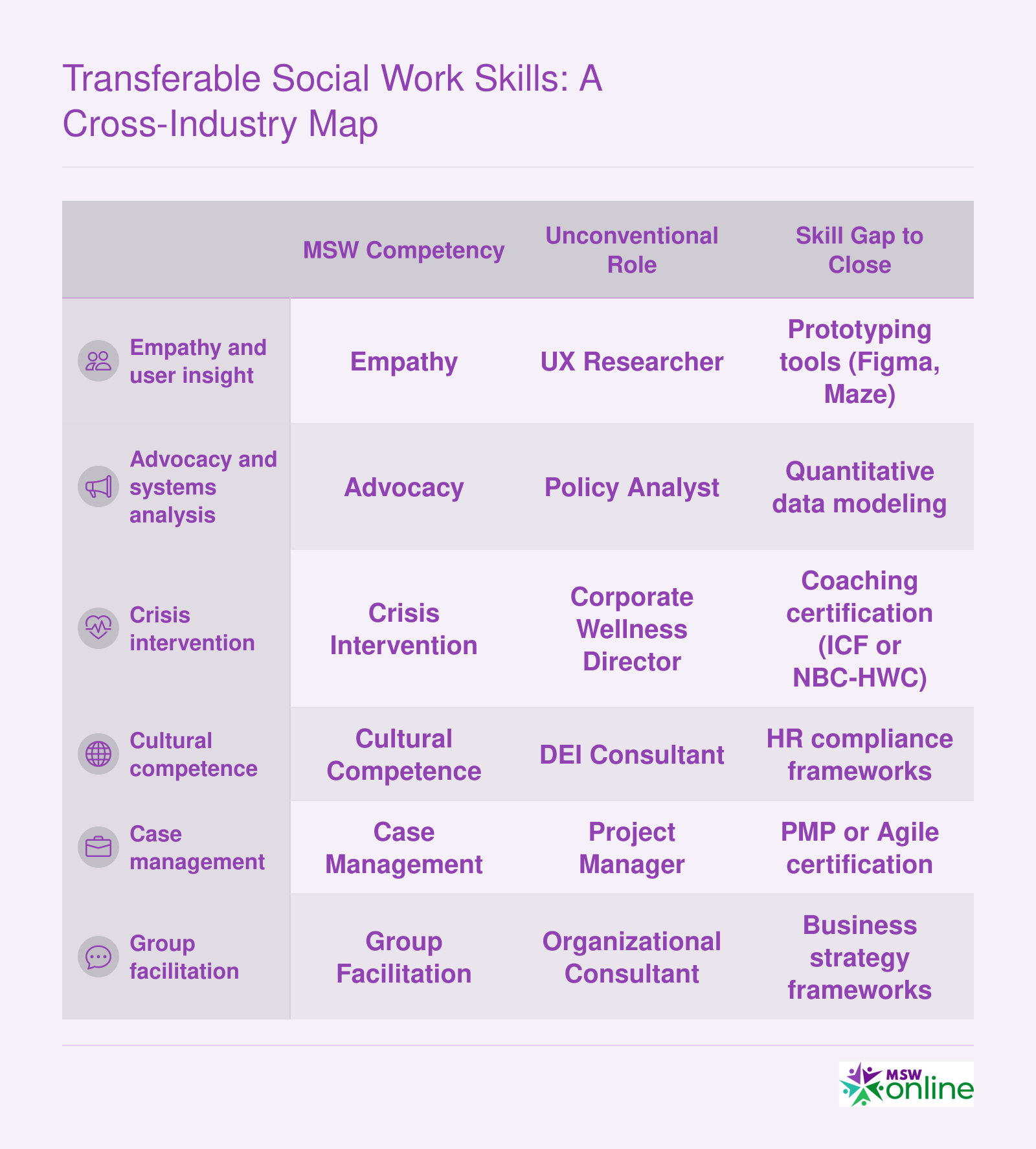
Transferable Social Work Skills: A Cross-Industry Map
Your MSW trained you in competencies that employers across industries actively seek. The challenge is recognizing which skills translate directly and where you may need to close a gap. This cross-industry map pairs six core MSW competencies with unconventional roles and flags the additional credential or tool you would need to make the leap.
MSW Salary Comparison: Traditional Vs. Unconventional Roles
The table below compares median and mean annual wages for traditional social work roles tracked by the Bureau of Labor Statistics. While federal data captures conventional positions well, earnings for unconventional MSW careers (such as corporate consulting, user experience research, mediation, or entrepreneurship) are not reported under standard social work occupation codes, making direct comparisons difficult. What the data does show is that traditional social work salaries cluster in a relatively narrow band, which helps explain why many MSW holders explore nontraditional paths where compensation ceilings can be significantly higher.
| Role | Total Employed | Median Annual Wage | Mean Annual Wage | 25th Percentile | 75th Percentile |
|---|---|---|---|---|---|
| Child, Family, and School Social Workers | 382,960 | $58,570 | $62,920 | $47,480 | $74,060 |
| Healthcare Social Workers | 185,940 | $68,090 | $72,030 | $55,360 | $83,410 |
| Social Workers, All Other | 64,940 | $69,480 | $74,680 | $52,010 | $95,390 |
| Social Workers (Broad Category) | 759,740 | $61,330 | $67,050 | $48,680 | $78,500 |
Highest-Paying States for Social Workers
Where you practice can significantly influence your earning potential, whether you stay in a traditional role or pivot toward something unconventional. The table below draws from the most recent Occupational Employment and Wage Statistics published by the U.S. Bureau of Labor Statistics (2024 data) and breaks out median annual wages across three major social work categories. States that pay well in one specialty do not always lead in another, so location strategy matters when planning your next move.
| State | Child, Family, and School Social Workers (Median) | Healthcare Social Workers (Median) | Social Workers, All Other (Median) |
|---|---|---|---|
| California | $69,250 | $92,970 | N/A |
| Connecticut | $78,940 | $81,900 | N/A |
| District of Columbia | $78,920 | $92,600 | N/A |
| Massachusetts | $67,880 | N/A | $94,000 |
| New Jersey | $78,150 | $81,710 | N/A |
| Washington | $72,290 | $75,670 | $96,550 |
| Georgia | N/A | N/A | $92,750 |
| Oregon | N/A | $85,150 | N/A |
| South Carolina | N/A | N/A | $91,940 |
| Delaware | N/A | N/A | $91,710 |
| Texas | N/A | N/A | $89,520 |
| Maryland | $70,840 | N/A | $77,900 |
| Minnesota | $65,010 | $72,330 | $79,220 |
| Hawaii | $66,450 | $84,640 | N/A |
| Rhode Island | $67,150 | $79,460 | N/A |
Traditional clinical social workers earn a national median of $55,000 to $62,000 (Bureau of Labor Statistics), while MSWs who pivot into management analyst, human resources manager, or training director roles command $80,000 to $120,000 or more. That's a 50 to 100 percent salary premium for the same foundational degree, proof that where you apply your MSW matters as much as the credential itself.
Do You Still Need Licensure? LMSW and LCSW in Nontraditional Roles
One of the most persistent anxieties among MSW graduates considering a career pivot is whether stepping outside clinical practice means their license becomes useless, or worse, a liability. The reality is more nuanced: licensure requirements depend entirely on what you are doing, not simply on whether your job title includes the word "social work."
Three Categories of Roles
Think about nontraditional careers in three distinct buckets.
The first bucket includes roles where licensure is legally required. If your work involves diagnosing mental health conditions, providing psychotherapy, or delivering any form of clinical treatment, you need a clinical license, full stop. Employee assistance program counselors who function as direct clinical providers fall squarely here,1 and employers will verify credentials before hire.
The second bucket covers roles where a license is a competitive advantage but not a legal requirement. Corporate wellness program directors, human resources business partners with a mental health focus, and health coaches benefit enormously from holding an LMSW or LCSW because the credential signals credibility.1 Employers in these spaces increasingly value licensed candidates, even when no law compels them to hire one.
The third bucket is roles where licensure is simply irrelevant to the job function. UX research, corporate social responsibility strategy, grant writing, and most policy analyst social work positions do not require a social work license of any kind.1 Your MSW coursework and field experience matter; the credential on your wall does not.
LMSW vs. LCSW: What Each Credential Actually Covers
The LMSW, earned after passing the ASWB Masters exam,1 authorizes the holder to practice social work under supervision. It does not authorize independent clinical diagnosis or treatment. The LCSW supervision hours and exam requirements are more demanding: an MSW with clinically relevant coursework,3 at least 3,000 hours of supervised post-degree clinical experience with a minimum of 100 supervision hours, and a passing score on the ASWB Clinical exam.3 That higher bar reflects a broader scope: independent clinical practice.
One important wrinkle worth knowing: some states protect the title "social worker" by statute, meaning you may need a license even in a nonclinical role simply to use that professional title.1 If your business card or LinkedIn profile carries the designation, check your state board's rules.
State-by-State Variation
Licensure is regulated at the state level, and the differences are not trivial. California, for example, does not have an LMSW category at all. Pre-licensed clinicians register as Associate Clinical Social Workers before advancing to the LCSW.4 Florida requires 1,500 supervised clinical hours and 100 supervision hours for LCSW licensure,5 compared to the 3,000-hour national benchmark. Texas offers an Independent Practice Recognition designation that allows LMSW holders to practice nonclinical social work independently,6 a useful option for those building consulting or coaching practices without pursuing full clinical licensure.
North Carolina draws a clean line: the LCSW is required for clinical practice, while nonclinical certifications remain voluntary.7 That clarity is not universal, which is why a direct conversation with your state licensing board is essential before making any career decisions based on assumptions.
The Fear of Wasting Your License
Many social workers worry that pivoting away from clinical work means abandoning years of supervised hours and exam preparation. That fear is largely unfounded. A license does not expire the moment you take a nontraditional role. Most states allow you to maintain an active license through continuing education requirements while working in a nonclinical capacity. If you later return to clinical practice, your credential travels with you, provided you have kept it current.
If maintaining the license feels like an unnecessary expense during a long-term pivot, you can let it lapse and reapply later, though reinstatement processes vary and some states impose additional requirements after a lapse. The safer and more flexible choice for most people is maintenance.
For the most current continuing education requirements, renewal cycles, and title-protection rules in your state, go directly to your state's social work licensing board. National resources such as the Association of Social Work Boards provide exam information and general guidance,8 but state boards hold the binding authority.
Related Articles
How to Transition: A Step-By-Step Career-Change Framework
A career pivot with an MSW isn't a leap of faith , it's a structured project. Use this five-step process to move from social work into a field that matches your ambition, without starting over.
1. Conduct a Skills Audit
Inventory every competency you built through coursework, MSW field placements, and professional practice. Think beyond clinical skills: group facilitation, crisis de-escalation, case management, motivational interviewing, policy analysis, and community needs assessment all transfer to corporate, tech, and entrepreneurial roles. Map each skill to the language of your target industry. For example, "conducting biopsychosocial assessments" becomes "stakeholder needs analysis and risk evaluation" in a project management context. This translation is the foundation of your new professional narrative.
2. Perform a Gap Analysis
Identify what's missing. If you're eyeing UX research, do you understand usability testing tools? For HR roles, are you fluent in employment law and talent acquisition software? List required credentials, domain knowledge, and technical proficiencies. Then prioritize gaps by impact: which ones immediately disqualify you, and which can be learned on the job? This step prevents overspending on unnecessary training and keeps your timeline realistic.
3. Strategically Credential Up
Targeted certifications for social workers signal commitment and bridge knowledge gaps faster than another degree. Choose based on your target role: - PMP (Project Management Professional): $400, $600 exam fee, 35 required training hours, and 3, 5 years of work experience; ideal for corporate program or operations manager pivots.1 - SHRM-CP: $300, $475 exam fee, 1, 3 months prep; best for HR generalist, people operations, or employee relations roles.2 - Google UX Design Professional Certificate: $240, $360, approximately 6 months self-paced; opens doors to UX research and design positions. - ICF-Accredited Coaching Credential (ACC): $3,000, $11,000, 12, 24 months; powerful for launching a coaching or consulting practice.4 - Certified ScrumMaster: $500, $1,200, 2-day course; valuable for agile project environments and tech-adjacent roles.1
4. Engage in Strategic Networking
Join professional associations outside social work, such as the Project Management Institute, SHRM, or the Interaction Design Foundation. Attend industry meetups and conferences. On LinkedIn, follow thought leaders in your target sector and comment meaningfully on their posts. Informational interviews are your secret weapon: 15-minute conversations with people doing the job you want often surface unadvertised opportunities and insider advice.
5. Find Bridge Roles
Look for transitional positions that blend social work skills with your target field. Employee Assistance Program (EAP) coordinator roles, for instance, combine counseling expertise with corporate wellness, a natural stepping stone to HR management. Community outreach manager, learning and development specialist, or nonprofit program evaluator can similarly straddle sectors, giving you relevant experience without a sudden break.
Realistic Timeline and a Hidden Advantage
Most career transitions take 6, 18 months, depending on certification requirements and networking pace. Don't overlook your MSW field placement: you can strategically choose practicums aligned with nontraditional goals. An internship in a corporate foundation, policy think tank, or hospital administration department builds your resume before you graduate. This underused advantage can dramatically shorten your post-degree pivot timeline.
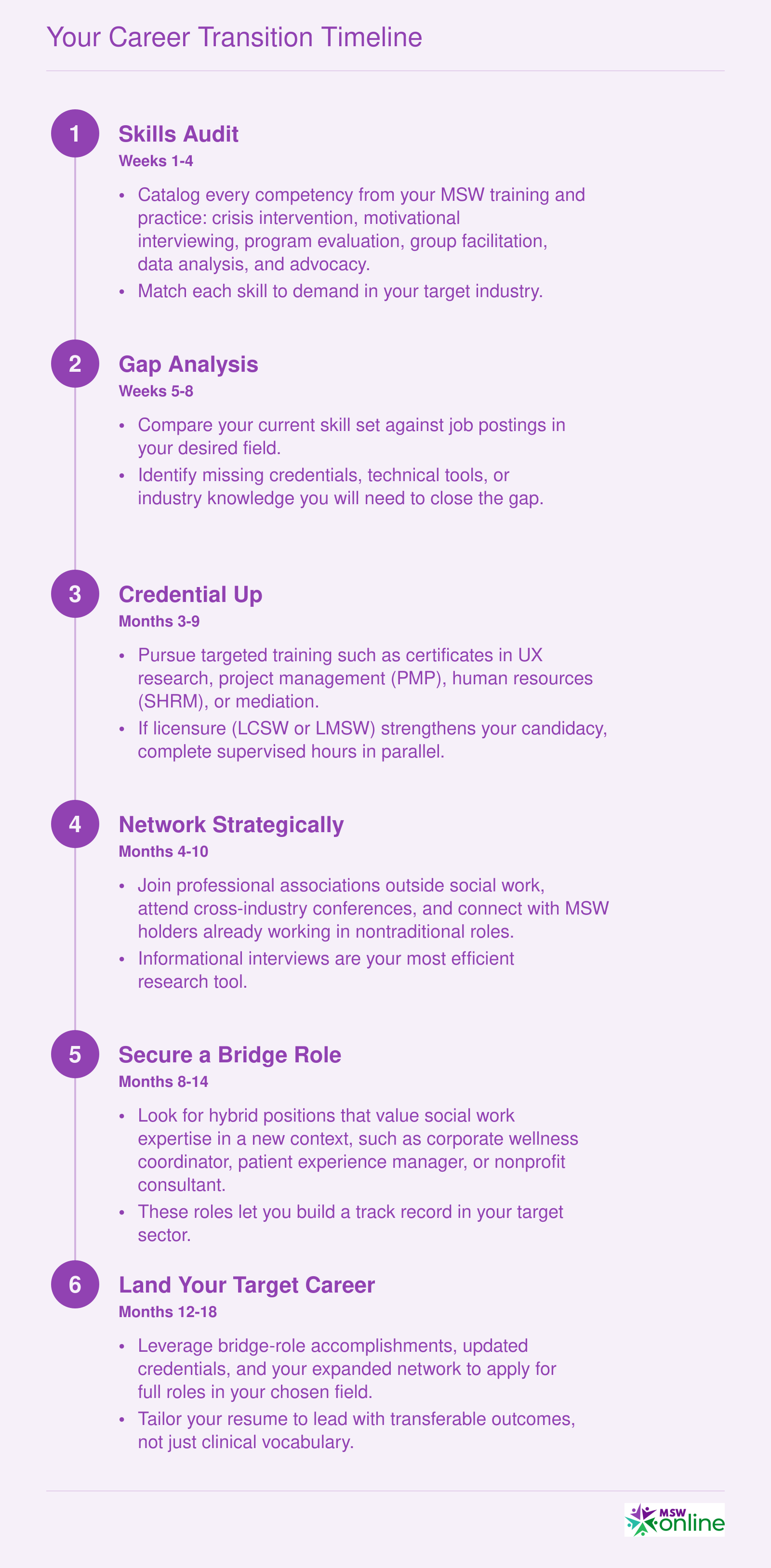
Your Career Transition Timeline
Moving from traditional social work into an unconventional career does not happen overnight, but a structured timeline keeps you on track. Use this framework to map each phase, set realistic deadlines, and build momentum toward your target role.
Which MSW Concentration Prepares You for Unconventional Work?
The tension MSW students face is between building deep clinical expertise, which can feel limiting, and cultivating a versatile skill set that opens doors to leadership, policy, and entrepreneurial roles. Choosing a concentration shapes not just your coursework, but your network, field placements, and the career narrative you tell employers. If you are aiming for a nontraditional path, some specializations offer a clearer runway than others.
Macro/Policy/Management/Leadership: The Obvious Pivot Point
If you want to step directly into systems-level work, this concentration is your strongest asset. Programs in macro practice teach you to analyze policy, manage programs, and advocate for structural change. Unconventional roles that align include: - DEI specialist: Applying advocacy skills to corporate diversity, equity, and inclusion initiatives. - Policy analyst: Working in think tanks, government, or nonprofits to shape legislation. - Consultant: Helping organizations improve social impact or community engagement strategies.
These tracks often lead to titles like social and community service manager or executive director, where the social work lens is a differentiator, not a detour.
Advanced Generalist: Build Your Own Bridge
This concentration blends micro and macro practice, giving you the flexibility to move between direct service and program coordination. It is an ideal launchpad for hybrid careers like: - Program director at a health nonprofit: Overseeing case management while analyzing data to improve outcomes. - Community engagement specialist: Combining counseling skills with outreach and partnership building. - Criminal justice reform coordinator: Using forensic electives to work at the intersection of mental health and legal systems.
Prioritize electives in substance abuse, criminal justice, or gerontology to signal specialized knowledge that atypical employers value. For additional advice on making the most of electives and placements, incoming MSW student tips from practitioners can help you map a sharper academic strategy.
Clinical/Behavioral Health: A Springboard with a Twist
While clinical tracks lead to traditional therapy roles, they also equip you with diagnostic and intervention skills that transfer to unconventional settings.2 Consider: - Private practice entrepreneur: Building a telehealth brand or niche coaching service. - Corporate wellness consultant: Advising companies on employee mental health strategies. - Substance use program designer: Creating treatment models for new populations.
The median wage for mental health and substance abuse social workers was $55,960 in 2022, with 11% projected job growth, but entrepreneurial paths can exceed this.2 For those drawn to leadership within this space, behavioral health leadership career opportunities offer a concrete look at how clinical training scales into management roles.
Public Health and School Concentrations: Narrower but Niche
An MSW/MPH dual degree opens doors to health educator, community health worker, or global health policy roles.3 A school social work concentration is more traditional, but experience in education systems can lead to youth advocacy or EdTech consulting.
To decide, skip the brochure and dig into alumni employment reports on program websites. Reach out for informational interviews with professionals in your target field and ask which concentration they found most relevant. Cross-reference BLS data on roles like community organizer or policy analyst, and review NASW or CSWE surveys on employer perceptions. Your concentration is a signal, not a sentence, but choosing strategically can sharpen your edge.
Common Questions About Unconventional MSW Careers
Below are some of the most common questions prospective and current social workers ask when exploring nontraditional career paths. Each answer draws on the transferable skills, licensure considerations, and career strategies discussed throughout this guide.