
Points of interest…
- MSW and DSW students now face a $20,500 federal loan cap.
- Twenty-five states and D.C. are suing to overturn the rule.
- Social workers earn a median $53,940 to $77,030 per year.
Social work graduate students now face a borrowing cap that fundamentally alters the cost of entering the field.
Under the RISE rule, finalized April 30, 2026, the U.S. Department of Education reclassified MSW and DSW programs as non-professional degrees, cutting annual federal loans from $50,000 to $20,500. The policy follows the One Big Beautiful Bill (P.L. 119, 21) and directly reduces the aid available to aspiring clinical social workers, despite federal projections of 6% job growth through 2034 and a median wage that already makes loan repayment challenging.
With base salaries around $54,000 to $77,000, the new limits could price many students out of graduate training, making social work grants a critical buffer at a time when mental health and social services are already strained.
What Makes a Degree 'Professional' for Federal Student Loans?
The term 'professional degree' in federal student aid is a narrow funding classification, not a judgment about a program's academic quality or career outcomes. It exists solely to determine how much federal student loan money a graduate student can borrow each year. This distinction has enormous practical consequences, especially now that social work degrees have been removed from the professional category.
The Regulatory Definition
Under 34 CFR 668.2, a professional degree is one that requires at least two academic years of pre-professional study before enrollment and is listed in one of nine specific fields: law, medicine, osteopathic medicine, dentistry, veterinary medicine, optometry, podiatric medicine, pharmacy, or divinity. Programs outside this list, regardless of rigor or necessity, are considered non-professional for federal loan purposes.
Why It Matters: Borrowing Limits
The classification triggers sharply different annual and aggregate loan caps. Professional degree students can borrow up to $50,000 per year in federal direct unsubsidized loans, with a cumulative limit of $150,000. All other graduate students fall under the general cap of $20,500 per year and $100,000 aggregate. The gap between $50,000 and $20,500 can easily be the difference between affording a program and abandoning it.
Social Work's Exclusion Under the RISE Rule
The Department of Education finalized the RISE rule on April 30, 2026, implementing changes from the One Big Beautiful Bill. The rule explicitly excludes nursing, and under the same regulatory logic, social work (MSW and DSW) is also excluded. This means that even though social workers fill essential community roles and the profession is projected to grow faster than average, students in MSW programs are now treated as non-professional borrowers, facing the lower loan limits and potentially leaving significant tuition gaps.
Social work (MSW and DSW) no longer meets the federal definition of a professional degree, cutting annual borrowing to $20,500, down from $50,000. This severe reduction makes financing a social work education much harder, despite the field's essential role and projected 6% job growth. Students must now scramble for alternative funding.
Which Social Work Degrees Are Affected? BSW, MSW, and DSW
The reclassification changes how graduate and doctoral social work degrees are treated for federal loans, while undergraduate programs remain untouched. Below is a breakdown by degree level.
Bachelor of Social Work (BSW): Unaffected
BSW programs are undergraduate degrees and already follow undergraduate federal loan limits ($5,500, $7,500 annually for dependent students, $31,000 aggregate). The new professional degree rule doesn't alter these caps or the classification, so BSW students see no direct financial impact.
Master of Social Work (MSW): Loss of Professional Status
The MSW faces the biggest change. Previously, many MSW programs qualified as professional degrees, allowing graduate students to borrow up to $50,000 per year. Now, all MSW programs, whether you’re choosing an online MSW program or a traditional campus track, and whether a two-year or one-year advanced standing plan, face a strict $20,500 annual and $100,000 aggregate limit. Even a one-year MSW can surpass this cap, forcing students to seek private loans.
Doctor of Social Work (DSW): A Harder Path
DSW programs also lose professional status. Unlike a PhD, which often comes with assistantships or stipends (see DSW vs PhD in social work for funding comparisons), DSW programs typically charge full tuition. Under the new rule, DSW students are limited to the same $20,500 yearly federal maximum and $100,000 aggregate cap, potentially making these programs financially out of reach.
Old Vs. New Borrowing Limits for Social Work Graduate Students
For social work graduate students, the new loan limits force a stark choice: find substantial alternative funding or drastically downsize your educational plans. Under the pre‑July 2026 professional classification1, MSW and DSW students could borrow up to $50,000 a year in Direct Unsubsidized Loans2. Now, that ceiling has been cut to just $20,5002, a reduction of nearly 60%. The aggregate lifetime cap also plunges from $200,000 to $100,0003, a figure that may cover only one year of a pricey private program.
Borrowing Caps at a Glance
The table below compares the key federal loan options before and after the July 1, 2026 reclassification. Note that Grad PLUS loans are no longer available to new borrowers entering social work programs after that date.3
| Loan Type | Old (Professional) Limit | New (Non‑Professional) Limit |
|---|---|---|
| Direct Unsubsidized , Annual | $50,000 | $20,500 |
| Direct Unsubsidized , Aggregate | $200,000 | $100,000 |
| Grad PLUS (new borrowers) | Up to cost of attendance | Not available |
| Grad PLUS (legacy borrowers)* | Up to cost of attendance | Up to cost of attendance (phase‑out by 2029) |
*Legacy borrowers: those who had outstanding Grad PLUS loans before July 1, 20263, may continue to borrow Grad PLUS for up to three academic years, ending June 30, 2029.
What the Numbers Mean for Tuition Bills
With the annual Direct Unsubsidized limit now at $20,5002, a student attending a program with $40,000, $60,000 tuition faces an immediate shortfall of $19,500, $39,500, *before* accounting for living expenses. Previously, the $50,000 cap and Grad PLUS option could cover most costs. Today, unless you are a legacy borrower, Grad PLUS is off the table entirely3, leaving private loans, msw financial aid and scholarships, or employer assistance as the only bridges.
The Aggregate Crunch for Multi‑Year Programs
The aggregate cap falling from $200,000 to $100,0003 hits hardest for students in extended or dual‑degree programs. An MSW typically spans two years, but many students take three or combine with another degree. Under the new rules, total Direct Unsubsidized borrowing across all graduate years cannot exceed $100,0003. For a two‑year program, that is $50,000 per year, far above the annual $20,500 limit, but in reality the lifetime cap may force tough choices if tuition rises or if a student switches programs.
Am I Grandfathered? Key Dates and Cutoffs for Current Students
Will my current MSW enrollment protect my loan limits? The short answer is: it depends on when you took out your first federal loan for your program and whether you stay continuously enrolled.
The July 1, 2026 Dividing Line
The new borrowing caps take effect on July 1, 2026.2 If your first Direct Loan for a professional program (including MSW or DSW) was disbursed before that date, you may qualify as a legacy borrower. That means you could keep the old, higher limits for the remainder of your program, as long as you meet all the conditions.
Grandfathering Rules for Current Students
To retain the previous $50,000 annual and $200,000 aggregate limits1, you must: - Enrollment: Have been enrolled in an eligible program on or before June 30, 2026.2 - Loan Disbursement: Have received your first Direct Loan for that program before July 1, 2026.2 - Continuous Enrollment: Remain enrolled without a break longer than what your school considers a leave of absence. If you drop out or take too much time off, you lose grandfathered status.2
The protection lasts only for the expected time to earn your credential.2 If your program typically takes two years, you will have the old limits for those two years , not indefinitely.
What This Means for BSW-to-MSW Students
If you are finishing your BSW and plan to start an MSW after the cutoff, you will likely face the new, lower caps. Even advanced standing students who began graduate-level federal borrowing after June 30, 2026, are subject to the $20,500 yearly limit and a $100,000 aggregate cap.12 The grandfathering shield does not carry over from undergraduate loans.
Special Cases: Transfers and Accelerated Pathways
Transferring to a different school resets your status: you lose any grandfathering you had at your original institution.2 For students in accelerated MSW programs, protection lasts only for the official length of that shorter program.2 If you need extra time, you might hit the new caps once the standard timeline expires.
Because the rules hinge on disbursement dates and continuous enrollment, every situation is unique. Immediately contact your financial aid office. Ask specifically whether your loans fall under the legacy borrower definition and what steps you must take to avoid losing grandfathered status.
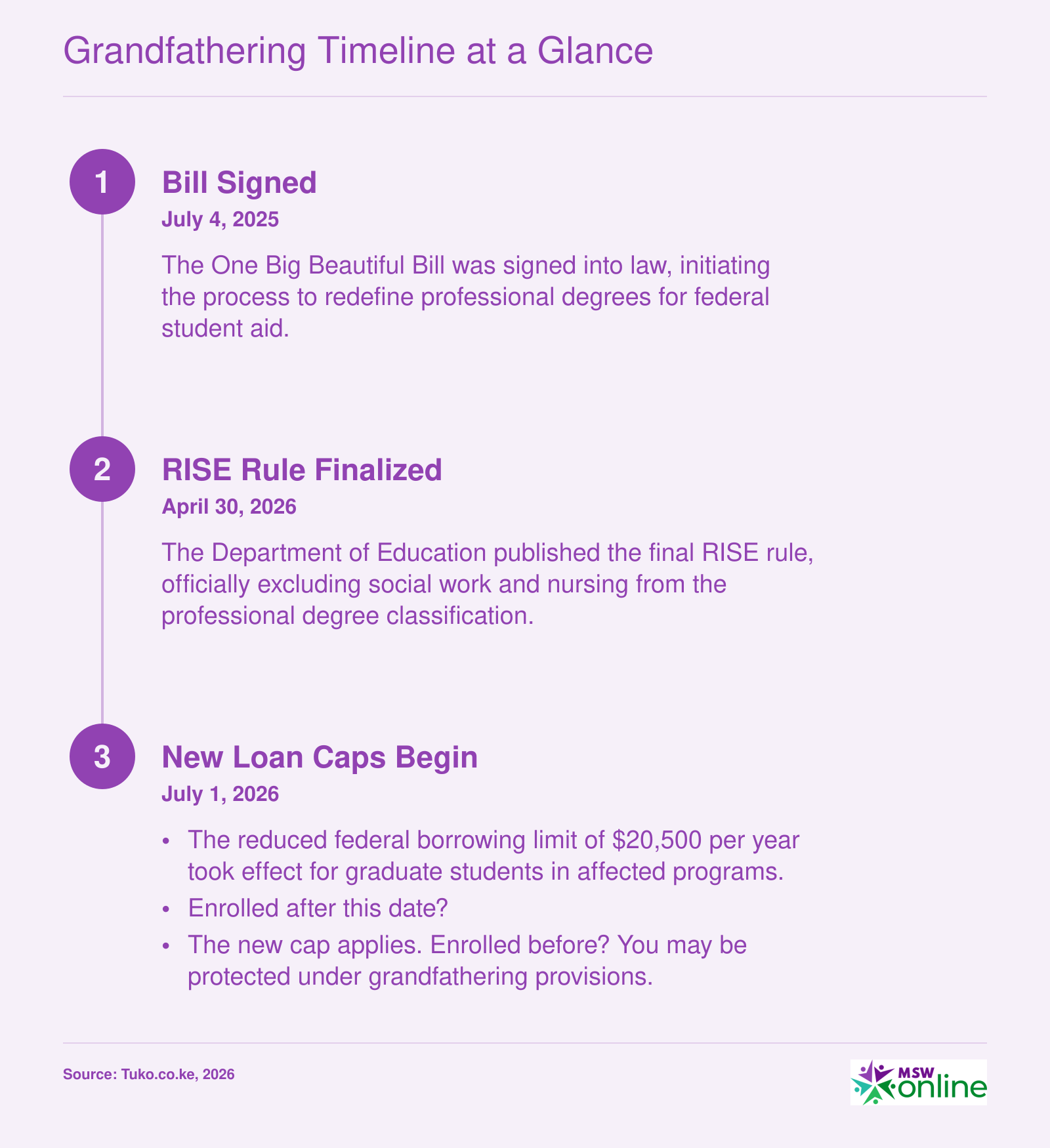
Grandfathering Timeline at a Glance
These dates determine whether you will face the new borrowing limits. If you were already enrolled before July 1, 2026, you may be protected.
Can You Afford an MSW Under the New Caps? Real-World Tuition Scenarios
Public vs. private MSW programs have always presented a cost divide, but the new federal loan cap turns that gap into a decisive factor for many prospective social workers. With annual federal borrowing now capped at $20,50010 for non-professional degrees, the math changes dramatically, especially for programs where tuition alone exceeds that threshold.
The Public vs. Private Cost Gap Under a $20,500 Cap
At public universities, in-state MSW students often scrape by. Rutgers University in New Jersey charges $21,120 per year1 for in-person MSW students, leaving just a $620 shortfall that could be covered by savings or a modest Grad PLUS loan. Nationally, total public MSW program costs land between $14,000 and $30,000, putting many within reach if you can manage a low-cost living situation. Private institutions tell a different story. Boston University’s MSW runs $41,184 annually for 2026-20272; after the federal loan, you are left with a $20,684 gap. NYU Silver School of Social Work pushes that to an extreme: $56,294 per year3 means a $35,794 shortfall. At these rates, Grad PLUS loans become mandatory for most, piling on additional borrowing beyond the subsidized limit.
Online Programs: A Mixed Bag of Affordability
Online MSW programs can trim costs, but not uniformly. The median online MSW annual tuition sits at $9,024, and total program costs frequently range from $20,000 to $50,000. That median suggests many online degrees slide under the $20,500 cap with room to spare. However, brand-name online programs often defy the trend. Syracuse University’s online MSW charges $1,196 per credit4, yielding an annual tuition of $35,880, a $15,380 gap. USC’s online MSW, at $2,322 per credit5, creates a staggering $55,728 annual cost, leaving a $35,228 hole even after the federal maximum. For students banking on the flexibility of online learning, the price tag can rival or exceed on-campus private rates, making price shopping essential.
Advanced Standing: A Path That Might Fit Within the Cap
If you hold a BSW and qualify for an advanced standing MSW, the one-year timeline can work in your favor. Programs like the University of Wyoming’s, with a total program cost of $18,000, or California State University San Bernardino’s, at $8,400 to $17,940, fall comfortably below the $20,500 annual limit. Even some private advanced standing options, such as Pacific Lutheran University’s $54,780 total9 (roughly $27,390 annually for a two-semester accelerated track), require only a manageable $6,890 beyond the cap. For BSW graduates willing to relocate or choose a low-residency program, advanced standing can often be funded without leaning heavily on Grad PLUS loans.
The Long-Term Debt Reality on a Social Work Salary
Even with Grad PLUS lending, the true cost surfaces after graduation. A typical private two-year MSW program at $45,000 per year means $41,000 in unsubsidized loans and roughly $49,000 in Grad PLUS, totaling $90,000 just for tuition. Add living expenses and the final balance can easily top $120,000. Against the median social worker salary of $53,940 to $77,030, monthly payments under a standard 10-year plan consume 15-25% of gross income. In high-cost cities, that ratio constricts an already tight budget. For many, public service loan forgiveness becomes the only lifeline, yet that path demands a decade of qualifying employment and carries its own political risks. Before borrowing, calculate your expected debt-to-income ratio, it is the clearest measure of whether an MSW remains a wise bet under the new rules.
Beyond Federal Loans: Alternative Ways to Fund Your Social Work Degree
Federal loans alone may no longer cover the full cost of an MSW, but a combination of MSW scholarships, loan repayment programs, and employer aid can fill the gap.
Loan Repayment and Scholarship Programs for Social Workers
While the NHSC Scholarship Program does not extend to MSW students1, several federal loan repayment options reward licensed social workers who commit to underserved communities. The NHSC Loan Repayment Program offers up to $50,000 for a two-year service commitment and is open to LCSWs in qualifying settings.2 For those focused on addiction treatment, the Substance Use Disorder Workforce LRP provides up to $75,000 over three years.2 Social workers practicing in rural areas can access the Rural Community LRP, a loan forgiveness for rural social workers program, which offers tax-free awards ranging from $25,000 to $100,000 for two to three years of service.2 Additionally, the Scholarships for Disadvantaged Students program (applications open June 26 , July 28, 2026)3 may provide institutional grants that reduce tuition costs; check with your school’s financial aid office for availability.
TEACH Grants: A Narrow Path for School Social Workers
Social work is not a standard TEACH Grant-eligible field, but some school social work positions may qualify if they serve in a designated high-need school and teach or support academic success in a way that meets the grant’s requirements. The award provides up to $4,000 per year, but it converts to an unsubsidized loan if service obligations are not met. Consult your program and your school’s financial aid administrator to determine eligibility before applying.
Public Service Loan Forgiveness (PSLF) as a Long-Term Strategy
For graduates who already hold federal loans, PSLF can erase remaining debt after 120 qualifying monthly payments while working full-time for a government or nonprofit employer. Most social work roles in public agencies, hospitals, and community organizations qualify. While this does not help with upfront costs, it can dramatically reduce the total debt burden over time. Submit your employer certification forms yearly to ensure you stay on track.
Employer Tuition Assistance and State-Based Programs
Many hospitals, community mental health centers, and government agencies offer tuition reimbursement or direct educational benefits. Employers may contribute thousands of dollars per year if you commit to a service period after graduation. Additionally, dozens of states run their own loan repayment programs for behavioral health professionals, often mirroring or supplementing the NHSC. Check with the social work licensing board or health department in your state for current opportunities.
Private Loans: A Last Resort
Private student loans can bridge smaller gaps, but they lack the flexible repayment and forgiveness options of federal programs. Interest rates and terms vary widely, and they often require a co-signer. Exhaust all federal loan eligibility, scholarships, grants, and employer assistance before considering private lenders.
What Social Workers Actually Earn
Will This Affect Social Work Licensure or Professional Standing?
The funding label attached to your student loans does not alter your professional license or the integrity of your social work degree. Understanding this distinction is critical for anyone pursuing licensure.
Licensure Requirements Remain Unchanged
State licensing boards and the Council on Social Work Education (CSWE) determine what qualifies you to practice, not the Department of Education’s funding rules. To become a licensed social worker, you must complete a CSWE-accredited program, pass the appropriate Association of Social Work Boards (ASWB) exam, and meet supervised experience hours, often through a post-MSW clinical fellowship. None of these steps hinge on whether your degree was labeled “professional” for federal loan purposes. Your MSW or DSW does not become less rigorous, less accredited, or less recognized simply because it lost that label under a single federal rule.
The Degree Itself Holds Its Full Worth
The reclassification is a funding label, not a judgment on the social work profession. Social work remains a vital, regulated healthcare field with strong projected demand. The Bureau of Labor Statistics estimates 6% job growth for social work jobs from 2024 to 2034. Whether you finance your education through federal loans, private loans, or personal savings, the clinical skills and ethical foundation you gain remain unchanged. Employers, clients, and regulatory bodies see your degree, not your loan type. This separation of policy and practice is essential to remember as legal challenges unfold.
What’s Being Done? Lawsuits, Advocacy, and the Fight to Reverse the Rule
Can the social work professional degree reclassification still be overturned? Several major legal challenges are already in motion, and advocacy groups are pressing for a full reversal.
Legal Challenges Put the RISE Rule on Hold
- Multi-state lawsuit: Twenty-five states and Washington, D.C., filed a federal suit in Maryland, seeking to vacate the portions of the RISE rule that exclude nursing and health professions. The case remains pending as of July 2026 and argues the Department of Education's definition was procedurally flawed and would worsen workforce shortages.1
- D.C. coalition lawsuit: A separate coalition of nursing and health associations won a nationwide stay on June 24, 2026.2 The court found that the department's narrowed definition was likely contrary to law,3 forcing a temporary return to the long-standing three-part statutory test. This ruling restored professional-degree status for several fields (including MSN, DNP, PA, and OT programs), though social work was not directly listed in the interim CIP codes.4
While these rulings are preliminary, they signal that courts may reject the regulatory change. Summary judgment briefing in the D.C. case extends through December 2026, and the department has not yet appealed.2
NASW and Social Work Advocacy Efforts
- No standalone NASW lawsuit has been filed, but the National Association of Social Workers is deeply involved in broader advocacy coalitions.6 These groups are urging legislators to introduce bills that would explicitly classify social work degrees as professional, and they are mobilizing members to contact lawmakers.
- Stay informed: The situation is fluid. A final court ruling could restore access to higher federal loan limits, or legislative action could override the rule entirely. Social workers should monitor updates from NASW, CSWE, and state licensing boards to know when changes take effect.
Because the RISE rule is partially on hold, many programs are currently operating under the pre-2026 definition, but the future remains uncertain.6 Professional associations remain the best source for real-time guidance.
Social Worker Salaries Across the U.S.
Salary is only one part of the value proposition for a social work degree, but it matters a great deal when mapping out loan repayment under the new borrowing caps. The table below shows state-level employment and median annual wages for healthcare social workers, a common clinical specialty for MSW graduates, using May 2024 data from the Bureau of Labor Statistics. While the national median falls between $53,940 and $77,030, salaries in states like California and Connecticut can top $80,000 or $90,000, potentially easing the burden of reduced federal loans.
| State | Employment | Median Annual Wage |
|---|---|---|
| California | 19,680 | $92,970 |
| District of Columbia | 490 | $92,600 |
| Oregon | 2,050 | $85,150 |
| Hawaii | 680 | $84,640 |
| Connecticut | 2,010 | $81,900 |
| New Jersey | 4,390 | $81,710 |
| Rhode Island | 570 | $79,460 |
| Vermont | 300 | $78,390 |
| New Hampshire | 530 | $78,000 |
| Alaska | 290 | $77,990 |
| Nevada | 1,070 | $76,280 |
| Washington | 4,970 | $75,670 |
| Maine | 590 | $72,520 |
| Utah | 1,930 | $72,370 |
| Minnesota | 2,530 | $72,330 |
Related Articles
Frequently Asked Questions About the Social Work Professional Degree Reclassification
The 2026 reclassification has left many social work students and professionals with urgent questions about loan limits, eligibility, and licensure. Here are direct answers grounded in the latest policy changes.